“It’s a beautiful day in the office,” our Maasai guide Lemomo Lesaito jokes, his smile beaming as brightly as the sun as it rises over the highlands on the outskirts of the Tanzanian town of Karatu.
asserted
it → ’ → Karatu
We’re on safari, Serengeti-bound, via the Ngorongoro Crater, the world’s largest inactive volcanic caldera and its promised plethora of African animals.
asserted
We → ’re → animals
Uniformed local school children lining up for the school bus wave enthusiastically in the piercing morning light.
asserted
children → line → light
An ordinary day for them, and what promises to be an extraordinary day for us first-timers to Africa.
asserted
what → promise → Africa
The hot and dusty red-dirt road gives way first to a dense patchwork of small farms growing subsistence crops, then coffee and banana plantations that thrive in the volcanic soil.
asserted
that → give → soil
It becomes noticeably cooler as we climb in elevation to enter the Ngorongoro Conservation Area gates – this is not your standard African dry heat.
asserted
this → become → gates
Lesaito explains the name Ngorongoro is onomatopoeic, imitating the sound of the cowbells that the Maasai people place around the necks of their cattle.
asserted
people → explain → cattle
It’s not the last grammar lesson we get on our first safari.
asserted
we → ’ → safari
We soon discover the collective nouns for the various animals that pass before us: a tower of giraffes, a dazzle of zebras, a confusion of wildebeests, a flamboyance of flamingos, a committee of vultures (unless they are in flight in which case it is a kettle).
asserted
it → discover → flight
Even before we catch sight of any animals, the landscape is captivating: shifting from lush rainforest to alpine-like moorland then sweeping grassland savannah and wetlands.
asserted
landscape → catch → savannah
We climb to 2500 metres above sea level and enjoy a misty view from atop the escarpment into the crater below.
asserted
We → climb → crater
We then descend to the base, revealing a cornucopia of colourful wildlife.
asserted
We → descend → wildlife
Lesaito pops up our vehicle’s roof and out come the binoculars, but we don’t really need them.
asserted
we → pop → them
We get so close to a pride of golden-maned lions, we can see them lick their chops post-kill.
asserted
them → get → chops
Pink flamingos balance on one leg in Lake Magadi; zebras gallop in their standard zigzag fashion; a gazillion gazelles (Thomson’s gazelles in particular with trademark black stripe on their sides) frolic past giant giraffes as they amble towards the acacias to munch on leaves.
asserted
they → balance → leaves
We are numbed by the numbers of every African animal imaginable.
asserted
We → numb → animal
The Tanzanian government moved the Maasai people en masse out of the base of the crater in 1974 to let the wildlife thrive.
asserted
wildlife → move → 1974
They now live in thatched-roof villages that cling to the edges of the caldera.
asserted
that → live → caldera
As we depart the crater, after an ascent through ancient rainforest, we stop at one of the picturesque villages.
asserted
we → depart → villages
Just like in Switzerland, to which this lush landscape bears more than a passing resemblance, we hear the low, resonant “ngor ngor” of the bells echoing across the verdant highlands, as cattle move up and down the hills.
asserted
cattle → bear → hills
No wonder nearby Arusha is called the “Geneva of Africa”.
asserted
Arusha → call → Africa
“It’s a very peaceful life for the Maasai who live here,” Lesaito says, pointing with an arm adorned with one of the beaded Maasai bracelets his mother has made.
asserted
mother → ’ → bracelets
“You can just hear the bells ringing, there’s no stress here, there are people living in harmony with the wild animals and the cows.
asserted
bells → hear → animals
Cattle remain central to Maasai life, Lesaito, our unwed guide explains to us.
asserted
Lesaito → remain → us
If he wants to marry, he will need at least 10 cows to offer a potential bride and her family, possibly more depending on her status in the community.
uncertain
he → want → community
Cows, not cash, remain currency in this part of Africa.
asserted
Cows → remain → Africa
He lives nearby, in a village called Makutuni.
asserted
He → live → village
We passed through there a few days before on the way to Tarangire National Park, known as “elephant’s paradise”.
asserted
We → pass → paradise
Being woken in the middle of the night to the sound of an elephant trumpeting – fortunately far away – is one of the sounds I’ll treasure from Tarangire, along with the sight of mother elephants, bathing their babies in mud baths.
asserted
I → wake → baths
Our long road trips in Lesaito’s “jeep/office” give us plenty of time to ask questions – not just about the animals but intricate details of Maasai life.
asserted
trips → give → life
He tells of a local man who has 30 wives and an “uncountable number of children”.
asserted
who → tell → children
He also details his responsibilities as the eldest in his family after his father died.
asserted
father → detail → family
His guiding work pays for his younger siblings’ education.
asserted
work → pay → education
He’s not sure how old he is, 30-something.
asserted
he → ’ → ?
His mother remembers his January birth because that year it rained – but he doesn’t know the date.
asserted
he → remember → date
Leaving Ngorongoro, we continue on the long dirt road to Ndutu Safari Lodge on the edge of the Serengeti.
asserted
we → leave → Serengeti
Here, Lesaito swaps his khaki outfit, standard fare for most safari guides, to don his traditional red-checked shuka, the robes the cattle-herding Maasai wear, which can double as a blanket for when sleeping outdoors.
asserted
which → swap → blanket
“I feel more comfortable in these clothes,” he explains, over a delicious dinner, while above us in the rafters, a mother genet – a small nocturnal carnivore native to Africa – feeds beetles to her babies.
asserted
genet → feel → babies
Fortunately for us, the mosquitoes don’t feast on us that night, thanks to the mosquito nets in our stone-hewn cottages.
asserted
mosquitoes → feast → cottages
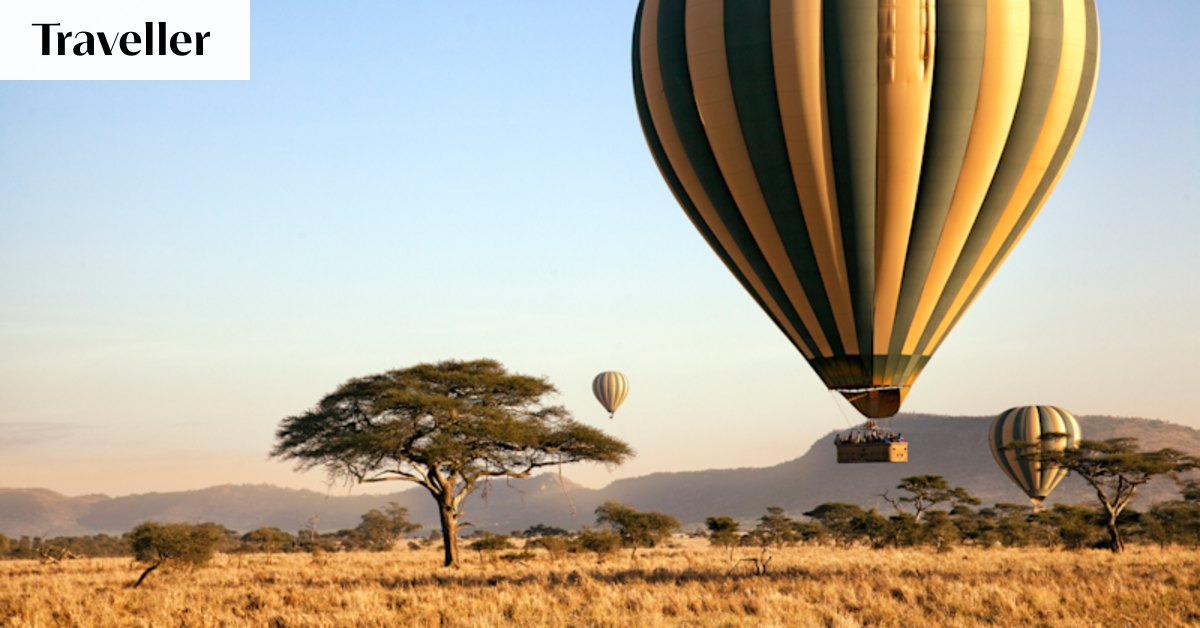
There’s not much time to sleep anyway, as we are up at 5am for a sunrise balloon flight to view the wildebeest migration from on-high.
asserted
we → ’ → high
…and 14 more, not listed.
 The Aporia