What appeared to be a neck-and-neck race between two top contenders for the mayor’s seat helped draw more people to the polls in Toronto, leading to the city’s highest turnout in more than a decade, some experts say.
asserted
experts → appear → decade
Nearly one million people in the city cast a ballot in this week’s municipal election, and unofficial results collected by the Association of Municipalities of Ontario show 46 per cent of those eligible to vote in Toronto did so.
asserted
cent → cast → Toronto
Meanwhile, the average turnout across the province was around 36 per cent, according to the association’s data.
uncertain
turnout → accord → data
Some political scientists say a competitive race, increased civic engagement, a stronger political culture and greater media coverage all contributed to the higher turnout in Toronto.
asserted
race → say → Toronto
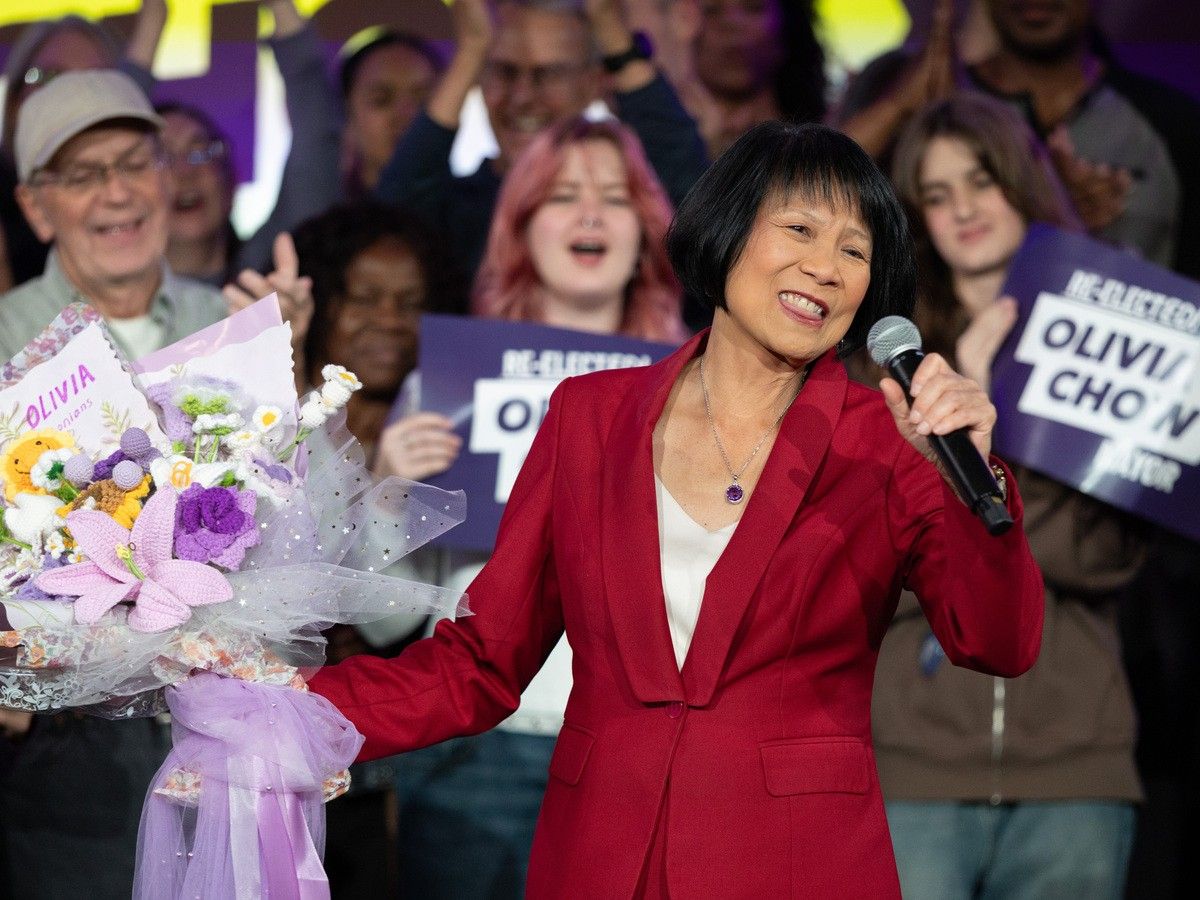
The top driver for Toronto’s increased voter participation was the apparent close contest between mayoral front-runners Olivia Chow and Brad Bradford, as well as tight races for council positions in several wards, said Cristine de Clercy, a political scientist who teaches at Trent University.
asserted
who → increase → University
“It attracted attention, and it seems to me an important effect that that contest, which seemed to become closer as the campaign wore on … certainly had a large effect on turnout.”
asserted
campaign → attract → turnout
Polls placing the two so close, including one that put Bradford ahead just days before the election, motivated voters and campaign volunteers because they felt their efforts and votes could make a difference, she said.
“So that certainly got some other people out to the polls who normally might not have voted if they thought either the incumbent was going to win in a landslide, or her opponent was going to win a landslide,” she said.
uncertain
she → place → landslide
Community organizations also played an important role in getting people to vote in Toronto during this municipal election cycle, she said.
asserted
she → play → cycle
While the competitive race between Chow and Bradford was the main draw, Myer Siemiatycki, a professor emeritus of politics and public administration at Toronto Metropolitan University, said that alone couldn’t explain why Toronto’s turnout eclipsed that of other municipalities with hard-fought elections.
asserted
turnout → say → elections
In nearby Mississauga, where both the incumbent Carolyn Parrish and her predecessor Bonnie Crombie lost a close three-way race to Alvin Tedjo, 34 per cent of eligible voters cast ballots.
asserted
cent → lose → ballots
While that represents a 12-point surge from 2022, it’s still significantly lower than in Toronto, Siemiatycki said.
asserted
Siemiatycki → represent → Toronto
“I think the difference in Toronto is number one, there’s a much stronger political culture of participation in the city than in Mississauga,” which many still consider a suburb, he said.
asserted
he → think → which
“Generally, central cities have a stronger history and pattern of political participation than suburban areas do.”
asserted
areas → have → participation
Robust media coverage in Toronto, along with a wide range of issues that people cared about, such as bike lanes, school nutrition programs and traffic gridlock, could also have fuelled higher turnout, he said.
uncertain
he → care → turnout
Chow’s army of volunteers also made a difference, he said.
asserted
he → make → difference
“She has a lot of very dedicated supporters who, on election day, canvass and knock on doors and encourage people to go out and vote, and that certainly played out to drive up the vote,” he said.
asserted
he → have → vote
Meanwhile, the declining media landscape in smaller communities has created an information gap, Siemiatycki said.
asserted
Siemiatycki → decline → gap
“Whereas in Toronto, of course, there’s such a rich and multifaceted, diverse media ecosystem, there’s just a lot more information, a lot of reminders and focus on the municipal election race,” he said.
asserted
he → ’ → race
Despite being higher than the rest of the province, the turnout in Toronto is “still too low and is a problem and we need to think about how to increase it,” he added.
asserted
he → need → it
The Association of Municipalities of Ontario’s data show more than four million Ontarians voted across the province, including Toronto, where the city said 989,990 ballots were cast.
asserted
ballots → show → Toronto
Chow secured victory with 532,201 certified votes compared to Bradford’s 404,013.
asserted
Chow → secure → 404,013
In London, Ont., where the incumbent Josh Morgan was re-elected, the turnout was 31 per cent, an increase of around six percentage points from 2022.
asserted
turnout → re → 2022
Morgan got over 45 per cent of the total votes, while his closest competitor received a little over 26 per cent.
asserted
competitor → get → cent
Cameron D. Anderson, a professor of political science at the University of Western Ontario, said the city’s voter turnout has historically been behind Toronto’s, but the lack of tough opposition for Morgan further dampened participation.
asserted
lack → say → participation
“Generally speaking … it was assumed that he would win again,” Anderson said.
asserted
Anderson → speak → ?
“Whereas in Chow’s case, there was a sense that, oh no, look, the challenger is getting really, really close and maybe could beat her,” which increases the motivation to vote, he said.
uncertain
he → be → motivation
The Association of Municipalities of Ontario said unofficial results show that voter turnout varied considerably across municipalities with populations of over 100,000.
asserted
turnout → say → 100,000
Chatham-Kent and Greater Sudbury, for example, were at 41 per cent while Kitchener had the lowest turnout at 22 per cent.
asserted
Kitchener → have → cent
 The Aporia