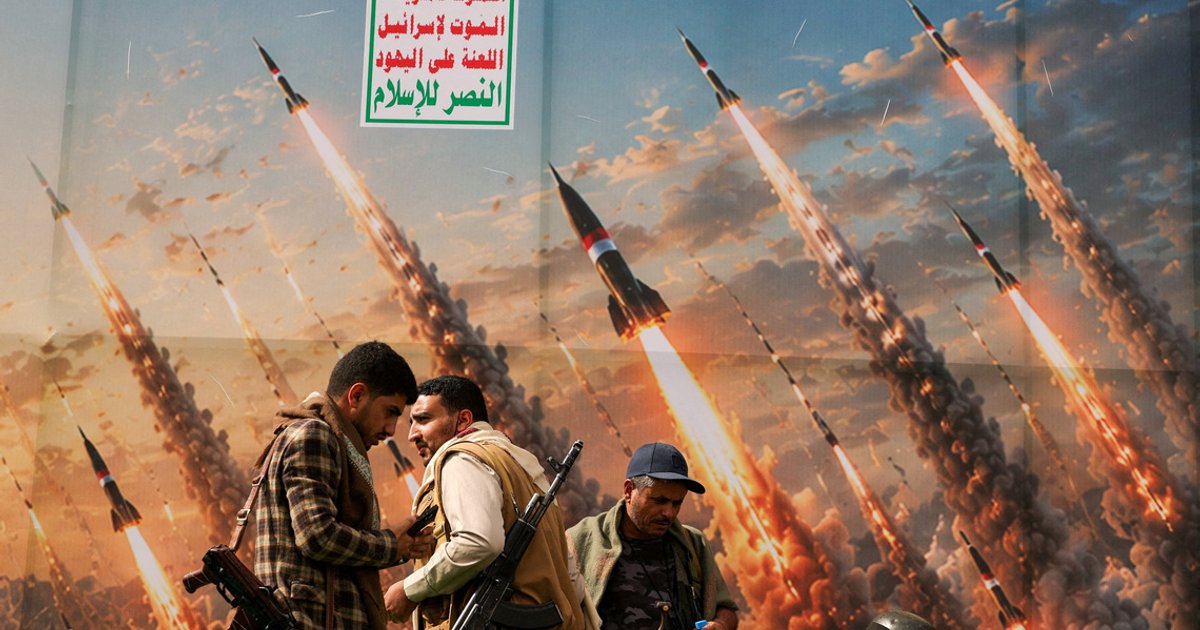
An investigation has revealed that Russian satellites are assisting the Iran-aligned Houthis to strike Saudi Arabia’s military and energy infrastructure, further upending global energy markets amid the US war on Iran.
asserted
satellites → reveal → Iran
Hostilities between the internationally recognised Yemeni government, which is backed by Saudi Arabia, and the Houthis have been ongoing since July and escalated in September when the rebel group seized full control of Yemen’s Red Sea coast.
Recommended Stories
list of 3 items- list 1 of 3Mapping the siege of Yemen’s Taiz, and the price families are paying
- list 2 of 3Are GCC countries looking for a regional security pact with Iran?
- list 3 of 3Fighting rages near Yemen’s Taiz as UN urges humanitarian access
Last
asserted
UN → recognise → access
, the Houthis also carried out a precision strike on pumping stations on Saudi Arabia’s most important oil pipeline, the East-West pipeline.
asserted
Houthis → carry → pipeline
An investigation by Geneva-based private firm AURORAH GeoSignal Intelligence revealed that Russian satellites had been surveying the region days in advance to gather intelligence about the pipeline.
asserted
satellites → base → pipeline
With fighting for control of Yemen between the Houthis and the Saudi-backed Yemeni government continuing, how significant is Russia’s support to the Houthis?
asserted
support → back → Houthis
Why can’t Saudi Arabia, the most powerful of the Gulf states that is backed by the US, hold back a group of rebel fighters?
asserted
that → back → fighters
Here’s what we know:
What did the investigation into the use of Russian satellites show?
asserted
investigation → ’ → satellites
As revealed by The Associated Press news agency this week, between July 1 and October 19, AURORAH Geosignal Intelligence examined 40 missile and drone attacks against Saudi Arabia by Yemen’s Houthis and, in every case, found a pattern of Russian government and military satellites observing the targeted areas both before and after the attacks.
asserted
satellites → reveal → attacks
Nawaf Obaid, founder of the geosignal intelligence firm, told Al Jazeera that by reconstructing Russia’s military reconnaissance architecture, the group had identified individual satellites, calculated their orbital trajectories and then established observation opportunities and correlated their activity with military developments across Saudi Arabia, Jordan, Bahrain, Kuwait, Qatar, the UAE and Yemen.
asserted
group → tell → Arabia
He said the satellites they identified include Russia’s Bars-M military mapping satellites, Persona optical reconnaissance satellites, Lotos-S1 electronic intelligence satellites, Pion-NKS maritime reconnaissance systems and Kondor-FKA radar-imaging satellites.
asserted
they → say → satellites
They also examined the EKS/Tundra infrared early-warning constellation.
asserted
They → examine → constellation
“The critical finding was not the presence of individual Russian satellites, but the sequencing and integration of their complementary intelligence capabilities,” he said.
asserted
he → say → capabilities
Obaid also confirmed to Al Jazeera that based on the findings, “Russian military geospatial and signals intelligence has supported the Iranian-led intelligence architecture assisting Houthi operations in Yemen.”
asserted
intelligence → confirm → Yemen
He said the strongest operational example of this has been the Houthi offensive along Yemen’s western coast towards Bab al-Mandeb, where Russian-derived intelligence, Iranian command integration and local human intelligence all contributed to “the rapid deterioration of opposing Yemeni forces’ battlefield coordination”.
asserted
example → say → coordination
“We assess that this intelligence relationship is also relevant to Houthi missile and drone targeting against Saudi Arabia.
asserted
relationship → assess → Arabia
Russian military reconnaissance provides capabilities far beyond ordinary commercial satellite imagery, particularly when optical, radar and electronic intelligence are integrated,” he said.
asserted
he → provide → imagery
“The September attacks against Saudi Arabia’s East-West Petroline illustrate the sophistication of the targeting problem,” he said.
asserted
he → illustrate → problem
That was when three pumping stations – PS8 at Afif, PS9 at Al-Dhekra and PS11 at Al-Mesba’ah – were struck within the pipeline’s “critical high-elevation western section”.
asserted
stations → strike → section
“Their selection reflected an understanding of the infrastructure’s engineering vulnerabilities and strategic importance,” he explained.
asserted
he → reflect → vulnerabilities
Brussels-based military analyst Elijah Magnier said AURORA’s findings don’t necessarily show the whole picture.
asserted
findings → base → picture
“Inability to intercept an intelligence transmission doesn’t establish who had access to the Russian satellite information, whether Russia deliberately shared it, or whether Iran obtained it independently,” he said, adding that for this, there are four possible scenarios.
asserted
he → intercept → this
“First, Russia could have deliberately shared information with Iran,” he said.
uncertain
he → share → Iran
“The second is Iran obtained Russian satellite imagery through commercial channels…
asserted
Iran → obtain → channels
However, the Russian military’s reconnaissance imagery is generally not publicly accessible, so the commercial Russian imagery would not necessarily establish Russian government involvement,” he noted.
asserted
he → establish → involvement
“The third is Iran obtained information through another intermediary, so a third party could theoretically have supplied the intelligence originated from the Russian system, and there is no currently publicly verified evidence establishing such an arrangement,” he added.
uncertain
he → obtain → arrangement
But Obaid highlighted that distinguishing a Russian-supported intelligence architecture from proof that a particular Russian satellite supplied the targeting data for an individual Houthi strike is essential.
asserted
satellite → highlight → strike
“Our assessment establishes the wider intelligence relationship; attribution of specific satellite-derived intelligence to individual missile launches requires additional corroboration,” he said.
asserted
he → establish → corroboration
Three officials, including one from Saudi Arabia and another in the top ranks of the Houthis, as well as a private intelligence analyst, confirmed to The Associated Press that the Houthis and other Iranian allies have benefitted from Russian intelligence, as well as Chinese capabilities.
asserted
Houthis → include → intelligence
Last week, the Saudi Foreign Ministry’s deputy minister for public diplomacy, Rayed Krimly, told reporters that the Houthis receive intelligence from Russia and China.
asserted
Houthis → tell → Russia
“We do discuss these matters regularly with China and Russia, and we will continue to do so,” he had said.
asserted
he → discuss → China
Russian officials have not yet commented on AURORAH’s findings, but in recent years, technological and military ties between Russia and Iran have deepened significantly, anchored by joint strategic agreements, space cooperation, and the exchange of defence technology.
asserted
ties → comment → technology
Ahmed Nagi, a senior analyst on Yemen at the International Crisis Group, said Moscow reportedly supporting Tehran’s allies like the Houthis is particularly significant because it would mean a shift in the trajectory of the Yemeni conflict.
uncertain
it → say → conflict
“It is increasingly moving beyond its domestic dimensions and becoming intertwined with wider regional dynamics.
asserted
It → move → dynamics
Supporting the Houthis is no longer a matter of interest to Iran alone.
asserted
Supporting → support → Iran
We are now seeing other actors, particularly Russia, providing Iran with intelligence support and sophisticated weaponry, from which the Houthis are also benefitting,” he told Al Jazeera.
asserted
he → see → Jazeera
“The question is whether this support is being channelled directly to the Houthis or indirectly through Iran.
asserted
support → channel → Iran
I don’t think that distinction is important.
asserted
distinction → think → ?
The bottom line is that the Houthis are benefitting from increasingly diversified external support involving several countries,” he added.
asserted
he → benefit → countries
But Nagi warned that Russian support to the Houthis has implications for both the Yemeni government and Saudi Arabia.
asserted
support → warn → government
“Russia’s role also extends into the diplomatic arena, where Moscow has taken positions at the United Nations Security Council opposing stronger international action against the Houthis.
asserted
Moscow → extend → Houthis
…and 57 more, not listed.
 The Aporia