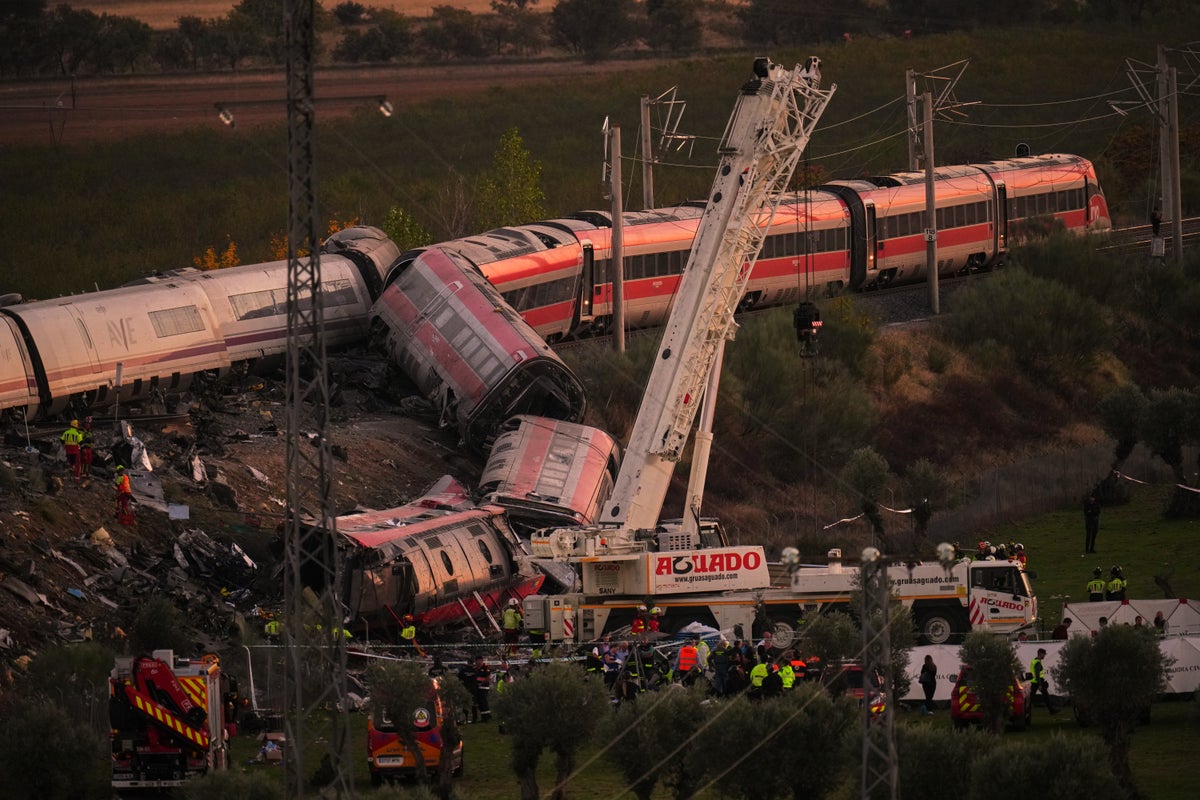
Photo via Toronto Star

On board a Spanish high-speed train in the aftermath of the system's latest catastrophe

Read the original at Toronto Star ↗
Cite

Wilson, J., & Gestoso, M. (2026, October 31). On board a Spanish high-speed train in the aftermath of the system's latest catastrophe. Toronto Star. https://www.thestar.com/news/world/europe/on-board-a-spanish-high-speed-train-in-the-aftermath-of-the-system-s-latest-catastrophe/article_cc3de0b7-5665-574f-9d50-eab2ce06e9b2.html

Dated from the outlet's own feed. Check the original for its byline.

Toronto Star · collected 2026-10-31 · by Joseph Wilson, María Gestoso

Quick Summary

In Spain, travelers express mixed feelings about using high-speed trains following two deadly collisions within nine months that killed over 100 people. A train conductor thanked passengers aboard a Madrid to Zamora route for continuing to use the service despite recent tragedies. Spanish Prime Minister Pedro Sánchez acknowledged the need to rebuild trust in the rail network after the latest crash shattered confidence, promising solutions to prevent future accidents.
Written by AI on 2026-10-31, from this article's own text only (the story summary below draws on all the coverage).

AI analysis

Story summary

As of October 28, at least 69 people were killed and over 100 injured when two high-speed trains collided near the town of Mora in Toledo province, central Spain. The crash occurred around 9 AM local time on Wednesday morning between a Renfe train heading from Madrid to Seville and an Iryo train traveling in the opposite direction. Rail operator ADIF suspended services between Madrid and Andalusia after the incident.

According to officials, the Iryo train had stopped for unknown reasons before being struck by the high-speed Renfe AVE train moving at over 150 km/h. The mayor of Urda, Manuel Galán, reported that passengers were injured and local authorities were preparing a sports hall as an emergency response center.

Spanish Prime Minister Pedro Sánchez acknowledged on October 30 that trust in Spain’s rail system has been "broken" following this crash, which marks the second deadly collision within nine months. The accident raised questions about the safety of high-speed trains and prompted investigations into potential causes including human error or technical malfunctions.

Written for “Spanish Train Crash Investigation Continues” on 2026-10-31, grounded in this article and the 122 other(s) covering the same event.
Why this leaning score
This article does not take a side on a contested political question, so it has no leaning score. That is an answer rather than a gap: a match report or a rescue can be warmly or critically written without being left or right, and scoring it anyway is how approval of a subject gets recorded as a political position.
No political leaning scored for article 119054 · logged 2026-10-31

Story

📰 Spanish Train Crash Investigation Continues
World · 123 article(s) covering the same event. Compare every outlet's account →

Compared with similar articles

This article reads unscored and hedges 7% of its claims. Each row says how that neighbour differs.
The Guardian
Hedges 3 of 26 claims Outlet record 66/100
BBC News
Hedges 3 of 51 claims Outlet record 68/100
ABC News (AU)
⚖️ Leans left Hedges 1 of 28 claims Outlet record 68/100
Al Jazeera
Hedges 0 of 3 claims Outlet record 60/100
The Globe and Mail
Hedges 0 of 2 claims Outlet record 52/100
BBC News
Hedges 0 of 34 claims Outlet record 68/100
The Straits Times
Hedges 0 of 23 claims Outlet record 66/100
The Independent
Hedges 0 of 35 claims Outlet record 59/100
NPR
Hedges 0 of 36 claims Outlet record 60/100
Al Jazeera
Hedges 5 of 46 claims Outlet record 60/100
How this article was measured signals, leaning charts, publisher record, byline, topics and claims

Signals How these are calculated →

Claims extracted
27
sentences that state something as happening or true
Uncertain
7%
2 of 27 hedged ("reportedly", "may", "according to")
Leaning
not political
takes no side on a contested political question
Publisher signals
64/100
Toronto Star's corrections and hedging, across everything collected from it. Not a measure of accuracy.
Outlets on this story
123
World
Same framing elsewhere
1
articles that frame the event the way this one does
Analyzed 2026-10-31 · how these are computed

How this is being covered How these are calculated →

Article leaning vs. publisher reliability
Source leaning vs. consistency

Publisher

Toronto Star · 10694 article(s) · 27 correction(s) detected
Running correction rate · 27 correction(s)
2026-10-26
Correction
2026-10-24
Correction
2026-10-07
Correction
2026-09-24
Correction

Who wrote this

Joseph Wilson
12 article(s) here · 1 carrying a prediction
🔮 “Today I feel safer traveling because I know they will be focused.”
🔮 “We will have to take measures so this never happens again.”
🔮 Now it appears he will have to handle concerns over the state of Spain's rail service along with attacks from right-wing parties over his liberal migration policies and accusations of corruption against his party and his wife, which both he and his wife deny.
🔮 The big win pulled Madrid to within three points of first-placed Barcelona and will do wonders to silence the criticism of Mourinho which began after a derby defeat to Atletico Madrid in September.
🔮 Spain’s growing influence on world soccer will be on full display at next week’s Ballon d’Or gala, the annual award ceremony honoring the sport’s top performers.
2026-10-23 · assertive framing · How Spanish coaches became soccer's hottest commodity
🔮 BARCELONA, Spain (AP) — Lamine Yamal and Kylian Mbappé are both hoping to win the Ballon d’Or on Monday night when they are expected to attend the Parisian gala for the most prestigious individual award in soccer.
🔮 The channel regularly runs reels of what it considers gross errors by match officials who are set to work upcoming games for the 15-time European champion.
🔮 Her death is set to reinvigorate the protest movement and further polarize Spain ahead of a national election next month when the housing issue will be central.
🔮 "We need to mobilise and win a much larger progressive majority in parliament, one that will allow us to overcome vested interests, deliver new social advances and continue transforming Spain."
Also by Joseph Wilson
Nothing else under this byline is closely related to this article, so these are simply their most recent.
All 12 articles by Joseph Wilson →
María Gestoso
1 article(s) here · 1 carrying a prediction
🔮 “Today I feel safer traveling because I know they will be focused.”
The only article under this byline in the corpus.

Topics

Madrid Spain Spaniards Spanish ZAMORA

Subjects

Spain GPE · 9× Madrid GPE · 6× Spanish NORP · 3× ZAMORA GPE · 3× Barcelona ORG · 2× Alicante GPE · 1× Associated Press ORG · 1× Carla Fuentes PERSON · 1× Fuentes PERSON · 1× Spaniards NORP · 1×

Narrative

Authorities admit trust in the railways is shattered Spanish Prime Minister Pedro Sánchez, who faces an election in four weeks, acknowledged Friday at the crash site that authorities must work hard to restore the reputation of the rail service. “Trust in our high-speed railway has been broken, and the job of this government is to not only understand what went wrong but to offer the solutions so that a tragedy of this magnitude never happens again,” Sánchez said.
framing: assertive · carried by 1 article(s) · first seen 2026-10-31
🔮 “Today I feel safer traveling because I know they will be focused.”

Claims (27 extracted, 2 hedged)

ZAMORA, Spain (AP) — For decades, Spaniards have been avid users of the country’s touted high-speed trains, choosing the Ave, Spanish for “bird,” over driving or flying for work trips or holidays each year. asserted
Spaniards → tout → trips
But two devastating collisions in nine months that killed more than 100 people have shaken confidence in a rail network long hailed for its speed and safety. asserted
that → kill → speed
Two days after a train collision in central Spain killed 69 people and stunned the nation with horrific images of shredded carriages and bloodied survivors, an Associated Press journalist spoke to travelers who had decided to keep traveling by train. asserted
who → kill → train
“I have to travel for work and am taking the train because I don’t have another option, but I have colleagues who are going by car and won’t take another train until something really changes,” Carla Fuentes, a 37-year-old economist, said before boarding in Madrid for Alicante, in southern Spain. asserted
Fuentes → have → Spain
Fuentes’ train was canceled on Thursday due to a strike by train workers to demand improved rail safety. asserted
train → cancel → safety
“It is understandable,” she said about the strike. asserted
she → say → strike
“Many lives were lost and there are a lot of people who are angry.” asserted
who → lose → people
The catastrophe was impossible to forget once aboard the train from Madrid to Zamora on Friday, even if most of the passengers were philosophical about whizzing along at 300 kph (186 mph). asserted
most → forget → kph
Once the train started after a 50-minute delay, the train conductor made an announcement to thank those who had stuck with the Ave. asserted
who → start → Ave
“I only have words of thanks for your patience and admiration for your decision to continue traveling by train at this time,” he told the passengers. asserted
he → have → passengers
Authorities admit trust in the railways is shattered Spanish Prime Minister Pedro Sánchez, who faces an election in four weeks, acknowledged Friday at the crash site that authorities must work hard to restore the reputation of the rail service. “Trust in our high-speed railway has been broken, and the job of this government is to not only understand what went wrong but to offer the solutions so that a tragedy of this magnitude never happens again,” Sánchez said. asserted
Sánchez → admit → magnitude
The crash in the province of Toledo came just nine months after another collision further south on the same Madrid-Seville line killed 49 people when one train jumped the track and slammed into another coming from the opposite direction. asserted
train → come → direction
“I have spent a long time traveling in high-speed trains, but now my confidence has been hurt a bit,” 56-year-old traveler María Rodríguez said on the train to Zamora. asserted
Rodríguez → spend → Zamora
The train rules in Spain High-speed trains have transformed Spain, sharply reducing commutes between Madrid in central Spain and major cities, many of them located on the coast. asserted
many → transform → coast
Since opening its first high-speed line in 1992, Spain has laid 3,900 kilometers (2,400 miles) of high-speed track for its 49 million residents. asserted
Spain → open → residents
Only China — with 45,000 kilometers (28,000 miles) for its 1.4 billion people — has more high-speed track, according to the International Union of Railways. uncertain
China → have → Railways
The union defines high-speed trains as those traveling at more than 250 kph (155 mph). asserted
union → define → kph
Nine million of the 13 million trips made between Madrid and Barcelona in 2024 were made by high-speed rail, according to the Spanish National Markets and Competition Commission. uncertain
million → make → Commission
Rail travel is growing: The number of high-speed train passengers in Spain doubled between 2019 and 2025. asserted
number → grow → 2019
On an old, slow train, the 600-kilometer (385-mile) journey between Madrid and Barcelona used to take around seven hours, meaning many business travelers opted to take a plane. asserted
travelers → use → plane
Now that trip can be done in 2 1/2 hours. asserted
trip → do → hours
Shorter travel times have made day trips between many Spanish cities possible. But Spain’s enormous investment in building high-speed rail has come at the expense of slower commuter services, while train workers’ unions argue that the administration has not spent enough on maintaining the network. asserted
administration → make → network
Adrián Blaya, a 29-year-old data analyst traveling on the Zamora-Madrid line, echoed the common complaint that the service has worsened in recent years with delays and breakdowns becoming habitual. asserted
delays → travel → years
Ironically, he felt safer than usual following the deadly crash. asserted
he → feel → crash
“The safest time to travel in Ave is after a tragedy because this is when they are extra careful,” he said. asserted
he → travel → tragedy
“Today I feel safer traveling because I know they will be focused.” asserted
they → feel → ?
___ Wilson reported from Barcelona, Spain. asserted
Wilson → report → Barcelona

💬Give feedback
🕘History 🎫Support