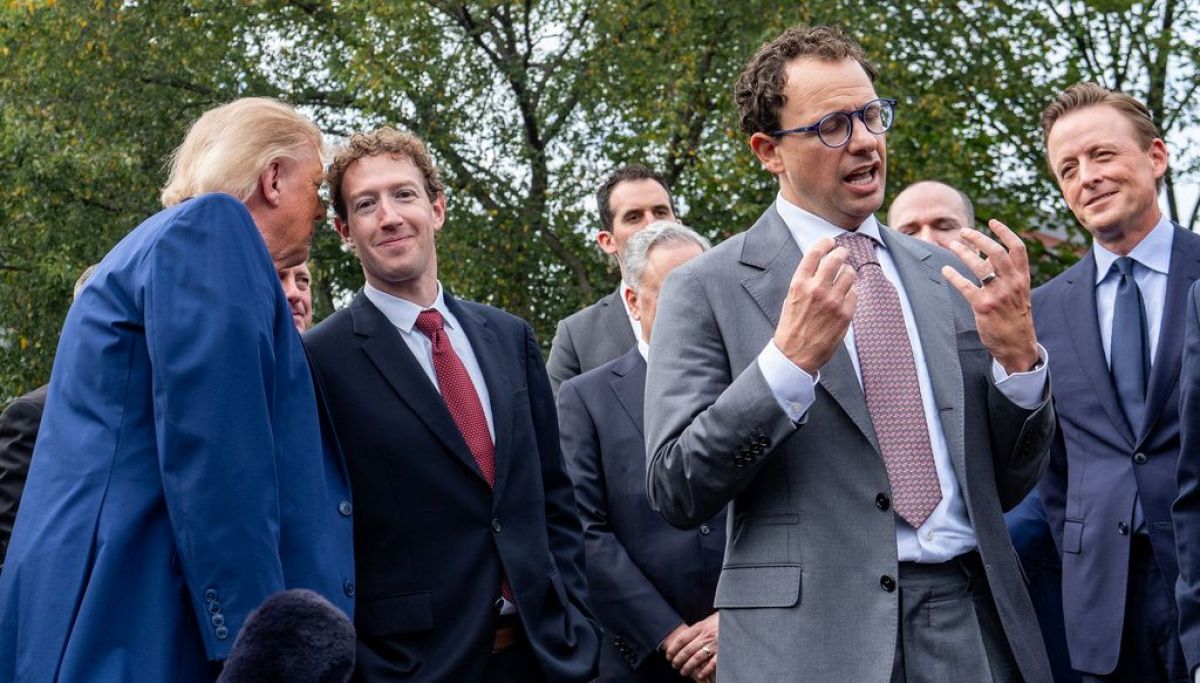
“We are living through the greatest transformation that we have seen in our lifetimes, and likely for a significant time before that,” two-time Surgeon General Vivek Murthy told an audience at New York City’s flagship public library on Oct. 28, comparing the advent of artificial intelligence to the advent of nuclear weaponry in terms of the need for carefully thought out safety standards.
asserted
Murthy → live → standards
“We're at a branch point,” he added.
asserted
he → add → point
“What should the future really look like, what are we trying to protect and preserve?”
asserted
we → look → what
Murthy was not alone in sounding the alarm.
asserted
Murthy → sound → alarm
Jim Steyer, founder and CEO of Common Sense Media, the organizer of the conference, told the mostly supportive crowd that recent history had proved that the industry leaders or, as he called them “tech broligarchs,” could not be relied upon to create digital information systems that were safe or healthy for children.
uncertain
that → tell → children
We did not get out in front of social media in time,” he told the gathering.
asserted
he → get → gathering
New York’s governor Kathy Hochul seemed to underscore the point when she made an unscheduled stop at the daylong summit to announce new regulations around chatbots interactions with children.
asserted
she → seem → children
The bill was designed to ensure that AI agents do not impersonate humans or communicate in a way that suggests they have a relationship with a child.
uncertain
they → design → child
“It's happening so quickly,” said Hochul of the technological changes.
asserted
Hochul → happen → changes
“It's almost impossible for parents to know what's going on, for elected officials to stay ahead of it, and we certainly have learned the lesson that we can't count on the companies to put out products that are responsible and that put children first.”
asserted
that → know → children
Specifically, the new law, which goes into effect in January, will ban chatbots from encouraging suicide, self-harm, secrecy, or isolation and from discouraging children to seek help from other humans.
asserted
which → go → humans
They will also be banned from engaging in sexually explicit interactions and restricted from using a child’s past personal or health information in later conversations.
asserted
They → ban → conversations
For the attendees and speakers at the summit, who ranged from Chelsea Clinton and Columbia law professor Tim Wu (onstage) to Uma Thurman (in the audience), the announcement was a good start, although many bemoaned the lack of federal regulation, around both AI and social media.
asserted
many → range → AI
“To this day, 2026, our federal government and Congress has still—nearly a quarter century after the advent of social media—failed to announce anything to protect our kids,” said Murthy, who is now chair of the advisory board of Common Sense Media’s Youth AI Safety Institute, which studies, tests, and rates AI platforms for children.
asserted
which → fail → children
Panelists called for a range of protective and preventative remedies for what they described as the coming tsunami of AI, including requiring more data transparency from tech companies by enabling regulatory agencies and researchers to get more access to the information they’re holding, using consumer-protection laws to ensure that AI models have been rigorously tested for potential negative outcomes, adopting the European model of not allowing AI companies to deploy their platforms until they have proved they are safe, or even instituting criminal penalties for AI companies who unleash unsafe technologies.
asserted
who → call → technologies
“As a former prosecutor, I can tell you one thing,” said New Mexico Attorney General Raúl Torrez, who earlier this month won a $25 billion judgment against Meta.
asserted
who → tell → Meta
“When you bring out handcuffs, suddenly everything changes.”
asserted
everything → bring → handcuffs
Not all the issues around AI can be solved by the law, however.
asserted
issues → solve → law
One concern is the socialization of very young children by AI, including via voice-activated assistants like Alexa or very agreeable AI-enabled toys.
asserted
concern → include → Alexa
“What do kids start to learn to expect from social practice?
asserted
kids → start → practice
Do they expect someone to always agree with them?
asserted
someone → expect → them
Is it always like a transaction?” asked Dana Suskind, an early-childhood expert and professor at the University of Chicago.
asserted
Suskind → ask → Chicago
Human relationships are a lot messier, she noted.
asserted
she → note → ?
“They're chaotic, and that sort of mess is where a lot of learning happens.”
asserted
lot → happen → learning
Parents, who were caught off-guard by the influence of social media and digital devices, need to be educated about AI and encouraged that their imperfect parenting, as well as other human interaction, is vastly more beneficial to children than an AI companion, she said.
asserted
she → catch → companion
The summit also touched on the enormous implications AI is having on education and students’ ability to work and learn, when answers are in such ready supply.
asserted
answers → touch → supply
“MIT just did a report saying every assignment at MIT could be done by generative AI,” said John King, a former U.S. Secretary of Education and current chancellor of State University in New York.
uncertain
King → do → York
King is considering major changes to student assessment.
asserted
King → consider → assessment
“We have to make sure we are seeing the students do the work, and we have to make sure they're getting those foundational skills,” he said.
asserted
he → have → skills
“It literally means every faculty member reassessing what they assign and how they measure student learning.”
asserted
they → mean → learning
And, as Clinton pointed out, this is an equity issue too.
asserted
this → point → ?
“We know that in families with less than $30,000 of household income, teenagers are three times more likely to either largely or entirely do their homework through artificial intelligence than those households with family incomes of $75,000 or more,” she said.
asserted
she → know → more
At the same time, students need to be prepared to enter a workforce in which AI skills are not optional.
asserted
skills → need → which
For those who have mastered them, the future is very bright.
asserted
future → master → them
“The people coming in learn much more rapidly because AI gives them more capacity than they've had before,” said Gene Sykes, chairman of global mergers and acquisitions at Goldman Sachs of the banking giant’s new recruits.
asserted
Sykes → come → recruits
“So somebody, within a month, can be doing incredibly productive work.”
asserted
somebody → do → work
If good education in AI is distributed unevenly, some graduates will be vastly better prepared for a career than others, further exacerbating wealth inequities.
asserted
graduates → distribute → inequities
While there was little consensus on the immediate steps to take as AI arrives, there was no argument that it will be consequential for children, families, and generations to come.
asserted
children → be → steps
“As we go into this age of transformation,” Murthy noted, “the question forced upon us is the following: What aspects of human existence do we want to protect and preserve at all costs?”
asserted
we → go → costs
 The Aporia