An LLM wiki changed how I work

Platformer · collected 2026-08-19 · by Casey Newton
Read the original at Platformer ↗

Summary

The author of this column uses an AI-powered wiki to organize knowledge on specific topics and reports that it has been the most useful productivity tool they've tried this year. The author mentions three apps they've recommended in previous years, with Raycast being a launcher app that remains their preferred way to navigate a computer. They note that they've renewed its subscription and use it extensively for tasks such as looking up words, doing math, and accessing websites.
Written by the local model on 2026-08-19, using this article's own text rather than the other coverage of the same event (that is the story summary below).

Signals How these are calculated →

Claims extracted
132
claim-shaped sentences
Uncertain
9%
12 of 132 hedged
Leaning
not scored
needs a local LLM pass
Publisher trust
96.5
red-flag proxy, not a credibility rating
Outlets on this story
1
Technology
Narrative spread
1
articles carrying this framing
Analyzed 2026-08-19 · how these are computed

AI analysis (generated at analysis time, not now)

Story summary

Andrej Karpathy, a prominent AI researcher, tweeted in early April that he was using Large Language Models (LLMs) to build personal knowledge bases for various topics of interest. This idea quickly went viral online, with many people setting up their own LLM wikis using platforms like GitHub and tools like Raycast. The author of this article tried building a LLM wiki after being exposed to the idea and was initially skeptical that it would be beneficial. However, they found that it has actually helped them improve their productivity and work at the deskbound parts of their job. Specifically, the author used an LLM to extract information from their own writing on Platformer (their own website) to create a Markdown wiki that is updated as new material is added. The author notes that this process was initially time-consuming but has ultimately been valuable.

Written for “LLM Wiki Impact” on 2026-08-31, grounded in this article and the 0 other(s) covering the same event.
Why this leaning score
This article does not take a side on a contested political question, so it has no leaning score. That is an answer rather than a gap: a match report or a rescue can be warmly or critically written without being left or right, and scoring it anyway is how approval of a subject gets recorded as a political position.
No political leaning scored for article 1166 · logged 2026-08-24

Story

📰 LLM Wiki Impact
Technology · 1 article(s) covering the same event. This is the one the site leads with.

How this is being covered How these are calculated →

Article leaning vs. publisher reliability
Source leaning vs. consistency

Compared with similar articles

This article reads unscored and hedges 9% of its claims. Each row says how that neighbour differs.
A big week for AI denialism different event · 100%
Platformer
⚖️ leaning not scored 🔴 11% hedged 12 of 108 📰 publisher trust 96
“The articles describe two different incidents: one about AI models breaking out of their test environment and another about using LLMs to build personal knowledge bases”
Platformer
⚖️ leaning not scored 🔴 14% hedged 11 of 77 📰 publisher trust 96
“The articles are about different topics, one discussing AI's impact on jobs and the other an individual's use of LLMs for productivity”
Notes on the third era of slop different event · 80%
Platformer
⚖️ leaning not scored 🔴 0% hedged 0 of 2 📰 publisher trust 96
“Although both articles mention AI researchers, they cover different topics and ideas from two separate individuals, making them unlikely to be describing the same specific event.”
Congress proposes an AI kill switch different event · 80%
Platformer
⚖️ leaning not scored 🔴 0% hedged 0 of 2 📰 publisher trust 96
“The articles mention different events: one about AI research and productivity, and the other about an LLM wiki”
Platformer
⚖️ leaning not scored 🔴 6% hedged 2 of 31 📰 publisher trust 96
“Article A discusses an AI researcher's use of LLMs for personal knowledge bases, while Article B reports on the release of two new language models (GPT-5.6 and Muse Spark 1.1) by OpenAI and Meta”

Publisher

Platformer · 18 article(s) · 0 correction(s) detected
SignalValueWeight
Correction rate 0.000 0.4
Uncertainty density 0.070 0.25
Assertive mismatch rate 0.000 0.35
No corrections detected for this publisher. That may mean careful reporting, or simply that nothing has been checked.

Who wrote this

Casey Newton
17 article(s) here · 1 carrying a prediction
🔮 Our first guest, Box CEO Aaron Levie, argued that mass disruption would be highly unlikely.
🔮 The states filed their agreement with Meta on Wednesday morning in that court, where Judge Yvonne Gonzalez Rogers is expected to approve it.
2026-08-27 · assertive framing · Meta settles with the states over child safety failures
🔮 It’s an effort to capture the expertise of a single employee and distribute it more broadly throughout the enterprise — a preview, I think, of how more businesses will think about the relationship between AI and employees in the years to come.
🔮 It includes a free tier with a one-time bundle of credits that will let you build an app or two; after that you'll need a Pro subscription — $20 a month at launch — which refreshes with 200 credits monthly and lets you buy more if you run out.
2026-08-19 · assertive framing · Vibe coding has escaped the terminal
🔮 Lately, the only important question about a new large language model has been whether the Trump administration would allow anyone to use it.
2026-08-19 · assertive framing · OpenAI's big launch — and bigger departure
🔮 I call the idea an infohazard because, simply by becoming aware of it, I had ensured that I would devote the next several weeks to building it, without having any idea whether it would benefit me at all.
2026-08-19 · assertive framing · An LLM wiki changed how I work
🔮 Our Platformer podcast miniseries took the question to seven experts with a variety of perspectives, and the debate ended mostly in optimism — with most guests casting doubt on the idea of mass long-term unemployment, even as they acknowledged that AI will likely cause most jobs to change dramatically.
2026-08-18 · assertive framing · The loudest warning about AI and jobs yet
🔮 Last season on the Platformer podcast, we explored what AI means for jobs — including the risk that huge numbers of them might soon go away.
🔮 When I talked to Eugenia Kuyda for the Platformer podcast, she predicted that the long tail of subscription apps on your phone would soon disappear.
2026-08-18 · assertive framing · The case for making your own apps
🔮 The document states that a model will represent a critical risk when “A tool-augmented model can identify and develop functional zero-day exploits of all severity levels in many hardened real-world critical systems without human intervention.”
2026-08-18 · assertive framing · A big week for AI denialism
More on this subject from Casey Newton
A big week for AI denialism
2026-08-18 · Platformer · 65% similar
The loudest warning about AI and jobs yet
2026-08-18 · Platformer · 63% similar
Notes on the third era of slop
2026-08-18 · Platformer · 57% similar
All 17 articles by Casey Newton →

Topics

Anthropic GitHub LLM Markdown Raycast

Subjects

LLM ORG · 3× Andrej Karpathy PERSON · 1× Anthropic ORG · 1× Capacities ORG · 1× GitHub ORG · 1× Google ORG · 1× Karpathy PERSON · 1× Techmeme ORG · 1× YouTube ORG · 1×

Narrative

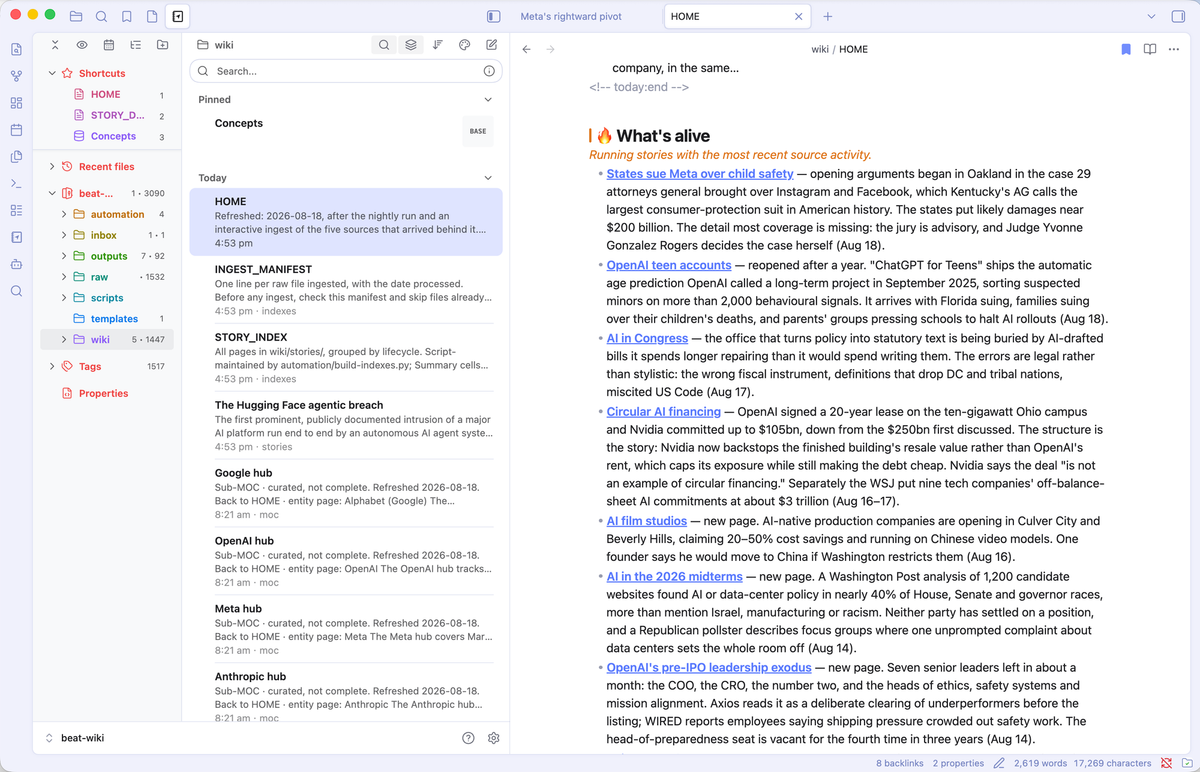
One thing that makes the wiki particularly valuable for me is that I first seeded it with my own writing: the entire Platformer archive, from which Claude expertly extracted all the various people, companies, and concepts that I’ve covered here since 2020 and wrote them up in Markdown files that live on my computer.
framing: assertive · carried by 1 article(s) · first seen 2026-08-19
🔮 I call the idea an infohazard because, simply by becoming aware of it, I had ensured that I would devote the next several weeks to building it, without having any idea whether it would benefit me at all.
2026-08-19 · Platformer
An LLM wiki changed how I work · assertive framing

Claims (132 extracted, 12 hedged)

My fiancé works at Anthropic. asserted
fiancé → work → Anthropic
At the beginning of April, the prominent AI researcher Andrej Karpathy tweeted out an idea that was, for a certain kind of productivity nerd, an infohazard. asserted
that → tweet → nerd
He described the idea this way: “Something I’m finding very useful recently: using LLMs to build personal knowledge bases for various topics of research interest.” asserted
I → describe → interest
He proceeded to describe his process: adding source documents to a local folder and using an LLM to extract and organize their contents into a Markdown wiki that gets updated as he adds new material. asserted
he → proceed → material
Karpathy’s AI-related pronouncements are closely followed online — he is, after all, the person who coined the term “vibe coding.” asserted
who → relate → term
And so, seemingly within hours, the web had filled up with GitHub repos, YouTube videos and Substack posts about how to set up an LLM wiki for yourself. asserted
web → fill → yourself
I call the idea an infohazard because, simply by becoming aware of it, I had ensured that I would devote the next several weeks to building it, without having any idea whether it would benefit me at all. asserted
it → call → me
As it so happens, it has. asserted
it → happen → ?
Of everything I tried this year to get better at the deskbound parts of my job, the LLM wiki has easily been the most useful. asserted
wiki → try → job
Like a vintage sports car, it requires a fair degree of maintenance, and there are almost certainly easier ways to create a personal knowledge base. asserted
it → require → base
But if you do any sort of work that has made you crave the help of a good research assistant, an LLM wiki might be worth your time. uncertain
wiki → do → assistant
The wiki is the centerpiece for my annual productivity post, where I run down any changes to the way I work that might be interesting to others afflicted by an inexplicable enthusiasm for software. uncertain
that → run → software
So with that, here’s what I’m still doing from last year, what I stopped doing, and what’s new. asserted
what → ’ → what
What I'm still doing Given how often I switch apps, the best test for whether something actually makes me more productive is longevity. asserted
me → do → apps
Do I install the app on a new machine? asserted
I → install → machine
Do I renew the subscription when it’s time? asserted
it → renew → subscription
Can I point to the places where it actually saves me time? asserted
it → point → time
Three apps I’ve recommended in previous years still clear that bar. Raycast, a launcher app that replaces Spotlight, remains my preferred way to navigate a computer. asserted
that → recommend → computer
When I press ⌘-space, the Raycast window instantly materializes and lets me perform actions across most of the apps that I use. asserted
I → press → that
I look up words; I do math; I reposition windows; I access my clipboard history; I open websites. asserted
I → look → websites
And thanks to a paid upgrade, I do tons of simple AI searches in the Raycast window. asserted
I → pay → window
(I use GPT-5.5 Instant here for the high quality-to-speed ratio.) asserted
I → use → ratio
When I’m done, there’s no getting lost in a jumble of open tabs or windows — Raycast simply fades back into the background. asserted
Raycast → do → background
At this point, I really can’t imagine my Mac without it. asserted
I → imagine → it
And in a nice development since last year, it’s now available for Windows as well. asserted
it → ’ → Windows
Capacities, which bills itself as “a studio for your mind,” is where I keep my daily journal. asserted
I → bill → journal
Each morning, I write a bit about whatever’s on my mind. asserted
whatever → write → mind
Then, I add notable news links from Techmeme to the bottom of my journal and tag them. asserted
I → add → them
The result is that when I’m writing a story or preparing for a podcast, I can click a tag like “Labor” and instantly see all the stories I’ve saved on that subject since I started building this system a couple years ago. asserted
I → write → system
This has been enormously helpful in planning our current podcast miniseries on AI and productivity, since we discuss jobs news on each episode. asserted
we → plan → episode
I used to spend a lot of time digging through databases or running fruitless Google searches in an effort to jog my memory about something I had read; Capacities ensures that it’s all just a click away. asserted
it → use → something
You could easily do this with any number of apps, but after three years I still find myself appreciating the simplicity and calm of Capacities. uncertain
myself → do → Capacities
Finally, last year I mentioned testing an app called Recall that (anticipating the LLM wiki!) helps you save and organize content from the web. asserted
you → mention → web
I found myself using it less for that purpose over the past year, except for one remaining killer use case: its Chrome extension provides near-instant text summaries of YouTube videos. asserted
extension → find → videos
Over the past year, I’ve saved myself many hours by dumping podcasts I feel like I should listen to for work into Recall and simply skimming the summaries. asserted
I → save → summaries
What I stopped doing The two things I stopped doing over the past year are related to each other — and to the LLM wiki. asserted
I → stop → wiki
For years now, I’ve been seeking a solution to problems of memory. asserted
I → seek → memory
I’ve been a tech reporter for almost 16 years, have written a newsletter for almost nine, and have written this newsletter for six. asserted
I → write → six
For much of that time, I’ve been publishing stories and saving research materials in various places. asserted
I → publish → places
And when a news story comes along that draws on some of that history, I want to find that context as quickly as possible. asserted
I → come → context
…and 92 more, not listed.

💬 Give feedback
🕘 History 🎫 Support