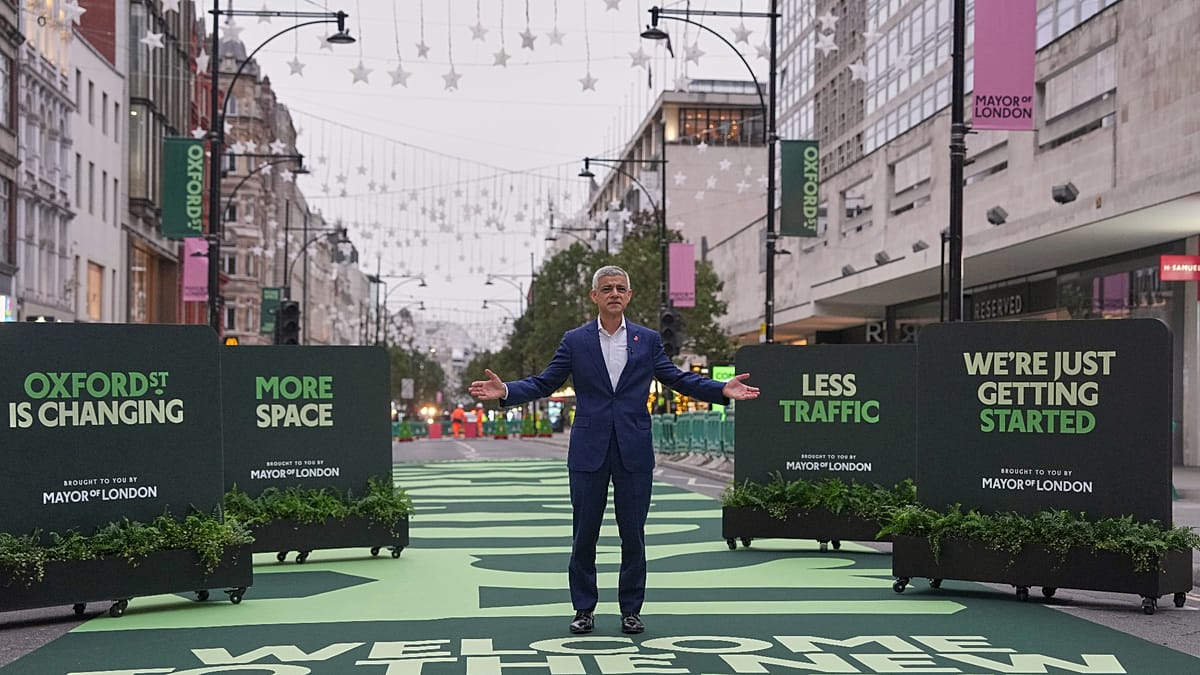
Sadiq Khan's vision of Oxford Street as a peaceful, pedestrian utopia has inelegantly fallen flat on its face just days into the scheme.
asserted
vision → fall → scheme
We were promised, by glossy digital artwork, gentle crowds of shoppers wafting among green trees, hand-in-hand and beaming as they admired the window displays.
asserted
they → promise → displays
Traffic and buses would have no problem breezing through surrounding roads after being blocked from the thoroughfare, diagrams helpfully demonstrated.
asserted
diagrams → have → thoroughfare
What to make, then, of the scores of cyclists that have this week been jostling with pedestrians and tearing through the new zone, as security guards watched on?
asserted
guards → make → zone
Or of the hard-working black cab drivers who say their days have suddenly become more difficult, with an extra 20 minutes lumped onto journeys through central London?
asserted
minutes → work → London
One video filmed in an evening shows dozens of cyclists, mainly young men or teenagers, blatantly disregarding the new rules and biking down Oxford Street as if nothing had changed.
'He's given up,' one can be heard chuckling, in reference to a security guard standing with his arms outstretched at the bollards.
asserted
arms → film → bollards
The peloton had gathered at one of the crossings where cars still pass through the pedestrianised zone, before recklessly weaving through bewildered shoppers.
asserted
cars → gather → shoppers
Cyclists have refused to obey the new rules and continued to ride down Oxford Street
One video posted online shows chaos as bikes weave among startled shoppers in the pedestrianised zone
Bahrain 'Baha' Mujagata, 21, thought to be London's youngest black cab driver, is not a fan of Lord Khan's scheme
Oxford Street was closed to cars, bikes, buses and taxis from Monday morning
With loud music blaring in the background, the chaos and confusion was a far cry from the dream Londoners had been sold.
asserted
Londoners → refuse → dream
One of the capital's residents best-placed to assess the impacts of the new scheme is Bahrain Mujagata, who at 21 is thought to be London's youngest black cab driver.
asserted
who → place → 21
He described how the surrounding roads have since snarled up with traffic – and was already wistfully recalling 'how it was before'.
asserted
it → describe → traffic
Mr Mujagata told the Local Democracy Service: 'Yesterday, I felt the real-time repercussions—there was so much traffic on Regent Street with nowhere else to go.
asserted
I → tell → nowhere
Sitting through traffic that I used to bypass makes life much harder.
asserted
life → sit → that
Regent Street going northbound is very crowded, with a cycle lane on the left and a central reservation.
asserted
Street → go → left
If a bus picks up passengers, you have to stay behind it.
asserted
you → pick → it
If it’s like that at night, I can only imagine what it’s like during the day.'
asserted
it → ’ → day
The driver said he was not in principle against the pedestrianisation of Oxford Street, but that Lord Khan's effort was not the way forward.
asserted
effort → say → Street
Mr Mujagata added: 'We will evolve and get used to it, like whenever they change a road or turn.
asserted
they → add → road
But drivers who knew how it was before will always remember.'
asserted
it → know → ?
It was at dawn on Monday that Lord Khan, London's mayor, stood proudly in the centre of Oxford Street, testing a range of poses for the cameras: arms outstretched, a wave to passing workers, gazing at the sky in adulation.
asserted
arms → stand → adulation
A video from Wigmore Street this week showed cars and buses backed up to a standstill
Locals had warned of congestion on the roads around Oxford Street, and their fears were realised
A team of security guards on day one barked instructions at cyclists to disembark, with mixed results
New signs were installed overnight that asked cyclists to dismount from their bikes and walk them through the pedestrianised zone
Hours earlier, green bollards had been installed at either end of a 0.9km stretch of the famous shopping hub – from the famous Selfridges department store down to Ikea.
asserted
bollards → show → Ikea
Despite a team of guards barking orders to disembark, at mid-morning cyclists continued to race through the bollards and down the road, trundling over the big new green sticker that had been laid over the tarmac.
asserted
that → bark → tarmac
Perhaps it would take a day or so for them to get the message, onlookers suggested.
uncertain
onlookers → take → message
The fresh footage suggests not.
uncertain
footage → suggest → ?
Speaking to the Daily Mail, Tim Barnes, Westminster City Councillor for Growth and Planning, said after the scheme's launch: 'We have been concerned from the outset that taking London's main east-west road and pushing it to the smaller side roads behind was always going to inevitably lead to traffic problems.
asserted
taking → speak → problems
'You just can't take that much traffic out of central London and push it on to roads that are smaller, less well suited to taking big vehicles, and not expect it to cause problems.
asserted
it → take → problems
There was traffic on Regent Street that was backed up, and indeed it stopped for so long at times that we even saw a big waste truck having to turn around and go the wrong way [up the street].
asserted
truck → be → street
And if you look at Wigmore Street, there are points where buses now have to make very, very hard right-hand turns or 90-degree turns, which I think will be a problem for pedestrians and cyclists.
asserted
I → look → pedestrians
I also think it's only a matter of time until we see more incidents with cyclists hitting pedestrians on Oxford Street itself.'
asserted
cyclists → think → Street
Artist's imaginings of pedestrianised Oxford Street were a far cry from the recent scenes
Workmen erecting bollards at one end of Oxford Street as the pedestrianisation came into force
Lord Khan claimed the street had been 'in decline' for the past two decades
The changes have prompted fears that traffic, noise and pollution will simply be pushed on to smaller residential roads, leaving those living and working nearby to bear the brunt of the Mayor's flagship project.
asserted
traffic → erect → project
Among the roads affected by the new arrangements are Wigmore Street, Henrietta Place and Cavendish Place, which are now accommodating diverted bus services.
asserted
which → affect → services
Transport for London has confirmed that five bus routes – the 98, 139, 390, N98 and N207 – have been redirected on to surrounding roads, with new stops introduced to accommodate passengers.
asserted
stops → confirm → passengers
Other services have been shortened or altered, while taxis and private hire vehicles are no longer permitted to enter the pedestrianised section.
The upheaval comes despite warnings from Westminster City Council that the scheme risked creating serious problems for residents, businesses and motorists.
Residents in neighbouring Marylebone had also raised concerns before the closure that their streets would become increasingly congested as buses and other vehicles were forced away from Oxford Street.
asserted
buses → shorten → Street
The Marylebone Association previously calculated that Wigmore Street could see around 46 additional bus movements an hour during peak periods.
uncertain
Street → calculate → periods
Henrietta Place has also been converted to accommodate two-way traffic as part of preparations for the scheme.
asserted
Place → convert → scheme
The changes represent a major transformation of one of Britain's most famous shopping destinations, which attracts around 500,000 visitors every day.
asserted
which → represent → visitors
 The Aporia