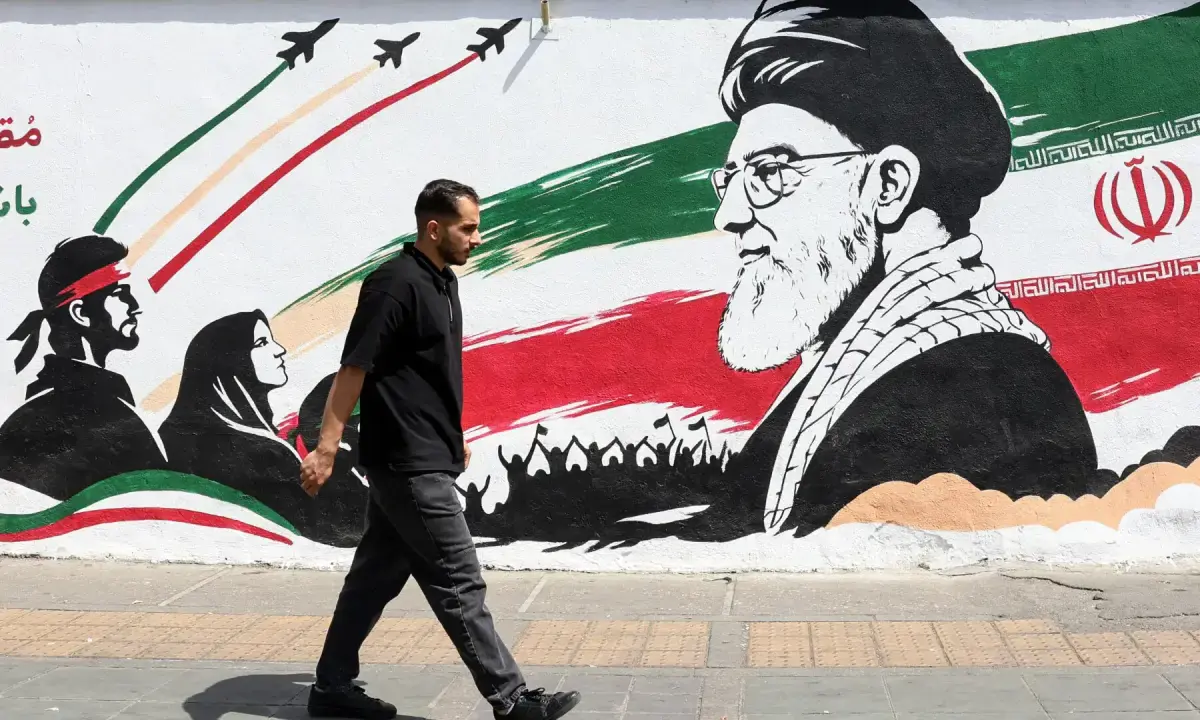
Photo via The Guardian

JD Vance letter may offer last chance to avert fresh conflict between US and Iran

Read the original at The Guardian ↗
Cite

editor, P. W. D. (2026, October 29). JD Vance letter may offer last chance to avert fresh conflict between US and Iran. The Guardian. https://www.theguardian.com/world/2026/oct/29/jd-vance-letter-may-offer-last-chance-to-avert-fresh-conflict-between-us-and-iran

Dated from the outlet's own feed. Check the original for its byline.

The Guardian · collected 2026-10-29 · by Patrick Wintour Diplomatic editor

Quick Summary

US Vice President JD Vance wrote a letter to Mohsen Rezaei, secretary of Iran’s supreme national security council, proposing renewed diplomacy aimed at easing sanctions and opening the Strait of Hormuz. The proposal requires Iran to make immediate commitments regarding its nuclear program, such as exporting highly enriched uranium, in exchange for US sanctions relief. However, Iran is reluctant to give up this bargaining chip without assurances that the US will uphold its end of the bargain, signaling potential challenges ahead for negotiations aimed at preventing a new conflict between the two countries.
Written by AI on 2026-10-29, from this article's own text only (the story summary below draws on all the coverage).

AI analysis

Story summary

US Vice President JD Vance has sent a letter to Mohsen Rezaei, secretary of Iran's Supreme National Security Council and a former commander of the Islamic Revolutionary Guard Corps (IRGC), in an attempt to restart peace negotiations between the US and Iran. This outreach comes as President Donald Trump threatens potential military action against Iran following the upcoming midterm elections. The Wall Street Journal reports that Vance’s letter was well-received by Iranian officials, who may now consider whether there is enough common ground for renewed talks. Meanwhile, Trump claims that Vance's contact with Rezaei relates to securing medical supplies for Iran, suggesting a humanitarian angle to the diplomatic efforts. However, some outlets like The Washington Examiner criticize this outreach as overly conciliatory towards Iran. As of now, it remains unclear if these initial overtures will lead to substantive negotiations or prevent further military escalation.

Written for “JD Vance Contacts Iran For Peace Talks” on 2026-10-30, grounded in this article and the 9 other(s) covering the same event.
Why this leaning score
The article's own words the score was based on. Each is quoted verbatim and was checked against the article text before being stored, so you can find it in the original.
Reading Leans left (beta estimate) Confidence medium
Leaning: leans left for article 115633 (medium confidence, 2 verified quotes) · logged 2026-10-29

Story

📰 JD Vance Contacts Iran For Peace Talks
Politics · 10 article(s) covering the same event. Compare every outlet's account →

Compared with similar articles

This article reads leans left and hedges 14% of its claims. Each row says how that neighbour differs.
The Straits Times
⚖️ Leans left Hedges 1 of 18 claims Outlet record 68/100
Times of India
⚖️ Leans left Hedges 5 of 27 claims Outlet record 59/100
The Independent
Hedges 3 of 20 claims Outlet record 59/100
Washington Examiner
Hedges 0 of 2 claims Outlet record 70/100
Semafor
⚖️ Leans right further right than this Hedges 1 of 6 claims Outlet record 60/100
Semafor
Hedges 1 of 4 claims Outlet record 60/100
Al Jazeera
Hedges 14 of 44 claims Outlet record 60/100
Euronews
Hedges 5 of 14 claims Outlet record 60/100
Washington Examiner
⚖️ Leans strongly right further right than this Hedges 0 of 8 claims Outlet record 70/100
Dawn
Outlet record 72/100
“Article A is an editorial expressing a viewpoint, while Article B reports on a specific letter from JD Vance offering to restart diplomacy with Iran.”
How this article was measured signals, leaning charts, publisher record, byline, topics and claims

Signals How these are calculated →

Claims extracted
29
sentences that state something as happening or true
Uncertain
14%
4 of 29 hedged ("reportedly", "may", "according to")
Leaning
Leans left
of the writing, not the subject · beta estimate
Publisher signals
66/100
The Guardian's corrections and hedging, across everything collected from it. Not a measure of accuracy.
Outlets on this story
10
Politics
Same framing elsewhere
1
articles that frame the event the way this one does
Analyzed 2026-10-29 · how these are computed

How this is being covered How these are calculated →

Article leaning vs. publisher reliability
Source leaning vs. consistency

Publisher

The Guardian · 2676 article(s) · 6 correction(s) detected
Running correction rate · 6 correction(s)

Who wrote this

Patrick Wintour Diplomatic editor
19 article(s) here · 1 carrying a prediction
🔮 Lingering hopes of averting a major new conflagration between Iran and the US soon after Tuesday’s midterm elections could rest on Iran’s response to a personal letter from the US vice-president, JD Vance, offering to restart diplomacy.
🔮 The US is aware of the talks’ progress but is holding out for a concession that European powers suggest could involve Iran allowing UN weapons inspectors back into the country.
🔮 Security officials and diplomats at Monday’s meeting were expected to discuss how Iran could persuade the Houthis in Yemen to end their crippling missile and drone attacks on infrastructure in Saudi Arabia.
🔮 She has justified her late – but widely predicted – entry into the race on the grounds that the UN security council appears to be close to deadlock on the six remaining candidates in the race, with no one as yet able to establish a clear lead after six rounds of voting, the latest on 16 October.
🔮 Foreign ministers at a summit of eight European and Middle Eastern countries have urged the US and Israel not to renews their attacks on Iran, warning a fresh outbreak of fighting would spread conflict and push oil prices even higher.
🔮 They are trying to burn it, but we can only anticipate there will be diseases such as cholera in the near future.
🔮 Col Javad Mokhtar Rezaei, the deputy head of cultural and social affairs for Iran’s cyber police (Fata), told the Tasnim news agency: “In some cases, the phones offered may actually exist, but exposing electronic components to saltwater and extreme humidity can cause corrosion of internal components, damage to the boards, battery and display, and cause hidden malfunctions in the device’s performance.” Meysam Doost-Mohammadi, a spokesperson for the Iranian mobile association, said it would be unusual for valuable phones to be transported by ship. The bulk of the recent spate of attacks have occurred close to the coast with Oman, a route that Iran regards as unauthorised.
🔮 Unlawful settlement activity will be captured through a breach of international humanitarian law, including the Geneva convention on occupation.
🔮 The report came as the United Nations’ special envoy to Yemen, Hans Grundberg, admitted to the UN security council in New York that Yemen – the poorest country in the world – had lapsed back into full-scale war and said the first victims would be women and children.
🔮 This could means as many as 27 Israeli diplomats being expelled from the UK, a step that would arguably mark the lowest point in British-Israeli diplomatic relations since the formation of the state of Israel.
Also by Patrick Wintour Diplomatic editor
Nothing else under this byline is closely related to this article, so these are simply their most recent.
All 19 articles by Patrick Wintour Diplomatic editor →

Topics

China Iran Iranian Qatari Tehran

Subjects

Iran GPE · 15× Tehran GPE · 3× Ghalibaf PERSON · 2× Rezaei PERSON · 2× Vance PERSON · 2× China GPE · 1× Iranian NORP · 1× JD Vance PERSON · 1× Mohsen Rezaei PERSON · 1× Qatari NORP · 1×

Narrative

The letter, written after predominantly Qatari mediation, was sent to the secretary of Iran’s supreme national security council, Mohsen Rezaei on Sunday and requires Tehran to agree to make commitments on its nuclear programme at the start of a process that would lead to the opening of the strait of Hormuz within seven days in return for US sanctions relief.
framing: assertive · carried by 1 article(s) · first seen 2026-10-29
🔮 Lingering hopes of averting a major new conflagration between Iran and the US soon after Tuesday’s midterm elections could rest on Iran’s response to a personal letter from the US vice-president, JD Vance, offering to restart diplomacy.

Claims (29 extracted, 4 hedged)

Lingering hopes of averting a major new conflagration between Iran and the US soon after Tuesday’s midterm elections could rest on Iran’s response to a personal letter from the US vice-president, JD Vance, offering to restart diplomacy. uncertain
hopes → linger → diplomacy
The letter, written after predominantly Qatari mediation, was sent to the secretary of Iran’s supreme national security council, Mohsen Rezaei on Sunday and requires Tehran to agree to make commitments on its nuclear programme at the start of a process that would lead to the opening of the strait of Hormuz within seven days in return for US sanctions relief. asserted
that → write → relief
A reply is imminent, but Iran is reluctant to give upfront and irreversible commitments on its nuclear programme, such as exporting its stockpile of highly enriched uranium to a third country, if the compensatory US steps, such as lifting sanctions on Iranian oil exports, are reversible. asserted
steps → give → exports
Some form of third-party guarantee that both sides will adhere to their commitments has been discussed, with China often mentioned as the only country of sufficient status to underwrite it. asserted
China → adhere → it
The return of Vance, a sceptic about the war, to the negotiations is significant and a sign that the US has not abandoned diplomacy. asserted
US → abandon → diplomacy
One Democrat senator briefed on the targets the US military had identified in Iran said described the plan for a renewed attack as “insane and likely lead to the destruction of our commitment to the rule of law”. asserted
military → brief → law
In a sign of Iran’s reluctance to meet US demands about sequencing, its chief negotiator, Mohammad Ghalibaf, wrote on X: “Iran’s conditions have been repeatedly and clearly stated to the mediators. asserted
conditions → meet → mediators
The carrot-and-stick approach has no effect on Iran. asserted
approach → have → Iran
Progress can only be achieved once Iran’s seven conditions have been agreed upon.” asserted
conditions → achieve → ?
Those conditions include the lifting of sanctions, ending asset freezes and the end to the war on all fronts, a phrase that requires an Israeli ceasefire in Lebanon. asserted
that → include → Lebanon
The US wants front-loaded, specific commitments about the removal of Iran’s stockpile of highly-enriched uranium. asserted
US → want → uranium
Tehran is reluctant to give up its bargaining leverage, and also resists the return of UN nuclear inspectors for fear they might provide the US with intelligence on the whereabouts and state of the stockpile. uncertain
they → give → stockpile
It has proposed blending the stockpile down inside Iran so it is no longer useable to make a nuclear weapon. asserted
it → propose → weapon
The Vance letter was sent to Rezaei rather than Ghalibaf or the foreign minister, Abbas Araghchi, because Washington judged that decision-making power rests with those closest to the Islamic Revolutionary Guards Corps. asserted
power → send → Corps
In practice, Iran tries to reach decisions through consensus at the highest level of government in a six strong committee. asserted
Iran → try → committee
Ghalibaf and Rezaei met the supreme leader, Mojtaba Khamenei, last week to discuss the risk of a new war. asserted
Ghalibaf → meet → war
Khamenei has said he would like an end to the current state of no war, no peace. asserted
he → say → war
Iran has well laid plans ready to strike back against US interests in the region by hitting desalination plants, internet cables and electricity grids across the Gulf. asserted
Iran → lay → Gulf
For a third US attack in two years to have any rationale or prospect of inducing Iran’s capitulation, the plan would require the US, probably in conjunction with a caretaker government in Israel, to mount attacks on previously off-limits targets. asserted
plan → have → targets
Europe would not join the attacks, but the views of the Gulf states, the chief targets of Iran reprisals, would be key. asserted
views → join → reprisals
The Connecticut senator Chris Murphy told a briefing at the Middle East Institute: “I did get a fairly detailed conversation about what the war plan would be … asserted
plan → tell → conversation
I will just say this their plan is insane. asserted
plan → say → this
It will lead to devastating escalation and the likely destruction of our commitment to the rule of law. asserted
It → lead → law
“There has been open reporting as to the civilian infrastructure we may be targeting … uncertain
we → target → infrastructure
I think the plan they have developed will lead in my judgement to a prolongment [sic] and escalation of this war that will be devastating to our security interest”. asserted
that → think → interest
Although Tehran trusts Vance marginally more than most White House politicians and envoys, the Iranian high command is still suspicious about his status after he negotiated a 14-point memorandum of understanding which then fell apart when other members of the US administration took charge of its implementation. asserted
members → trust → implementation
That led to unilateral US steps to reopen the strait of Hormuz that Iran said contravened the terms of the agreement. asserted
Iran → lead → agreement
Trump also came to detest it because it delayed the start of nuclear talks for as long as 60 days. asserted
it → come → days
In an offer made by Tehran on the margins of the UN general assembly, it proposed foreshortening the timeframe before nuclear talks started, saying they could start withinsix or seven days of the US restoring the sanctions waiver on its oil exports and the reopening of the strait of Hormuz. uncertain
US → make → Hormuz

💬Give feedback
🕘History 🎫Support