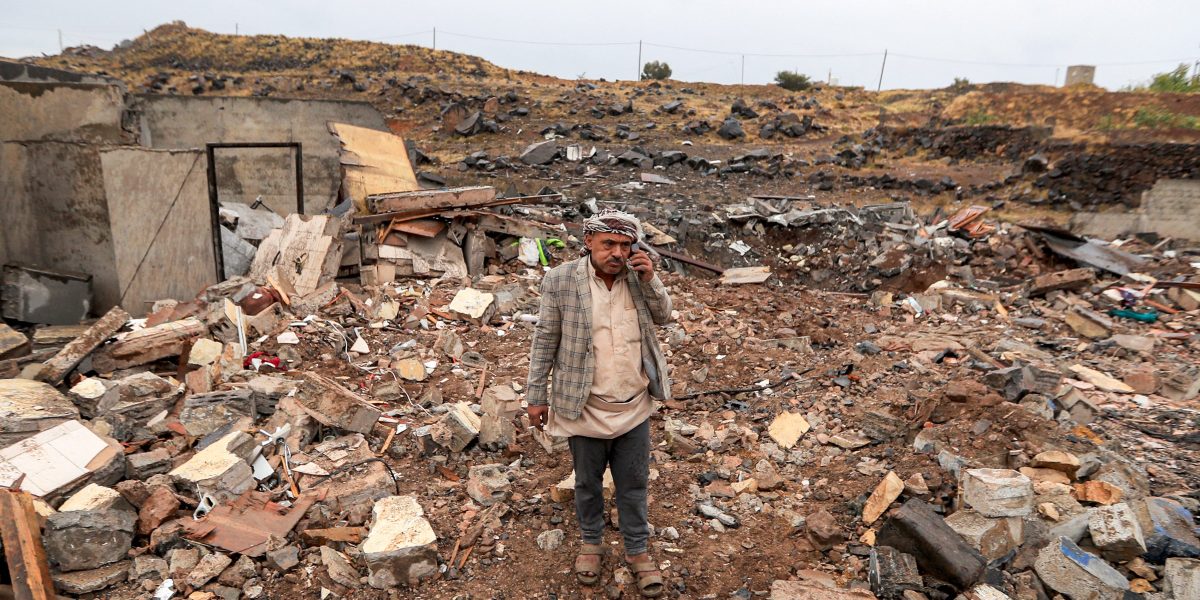
The failure of Tel Aviv and Washington to achieve their war aims in Iran has resulted in the most dramatic American retreat from a region since the U.S. flight from Vietnam in 1975.
asserted
failure → achieve → 1975
This startling American defeat — after a generation of forever war failures and stalemates — has been thrown into broad relief by the resumption of another regional conflict that has received far less attention than the Trump administration’s sputtering war with Tehran.
asserted
that → throw → Tehran
This fall, the forces that most Americans know as “the Houthis” have conducted a blitzkrieg in their native Yemen and have been pummeling Saudi Arabia’s aviation and energy infrastructure with missiles and drones.
asserted
Americans → know → missiles
In doing so, they have put a spotlight on the limits of American power, and the shrinking U.S. military footprint, in the Middle East.
asserted
they → do → East
The long-standing conflict between Saudi Arabia and northern Yemen’s Ansarullah, or “Helpers of God,” led by the Houthi clan, heated up again in July 2026, when Saudi Arabia struck Sanaa International Airport to prevent a Houthi delegation from landing on its return from the funeral in Iran for slain Ayatollah Ali Khamenei.
asserted
Arabia → stand → Khamenei
The Ansarullah government launched its own attacks and, in October, managed briefly to close Saudi Arabia’s own airport.
asserted
government → launch → airport
The renewed war has now expanded into a regional conflict, with Pakistan, Türkiye, and, recently, Egypt pledging to defend the kingdom from attack, though none of these regional powers appear eager to conduct operations in Yemen itself.
asserted
none → renew → Yemen
Notably absent from the current conflict is Saudi Arabia’s most powerful ally, the United States, since President Donald Trump has repeatedly declined to intervene on behalf of his Saudi allies.
asserted
Trump → decline → allies
The typical U.S. press framing of Ansarullah as an “Iran-backed militia” is inaccurate, since the movement has local, Arab nationalist reasons for its actions and is a full-scale government that rules some 80 percent of Yemen’s population.
asserted
that → back → population
Still, it does receive surreptitious technical and military support from Iran, though nothing like the hundreds of billions of dollars’ worth of high-tech armaments — from kits turning 2,000-pound “dumb” bombs into precision munitions to advanced air-to-air missiles — that the U.S. provides the Saudis.
asserted
U.S. → receive → Saudis
Ironically, Trump’s war on Iran, fought in conjunction with Israeli Prime Minister Benjamin Netanyahu, weakened the Saudis and exposed their vulnerabilities to military attack by Iranian drones and missiles, impelling them to seek a symbolic win over a less formidable enemy in neighboring Yemen.
asserted
war → fight → Yemen
But the weaknesses exposed by Iran’s drones helped encourage a vigorous Ansarullah rejoinder.
asserted
weaknesses → expose → rejoinder
The American refusal to join Saudi Arabia’s war signals a profound degradation in U.S. capabilities and standing in the Middle East.
asserted
refusal → join → East
The U.S. military had, for decades, dominated the region from a network of about 20 major bases.
asserted
military → dominate → bases
The U.S. Navy operated out of the headquarters of the Fifth Fleet in Manama, Bahrain.
asserted
Navy → operate → Manama
The U.S. Air Force flew missions from the massive al-Udeid Air Base in Qatar, which housed 10,000 U.S. personnel.
asserted
which → fly → personnel
Thousands of ground troops were barracked in Kuwait, the United Arab Emirates, and Jordan.
asserted
Thousands → barrack → Kuwait
The Pentagon admitted that “Iranian strikes damaged and destroyed hundreds of buildings and structures at U.S. bases in Kuwait, Bahrain, Qatar, UAE, Saudi Arabia, Iraq, Oman, and Jordan during the conflict.
asserted
strikes → admit → conflict
In addition, dozens of U.S. aircraft were destroyed or damaged during OEF.”
The naval base at Manama, one of America’s most important naval facilities and headquarters of the Navy’s Fifth Fleet, was destroyed by Iranian strikes.
asserted
base → destroy → strikes
(Acting Navy Secretary Hung Cao admitted last month that Iran “blew the hell out of Bahrain.”)
asserted
Iran → act → Bahrain
The loss of Manama led to supply shortages and poor morale aboard the USS Lincoln and other ships patrolling the Strait of Hormuz, bedeviling Secretary of Defense Pete Hegseth.
asserted
loss → lead → Hegseth
The CIA offices at the U.S. Embassy in Riyadh were annihilated.
asserted
offices → annihilate → Riyadh
Iran struck al-Udeid’s evacuated Combined Air Operations Center in Qatar, from which the Pentagon had directed its strikes on enemies as diverse as the Taliban and ISIL over recent decades, and rendered this facility inoperable.
asserted
facility → strike → decades
All U.S. troops were also withdrawn from Iraq, a process accelerated by the inability of U.S. missile interceptors to protect them from attacks by Iran and allied Shiite militias there.
asserted
troops → withdraw → Iran
Iran’s deployment of swarms of Shahed drones caused the United States and Israel to use up much of their stock of interceptors, which are time-consuming and expensive to replace.
asserted
which → cause → interceptors
A basic Shahed costs as little as $20,000, though new hardened versions are more expensive — whereas a Patriot interceptor costs $4 million.
asserted
interceptor → cost → million
One reason the Trump administration may be reluctant to intervene in Yemen is that if the U.S. cannot fly missions from al-Udeid, and cannot be sure any new fighter-jet fleets stationed in the region will be safe from Iran, given the paucity of interceptors, the Pentagon will have a limited ability to rescue any U.S. pilots shot down over Yemen.
uncertain
Pentagon → intervene → Yemen
America’s Profound Weakness in the Middle East
Saudi Arabia launched a war against the ascendant Ansarullah in 2015 when the latter staged a coup in the capital of Sanaa.
asserted
latter → launch → Sanaa
The Ansarullah movement is rooted in Yemen’s Zaidi Shiism, though it is more radical than traditional Zaidism.
asserted
it → root → Zaidism
(Zaidi Shiism differs substantially from Iranian Shiism, having no ayatollahs and having relatively good relations with Sunnis.
asserted
Shiism → differ → Sunnis
About a third of Yemenis are Zaidis, who predominate in the north of the country, and many have long resented the dominance of their politics and culture by neighboring, oil-rich, Sunni Saudi Arabia, whose official ideology is hard-line Wahhabism, a puritanical form of Islam that insists on a literal interpretation of the Quran.
asserted
that → predominate → Quran
Wahhabi proselytizing among the Shia enraged the Houthi clan and their followers began rebelling against the government of military dictator Ali Abdullah Saleh in 2004.
asserted
followers → enrage → 2004
But when he was deposed by popular demonstrations during the Arab Spring in 2012, Saleh gradually allied with the Houthis, and by 2015 about half the Yemeni military rallied to their side, along with some major Sunni tribes.
asserted
military → depose → tribes
In response to the Houthis’ rise, a Saudi-led coalition that included the United Arab Emirates began bombing Yemen in 2015.
asserted
that → lead → 2015
Until 2022, the U.S, then militarily dominant in the region, provided the Saudis with strategic advice, weaponry, and in-air refueling for their fighter jets in the Yemen war, though Riyadh’s tendency to bomb civilian infrastructure rather than confining themselves to military targets caused tension between the two allies.
asserted
tendency → provide → allies
While the Saudis and their coalition pushed the Houthis out of much of the south of the country, including Aden, they were unable to dislodge them from the north.
asserted
they → push → north
The Saudis implicitly acknowledged their failure with a United Nations-brokered truce in April 2022, which largely held until this past summer.
asserted
which → acknowledge → summer
The Forever Wars Effect
America’s forever wars against Middle Eastern countries that decline to accept the Israel project or American corporate neocolonialism helped reignite the Saudi–Yemeni conflict.
asserted
that → decline → conflict
Iran is the last major state in the region that rejects Israel and is off-limits to U.S. corporate investment, a stance that inspires much of Washington’s animus.
asserted
that → reject → animus
Netanyahu was therefore easily able to persuade Trump, as a privileged visitor to the White House Situation Room, to attack Iran in February.
asserted
Netanyahu → persuade → February
…and 71 more, not listed.
 The Aporia