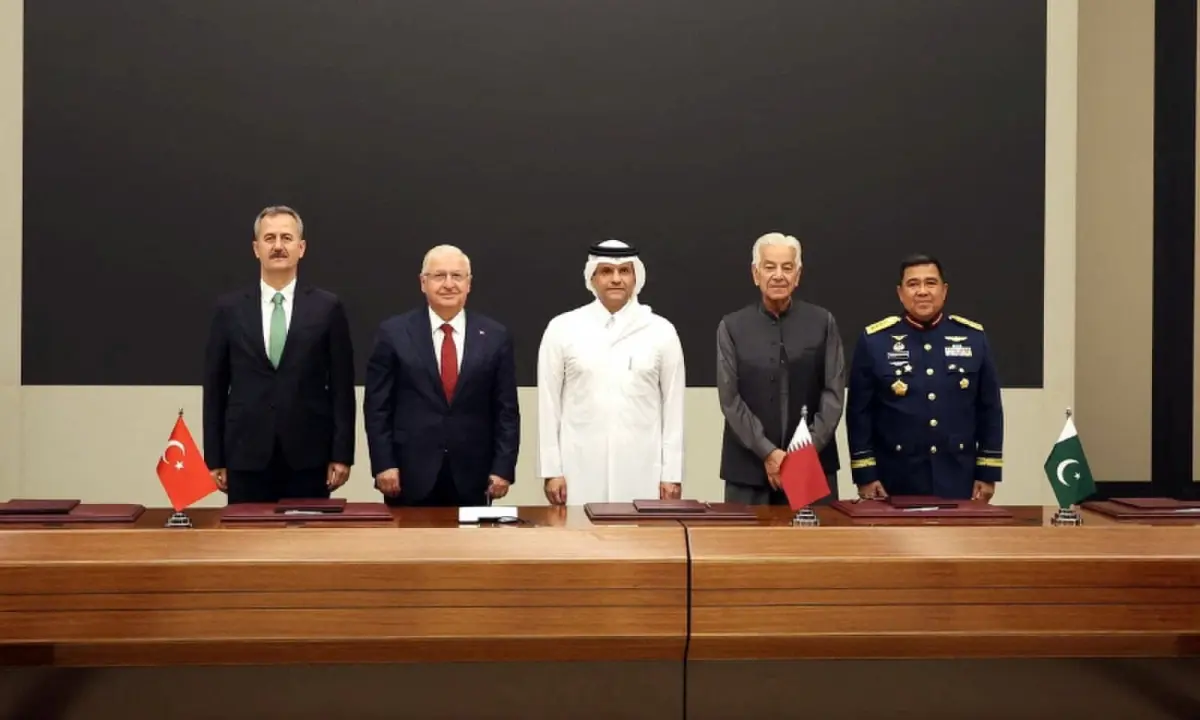
Several officials are ferrying messages between Iran and the US for an end to the conflict, having helped organise a short-lived peace agreement earlier in the year.
asserted
officials → ferry → year
Based on these and past events, there are a series of judgement calls that observers make about the Pakistani state and its position in the world order.
asserted
observers → base → order
One set of views sees Pakistan as a client state of the US, that is, one that’s subservient to America’s imperial interests and its immediate allies in the region, the Gulf monarchies.
asserted
that → see → region
This view is shared by sections of the left — globally, in the region, and within Pakistan — and disgruntled opponents of the current regime, who furnish as evidence for it the country’s role in global anti-communist politics in the 1950s and 1960s, its partnership with the US against the Soviets in Afghanistan, its role during the ‘war on terror’ between 2001 and 2013, and the proximity of ties with the Trump administration in recent months.
asserted
who → share → months
Ironically, conservatives and Islamists also cite the 1950s/1960s and the experience of US-Pakistan relations during the war on terror and especially in the last few years, as evidence of successive regimes siding with global secularist interests in subjugating both Islamic movements in the region and Muslim political identity at home.
asserted
regimes → cite → home
The other view, held in the same time-space continuum, sees the country as ideologically fundamentalist, and simultaneously, a client of China and an unpredictable ally of the US — one that is capable of undermining the global hegemon on its own or in collaboration with the Chinese.
asserted
that → hold → Chinese
This view is shared by much of the American and Indian mainstream, who cite CPEC and close military relations as an example of Chinese clientelism, previous support to the Taliban during the invasion of Afghanistan as an example of duplicity, and its approach to Kashmir, its recent diplomatic support for Iran, and the broader sociocultural and ideational life of its citizens, as an example of (religious) fundamentalism.
asserted
who → share → fundamentalism
As with most sweeping observations, many may detect a kernel of truth in these otherwise clearly contradictory positions.
uncertain
many → detect → positions
Close proximity to American imperial interests has characterised many passages in Pakistani political history.
asserted
proximity → characterise → history
Similarly, the relationship with China remains remarkably consistent since the 1970s.
asserted
relationship → remain → 1970s
However, in an effort to account for Pakistan’s global and regional behaviour, these observations lapse back to the rather broad and imprecise categories of ‘client state’ or ‘fundamentalist state’.
asserted
observations → account → state
The reality, just on the basis of the actions listed above, is that the state’s geopolitical and ideational positioning has varied considerably, which makes it hard to pin it down as a US ‘client’ of the same ilk as Japan/ South Korea or the Gulf monarchies, or as a Chinese client like North Korea.
asserted
it → list → Korea
There are a series of judgement calls that observers make about the state’s position in the world order.
asserted
observers → be → order
What is consistent though is the subordinate role that the state here plays in global affairs, not just in terms of geopolitics but also — and more fundamentally — in terms of international economic processes.
asserted
state → play → processes
How does ‘subordinate’ differ from ‘client’?
asserted
subordinate → differ → client
Beyond mere semantics, a substantive difference is that a subordinate actor may have limited agency, but it retains the capability of understanding and developing its own interests.
uncertain
it → have → interests
A client, on the other hand, would, by and large replicate the interests of its patrons.
asserted
client → replicate → patrons
On the evidence of the last seven decades, it would be incorrect to assert that the Pakistani state elite has not developed a sense of its own interests, even though some may disagree with the content of those interests or how those interests were developed.
uncertain
interests → assert → interests
There is also a persisting notion that it faces a periodically existential threat from a much more powerful eastern neighbour and that this threat should be countered by a military deterrent.
asserted
threat → be → deterrent
This in turn can only be obtained by forging reciprocal relations with more powerful states.
asserted
This → obtain → states
The presence of these interests/ ideas does not invalidate the fact that the state’s own actions and responses may have hastened insecurities in various ways.
uncertain
actions → invalidate → ways
Nor can it paper over the fact that the processes through which the state recognises its context and develops its response are heavily skewed towards a largely insulated military-bureaucratic state apparatus.
asserted
state → paper → apparatus
Both, in turn, lead to other domestic problems, including frequent civil-military political conflict and law and order insecurity in the peripheries.
asserted
Both → lead → peripheries
However, while some reduce Pakistan’s subordination to its geography or the original conditions of its creation, one can make the more substantive case that it remains in that place by the nature of the global economic order since the 1970s and due to its own economic dysfunction.
asserted
it → reduce → dysfunction
With basic processes of capital accumulation stagnating or being rendered highly inefficient, the dollar requirement to ensure subsistence-level growth under global conditions of economic liberalisation can only be met through wilful subordination to varied benefactors.
asserted
requirement → stagnate → benefactors
Periodic balance-of-payment crises since the 1980s have precipitated this pattern, and geopolitical posturing to extract IMF concessions or rents in other forms has cemented it.
asserted
posturing → precipitate → it
Each successive crisis of the last four decades has found resolution via subordination in the geopolitical domain: favour garnered with the Gulf monarchies via military assistance or labour provision in exchange for reserve deposits; providing the US with regional geopolitical support in exchange for IMF approval, or allowing Chinese capital to make infrastructure investments to kickstart (fleeting) economic growth.
asserted
capital → find → growth
Ultimately, each temporary staving off of an economic crisis has pinned down the state’s subordinate position.
asserted
staving → pin → position
And in the process little has been done to fix the underlying issue of domestic economic dysfunction.
asserted
little → do → dysfunction
The writer teaches politics and sociology.
asserted
writer → teach → politics
 The Aporia