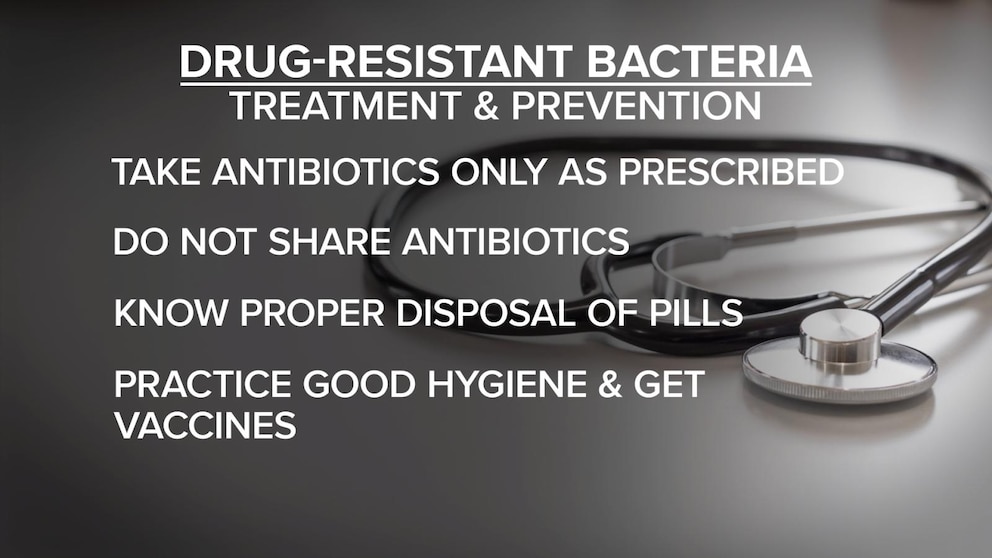
These are the 4 most urgent superbugs spreading in the US this winter

Read the original at The Independent ↗
Cite

Musto, J. (2026, October 28). These are the 4 most urgent superbugs spreading in the US this winter. The Independent. https://www.independent.co.uk/news/health/cdc-bacteria-pathogens-infections-deaths-b3074880.html

Dated from the outlet's own feed. Check the original for its byline.

The Independent · collected 2026-10-28 · by Julia Musto

Quick Summary

The Centers for Disease Control and Prevention (CDC) has identified four superbugs as urgent threats in the United States this winter: Candida auris, Acinetobacter (CRAB), Enterobacterales (CRE), and Neisseria gonorrhoeae. These pathogens cause 9.7 million infections annually, leading to over 50,800 deaths and nearly $12 billion in healthcare costs. The CDC projects that these superbugs could lead to 317,000 annual deaths by 2050 if left unchecked.
Written locally by qwen2.5:14b on 2026-10-28, using this article's own text rather than the other coverage of the same event (that is the story summary below).

AI analysis runs on qwen2.5:14b, locally

Story summary

As of October 28, 2026, the Centers for Disease Control and Prevention (CDC) has identified four drug-resistant superbugs as "urgent threats" in the United States. These bacteria are responsible for 9.7 million infections and 50,800 deaths annually. The CDC also flagged an additional six pathogens as requiring urgent attention due to their potential risks.

The four most critical superbugs include Candida auris, Acinetobacter, Enterobacterales, and Neisseria gonorrhoeae. These bacteria primarily spread in healthcare settings like hospitals and clinics, causing over 42,000 deaths each year and resulting in nearly $12 billion in healthcare costs.

CDC Director Dr. Erica Schwartz warned that antimicrobial resistance poses a significant threat to modern medicine and endangers millions of Americans yearly. Researchers predict the annual death toll from superbugs in North America could rise to 317,000 by 2050 if no action is taken.

Written for “Superbugs Spreading In US This Winter” on 2026-10-28, grounded in this article and the 0 other(s) covering the same event.

Story

📰 Superbugs Spreading In US This Winter
Health · 1 article(s) covering the same event.

Compared with similar articles

This article reads unscored and hedges 21% of its claims. Each row says how that neighbour differs.
ABC News (US)
⚖️ leaning not scored 🔴 0% hedged 0 of 2 📰 publisher trust 70
“While both articles discuss urgent drug-resistant bacteria warnings from the CDC on the same day, Article A focuses on a general report warning, while Article B specifies details about four particular superbugs identified as urgent threats.”
How this article was measured signals, leaning charts, publisher record, byline, topics and claims

Signals How these are calculated →

Claims extracted
34
sentences that state something as happening or true
Uncertain
21%
7 of 34 hedged ("reportedly", "may", "according to")
Leaning
not political
takes no side on a contested political question
Publisher signals
59/100
The Independent's corrections and hedging, across everything collected from it. Not a measure of accuracy.
Outlets on this story
1
Health
Same framing elsewhere
1
articles that frame the event the way this one does
Analyzed 2026-10-28 · how these are computed

How this is being covered How these are calculated →

Article leaning vs. publisher reliability
Source leaning vs. consistency

Publisher

The Independent · 3259 article(s) · 6 correction(s) detected
Running correction rate · 6 correction(s)

Who wrote this

Julia Musto
31 article(s) here · 1 carrying a prediction
🔮 The threat is projected to worsen with researchers projecting 317,000 annual deaths from superbugs in North America by 2050.
🔮 If you have a sore throat right now, it might not be a cold or the onset of the flu.
🔮 So the longer your house remains at the lower temperature, the more energy you save, because your house has lost less energy than it would have at the higher temperature,” the department says.
🔮 The state’s parks department is conducting additional wildlife surveillance in the area and a previously-established “infested zone” will be updated following the detection, the department said.
🔮 “Now that we know what may cause people to become allergic and pick up more sensitivities, we can design ways to stop it from happening,” senior author Dr. Caroline Sokol, a physician-scientist in the Mass General Brigham Department of Medicine, explained in a statement.
🔮 It’s about to get a lot colder across the U.S., with forecasters projecting a 40-degree temperature drop for the East Coast this weekend.
🔮 The findings reinforce what experts already know about gambling: it’s an addiction that is linked to poor mental health and substance abuse. Sports betting became legal in 39 states following a May 2018 Supreme Court ruling.
🔮 If you come across an animal that you suspect may have rabies, you should contact your local animal control department.
🔮 That findings could change the way hospitals respond to the pervasive illness, the doctors noted in a federal report.
Also by Julia Musto
Nothing else under this byline is closely related to this article, so these are simply their most recent.
All 31 articles by Julia Musto →

Topics

CDC Independent U.S. the Centers for Disease Control and Prevention the United States

Subjects

CDC ORG · 6× U.S. GPE · 2× Americans NORP · 1× Erica Schwartz PERSON · 1× Independent NORP · 1× the Centers for Disease Control and Prevention ORG · 1× the Cleveland Clinic ORG · 1× the United States GPE · 1×

Narrative

The report also identified 13 additional pathogens as “serious threats” that require prompt and sustained action, including some that are regularly in the news, such as drug-resistant Shigella, C. diff, nontyphoidal Salmonella and Staph.
framing: mixed · carried by 1 article(s) · first seen 2026-10-28
🔮 The threat is projected to worsen with researchers projecting 317,000 annual deaths from superbugs in North America by 2050.
2026-10-28 · The Independent
These are the 4 most urgent superbugs spreading in the US this winter · mixed framing

Claims (34 extracted, 7 hedged)

Dangerous, drug-resistant superbugs continue to be an urgent problem in the United States, according to a new report from the Centers for Disease Control and Prevention. uncertain
superbugs → continue → Control
The CDC identified 19 pathogens, responsible for 9.7 million infections and 50,800 deaths a year, as well as six others that are being monitored. asserted
that → identify → infections
The four superbugs deemed “urgent threats” include Candida auris, Acinetobacter and Enterobacterales and Neisseria gonorrhoeae. asserted
superbugs → deem → auris
These bacteria often spread in medical settings, like hospitals and clinics, accounting for more than 42,000 deaths and nearly $12 billion in healthcare costs, according to the report. uncertain
bacteria → spread → report
The threat is projected to worsen with researchers projecting 317,000 annual deaths from superbugs in North America by 2050. asserted
researchers → project → 2050
“Antimicrobial resistance threatens modern medicine and puts millions of Americans at risk every year,” CDC Director Dr. Erica Schwartz said. asserted
Schwartz → threaten → risk
These are the most urgent threats, according to the CDC. uncertain
These → accord → CDC
Candida auris Candida auris, or C. auris, is a deadly fungus that has led to more than 6,700 infections across the U.S. this year. asserted
that → lead → U.S.
Since 2019, the number of clinical cases has increased nearly tenfold. asserted
number → increase → cases
The pathogen typically spreads in hospitals and long-term care facilities, putting patients with serious underlying health conditions at the greatest risk . asserted
pathogen → spread → risk
The fungus can spread to the body through medical devices, but also by touching contaminated objects and surfaces. asserted
fungus → spread → objects
It can survive there for weeks, the CDC says. asserted
CDC → survive → weeks
Infections after exposure can cause organ failure, sepsis and shock, according to the Cleveland Clinic. uncertain
Infections → cause → Clinic
While C. auris infections have contributed to deaths, the exact number is hard to pinpoint because most patients already have other serious health problems. asserted
patients → contribute → problems
Patients infected with C. auris must be isolated and those around them should wear protective gear and disinfect surfaces. asserted
those → infect → surfaces
CRAB Carbapenem-resistant Acinetobacter, also known as CRAB, can cause deadly bacterial infections and large outbreaks among hospitalized patients and nursing home residents, according to the CDC. uncertain
Acinetobacter → know → CDC
Cases can spread through touching infected objects, surfaces and from person to person, and lead to blood, lung, wound and urinary tract infections. asserted
Cases → spread → infections
CRAB cases appeared to be declining in U.S. hospitals from 2012-2017 but since then the number of infections have risen. asserted
number → appear → infections
There were an estimated 9,497 cases and 817 deaths in 2023, leading to more than $355 million in healthcare costs, the new report shows. asserted
report → be → costs
People can protect themselves from CRAB by regularly washing their hands with warm water and soap and disinfecting surfaces. asserted
People → protect → surfaces
CRE Carbapenem-resistant Enterobacterales, or CRE, is another life-threatening bacterial infection that can cause pneumonia, meningitis, as well as the same infections as CRAB. asserted
that → threaten → CRAB
People who require ventilators or catheters, have weakened immune systems or are on certain antibiotics long-term are at a greater risk for CRE, the CDC says. asserted
CDC → require → CRE
There were an estimated 14,878 cases in hospitalized patients in 2023, the new report shows, and 1,252 died due to infections, leading to more than $174 million in healthcare costs. asserted
1,252 → be → costs
The bacteria can spread from person-to-person through dirty hands, wounds or stools, as well as by touching contaminated medical equipment and devices. asserted
bacteria → spread → equipment
“With recent, rapid increases in carbapenemase-producing CRE (CP-CRE), more people may develop CRE infections and deaths may increase,” the report warns. uncertain
report → produce → infections
People can protect themselves from CRE by frequently washing their hands with warm water and soap, disinfecting surfaces and wearing protective equipment when necessary. asserted
People → protect → equipment
Infections can lead to infertility, increase the risk of getting and giving HIV and result in rare complications. asserted
Infections → lead → complications
Some women with infections may develop an inflammatory disease in their reproductive system and those who are pregnant could be at risk of a life-threatening ectopic pregnancy. uncertain
who → develop → pregnancy
Infections can occur when someone has sex with a person who has the infection without using a condom. asserted
who → occur → condom
Infections can also spread to infants during childbirth. asserted
Infections → spread → childbirth
People can protect themselves from gonorrhea by using a condom during sex and talking with partners about their sexual history. asserted
People → protect → history
The report also identified 13 additional pathogens as “serious threats” that require prompt and sustained action, including some that are regularly in the news, such as drug-resistant Shigella, C. diff, nontyphoidal Salmonella and Staph. asserted
that → identify → Shigella
Cases of sexually-transmitted Shigella are rising in the U.S. this year, with infections leading to bloody diarrhea, dysentery, seizures, blood infections and even death. asserted
infections → transmit → diarrhea
Salmonella infections have sickened dozens of people following exposure to contaminated shellfish, eggs, jalapeños and alfalfa sprouts over the past few months. asserted
infections → sicken → months

💬Give feedback
🕘History 🎫Support