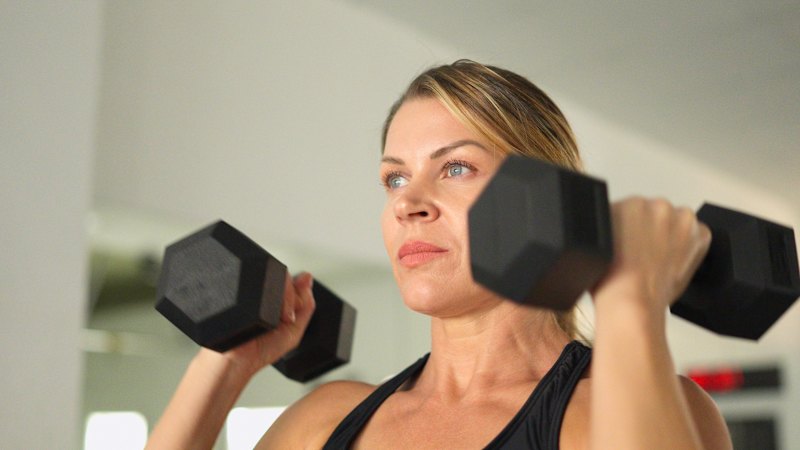
When some women first walk into the gym at The Bone Clinic, their bones are thinning, their bodies are stooped, and they’re often leaning on a walking stick.
asserted
they → walk → stick
“They see people lifting heavy weights and say, ‘I could never do that’.
uncertain
I → see → that
But they do, and it’s not long before they’re standing straighter and carrying their own groceries,” says Professor Belinda Beck from the School of Allied Health, Sport Sciences and Social Work at Griffith University, and director of the Brisbane-based clinic which runs an exercise program to strengthen muscle and bone.
asserted
which → do → muscle
“Frailty isn’t inevitable with age, and it can be reversed.
asserted
it → reverse → age
Our bread and butter is seeing people become functional again.”
asserted
people → see → ?
Frailty might seem a long way off in your 40s, but research from Flinders University has found that almost half of 40- to 49-year-olds have what’s known as “pre-frailty”, meaning they already have signs of poor muscle strength and poor balance.
uncertain
they → seem → strength
You could blame convenience technology, like the computers, remote controls and robot lawn mowers that have stolen so much movement over the last few decades, but it’s more complex than that.
uncertain
it → blame → that
“In our study, pre-frailty was associated with more loneliness, more negative attitudes towards ageing, and having a sense of feeling older than your chronological age,” says researcher Dr Tom Brennan of Flinders University, one of the authors of a 2024 review of interventions to prevent or reverse pre-frailty and frailty.
asserted
Brennan → associate → frailty
“If we want to prevent frailty, we should ask more about what’s happening in someone’s life.
asserted
what → want → life
Do they see changes in their health as something they can work on improving, or something they have to accept as they get older?” he says.
asserted
he → see → something
“But part of the challenge is that people in middle age may think ‘frailty’ has nothing to do with them – talking about maintaining strength, confidence and the ability to keep doing things they enjoy may make prevention feel more relevant.”
Another reason to head off frailty sooner rather than later is new research linking frailty in older adults to a 74 per cent higher dementia risk.
“Muscle is important for so many reasons as you get older.
uncertain
you → think → reasons
If you’re frail, you’re less able to engage in things that help prevent dementia, like physical activity and social interaction.
asserted
that → ’re → activity
If it’s becoming harder to go out, you might not be seeing friends, and we know that social connection is linked to dementia risk,” says Dr Katya Numbers from the UNSW Sydney’s Centre for Healthy Brain Ageing (CHeBA) who did the research into frailty and dementia.
uncertain
who → become → frailty
The effect of muscle loss on the brain may also be playing a part.
uncertain
effect → play → part
When muscles exercise, they produce myokines (substances that help protect the brain), which may be part of why a University of Sydney study found that lifting weights slowed or stopped degeneration in parts of the brain vulnerable to Alzheimer’s.
uncertain
lifting → exercise → Alzheimer
But preventing frailty – now affecting more than 20 per cent of over 65s – isn’t always as simple as urging older people to pick up weights, Numbers says, adding that the CHeBA study also found living alone seemed to compound dementia risk in people who were frail.
asserted
who → prevent → people
“Frail older adults living alone had almost double the risk of dementia compared with robust adults living alone.
asserted
adults → live → adults
We need to look at the whole person.
asserted
We → need → person
You’re not going to sign up for strength training if you’re feeling lonely and miserable.
asserted
you → go → training
”
We should also let older people do things for themselves when they can, says Beck.
asserted
Beck → let → themselves
“Sometimes chivalrous husbands don’t let their wives lift heavy things ‘so they don’t hurt themselves’, but unfortunately this just makes it more likely their wives will become frail and less likely to be able to do things for themselves,” she says.
“If you lose that chivalrous husband or become his carer, suddenly you’ll be the one who has to do the heavy lifting.
asserted
who → let → lifting
Her research at Griffith University into building bone strength is the basis of The Bone Clinic’s program.
asserted
research → build → program
Called ONERO, it combines high-intensity resistance training and impact exercises with balance training.
asserted
it → call → training
It’s supervised by exercise physiologists and available around Australia.
asserted
It → supervise → Australia
“I want to get the program available on the Medicare Benefits Schedule, so that cost isn’t a barrier.
asserted
cost → want → Schedule
If more people could access strength training programs, the effect would be huge – we would have fewer hip fractures, and keep more people out of aged care.
uncertain
we → access → care
Ultimately, it’s about quality of life,” she says.
asserted
she → ’ → life
“The message that frailty isn’t a normal part of ageing and can be prevented needs to target people at all life stages – not just once you’ve crossed the threshold into frailty,” says Dr Coralie Wales who heads Strong Australia, a charity that promotes the importance of maintaining strength.
asserted
that → prevent → strength
“If you lose physical strength, you lose the foundation of a healthy old age and your enjoyment of life.
asserted
you → lose → life
 The Aporia