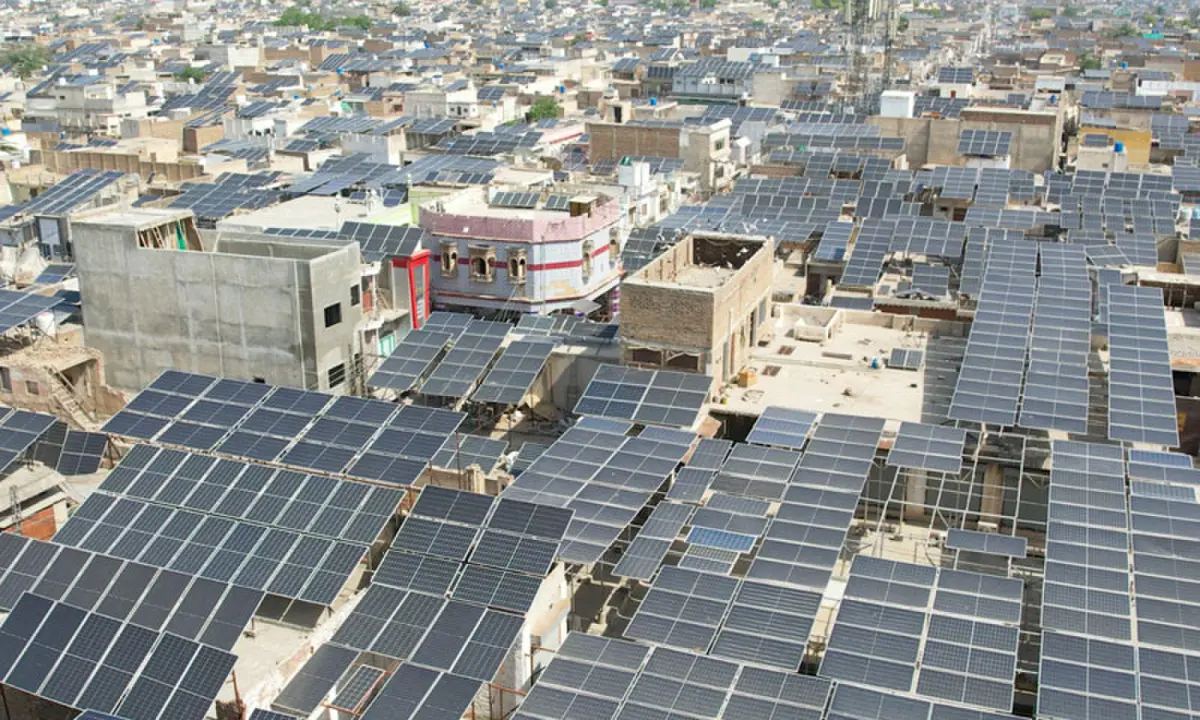
In May 2026, Islamabad-based vlogger Muhammad Mobeen filmed Dera Ismail Khan’s famous Chowgalla, the British-era town centre where four bazaars intersect, using a drone.
uncertain
bazaars → base → drone
The video glides over the crowded bazaars in the heart of Dera Ismail Khan before pulling back to reveal buildings packed tightly together.
asserted
video → glide → buildings
As the camera pulls back, rooftops fill the frame, covered not in the usual clutter of water tanks and laundry lines but in sleek black and blue solar panels, stretching as far as the eye can see.
asserted
eye → pull → panels
The video has garnered roughly a million views and more than 25,000 likes on TikTok alone.
asserted
video → garner → TikTok
Its popularity has spawned a host of copycat videos, with some content creators dubbing the city “Solar Ismail Khan.”
asserted
creators → spawn → city
The city’s urban area covers approximately 40 square kilometres and has a population of roughly 210,000, according to the 2023 census.
uncertain
area → cover → census
Beyond the spectacle of thousands of solar panels covering the city’s rooftops, Dera Ismail Khan’s solar transition is beginning to reshape the local economy.
asserted
transition → cover → economy
It is creating new opportunities while making some traditional trades less viable in this dusty, conflict-affected city in southern Khyber Pakhtunkhwa, roughly 300 kilometres from Peshawar.
asserted
trades → create → Peshawar
From specialised solar markets to farmers abandoning diesel-powered irrigation, an unreliable grid is driving a new economy in Dera Ismail Khan — but not everyone can afford to join it
A SOLAR BOOM
Over the past few years, three specialised solar markets have emerged in the city, at Khushal Market, Bannu Adda and Tank Road.
asserted
markets → abandon → Market
Circular Road alone has up to 70 shops dealing exclusively in solar equipment, serving as a major distribution hub for neighbouring Tank, and Upper and Lower South Waziristan.
asserted
Road → have → Tank
The boom has extended beyond retail, creating work in solar installation, electrical wiring and the supply and maintenance of batteries, tube wells and related equipment.
asserted
boom → extend → batteries
Muhammad Saeed, a local solar appliances dealer, says that, by his estimates, the majority of households in the city have adopted solar power.
asserted
majority → say → power
“Those who installed solar [systems] earlier are now upgrading to lithium batteries as prices fall,” says Saeed.
asserted
Saeed → instal → batteries
The solar transition has also created ancillary jobs in supply chains and logistics, as well as work for solar-panel cleaners and wiring technicians.
asserted
transition → create → cleaners
At the same time, traditional electricians are seeing a decline in conventional electrical-appliances repairs.
asserted
electricians → see → repairs
“If consumers use solar energy instead of grid electricity, there is less need for repairs,” electrician Muhammad Naveed tells Eos.
asserted
Naveed → use → Eos
To supplement his income, Naveed now also takes on jobs involving solar systems, including for tube wells, alongside specialised wiring work.
asserted
Naveed → supplement → work
THE PRICE OF POWER
Saeed and other solar traders say the city’s crippling, year-round power outages are the biggest driver of the transition.
asserted
outages → say → transition
Data from the Peshawar Electric Supply Company (Pesco) show that 43 of the city’s 83 electricity feeders record line losses of at least 80 per cent.
asserted
43 → show → cent
Pesco also identifies widespread electricity theft as a problem in the area.
asserted
Pesco → identify → area
A spokesperson for the power utility tells Eos that such areas may face outages lasting 16 to 18 hours a day.
uncertain
areas → tell → hours
Rising temperatures add to the pressure on residents.
asserted
temperatures → rise → residents
During summer, daytime temperatures in Dera Ismail Khan frequently reach 40–45 degrees Celsius, adding to the incentive to seek alternatives.
asserted
temperatures → reach → alternatives
Dera Ismail Khan’s solar boom is part of a wider shift across Pakistan, driven in part by falling prices for Chinese-made panels and rising electricity tariffs over the past four years.
asserted
boom → drive → years
A report by the UK-based energy think tank Ember, titled The Solarisation of Pakistan’s Energy Economy, estimates that Pakistan’s solar power generation rose by 21 terawatt-hours (TWh) in just two years, taking the total increase to 33 TWh.
asserted
generation → base → TWh
Distributed solar accounted for 28 per cent of Pakistan’s electricity generation in FY25, up from 10 per cent in FY23, the report says.
asserted
report → distribute → FY23
Eight 585-watt panel solar systems have a combined rated capacity of 4.68 kilowatts (kW).
asserted
systems → have → kilowatts
According to local traders, a system of this size can power an air conditioner, refrigerator, lights and fans, with battery storage providing back-up when solar generation is insufficient.
uncertain
generation → accord → up
According to solar trader Ali Jan, an individual panel that sold for Rs75,000 not long ago now costs roughly Rs16,000, following a global glut that drove down solar-panel prices.
uncertain
that → accord → prices
The price per watt has fallen from Rs128 to around Rs28, he says.
asserted
he → fall → Rs28
The cost of an eight-panel set-up fell to around Rs220,000, says Jan, adding that households could recoup the investment within one to two years through savings on electricity.
uncertain
households → fall → electricity
The imposition of general sales tax on solar imports last year, along with geopolitical tensions in the Middle East, has pushed prices back up, Naveed explains.
asserted
Naveed → push → prices
“Today, solar panels sell for up to 32 rupees per watt in Dera Ismail Khan, bringing the cost of an eight-panel installation to approximately 280,000 rupees,” he says.
asserted
he → sell → rupees
THE UNEVEN DIVIDENDS
Dr Aijaz Ahmed has had small solar panels installed at his home and clinic for more than a decade.
asserted
panels → have → decade
“In most months, I do not have to pay for electricity,” he tells Eos.
asserted
he → have → Eos
“At the clinic, too, the electricity bill is a fraction of what it used to be,” he says.
asserted
he → use → what
The savings extend beyond households.
asserted
savings → extend → households
Small industries and commercial enterprises, facing high grid-electricity tariffs and rising fuel costs, have also embraced solar power.
asserted
industries → face → power
One businessman estimates that running a stone-crushing plant on a diesel generator costs up to Rs1.8 million a month.
asserted
running → estimate → million
Converting it to solar would require an initial investment of around Rs10.5 million, he says, which could be recovered in just under three years.
uncertain
which → convert → years
…and 18 more, not listed.
 The Aporia