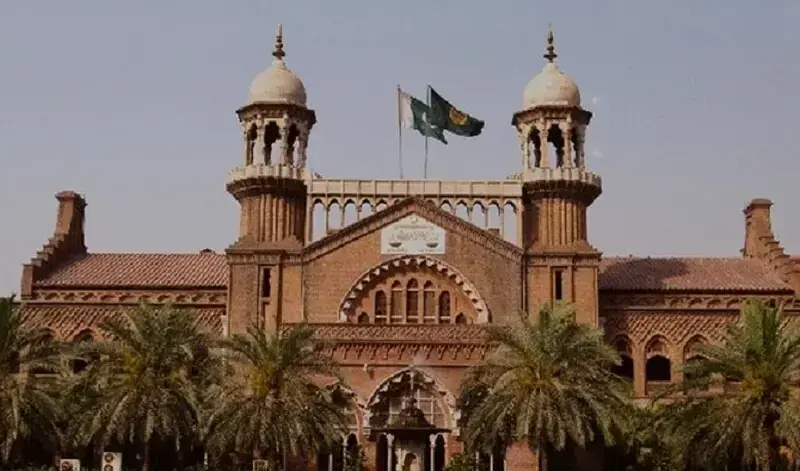
Lahore High court rules against divorce-linked Quran oath

Read the original at Dawn ↗
Cite

Sheikh, W. A. (2026, October 28). Lahore High court rules against divorce-linked Quran oath. Dawn. https://www.dawn.com/news/2040316/lahore-high-court-rules-against-divorce-linked-quran-oath

Dated from the outlet's own feed. Check the original for its byline.

Dawn · collected 2026-10-28 · by Wajih Ahmad Sheikh

Quick Summary

In Lahore, the Lahore High Court ruled on August 24, 2023, that an oath on the Quran with a condition of divorce if proven false is unlawful under Pakistan's Oaths Act, 1873. Justice Anwaar Hussain determined that such conditions violate public policy and are not permissible as they affect third parties. The court allowed Muhammad Azam Khan to withdraw his offer, rejecting Akhtar Khan’s claim that the oath had been accepted unconditionally.
Written locally by qwen2.5:14b on 2026-10-28, using this article's own text rather than the other coverage of the same event (that is the story summary below).

AI analysis runs on qwen2.5:14b, locally

Story summary

The Lahore High Court ruled against a conditional Quranic oath that would have led to divorce if proven false, declaring it unlawful. Justice Anwaar Hussain issued this decision in response to Muhammad Azam Khan’s civil revision case against Akhtar Khan and others. In August 2023, Khan had offered to resolve a dispute through such an oath, but the respondents accepted only on condition that Khan withdrew his divorce clause. When he attempted to withdraw the offer, the appellate court rejected it in September 2023, ruling instead for the Quranic oath to proceed without conditions. Justice Hussain disagreed, stating that since the petitioner never fully assented to the altered arrangement and had withdrawn his offer before acceptance of all terms, a binding agreement did not exist.

Written for “Lahore High Court Divorce Ruling” on 2026-10-28, grounded in this article and the 0 other(s) covering the same event.
Why this leaning score
This article does not take a side on a contested political question, so it has no leaning score. That is an answer rather than a gap: a match report or a rescue can be warmly or critically written without being left or right, and scoring it anyway is how approval of a subject gets recorded as a political position.
No political leaning scored for article 111212 · logged 2026-10-28

Story

📰 Lahore High Court Divorce Ruling
Crime & Law · 1 article(s) covering the same event.

Compared with similar articles

Nothing to compare against. No article is close enough to this one for the pipeline to have linked or judged the pair.
How this article was measured signals, leaning charts, publisher record, byline, topics and claims

Signals How these are calculated →

Claims extracted
16
sentences that state something as happening or true
Uncertain
6%
1 of 16 hedged ("reportedly", "may", "according to")
Leaning
not political
takes no side on a contested political question
Publisher signals
72/100
Dawn's corrections and hedging, across everything collected from it. Not a measure of accuracy.
Outlets on this story
1
Crime & Law
Same framing elsewhere
1
articles that frame the event the way this one does
Analyzed 2026-10-28 · how these are computed

How this is being covered How these are calculated →

Article leaning vs. publisher reliability
Source leaning vs. consistency

Publisher

Dawn · 2330 article(s) · 3 correction(s) detected
Running correction rate · 3 correction(s)

Who wrote this

Wajih Ahmad Sheikh
28 article(s) here · 1 carrying a prediction
🔮 During a pending appeal before an appellate court, the petitioner had offered in August 2023 to have the matter decided by an oath on the Holy Quran taken by the opposing side, with a condition that the oath-taker’s wife would stand divorced if the oath proved false.
🔮 The chief minister declared that she stood “firmly with the oppressed, regardless of how powerful their oppressors may be”.
🔮 The judge, however, observed that the official could not be summoned as he had not been made a party to the petition.
🔮 The tribunal said a detailed judgment would be issued separately.
🔮 An anti-terrorism court (ATC) on Thursday extended the physical remand of PTI leader Hammad Azhar by 12 days in the Jinnah House attack case related to the May 9 riots.
🔮 The counsel further requested the court to summon the Lahore Capital City Police Officer and the deputy commissioner in person, arguing that their appearance would help clarify the circumstances surrounding the detention notifications.
🔮 Justice Khan asked the counsel to specify the items required, observing that only items ordered by the court would be allowed into the jail.
🔮 “I had a plan to visit Skardu, but I could not go there because I was alone,” she said.
Also by Wajih Ahmad Sheikh
Nothing else under this byline is closely related to this article, so these are simply their most recent.
All 28 articles by Wajih Ahmad Sheikh →

Topics

LAHORE Section 8 The Lahore High Court the 1873 Act the Oaths Act,

Subjects

Hussain PERSON · 2× Akhtar Khan PERSON · 1× Anwaar Hussain PERSON · 1× Awais Arshad PERSON · 1× Dawn ORG · 1× LAHORE GPE · 1× Muhammad Azam Khan PERSON · 1× Pakistan GPE · 1× The Lahore High Court ORG · 1×

Narrative

He said acceptance does not automatically follow an offer and, in the present case, where the petitioner expressed his intention to withdraw the offer during the same proceedings in which the respondents conveyed their acceptance, it cannot be presumed that a concluded agreement had come into existence. Justice Hussain ruled that a court cannot strike out an objectionable condition and enforce the rest against a party who never assented to the altered arrangement. The judge also found that the order sheet of the relevant hearing did not establish whether the petitioner’s refusal came before or after the respondents’ willingness.
framing: assertive · carried by 1 article(s) · first seen 2026-10-28
🔮 During a pending appeal before an appellate court, the petitioner had offered in August 2023 to have the matter decided by an oath on the Holy Quran taken by the opposing side, with a condition that the oath-taker’s wife would stand divorced if the oath proved false.
2026-10-28 · Dawn
Lahore High court rules against divorce-linked Quran oath · assertive framing

Claims (16 extracted, 1 hedged)

The Lahore High Court has held that an offer to settle a civil dispute through a “special oath” on the Holy Quran, coupled with a condition of divorce if the oath is false, is not a lawful offer. asserted
oath → hold → divorce
Justice Anwaar Hussain issued the ruling allowing a civil revision filed by Muhammad Azam Khan against Akhtar Khan and others. asserted
Hussain → issue → Khan
During a pending appeal before an appellate court, the petitioner had offered in August 2023 to have the matter decided by an oath on the Holy Quran taken by the opposing side, with a condition that the oath-taker’s wife would stand divorced if the oath proved false. asserted
oath → pende → condition
On Aug 22, the respondents appeared before the appellate court and expressed willingness to take the oath, while the petitioner said he did not wish to proceed. asserted
he → appear → oath
Says divorce clause renders special oath offer unlawful; sets aside order refusing withdrawal of special oath offer He formally applied to withdraw the offer on Aug 24, when the respondents accepted the oath but rejected the divorce condition. asserted
respondents → say → condition
The appellate court dismissed his withdrawal application in September 2023, ruling that the offer had been accepted. It also directed that the oath be taken on the Holy Quran alone, holding the divorce stipulation contrary to public policy. asserted
stipulation → dismiss → policy
Justice Hussain held that the appellate court erred. asserted
court → hold → ?
He maintained a special oath is not a mere private contract but a procedure governed by the Oaths Act, 1873. asserted
oath → maintain → Act
Section 8 of the Act permits only oaths that are not repugnant to justice or decency and do not affect any third person. asserted
that → permit → person
A condition tying a perjury penalty to the oath-taker’s wife’s divorce violated both limits, the judge said. asserted
judge → tie → limits
The judge noted that, even if the offer was valid, the respondents’ reply was not absolute. asserted
reply → note → ?
Assisting the court as amicus curiae, Barrister Awais Arshad, submitted that an offer for special oath must be examined not only under the 1873 Act, but also in the light of the principles governing offer, acceptance and revocation under the Contract Act, 1872. asserted
offer → assist → Act
He said acceptance does not automatically follow an offer and, in the present case, where the petitioner expressed his intention to withdraw the offer during the same proceedings in which the respondents conveyed their acceptance, it cannot be presumed that a concluded agreement had come into existence. Justice Hussain ruled that a court cannot strike out an objectionable condition and enforce the rest against a party who never assented to the altered arrangement. The judge also found that the order sheet of the relevant hearing did not establish whether the petitioner’s refusal came before or after the respondents’ willingness. asserted
refusal → say → willingness
He further noted that a claim that one respondent had travelled from abroad specifically for the oath collapsed when his passport was summoned and the counsel acknowledged he was already in Pakistan. uncertain
he → note → Pakistan
The judge allowed the petition and set aside the appellate court’s order that had refused to let the petitioner withdraw the offer. asserted
petitioner → allow → offer
The judge directed the appellate court to decide the appeal on its merits without treating the proposed oath as binding on the petitioner. asserted
judge → direct → petitioner

💬Give feedback
🕘History 🎫Support