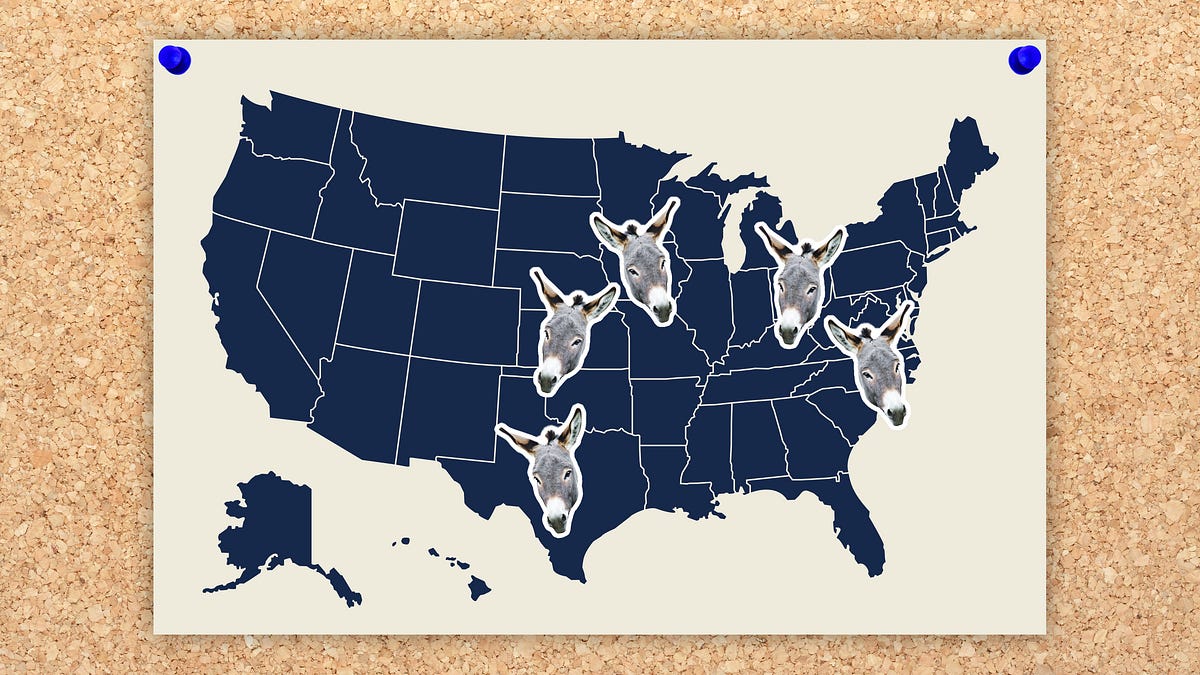
Whichever metaphor one prefers – landslide, earthquake, wave – it seems increasingly like the Democrats can expect a significant victory in the midterms.
asserted
Democrats → prefer → midterms
As the joke goes, every gas station display of prices has become an ad for Democrats; what’s more, some of them have managed to connect the relatively abstract issue of corruption to the daily misery of many Americans.
But, in the end, no election outcome ever interprets itself; Democrats should not rest content with the conclusion that only what moderate leaders (and consultants) like to call kitchen table issues really mattered.
asserted
like → go → issues
They have a historic opportunity to dislodge the image of the Republicans as the party of national security and the party best trusted with the economy.
asserted
They → have → economy
After 2024, Republicans massively benefited from elite actors – Silicon Valley oligarchs, no less than many journalists – reading a globally important “vibe shift” into the presidential election outcome; we now know that what political scientists politely call “low-information voters” were simply fed up with inflation, as opposed to a large majority thirsting for a far-right agenda.
But Trumpists turned the perception to their advantage; and to be sure, successful politicians are entitled to interpret a vote as they see fit.
asserted
they → benefit → vote
Democrats could stay relatively timid and read the outcome as simply a rejection of Donald Trump and the most egregious elements of his misrule since January 2025; they certainly should make the point that the spectacular cruelty of ICE and the incitement to hatred in which Stephen Miller and JD Vance regularly engage is deeply unpopular with the public.
uncertain
Miller → stay → public
But it would be a mistake to see the outcome as only a referendum on Trumpism.
asserted
it → see → Trumpism
True, the US president’s catastrophic record in foreign policy is partly explained by conduct the old Republican establishment could never have imagined: recklessly alienating allies, with the result that the US may never be trusted by Nato countries again; massively destroying soft power by mistreating foreign students and undermining the capacity of American universities to attract talent internationally; blatant interference in elections to favor the global far right.
uncertain
US → explain → right
But the Iran war shows continuities with the George W Bush era that neoconservatives probably find uncomfortable to contemplate: an inability to think strategically and an apparent indifference to loss of human life.
asserted
neoconservatives → show → life
In fact, a line can be drawn from the torture memos to the murders at sea and the plans for a public execution under the US secretary of defense, Pete Hegseth.
asserted
line → draw → defense
Yet the Republican party still lives off an image that the party of Ronald Reagan is supremely competent in matters of national security.
asserted
party → live → security
The right response is not that Democrats should not enter a competition of how often they can use the word “lethality” in one sentence; they should simply point out how shameful it is that Republicans, some murmuring on the part of has-beens like Thom Tillis aside, have betrayed Ukraine; how damaging the loss of bases in the Middle East will turn out to be; and that, from the very beginning of Trump 2.0, it was a sign of deep unseriousness to put a second-rate TV host in charge of the world’s most powerful military force.
asserted
it → enter → force
There might be monuments to both Trump and Hegseth in Moscow and Beijing one day; after all, they effectively capitulated to the former and sped up the rise of the latter.
uncertain
they → capitulate → latter
The Republican party has also long benefited from the notion that, as the party of business, they are best qualified to boost the economy (no doubt, some low-information voters still buy into the myth of Trump as the great entrepreneur).
asserted
voters → benefit → entrepreneur
The actual record has long shown something different: not just when it comes to Trump and his string of bankruptcies, but for the party as a whole.
asserted
it → show → whole
Since Trump engaged in policies so irrational and damaging that the old Republican establishment would never have contemplated them – tariffs being the obvious example – it is again easy to overlook continuities.
asserted
it → engage → continuities
The party that claims to be deeply concerned about debt and deficits (one of Elon Musk’s disingenuous justifications for Doge’s chainsaw massacres) has given us Reagan, Bush and Trump – all of whom managed massively to increase the national debt.
uncertain
all → claim → debt
The reason is, of course, that they pushed through enormous tax cuts that overwhelmingly benefited the wealthy.
asserted
that → push → wealthy
In the postwar period, economic growth, job creation and even stock market returns have on the whole been higher under Democratic administrations; it just seems that average gains are not enough for the uber-wealthy, who can buy themselves tax cuts by donating massively to Republicans.
asserted
who → seem → Republicans
Needless to say, as soon as Democrats are in charge, Republicans discover that the very debt they were instrumental in causing constitutes a national crisis and requires deep cuts to social security.
asserted
they → say → security
Conventional wisdom has it that the Biden administration overreached: too woke, too ambitious a Green New Deal, too harsh in its criticisms of Maga Republicans (with the next claim usually being that such overreach made a “backlash” inevitable and, so the implication goes, at least somewhat legitimate).
But what if the opposite is true?
uncertain
opposite → have → Republicans
What if Joe Biden’s mistake was to assume that there were still many Republicans who cared about policy – as opposed to endless culture war performance a la Hegseth – and long-term success for the country?
asserted
who → assume → country
What if Democrats seized the opportunity to discredit their opponents in the way Franklin D Roosevelt made the most of the Great Depression (as opposed to pining for bipartisanship); what if they showed people that all the Republicans who will soon be running away from Trump were not just complicit in the misrule, but that the misrule has been part of a larger story predating Trump?
asserted
misrule → seize → Trump
 The Aporia