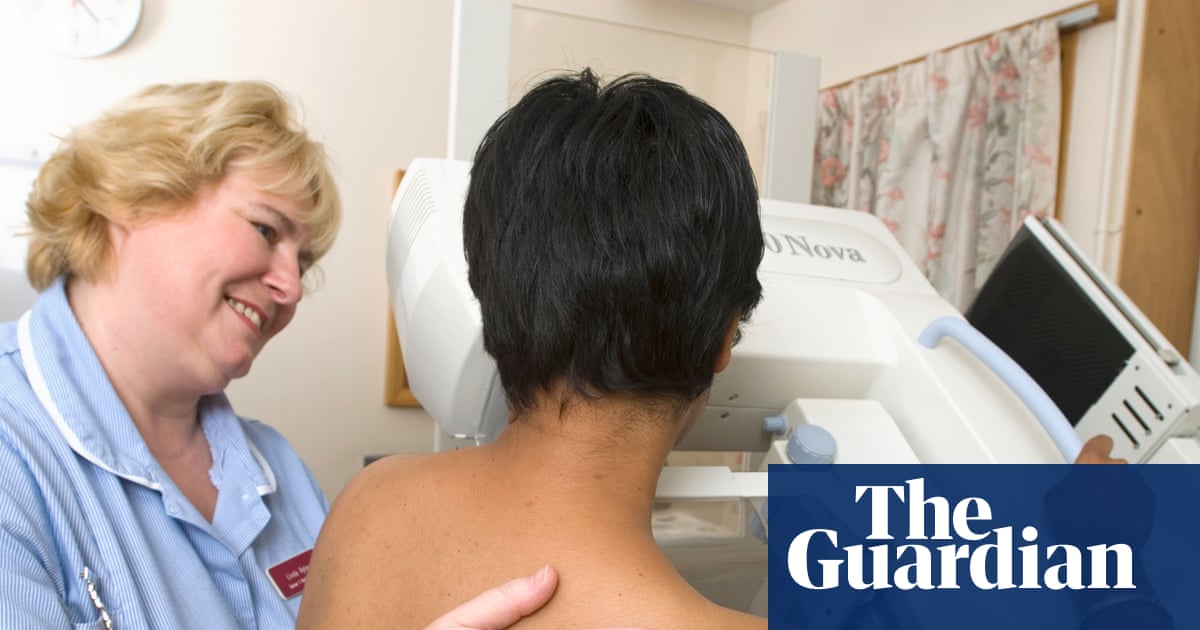
Ethnic minorities in England less likely to get breast cancer diagnosis from routine screening

Read the original at The Guardian ↗
Cite

Health, T. T., & correspondent, i. (2026, October 25). Ethnic minorities in England less likely to get breast cancer diagnosis from routine screening. The Guardian. https://www.theguardian.com/society/2026/oct/25/ethnic-minorities-england-breast-cancer-screening-disparity

Dated from the outlet's own feed. Check the original for its byline.

The Guardian · collected 2026-10-25 · by Tobi Thomas Health, inequalities correspondent

Quick Summary

Academics at the University of Surrey found that people from minority ethnic backgrounds in England are up to 33% less likely to be diagnosed with breast cancer through routine screening compared to other groups. The study, funded by Breast Cancer Now and based on data from 86,564 adults diagnosed between 2009 and 2019, also showed these individuals were up to 37% more likely to receive an emergency diagnosis. Manveet Basra of Breast Cancer Now highlighted that such disparities impact survival rates and emphasized the need for targeted efforts to address barriers faced by marginalized groups in accessing breast cancer screening and treatment.
Written locally by qwen2.5:14b on 2026-10-25, using this article's own text rather than the other coverage of the same event (that is the story summary below).

AI analysis runs on qwen2.5:14b, locally

Story summary

Summary unavailable.

Written for “Breast Cancer Screening Disparities” on 2026-10-25, grounded in this article and the 0 other(s) covering the same event.
Why this leaning score
The article's own words the score was based on. Each is quoted verbatim and was checked against the article text before being stored, so you can find it in the original.
Reading Leans strongly left (beta estimate) Confidence medium
Leaning: leans strongly left for article 105831 (medium confidence, 2 verified quotes) · logged 2026-10-25

Story

📰 Breast Cancer Screening Disparities
Health · 1 article(s) covering the same event.

Compared with similar articles

Nothing to compare against. No article is close enough to this one for the pipeline to have linked or judged the pair.
How this article was measured signals, leaning charts, publisher record, byline, topics and claims

Signals How these are calculated →

Claims extracted
18
sentences that state something as happening or true
Uncertain
22%
4 of 18 hedged ("reportedly", "may", "according to")
Leaning
Leans strongly left
of the writing, not the subject · beta estimate
Publisher signals
66/100
The Guardian's corrections and hedging, across everything collected from it. Not a measure of accuracy.
Outlets on this story
1
Health
Same framing elsewhere
1
articles that frame the event the way this one does
Analyzed 2026-10-25 · how these are computed

How this is being covered How these are calculated →

Article leaning vs. publisher reliability
Source leaning vs. consistency

Publisher

The Guardian · 2428 article(s) · 6 correction(s) detected
Running correction rate · 6 correction(s)

Who wrote this

Tobi Thomas Health
7 article(s) here · 1 carrying a prediction
🔮 Basra added: “This research helps us understand who is less likely to be diagnosed with breast cancer via screening, [who] might wait longer to get diagnosed or experience delays in treatment, and knowing what barriers they face enables us to work towards eliminating them.
🔮 Some conservative states that have rejected hardship exemptions for the new Medicaid requirements may be choosing not to due to political reasons, experts say.
🔮 The county at the center of Pennsylvania’s measles outbreak is at a clear disadvantage because, local officials say, it lacks its own health department and it will now get special assistance from the Centers for Disease Control and Prevention (CDC).
🔮 The bill, which will fully come into effect in the new year, will result in many adults covered through Medicaid having to meet new work requirements and being subject to more frequent eligibility checks, while there will be less federal funding for states for Medicaid.
🔮 We’re operating with the assumption that the disease may jump and spread to non-Plain [Amish] community members.
🔮 “And these rural hospitals may be less likely to have access to these therapies”.
🔮 Kate Brintworth, the chief midwifery officer for NHS England, said: “All staff working in NHS maternity and neonatal services are committed to ensuring that any disclosure of domestic abuse will be met with compassion, sensitivity and clear options for support.
Also by Tobi Thomas Health
Nothing else under this byline is closely related to this article, so these are simply their most recent.
All 7 articles by Tobi Thomas Health →
inequalities correspondent
8 article(s) here · 1 carrying a prediction
🔮 Basra added: “This research helps us understand who is less likely to be diagnosed with breast cancer via screening, [who] might wait longer to get diagnosed or experience delays in treatment, and knowing what barriers they face enables us to work towards eliminating them.
🔮 Some conservative states that have rejected hardship exemptions for the new Medicaid requirements may be choosing not to due to political reasons, experts say.
🔮 The county at the center of Pennsylvania’s measles outbreak is at a clear disadvantage because, local officials say, it lacks its own health department and it will now get special assistance from the Centers for Disease Control and Prevention (CDC).
🔮 The bill, which will fully come into effect in the new year, will result in many adults covered through Medicaid having to meet new work requirements and being subject to more frequent eligibility checks, while there will be less federal funding for states for Medicaid.
🔮 We’re operating with the assumption that the disease may jump and spread to non-Plain [Amish] community members.
🔮 “And these rural hospitals may be less likely to have access to these therapies”.
🔮 At the World Health Assembly in May, Mahama said Ghana lost $78m following the closure of USAID programs which affected maternal healthcare, the treatment of malaria, nutrition and HIV/Aids interventions.
🔮 Kate Brintworth, the chief midwifery officer for NHS England, said: “All staff working in NHS maternity and neonatal services are committed to ensuring that any disclosure of domestic abuse will be met with compassion, sensitivity and clear options for support.
Also by inequalities correspondent
Nothing else under this byline is closely related to this article, so these are simply their most recent.
All 8 articles by inequalities correspondent →

Topics

Asian Breast Cancer Now England NHS the University of Surrey

Subjects

Breast Cancer Now ORG · 2× England GPE · 2× the University of Surrey ORG · 2× Asian NORP · 1× Basra PERSON · 1× Manveet Basra PERSON · 1× NHS ORG · 1× QualityWatch ORG · 1× the Health Foundation ORG · 1× the Nuffield Trust ORG · 1×

Narrative

“Determined to improve breast cancer care and survival rates outcomes, we’re funding world-class research that actively identifies and addresses inequities, working with policymakers to improve equal access to screening, and ensuring our information, campaigns and life-changing support services reflect the diverse needs of everyone affected by this devastating disease.”
framing: mixed · carried by 1 article(s) · first seen 2026-10-25
🔮 Basra added: “This research helps us understand who is less likely to be diagnosed with breast cancer via screening, [who] might wait longer to get diagnosed or experience delays in treatment, and knowing what barriers they face enables us to work towards eliminating them.

Claims (18 extracted, 4 hedged)

People from minority ethnic backgrounds in England are up to a third less likely to be diagnosed with breast cancer via routine screening, and are more likely to be diagnosed in an emergency setting, analysis has found. asserted
analysis → diagnose → setting
The research, carried out by academics at the University of Surrey and funded by the charity Breast Cancer Now, involved analysis of 86,564 adults diagnosed with the disease between 2009 and 2019, from the Clinical Practice Research Datalink and the Cancer Registration Tumour and Treatment datasets. asserted
research → carry → Datalink
The analysis found that people from Black, Asian and mixed backgrounds, alongside people from deprived backgrounds, were up to 33% less likely to be diagnosed with breast cancer via screening, while these groups were also up to 31% more likely to be diagnosed via urgent suspected cancer referral, and up to 37% more likely to be diagnosed via emergency presentation. asserted
groups → find → presentation
Manveet Basra, the associate director of public health, inclusion and awareness at Breast Cancer Now, said the analysis revealed that people from marginalised groups “face inequalities at every stage of their breast cancer experience, and tragically this impacts their survival rates”. asserted
this → say → rates
Basra added: “This research helps us understand who is less likely to be diagnosed with breast cancer via screening, [who] might wait longer to get diagnosed or experience delays in treatment, and knowing what barriers they face enables us to work towards eliminating them. uncertain
they → add → them
“Determined to improve breast cancer care and survival rates outcomes, we’re funding world-class research that actively identifies and addresses inequities, working with policymakers to improve equal access to screening, and ensuring our information, campaigns and life-changing support services reflect the diverse needs of everyone affected by this devastating disease.” asserted
information → improve → disease
It accounts for about one in four cases of cancer and is one of the leading causes of death in women under 50. asserted
It → account → 50
Identifying women at higher risk early can pave the way for additional screening or preventive treatment. asserted
Identifying → identify → screening
The research also revealed that people living with a learning disability faced poorer cancer outcomes: their time to diagnosis was 18% longer than people without a learning disability, and they faced a 10% longer wait time for treatment. asserted
they → reveal → treatment
This research adds to existing evidence of the unequal outcomes people from marginalised backgrounds face in regards to cancer. asserted
people → add → cancer
A previous study showed that ethnic minorities required more visits to GPs than other people before being diagnosed with cancer. asserted
minorities → show → cancer
On average, one in five people across England require three or more GP interactions before being diagnosed with cancer. asserted
people → require → cancer
But for people from ethnic minority backgrounds, the figure rises to one in three, according to analysis of the NHS cancer patient experience 2022 survey by QualityWatch, a joint programme from the Nuffield Trust and the Health Foundation. uncertain
figure → rise → Trust
Research from the UK Health Security Agency has also suggested that young black women are more likely to have aggressive breast cancer tumours, experience poorer care and have higher mortality rates, but are significantly under-represented in clinical research. uncertain
women → suggest → research
Dr Rob Kerrison, an associate professor of cancer care and co-lead of the cancer care expert group at the University of Surrey and the lead investigator of this study, said: “We know that some groups of women in the UK have poorer breast cancer survival than others, but until now we have had only a limited understanding of why. asserted
we → say → why
Our findings suggest that inequalities in access to screening and timely treatment may be part of the explanation. uncertain
inequalities → suggest → explanation
“Women from a range of disadvantaged and under-served groups were less likely to have their cancer detected through screening and often waited longer to start treatment. asserted
cancer → serve → treatment
If we are serious about improving breast cancer outcomes, we need to ensure that everyone can access screening and receive prompt treatment, regardless of their background or circumstances.” asserted
everyone → improve → background

💬Give feedback
🕘History 🎫Support