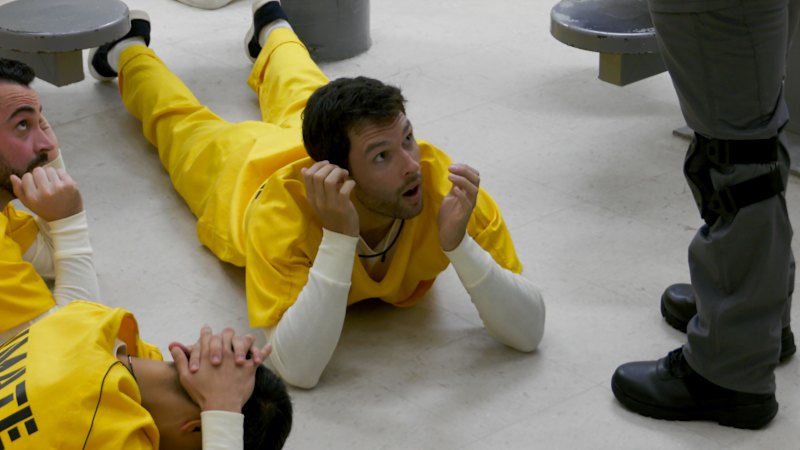
Netflix viewers have been left in shock by The New Stanford Prison Experiment, a recreation of the controversial 1971 psychological study.
asserted
viewers → leave → study
The original experiment split 24 male American college students into two groups of 12 – inmates and guards – but the abuse handed out by the guards was so brutal that the study had to be terminated after just six days.
asserted
study → split → days
Netflix's six-part series re-stages the experiment with 30 participants – eight guards and 22 inmates – to answer the original’s central question: Does power corrupt?
asserted
power → re → question
The streamer has defended the show by insisting there were several guardrails in place to protect participants, but that hasn't stopped the outrage.
asserted
that → defend → outrage
USA Today described the series as 'depraved', adding: 'Stanford pretends to be some kind of revolutionary experiment out to find some universal truth about humanity, but it is no different than The Traitors in prison jumpsuits.'
asserted
it → describe → jumpsuits
The Guardian branded the series 'insulting', stating: 'This rehash of the notorious study in which volunteers role-play as prisoners and guards pretends to be science.
asserted
volunteers → brand → prisoners
It isn’t – it’s patronising reality television.
asserted
it → ’ → ?
Meanwhile, the Sydney Morning Herald called it 'repellent', yet added 'It’s also one of the most thought-provoking shows I’ve seen.'
asserted
I → call → shows
As The New Stanford Prison Experiment airs – we take a look at some of the wild and eyebrow-raising shows that would NEVER be made now...
asserted
that → air → shows
As The New Stanford Prison Experiment (seen) airs - we take a look at some of the wild and eyebrow-raising shows that would NEVER be made now...
Susunu!
asserted
that → see → shows
The 1998 Japanese show Susunu! Denpa Shonen, or Do Not Proceed, Crazy Youth, saw a contestant stripped naked, starved and locked up alone for a year.
asserted
contestant → proceed → year
Aspiring comedian Tomoaki Hamatsu, then 22, was stripped of all his belongings and clothes and left alone with nothing but stacks of magazines, postcards, water, electricity and heating – while being tasked with entering mail-in magazine competitions until he won one million yen (around £6,000).
asserted
he → strip → yen
Tomoaki - who never signed a contract - was told he could leave at any time, but he decided to persist to complete the challenge, staying for a total of 15 months.
uncertain
he → sign → months
He thought the footage would be aired on TV at a later date – but what he did not know was it was actually being broadcast live to around 17 million people per week.
asserted
it → think → week
Not only did he have to accrue prize money from the magazine competitions, he had to win everything he needed to survive too – including food, clothing and toilet roll.
asserted
he → have → food
He ate undignified meals such as 5kg of uncooked rice, before he was forced to resort to eating wet dog food on day 80.
asserted
he → eat → day
Tomoaki's mental state got to the point that he admitted he wished for death – but he tried to stay sane by writing diaries, dancing and playing games.
asserted
he → get → games
The 1998 Japanese show Susunu! Denpa Shonen, or Do Not Proceed, Crazy Youth, saw a contestant stripped naked, starved and locked up alone for a year
Aspiring comedian Tomoaki Hamatsu, then 22, was stripped of all his belongings while being tasked with entering mail-in magazine competitions until he won one million yen (around £6k)
The live stream of his endeavours was one segment, dubbed A Life In Prizes, of the larger programme, which saw lots of ordinary people take on crazy tasks.
asserted
lots → proceed → tasks
In an interview with The Sun, he said: 'The loneliness affected me much more than not being able to eat or not having clothes.
asserted
loneliness → say → clothes
'There were so many moments where I thought it probably would be better to die now than keep going.
asserted
it → be → ?
The toughest moment was when the rice ran out and I needed to face up to eating dog food.
asserted
I → run → food
I didn't want to eat it but there was no alternative.'
asserted
I → want → it
Tomoaki admitted that he was in 'such emotional turmoil that I couldn't sleep' and at points even hallucinated to the extent he believed he had been 'abducted by aliens'.
asserted
he → admit → aliens
In his diaries, he wrote: 'I don't have enough nutrition going to my brain.
asserted
nutrition → write → brain
Being driven to the edge has brought out a madness in me.'
asserted
driven → drive → me
When he finally reached the number of winnings needed, Nasubi was eventually freed – but producers soon conned him into returning to the hellish experience.
asserted
producers → reach → experience
He was flown to what he thought was a celebratory trip to Korea – where the producers worked for three hours to convince him to go through the process again.
asserted
producers → fly → process
Tomoaki pleaded: 'I thought my life was over.
asserted
life → plead → ?
So many times I wanted to die.'
asserted
I → want → ?
He ended up competing for several more weeks, taking him to 434 days in isolation.
asserted
He → end → isolation
The contestant then returned to Japan, where he entered another apartment and stripped naked, thinking he was about to be subjected to the same turmoil again.
asserted
he → return → turmoil
But the walls then collapsed to reveal a TV studio with a live audience of fans, with him becoming aware for the first time that his ordeal had been seen by millions.
asserted
ordeal → collapse → millions
He had become an icon during his long ordeal, with the Truman Show-esque programme poking fun at him with slapstick noises and suggestive censoring.
'Without his knowledge or consent', as the BBC iPlayer synopsis explains, 'Nasubi became the most famous television personality in Japan.'
As well as the record-breaking viewing figures, his diaries from inside also became a best-seller.
asserted
diaries → become → inside
There's Something About Miriam
There's Something About Miriam saw six 'typical lads' - Tom Rooke, Toby Green, Scott Gibson, Aron Lane, Dominic Conway and Mark Dimino - compete to woo Mexican model Miriam Rivera
However, the cruel twist of the show was that the contestants weren't told that Miriam (pictured) was transgender and hadn't undergone gender-affirming surgery
There's Something About Miriam was one of the most controversial reality TV shows of the early 2000s.
The 2004 Sky One show saw six 'typical lads' enter a dating contest to woo Mexican model Miriam Rivera for a £10,000 prize and romantic yacht trip.
However, the cruel twist of the show was that the contestants weren't told that Miriam was transgender and hadn't undergone gender-affirming surgery until after the winner was announced – and after the men had flirted with her and even filmed intimate scenes together.
asserted
men → be → scenes
Despite being promised the 'adventure of a lifetime', the boys sued the show and prevented it from airing, eventually settling for an amount rumoured to be around £500,000.
asserted
boys → promise → amount
The dating show and its impact have since been explored in a Channel 4 documentary Miriam: Death Of A Reality star, which explores the life and tragic death of Miriam Rivera.
asserted
which → explore → Rivera
Miriam passed away in Mexico in 2019 aged just 38, and her death was ruled a suicide by the authorities – although her husband Daniel Cuervo has always insisted she was murdered.
asserted
she → pass → authorities
The fates of the six young men are less well known – and most hoped to fade from the spotlight after feeling 'duped' by TV executives and the world of fame.
asserted
most → know → fame
But the others have gone on to forge interesting careers since the show, with winner Tom Rooke – then a lifeguard – branching out into acting, while one even dated Kerry Katona.
asserted
one → go → Katona
Fat Families
Sky One's Fat Families was hosted by 'former fatty' Steve Miller and saw him mock the participants until they lost weight (pictured with contestants Toni and Neil Blackholly)
asserted
they → host → contestants
…and 125 more, not listed.
 The Aporia