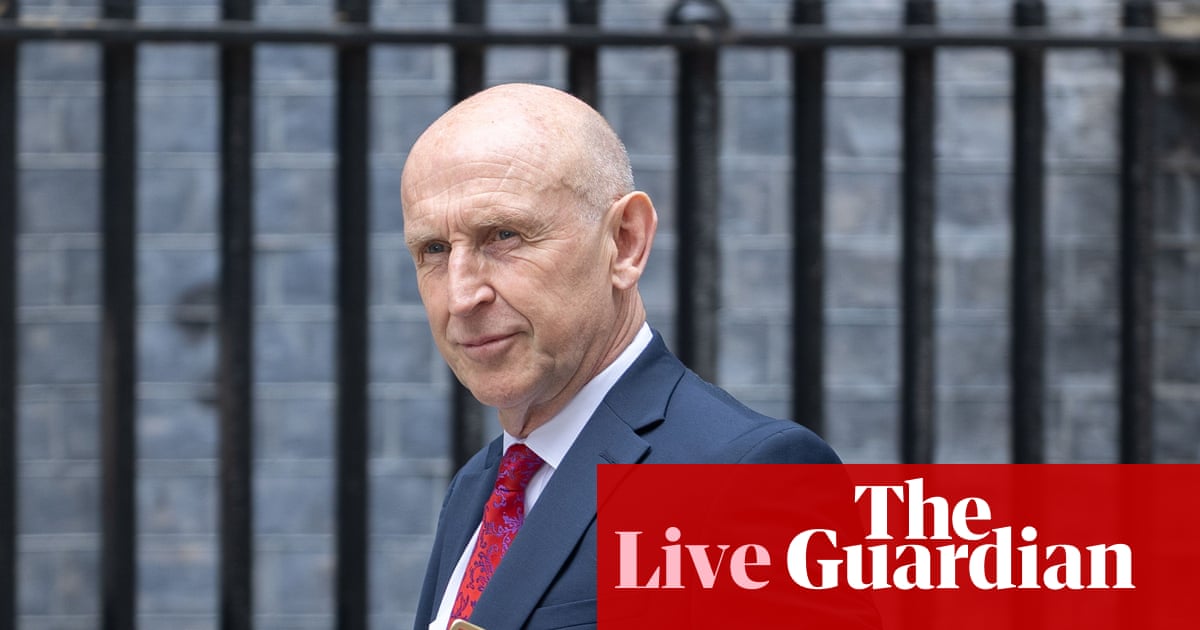
The Budget: What will be in it? What might be in it? What can be ruled out?

Read the original at Evening Standard ↗
Cite

Lynch, D. (2026, October 23). The Budget: What will be in it? What might be in it? What can be ruled out? Evening Standard. https://www.standard.co.uk/business/business-news/john-healey-budget-b1302131.html

Dated from the outlet's own feed. Check the original for its byline.

Evening Standard · collected 2026-10-23 · by David Lynch analysis

Quick Summary

John Healey will present his first Budget as Chancellor on October 28 amid economic challenges exacerbated by the Iran war. The Press Association reports that while details are scarce due to heightened security measures, expectations suggest a cautious approach rather than radical changes. With borrowing costs elevated because of the conflict, fiscal headroom is expected to be reduced, potentially impacting lenders' and investors' confidence in the UK economy. Additionally, Healey will address spending pressures caused by inflation and outline plans to support households and businesses through commitments like cutting VAT on energy bills and reducing business rates for certain venues.
Written locally by qwen2.5:14b on 2026-10-23, using this article's own text rather than the other coverage of the same event (that is the story summary below).

AI analysis runs on qwen2.5:14b, locally

Story summary

John Healey will deliver his first Budget as Chancellor on October 28, 2026, in a challenging economic environment worsened by the Iran war. The Press Association reports that Healey is not expected to introduce radical changes or propose significant military investments beyond those already planned. Instead, he aims for stability with a "steady as she goes" approach, focusing on managing government costs and borrowing expenses rather than making dramatic fiscal shifts. This cautious strategy reflects the current economic uncertainty and the need to maintain financial stability amidst geopolitical tensions.

Written for “The Budget Overview” on 2026-10-23, grounded in this article and the 0 other(s) covering the same event.
Why this leaning score
This article does not take a side on a contested political question, so it has no leaning score. That is an answer rather than a gap: a match report or a rescue can be warmly or critically written without being left or right, and scoring it anyway is how approval of a subject gets recorded as a political position.
No political leaning scored for article 102265 · logged 2026-10-23

Story

📰 The Budget Overview
Economy/Business · 1 article(s) covering the same event.

Compared with similar articles

This article reads unscored and hedges 21% of its claims. Each row says how that neighbour differs.
The Guardian
⚖️ Leans strongly right 🔴 8% hedged 3 of 36 📰 publisher trust 66
“The articles describe different points in time leading up to Chancellor John Healey's budget announcement, not the same specific incident.”
Evening Standard
⚖️ Leans right 🔴 12% hedged 2 of 16 📰 publisher trust 65
“Article A describes specific plans announced by Healey to cut paperwork for businesses, while Article B discusses speculation and expectations ahead of an upcoming budget speech, not the same specific occurrence.”
BBC News
⚖️ leaning not scored 🔴 0% hedged 0 of 15 📰 publisher trust 69
“Article A reports on a specific announcement by the chancellor about cutting paperwork, while Article B discusses expectations for the upcoming Budget speech without focusing on the same specific announcement.”
Daily Mail
⚖️ Leans left 🔴 29% hedged 7 of 24 📰 publisher trust 64
“The articles discuss different aspects of the upcoming Budget, with Article A focusing on a specific warning regarding energy assistance for poor benefits claimants and Article B providing an overview of what might be included in the Budget.”
Evening Standard
⚖️ Leans right 🔴 0% hedged 0 of 7 📰 publisher trust 65
“Article A reports on John Healey rejecting calls to raise capital gains tax specifically for an upcoming Budget, while Article B discusses expectations and speculation about what will be included in Healey's first Budget speech without mentioning the rejection of raising capital gains tax.”
Daily Mail
⚖️ leaning not scored 🔴 9% hedged 2 of 23 📰 publisher trust 64
“Article A focuses on the influence of unions on the Chancellor's decisions, while Article B discusses expectations and speculations for the upcoming Budget speech.”
The Guardian · 0.86 cosine similarity
⚖️ Leans strongly right 🔴 3% hedged 1 of 29 📰 publisher trust 66
“The articles discuss preparations and expectations for Chancellor John Healey's upcoming budget presentation, but they are written on different dates and do not describe the identical occurrence.”
Daily Mail
⚖️ Leans left 🔴 17% hedged 3 of 18 📰 publisher trust 64
“Article A reports on a poll predicting tax hikes ahead of the Budget, while Article B discusses what might be in the actual upcoming Budget statement.”
Evening Standard
⚖️ Leans right 🔴 11% hedged 1 of 9 📰 publisher trust 65
“While both articles refer to John Healey's upcoming Budget statement on October 28, Article A describes the Chancellor's intentions and stance leading up to the event, while Article B discusses expectations and speculations surrounding the Budget itself.”
Daily Mail
⚖️ Leans right 🔴 7% hedged 2 of 27 📰 publisher trust 64
“The articles discuss different aspects of the upcoming Budget, with Article A focusing on an interview where John Healey attempts to ease business concerns, while Article B provides an overview and speculation about what might be in the Budget.”
How this article was measured signals, leaning charts, publisher record, byline, topics and claims

Signals How these are calculated →

Claims extracted
34
sentences that state something as happening or true
Uncertain
21%
7 of 34 hedged ("reportedly", "may", "according to")
Leaning
not political
takes no side on a contested political question
Publisher signals
65/100
Evening Standard's corrections and hedging, across everything collected from it. Not a measure of accuracy.
Outlets on this story
1
Economy/Business
Same framing elsewhere
1
articles that frame the event the way this one does
Analyzed 2026-10-23 · how these are computed

How this is being covered How these are calculated →

Article leaning vs. publisher reliability
Source leaning vs. consistency

Publisher

Evening Standard · 6765 article(s) · 56 correction(s) detected
Running correction rate · 56 correction(s)

Who wrote this

David Lynch
53 article(s) here · 1 carrying a prediction
🔮 John Healey will deliver his first Budget as Chancellor on October 28 against the backdrop of a difficult domestic economic situation, made worse due to international market turmoil caused by the Iran war.
🔮 Despite the apparent willingness to negotiate, Russia has continued to launch missile strikes at Kyiv.
🔮 Zia Yusuf, Reform’s home affairs spokesman, announced the party would also launch a legal challenge against the multiple ITV journalists and the broadcaster’s board of directors it reported to the police.
🔮 Reform says it has reported ITV to the police over undercover investigation Zia Yusuf, Reform’s home affairs spokesman, announced the party would also launch a legal challenge against the multiple ITV journalists and the broadcaster’s board of directors it reported to the police.
🔮 The two leaders are expected to sign a new two-way investment agreement during the meeting, as well as a new maritime security pact aimed at sharing more information.
🔮 A decision on the Jackdaw gas field will be announced following months of speculation about its future.
🔮 Badenoch takes aim at Healey over public finances ahead of Budget The delay in setting out how defence funding will increase is “unconscionable”, Kemi Badenoch said, as she called on John Healey to slash welfare spending and reduce Government borrowing in next week’s Budget.
🔮 John Healey rejects calls to raise capital gains tax at the Budget Several prominent Labour voices have called in recent months for a rise in the tax, which applies to the profit made from selling off assets like a house or shares. Lord O’Neill of Gately, who has advised Mr Burnham and worked on the Northern Powerhouse project, told the newspaper that “raising capital gains tax would send very much the wrong message to business”.
🔮 Lord O’Neill of Gately, who has advised Mr Burnham and worked on the Northern Powerhouse project, told the newspaper that “raising capital gains tax would send very much the wrong message to business”. The biggest revenue raising measure set to be in the Budget is an increase in the rate banks pay on their profits, widely reported across the media last week.
🔮 Scotland’s devolved government is one of the most centralised devolved administrations in Europe, Mr Burnham will emphasise, as he seeks to persuade Mr Swinney to follow his drive to share power with town halls across the nation.
Also by David Lynch
Nothing else under this byline is closely related to this article, so these are simply their most recent.
All 53 articles by David Lynch →

Topics

Budget Treasury Westminster the Iran war the Press Association

Subjects

Healey PERSON · 8× Budget ORG · 4× Government ORG · 2× Treasury ORG · 2× John Healey PERSON · 1× Keir Starmer PERSON · 1× Times ORG · 1× Westminster ORG · 1× the Ministry of Defence ORG · 1× the Press Association ORG · 1×

Narrative

He is not expected to lay out plans for further military investment beyond this at the Budget, but will wait until next year to grapple with the issue of increasing defence spending to 3.5% of GDP by 2035, as per Britain’s promise to Nato.
framing: mixed · carried by 1 article(s) · first seen 2026-10-23
🔮 John Healey will deliver his first Budget as Chancellor on October 28 against the backdrop of a difficult domestic economic situation, made worse due to international market turmoil caused by the Iran war.
2026-10-23 · Evening Standard
The Budget: What will be in it? What might be in it? What can be ruled out? · mixed framing

Claims (34 extracted, 7 hedged)

John Healey will deliver his first Budget as Chancellor on October 28 against the backdrop of a difficult domestic economic situation, made worse due to international market turmoil caused by the Iran war. asserted
Healey → deliver → war
Here, the Press Association looks at what can be expected from Mr Healey’s statement, as well as what is widely speculated to be in it. asserted
what → look → it
– ‘Steady as she goes’ asserted
she → go → ?
In contrast with the wild speculation which has engulfed Westminster ahead of budgets in recent years, what has marked out the period running up to Mr Healey’s first stint in front of the despatch box is a relative lack of information. asserted
marked → engulf → information
The Chancellor is said to have introduced security procedures to the Treasury from the Ministry of Defence, where he served as defence secretary under Sir Keir Starmer, to prevent Budget leaks. asserted
he → say → leaks
What information has emerged in the weeks ahead of the fiscal event in newspapers suggests Mr Healey will not be using the Budget to make radical changes to the Government’s tax and spend plans, with the Times billing it as a “steady as she goes” Budget. uncertain
she → emerge → Budget
– Headroom and borrowing costs Mr Healey is likely to have a reduced fiscal headroom at this year’s Budget because of the increased cost of Government borrowing resulting from the Iran war. asserted
Healey → have → war
Fiscal headroom is the buffer the Government has above its self-imposed spending rules. asserted
Government → have → rules
The two main fiscal rules are that Government spending should be balanced or heading towards a surplus by 2029/30, rather than in deficit; and that public debt should fall as a share of the economy in the same year. asserted
debt → balance → year
Former chancellor Rachel Reeves raised taxes at last year’s budget to double the headroom to £22 billion. asserted
Reeves → raise → billion
The narrower headroom could dampen the confidence of lenders and investors in the UK, and would also reduce the Government’s ability to absorb a sudden economic shock in the event of another international crisis. uncertain
headroom → dampen → crisis
– Spending pressures But the widely-respected Institute for Fiscal Studies think tank has said the Chancellor should be more worried about spending pressures than the fiscal headroom. asserted
Chancellor → respect → headroom
The same inflation that is narrowing headroom is eroding the value of individual Government departments’ cash budgets. asserted
that → narrow → budgets
This means they will effectively have to meet commitments to pay their workers and provide services with less money, unless the Chancellor increases their budgets. asserted
Chancellor → mean → budgets
Paying for those increased budgets would however require him to find the money from somewhere else: tax rises or spending cuts. asserted
Paying → pay → money
The Chancellor will use the Budget to lay out how the Government plans to account for the commitments made since Andy Burnham came to power which are aimed at helping people and businesses with the increased costs of living and trading. asserted
which → use → living
These include the promise to cut VAT on energy bills this winter, and to slash business rates for pubs, clubs and live music venues. asserted
These → include → pubs
Mr Healey and the Prime Minister have both spoken about how they want to give the public and businesses “breathing space” at the Budget, hinting that further financial help could be doled out. uncertain
help → speak → Budget
– Slashing red tape A further measure to support business set to be detailed in the Budget is Mr Healey’s plan to cut back on “form-filling and pointless paperwork”. asserted
measure → slash → filling
The Treasury estimates that paring back the regulatory admin businesses are required to do could save small concerns up to £800 million worth of red tape. uncertain
businesses → estimate → tape
Mr Healey plans to streamline business reporting requirements, and cut bureaucracy around the chain of buying and selling homes. asserted
Healey → plan → homes
– Capital gains tax rise ruled out The Chancellor has rejected the possibility of hiking capital gains tax, the levy on profits from selling assets, at the Budget. asserted
Chancellor → rule → Budget
Prominent Labour voices have argued for the tax to be raised over the summer, including now Defence Secretary Wes Streeting, and Louise Haigh, the First Secretary of State. asserted
tax → argue → State
But Mr Healey has ruled out the move after warnings it could end up costing the Government money than it is worth if wealthy people leave the country or defer selling off assets. uncertain
people → rule → assets
– Bank tax under consideration Mr Healey does however appear to be weighing up the possibility of raising a tax on the profits of banks. asserted
Healey → appear → banks
The Chancellor is reportedly considering increasing the surcharge on bank profits from 3% to 8%, reversing a tax cut for the sector launched by former chancellor Jeremy Hunt. uncertain
Chancellor → consider → Hunt
The Trades Union Congress, a supporter of the move, said the hike on the “bumper profits” of banks would raise £2.25 billion a year. asserted
hike → say → billion
But City representatives have claimed the move will stifle investment in Britain. asserted
move → claim → Britain
– £4.7bn defence black hole The Chancellor has promised to fill a £4.7 billion black hole in Britain’s defence investment plan (Dip). asserted
Chancellor → promise → plan
The Dip, one of Sir Keir’s final major announcements as prime minister, promised an extra £15 billion of funding for the UK defence sector. asserted
Dip → promise → sector
The extra cash means Government spending on defence will rise to 2.7% of GDP by 2027. asserted
spending → mean → 2027
While £10.3 billion of the extra money has been funded, some £4.7 billion remains outstanding for Mr Healey to deal with at the Budget. asserted
Healey → fund → Budget
He is not expected to lay out plans for further military investment beyond this at the Budget, but will wait until next year to grapple with the issue of increasing defence spending to 3.5% of GDP by 2035, as per Britain’s promise to Nato. asserted
He → expect → Nato
When he resigned as Sir Keir’s defence secretary, Mr Healey suggested it was crucial to reach 3% of GDP on defence by 2030 to put the country on a war footing. uncertain
it → resign → footing

💬Give feedback
🕘History 🎫Support