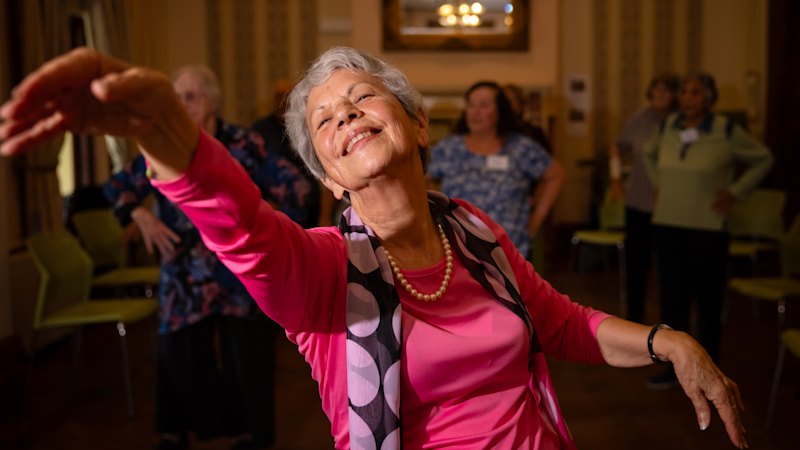
At 78, Elettra had an aching back and sore legs – then she started dancing

Read the original at The Sydney Morning Herald ↗
Cite

Seaman, A. (2026, October 23). At 78, Elettra had an aching back and sore legs – then she started dancing. The Sydney Morning Herald. https://www.smh.com.au/lifestyle/health-and-wellness/at-78-elettra-had-an-aching-back-and-sore-legs-then-she-started-dancing-20261023-p612ep.html?ref=rss&utm_medium=rss&utm_source=rss_feed

Dated from the outlet's own feed. Check the original for its byline.

The Sydney Morning Herald · collected 2026-10-23 · by Abby Seaman

Quick Summary

Elettra Piccoli, a 78-year-old resident of Concord, NSW, experienced relief from back and leg pain after joining the Dance Health Alliance program for seniors. New research from Adelaide University found that exercise can significantly reduce acute and chronic pain; on a zero to ten scale, exercise reduces pain by about 1.1 points, which is more effective than common pain medications. The study emphasizes that low-intensity exercises like dance-based programs are particularly beneficial and manageable for those dealing with persistent pain.
Written locally by qwen2.5:14b on 2026-10-23, using this article's own text rather than the other coverage of the same event (that is the story summary below).

AI analysis runs on qwen2.5:14b, locally

Story summary

At 78 years old, Elettra Piccoli started attending a dance program called Dance Health Alliance after her Commonwealth Home Support worker recommended it. Located in Concord, NSW, the program was designed for seniors like Elettra who were interested in exercise. Initially struggling with back aches and leg pain, she noticed immediate improvements in her physical condition once she began dancing regularly. Piccoli’s enthusiasm has inspired other friends to join her, including her husband Angelo, who has been married to her for nearly 70 years. The program not only enhanced her quality of life but also improved her balance, highlighting the benefits of exercise in reducing chronic pain and enhancing mobility among older adults. According to recent research from Adelaide University, exercise can significantly alleviate both acute and chronic pain across various conditions, affecting one in five Australians.

Written for “Elettra Usain-bolt's Dancing Journey” on 2026-10-23, grounded in this article and the 0 other(s) covering the same event.

Story

📰 Elettra Usain-bolt's Dancing Journey
Health · 1 article(s) covering the same event.

Compared with similar articles

Nothing to compare against. No article is close enough to this one for the pipeline to have linked or judged the pair.
How this article was measured signals, leaning charts, publisher record, byline, topics and claims

Signals How these are calculated →

Claims extracted
36
sentences that state something as happening or true
Uncertain
8%
3 of 36 hedged ("reportedly", "may", "according to")
Leaning
not political
takes no side on a contested political question
Publisher signals
61/100
The Sydney Morning Herald's corrections and hedging, across everything collected from it. Not a measure of accuracy.
Outlets on this story
1
Health
Same framing elsewhere
1
articles that frame the event the way this one does
Analyzed 2026-10-23 · how these are computed

How this is being covered How these are calculated →

Article leaning vs. publisher reliability
Source leaning vs. consistency

Publisher

The Sydney Morning Herald · 4760 article(s) · 11 correction(s) detected
Running correction rate · 11 correction(s)

Who wrote this

Abby Seaman
6 article(s) here · 1 carrying a prediction
🔮 Whether it’s the body aches that accompany ageing, monthly period cramps or a nasty migraine, exercising might sound like torture, but it will likely help.
🔮 They claim it will improve energy, cognitive clarity and oxidative stress.
🔮 This comes after Lee, 45, confirmed in a March episode of the Hamish & Andy podcast that he would tie the knot with Harding, 36, before the end of the year.
🔮 Exercise can help with drainage, but it will occur regardless.
2026-10-04 · assertive framing · Do you literally need to jump out of bed to be healthy?
🔮 My perfect holiday would be to bring Junior along but, understandably, most accommodation isn’t pet-friendly, especially for a 30-kilogram greyhound.
🔮 This article may contain links from our affiliate partners.
Also by Abby Seaman
Andy Lee and Rebecca Harding tie the knot in New York City
2026-10-14 · The Sydney Morning Herald
Do you literally need to jump out of bed to be healthy?
2026-10-04 · The Sydney Morning Herald
Nothing else under this byline is closely related to this article, so these are simply their most recent.
All 6 articles by Abby Seaman →

Topics

Australians Commonwealth Home Support Concord Dance Health Alliance NSW

Subjects

Singh PERSON · 4× Ellis PERSON · 3× Piccoli PERSON · 3× Chronic Pain Australia ORG · 2× Australians NORP · 1× Commonwealth Home Support ORG · 1× Concord GPE · 1× Dance Health Alliance ORG · 1× Elettra Piccoli PERSON · 1× NSW GPE · 1×

Narrative

Piccoli’s even convinced her friends to join in and occasionally, her husband of almost 70 years, Angelo, goes along too. Even if she doesn’t consider herself the best dancer in the class, she intends to continue attending because of how much it has improved her quality of life: “I’m not a great dancer, but I love dancing.”
framing: assertive · carried by 1 article(s) · first seen 2026-10-23
🔮 Whether it’s the body aches that accompany ageing, monthly period cramps or a nasty migraine, exercising might sound like torture, but it will likely help.
2026-10-23 · The Sydney Morning Herald
At 78, Elettra had an aching back and sore legs – then she started dancing · assertive framing

Claims (36 extracted, 3 hedged)

It didn’t take long for Elettra Piccoli to reap the benefits of movement. asserted
Piccoli → take → movement
The 78-year-old Concord, NSW, resident had been curious about exercising when her Commonwealth Home Support worker suggested she start going to Dance Health Alliance, a dance program designed for seniors. uncertain
she → exercise → seniors
For Piccoli, it was an easy choice given her love of dancing and music but almost immediately, she noticed a difference in her body: the back aches and leg pain that had been bothering her eased and her balance improved. asserted
balance → give → her
“The body was moving, every part of the body was moving, and I thought that was really great,” Piccoli says. asserted
Piccoli → move → body
Pain comes in many different forms. asserted
Pain → come → forms
One in five Australians adults and children live with chronic pain, which is categorised as pain that lasts more than three months. asserted
that → live → months
And it’s a leading cause of disability and lost productivity. asserted
it → ’ → disability
Whether it’s the body aches that accompany ageing, monthly period cramps or a nasty migraine, exercising might sound like torture, but it will likely help. uncertain
it → ’ → torture
That’s the message of new research from Adelaide University that found exercise can significantly reduce acute and chronic pain across a wide range of conditions. asserted
exercise → ’ → conditions
The research is the most complete review conducted into how exercise relieves pain. asserted
exercise → conduct → pain
Lead researcher Dr Ben Singh says on a zero to 10 pain scale, exercise can reduce pain by about 1.1 points. asserted
exercise → say → points
“That’s around 60 per cent greater than the average pain relief reported for common pain medications in separate studies, although we didn’t directly compare exercise with medication,” Singh says. asserted
Singh → report → medication
Almost every type of exercise was beneficial, and Singh emphasises that one exercise isn’t better than another, but Pilates and tai chi showed particularly strong results. asserted
Pilates → emphasise → results
So did dance-based exercise, but the evidence was limited. asserted
evidence → do → ?
Low-intensity at a consistent Piccoli’s experience echoes the new study’s findings that emphasise workouts needn’t be strenuous to be effective pain relief. asserted
workouts → echo → findings
A lower-intensity exercise and a program lasting under 12 weeks correlates with greater pain reduction. asserted
exercise → last → reduction
“For someone living with persistent pain, even the thought of exercise can feel overwhelming. asserted
thought → live → exercise
But our findings suggest that gentle, manageable movement can make a real difference,” Singh says. asserted
Singh → suggest → difference
“When it comes to managing pain, moving more doesn’t always mean feeling better.” asserted
moving → come → pain
Singh believes that health practitioners should be prescribing specific exercises for patients managing pain. asserted
practitioners → believe → pain
“Rather than simply telling patients to ‘stay active’, doctors could provide more specific exercise recommendations tailored to their condition, abilities and preferences,” he says. uncertain
he → tell → condition
Nicolette Ellis, chair of Chronic Pain Australia and a pharmacist specialising in chronic pain, agrees that effective pain care must be a tailored approach. “Practical support to help people introduce and sustain it remains underused. asserted
people → specialise → it
Being told to ‘stay active’ is very different from being shown how to move when movement hurts,” Ellis says. asserted
Ellis → tell → ?
The new research is congruent with what Chronic Pain Australia hears from its community: lower-intensity programs appear to be more beneficial. Getting into a consistent routine, however, can still come with challenges. asserted
Getting → hear → challenges
“‘Boom and bust’ means doing more on a good day, triggering a flare-up and then needing extended recovery,” Ellis explains. asserted
Ellis → mean → recovery
“Avoidance can develop when exercise or even simple chores repeatedly increase pain, making people understandably apprehensive about going back. asserted
people → develop → pain
“We commonly hear from people who have been deterred from exercise because basic pain management principles were not applied, and they were left in more pain, with less confidence to try again. asserted
they → hear → confidence
With pain relief movement, simply “pushing through” can undermine rehabilitation. asserted
pushing → push → rehabilitation
“People need to be taught how to move with pain, pace activity and build capacity without repeatedly overwhelming themselves,” Ellis says. asserted
Ellis → need → themselves
“Speak up if the plan is leaving you in more pain or reducing your ability to function. asserted
plan → speak → ability
Your experience should inform adjustments to your care.” asserted
experience → inform → care
Since starting dance classes 18 months ago, Piccoli hasn’t looked back, rarely missing a session because of how it makes her body feel. asserted
body → start → session
“Doing it is fun. asserted
Doing → do → it
I enjoy the music. asserted
I → enjoy → music
I enjoy the company,” she says. asserted
she → enjoy → company
Piccoli’s even convinced her friends to join in and occasionally, her husband of almost 70 years, Angelo, goes along too. Even if she doesn’t consider herself the best dancer in the class, she intends to continue attending because of how much it has improved her quality of life: “I’m not a great dancer, but I love dancing.” asserted
I → convince → life

💬Give feedback
🕘History 🎫Support