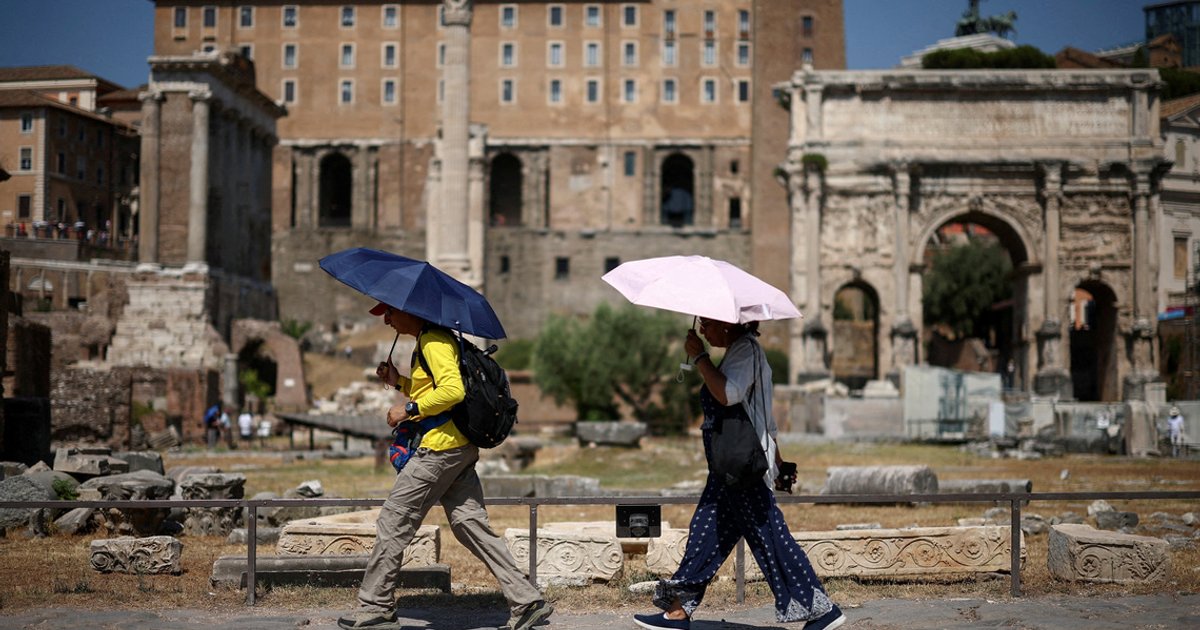
Summer 2026 was Europe's deadliest on record: Over 50,000 people died in urban areas - with climate change responsible for two thirds of deaths, study estimates

Read the original at Daily Mail ↗
Cite

Best, S. (2026, October 22). Summer 2026 was Europe's deadliest on record: Over 50,000 people died in urban areas - with climate change responsible for two thirds of deaths, study estimates. Daily Mail. https://www.dailymail.com/sciencetech/article-16229809/Summer-2026-Europe-deadliest-record-50000-people.html?ns_mchannel=rss&ns_campaign=1490&ito=1490

Dated from the outlet's own feed. Check the original for its byline.

Daily Mail · collected 2026-10-23 · by Shivali Best

Quick Summary

Summer 2026 in Europe saw over 50,000 urban residents die due to extreme heatwaves across 30 countries, according to a study by Imperial College London. Scientists predict that climate change was responsible for about two-thirds of these deaths, with southern and western Europe experiencing the highest death rates. The summer of 2026 surpassed previous record years in terms of heat-related mortality, particularly during late June when temperatures were 5°C above average.
Written locally by qwen2.5:14b on 2026-10-23, using this article's own text rather than the other coverage of the same event (that is the story summary below).

AI analysis runs on qwen2.5:14b, locally

Story summary

Summer 2026 was Europe's deadliest on record, with over 50,000 people dying in urban areas across 30 countries, including the UK and several EU nations. Scientists from Imperial College London estimate that climate change caused about two-thirds of these deaths, attributing roughly 32,000 fatalities directly to rising temperatures due to greenhouse gas emissions. Southern and western Europe experienced the highest death rates, with typically cooler regions like the UK also recording 4,500 deaths. The extreme heatwaves that summer were also estimated to have cost the European Union about €17 billion (or $24.36 billion) in economic losses from April through September, marking a significant impact on public health and GDP.

Written for “Summer Heat Toll In Europe” on 2026-10-23, grounded in this article and the 2 other(s) covering the same event.
Why this leaning score
The model judged this article politically coded and scored it -0.35, but all 2 of its quote(s) are attributed speech - words the article quotes from someone, not the article's own narration, so the score is not published.
Written under an earlier scoring contract, which gave a paragraph rather than checkable quotes. Re-analysing this article replaces it.
Leaning score withheld for article 100885: attributed speech only · logged 2026-10-23

Story

📰 Summer Heat Toll In Europe
Environment · 3 article(s) covering the same event. Compare every outlet's account →

Compared with similar articles

This article reads unscored and hedges 3% of its claims. Each row says how that neighbour differs.
The Straits Times · 0.87 cosine similarity
⚖️ Leans strongly left 🔴 15% hedged 4 of 27 📰 publisher trust 68
“Both articles describe the same specific study released on October 23, 2026, reporting over 50,000 deaths in Europe due to extreme summer heat.”
The Guardian · 0.86 cosine similarity
⚖️ Leans strongly left 🔴 13% hedged 4 of 30 📰 publisher trust 66
“Both articles report on the same specific summer of 2026 when a record number of people died in European urban areas due to extreme heat, with climate change being responsible for two thirds of these deaths.”
How this article was measured signals, leaning charts, publisher record, byline, topics and claims

Signals How these are calculated →

Claims extracted
31
sentences that state something as happening or true
Uncertain
3%
1 of 31 hedged ("reportedly", "may", "according to")
Leaning
withheld
no quote in the article backed the model's score
Publisher signals
64/100
Daily Mail's corrections and hedging, across everything collected from it. Not a measure of accuracy.
Outlets on this story
3
Environment
Same framing elsewhere
1
articles that frame the event the way this one does
Analyzed 2026-10-23 · how these are computed

How this is being covered How these are calculated →

Article leaning vs. publisher reliability
Source leaning vs. consistency

Publisher

Daily Mail · 7055 article(s) · 15 correction(s) detected
Running correction rate · 15 correction(s)

Who wrote this

Shivali Best
11 article(s) here · 1 carrying a prediction
🔮 Pictured: wildfires in southeastern France on July 28 To understand the role climate change played in these excess heat deaths, the researchers compared the temperatures that occurred in each urban area with those that would have been expected without the addition of greenhouse gases.
🔮 If you make a purchase via links on this page we will earn commission - learn more
🔮 According to the Criminal Bar Association (CBA), the outage has 'hampered' barristers' efforts to clear the court backlogs The outage appears to have caused disruption for a wide range of websites, potentially affecting millions of users Of those affected customers, 36 per cent said they were unable to log in, 31 per cent said they could not use online banking, while a further 25 per cent said they could not use the app.
🔮 He explained: 'Chucking things into the toilet may feel like a quick way to discard items like wet wipes, period products, nail clippings, dead pet goldfish or even those leftover baked beans not eaten at lunchtime, but these items do not break down easily or quickly and are likely to accumulate in your drainage systems.' Experts at Initial Washroom Hygiene have revealed the most unusual items they've recovered from toilets across the UK '
🔮 While the letter would have originally come with a key, this has long been lost – meaning the contents have been a mystery.
🔮 In their study, the team stuck googly eyes on takeaway food boxes to test whether it would affect their appeal to hungry gulls.
🔮 But a new study might make you think twice before choosing certain varieties for your family.
🔮 Worryingly, the scientists say this could just be a taste of what's to come as global temperatures continue to rise.
🔮 A researcher at a leading AI company has quit over concerns that big tech firms are in an 'out of control' race to build systems that could wipe out humanity.
🔮 - READ MORE: Area affected by wildfires in Europe will TRIPLE by 2100 - See more Daily Mail on Google - save us as a Preferred Source Over the summer, devastating wildfires have swept across Europe, displacing thousands of people.
Also by Shivali Best
Nothing else under this byline is closely related to this article, so these are simply their most recent.
All 11 articles by Shivali Best →

Topics

France Imperial College London the Centre for Environmental Policy the London School of Hygiene & Tropical Medicine

Subjects

Imperial College London ORG · 4× Andrew Hartle PERSON · 1× Clair Barnes PERSON · 1× France GPE · 1× Imperial College ORG · 1× the Centre for Environmental Policy ORG · 1× the London School of Hygiene & Tropical Medicine ORG · 1×

Narrative

Looking at specific regions, southern and western Europe had the highest death rates, while 4,500 deaths occurred in typically cooler countries, such as the UK Over the summer, Europe was hit by a series of extreme heatwaves. Western Europe had its hottest summer on record, with average temperatures reaching 2.9°C above the 1991–2020 average.
framing: assertive · carried by 1 article(s) · first seen 2026-10-23
🔮 Pictured: wildfires in southeastern France on July 28 To understand the role climate change played in these excess heat deaths, the researchers compared the temperatures that occurred in each urban area with those that would have been expected without the addition of greenhouse gases.

Claims (31 extracted, 1 hedged)

Summer 2026 was Europe's deadliest on record, a new study has confirmed. asserted
study → confirm → record
Scientists from Imperial College London predict that over 50,000 people died in urban areas across 30 countries, including the UK, as a result of extreme heat. asserted
people → predict → heat
According to the experts, climate change was responsible for about two thirds of these deaths. uncertain
change → accord → deaths
Dr Clair Barnes, Extreme Weather and Climate Change Researcher at the Centre for Environmental Policy, Imperial College London said: 'I think we can be quite confident in stating that the summer of 2026 is likely to have been the worst on record for heat–related mortality across much of Europe. asserted
summer → say → Europe
These numbers are a stark reminder that our hotter, more extreme summers are having an increasingly severe impact on public health. asserted
summers → have → health
Behind these statistics are real people whose lives were lost and real families who grieve for them.' asserted
who → lose → them
Summer 2026 was Europe's deadliest on record, a new study has confirmed. asserted
study → confirm → record
Scientists from Imperial College London predict that over 50,000 people died in urban areas across 30 countries, including the UK asserted
people → predict → UK
Looking at specific regions, southern and western Europe had the highest death rates, while 4,500 deaths occurred in typically cooler countries, such as the UK Over the summer, Europe was hit by a series of extreme heatwaves. Western Europe had its hottest summer on record, with average temperatures reaching 2.9°C above the 1991–2020 average. asserted
temperatures → look → average
In two studies, researchers from Imperial College London and the London School of Hygiene & Tropical Medicine set out to understand exactly how many excess deaths this extreme heat caused. asserted
heat → set → deaths
The team looked at 854 urban areas that make up about 40 per cent of the population of the 30 countries studied. asserted
that → look → countries
Using temperature records and modelling, they were able to estimate exactly how many heat–related excess deaths occurred in each area during the summers from 2000 to 2026. asserted
deaths → use → 2026
Their results revealed that over this summer, 50,391 excess heat deaths occurred in the 854 areas studied. asserted
deaths → reveal → areas
That figure is substantially higher than the previous worst years of 2003 and 2022, during which 28,000 and 29,000 excess heat deaths occurred, respectively. asserted
deaths → occur → which
Late June was especially severe, with almost a third of all deaths estimated to have occurred between 17 June and 1 July, when daily average temperatures were a staggering 5°C above average. asserted
temperatures → estimate → average
Over the summer, Europe was hit by a series of extreme heatwaves. asserted
Europe → hit → heatwaves
Western Europe had its hottest summer on record, with average temperatures reaching 2.9°C above the 1991–2020 average. asserted
temperatures → have → average
Pictured: wildfires in southeastern France on July 28 To understand the role climate change played in these excess heat deaths, the researchers compared the temperatures that occurred in each urban area with those that would have been expected without the addition of greenhouse gases. asserted
that → picture → gases
The results suggest that climate change was responsible for two–thirds of heat–related deaths this year Looking at specific regions, southern and western Europe had the highest death rates, while 4,500 deaths occurred in typically cooler countries, such as the UK. asserted
deaths → suggest → UK
In terms of the victims, the majority of people (44,000) who died in the heat were elderly, while the reamining 6,000 were under–65. asserted
6,000 → die → heat
'We know that those who are older, very young or have pre–existing morbidities face the highest dangers from exposure to extreme heat,' said Professor Andrew Hartle, from Imperial College. asserted
Hartle → know → College
'But the temperatures we are increasingly seeing pose a threat to healthy people too. asserted
we → see → people
'We need to ensure we are informing the public of this, and rolling out measures to protect people during the most extreme temperatures. asserted
we → need → temperatures
' To understand the role climate change played in these excess heat deaths, the researchers compared the temperatures that occurred in each urban area with those that would have been expected without the addition of greenhouse gases. asserted
that → understand → gases
The results suggest that climate change was responsible for two–thirds of heat–related deaths this year. asserted
change → suggest → deaths
For comparison, earlier in the century, it was estimated to be responsible for about 40 per cent. asserted
it → estimate → cent
Dr Pierre Masselot, from London School of Hygiene & Tropical Medicine said: 'This summer has been another dramatic reminder that climate change is everybody's problem. asserted
change → say → Hygiene
'It is not just hot regions that are suffering anymore with some parts of Western and Northern Europe experiencing extreme heat and historically high health burden. asserted
parts → suffer → heat
'And the whole population is affected, as shown by the significant death toll among younger age groups. ' asserted
population → affect → groups
It is becoming increasingly clear our cities are poorly adapted to rising heat, and it is critical we improve our efforts towards adaptation. asserted
we → become → adaptation
'This means cooling the cities through more green spaces and less pollution, and providing health care for affected populations.' asserted
This → mean → populations

💬Give feedback
🕘History 🎫Support