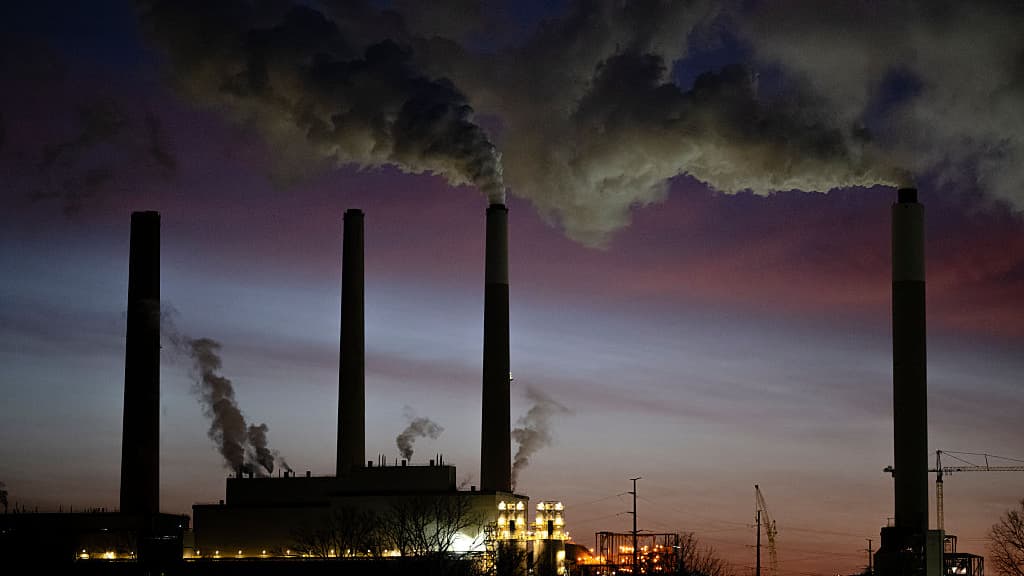
Photo via TIME

Five Facts You Need To Know From The U.N.'s Major Emissions Gap Report

Read the original at TIME ↗
Cite

Shah, S. (2026, October 21). Five Facts You Need To Know From The U.N.'s Major Emissions Gap Report. TIME. https://time.com/article/2026/10/21/un-emissions-gap-report-what-to-know/

Dated from the outlet's own feed. Check the original for its byline.

TIME · collected 2026-10-21 · by Simmone Shah

Quick Summary

The United Nations Environmental Program released its Emissions Gap report on Wednesday, stating that the world is unlikely to meet the Paris Agreement goal of limiting global warming to below 1.5°C above pre-industrial levels. The report finds that under current policies outlined in Nationally Determined Contributions (NDCs) from over 150 nations, Earth is set to warm by 2.8°C by 2100, with updated NDCs reducing this projection slightly to 2.6°C. To limit warming closer to the Paris target of 1.7°C or 1.8°C, global emissions must decrease by 18% by 2030 compared to 2025 levels, alongside significant carbon dioxide removal efforts.
Written by AI on 2026-10-21, from this article's own text only (the story summary below draws on all the coverage).
See how they differ ↓

AI analysis

Story summary

As countries prepare for the upcoming COP31 climate conference in Turkey, a new UN report reveals that global temperatures are now projected to rise between 1.7-1.8 degrees Celsius above pre-industrial levels by mid-century, even under the most optimistic scenarios. The United Nations Environment Programme's (UNEP) annual Emissions Gap Report indicates that current national climate plans would result in only a 5% to 8% reduction in emissions by 2030 and an 11-15% reduction by 2035, far short of the necessary reductions. To achieve even the best-case scenario outlined in the report, global emissions must decrease by 45% by 2035 and 69% by 2040 from 2025 levels. UN Secretary-General Antonio Guterres emphasized that urgent action is needed to avoid further devastating impacts of climate change such as extreme weather events.

Written for “Global Warming And Climate Action Shortfalls” on 2026-11-20, grounded in this article and the 5 other(s) covering the same event.

How they differ

5 outlets covered “Global Warming And Climate Action Shortfalls”.

What each outlet says

One AI summary per outlet of its latest article on this story, written from that article alone and checked against it. Open the article for the outlet's own words.

TimeThis outlet21 Oct

The United Nations Environmental Program released its Emissions Gap report on Wednesday, stating that the world is unlikely to meet the Paris Agreement goal of limiting global warming to below 1.5°C above pre-industrial levels. The report finds that under current policies outlined in Nationally Determined Contributions (NDCs) from over 150 nations, Earth is set to warm by 2.8°C by 2100, with updated NDCs reducing…

Five Facts You Need To Know From The U.N.'s Major Emissions Gap Report (this article)
The Straits Times21 Oct

UN Secretary-General Antonio Guterres warned on October 21 that global commitments to reduce emissions are insufficient, putting the world on track for a temperature rise of 2.6 degrees Celsius by 2100, well above the Paris climate goals of limiting warming to below 2 degrees and striving for 1.5 degrees. The United Nations Environment Programme (UNEP) report indicates that even if countries fulfill their latest…

World falling ‘dangerously short’ on climate action, UN chief warns →2 articles from The Straits Times on this story
CBC21 Oct

The UN has revised its climate goal, moving away from limiting global warming to 1.5°C above pre-industrial levels and instead proposing a pathway that limits peak warming to 1.7-1.8°C before aiming to reduce temperatures later this century. This adjustment comes after the realization that avoiding 1.5°C of warming is now unattainable, as indicated in an annual UN report on global climate action. The new approach…

UN retreats from 1.5 C global warming limit and proposes a plan B →
Semafor21 Oct

The UN Environment Programme reports that efforts to limit global temperature rises have largely failed and a breach of the Paris Agreement’s target of 1.5℃ is now inevitable. The UNEP predicts overall global warming will likely reach between 2.6℃ and 2.8℃ by an unspecified future date. To avoid permanently exceeding the 1.5℃ limit, nations would need to cut emissions by about 45% by 2035, but current national plans…

Breach of Paris Agreement global warming level ‘inevitable,’ UN says →
Washington Examiner21 Oct

The United Nations Environment Programme reports that global temperatures are on track to surpass the Paris Agreement's goal of limiting warming to 1.5 degrees Celsius above preindustrial levels. This conclusion, presented in a new report released Wednesday, indicates an unavoidable breach of this critical threshold, which experts warn would significantly increase the likelihood of severe weather events due to…

‘Inevitable’ that Paris climate goal of only 1.5-degree warming will be breached: UN →

Where they agree and split

Framing

How the first headlines put it

Attributed to a source3
Stated as fact2
The headlines (5)

Breach of Paris Agreement global warming level ‘inevitable,’ UN says Semafor · attributed to a source

‘Inevitable’ that Paris climate goal of only 1.5-degree warming will be breached: UN Washington Examiner · attributed to a source

Five Facts You Need To Know From The U.N.'s Major Emissions Gap Report Time · attributed to a source

UN sees higher global warming, even in best-case scenario The Straits Times · stated as fact

UN retreats from 1.5 C global warming limit and proposes a plan B CBC · stated as fact

The full story: what happened, how it changed, and all 6 articles →

Compared with similar articles

This article reads unscored and hedges 3% of its claims. Each row says how that neighbour differs.
The Straits Times
Hedges 1 of 11 claims Outlet record 64/100
Washington Examiner
Leans left Hedges 1 of 3 claims Outlet record 67/100
The Straits Times
Leans strongly left Hedges 1 of 30 claims Outlet record 64/100
CBC News
Hedges 8 of 39 claims Outlet record 72/100
Semafor
Hedges 0 of 4 claims Outlet record 64/100
NPR
Hedges 2 of 31 claims Outlet record 60/100
“While both articles discuss a UN report related to climate pollution, Article A focuses specifically on the U.S.'s role and increase in emissions, while Article B provides an overview of key points from the broader UNEP Emissions Gap Report.”

Story

Global Warming And Climate Action Shortfalls
Environment · 6 article(s) covering the same event. Compare every outlet's account →
How this article was measured signals, leaning charts, publisher record, byline, topics and claims

Signals How these are calculated →

Claims extracted
38
sentences that state something as happening or true
Uncertain
3%
1 of 38 hedged ("reportedly", "may", "according to")
Leaning
withheld
no quote in the article backed the model's score
Publisher signals
60/100
TIME's corrections and hedging, across everything collected from it. Not a measure of accuracy.
Outlets on this story
6
Environment
Same framing elsewhere
1
articles that frame the event the way this one does
Analyzed 2026-10-21 · how these are computed

How this is being covered How these are calculated →

Article leaning vs. publisher reliability
Source leaning vs. consistency

Publisher

TIME · 1070 article(s) · 2 correction(s) detected
Running correction rate · 2 correction(s)

Who wrote this

Simmone Shah
19 article(s) here · 1 carrying a prediction
The bill—which has divided environmentalists and clean energy advocates—will now face a final Senate vote before moving to the House of Representatives.
As the world reckons with what is set to be the strongest El Niño in recorded history, combined with a potential cold-snap from the polar vortex expected next week, holiday travels this year could be at risk of more weather-related delays and cancellations.
That number is only expected to grow: the research firm Synergy estimates that the total capacity of U.S. data centers will double in the next three years, largely driven by the growth of hyperscale data centers.
A record-early breakdown of the polar vortex is expected to bring cold weather to the United States by the end of the month.
Yet on the other side of the transition, he noted, are people like Bennie, a supervisor at one of South Africa's oldest coal-fired power stations who might soon see the place he has worked at for much of his career sunset.
Two of the world’s three biggest emitters are expected to see a drop in emissions.
2026-11-10 · assertive framing · Fossil Fuel Emissions Are Expected to Decrease in 2026
Following two years of anti-climate legislation from Washington, Tuesday’s blue tidal wave—giving Democrats control of both the Senate and the House—could provide an opportunity to change course.
When confronted with a rotting, deflating carved pumpkin, your first instinct might be to beeline to the trash as quickly as possible.
With Democrats being significantly more likely to view climate action as a priority, many in the climate movement are hopeful that if the Democrats take back some leadership in Congress, as it could prove essential in helping to prevent further rollbacks.
Combined, all of the world’s private jets emit more in 2 seconds than someone in the world’s poorest 50%, those annually making an average of $1,500, would emit in a year.
Also by Simmone Shah
Nothing else under this byline is closely related to this article, so these are simply their most recent.
All 19 articles by Simmone Shah →

Topics

UNEP the Paris Agreement the United Nations Environmental Program’s

Subjects

UNEP ORG · 3× U.S. GPE · 2× Anne Olhoff PERSON · 1× G20 ORG · 1× Inger Andersen PERSON · 1× The Trump Administration’s ORG · 1× the State Department ORG · 1× the United Nations Environmental Program’s ORG · 1× the United States GPE · 1×

Narrative

“Every additional fraction of a degree and additional year of warming above 1.5°C increases climate impacts and risks, such as the deadly floods, heat waves, and wildfires that have plagued many nations this year,” said UNEP executive director Inger Andersen.
framing: assertive · carried by 1 article(s) · first seen 2026-10-21
Doing so would provide a greater chance at avoiding the worst impacts of climate change.

Claims (38 extracted, 1 hedged)

The goal of limiting global warming to below 1.5°C above pre-industrial levels is largely out of reach. asserted
goal → limit → reach
That’s according to the United Nations Environmental Program’s (UNEP) 2026 Emissions Gap report released on Wednesday, considered the definitive assessment of global climate action. uncertain
That → accord → action
“We’ve spent decades postponing cuts to emissions and now we’re facing the consequences,” Anne Olhoff, director of the UNEP-Copenhagen Climate Centre, and one of the report’s authors, said after the report’s publication. asserted
Olhoff → spend → publication
“The world can still attain the goals of the Paris Agreement but we must work hard to not only meet but surpass our most ambitious climate targets. asserted
we → attain → targets
The longer we wait, the larger the risk that we jeopardize the temperature goal.” asserted
we → wait → goal
While the report’s warning is stark, that doesn’t mean that all hope is lost. asserted
hope → mean → ?
Coordinated efforts to reduce emissions can still have a meaningful impact on climate change, it says—but action must be taken quickly. asserted
action → coordinate → change
The 1.5°C target is mostly out of reach Under the 2015 Paris Agreement, the world agreed to halt planetary warming at 2°C above pre-industrial temperatures and to pursue efforts to limit warming by 1.5°C. asserted
world → agree → C
Doing so would provide a greater chance at avoiding the worst impacts of climate change. asserted
Doing → do → change
The window to avoid overshooting the 1.5°C goal, however, is now closed, the report finds. asserted
report → avoid → goal
But that doesn’t mean that there’s no hope for climate action. asserted
that → mean → action
It is still possible to limit the overshoot and bring temperatures back below 1.5 degrees by the end of the century. asserted
It → limit → century
Every fraction of a degree of warming above 1.5°C increases climate impacts, making the goal to limit as much warming beyond 1.5°C all the more important. asserted
goal → increase → C
The world is on track to reach 2.8°C of warming by 2100 asserted
world → reach → 2100
Under the terms of the Paris Agreement, countries must submit updated climate pledges, known as Nationally Determined Contributions (NDCs), which outline specific goals to reduce national emissions. asserted
which → submit → emissions
Based on the policies currently in place under the NDCs submitted by over 150 nations, the planet is on track to reach 2.8°C of warming by the end of the century. asserted
planet → base → century
Based on this, today’s report concludes that global climate pledges are falling short. asserted
pledges → base → this
If countries meet their new NDCs, which set upgraded targets for 2035 and were due last year, global warming is still projected to reach 2.6°C by the end of the century. asserted
warming → meet → century
Both scenarios would have devastating consequences—dramatically transforming sea levels and ecosystems, and triggering compounding climate extremes such as higher temperatures and drought, increasing the likelihood of wildfires. asserted
scenarios → have → wildfires
We need to cut carbon emissions by 18% in the next four years The report notes that it is still possible to peak warming at 1.7°C or 1.8°C asserted
it → need → °
Doing so would require major changes. asserted
Doing → do → changes
We would need to cut emissions by 18% by 2030, 45% by 2035, and 69% by 2040, relative to 2025 levels. asserted
We → need → levels
This would require sustained emissions cuts along with carbon dioxide removal. asserted
This → require → removal
“Every additional fraction of a degree and additional year of warming above 1.5°C increases climate impacts and risks, such as the deadly floods, heat waves, and wildfires that have plagued many nations this year,” said UNEP executive director Inger Andersen. asserted
Andersen → increase → nations
“So, we must pull out all the stops to minimize peak warming and return to 1.5°C by the end of the century.” asserted
we → pull → century
The U.S. is a major outlier for emissions While emissions growth has slowed down in most G20 countries, emissions in the United States “far exceeded that of all other countries," the report says. asserted
report → slow → countries
That’s due to the increased electricity demand, in part due to data centers, and new policies that encouraged the use of fossil fuels like coal over clean energy sources. asserted
that → ’ → sources
The report includes a statement from the State Department, noting that the U.S. "does not endorse or agree with its analysis or conclusions, and has not provided comments to this report." asserted
U.S. → include → report
The Trump Administration’s decision to withdraw from the Paris Agreement also worsened the climate projections, as estimates no longer include climate action that would have been taken under the United States’s NDC targets. asserted
that → withdraw → targets
The U.S. is the second largest emitter of climate-warming greenhouse gases, behind China, which has quickly become a world leader in renewable energy (while also ramping up coal production.) asserted
which → warm → production
Climate policies are reducing emissions asserted
policies → reduce → emissions
Since the adoption of the Paris Agreement just over a decade ago, global renewable electricity capacity has grown three times faster than anticipated, while solar PV build-out has increased seven times faster. asserted
out → grow → Agreement
If these trends were to continue, and coupled with more policies to support clean energy, the world would be on track to reach its renewable energy goals. asserted
world → continue → goals
The report examined more than 200 climate policies and found that they target emission reductions across a wide range of sectors and countries. asserted
they → examine → sectors
That’s an encouraging sign the report notes. asserted
report → ’ → ?
All that’s left is for these solutions to be scaled faster. asserted
solutions → leave → ?
“We have a wealth of success stories showing that emissions can be cut quickly,” said Andersen. asserted
Andersen → have → stories
“It is now up to nations to urgently put in place policies that spark fast, deep and sustained emissions reductions, and put the world on track for a more stable climate and more stable economies and societies.” asserted
that → put → climate
Give feedback · no sign-in needed

No sign-in needed for now. Your note is sent without a name, so it cannot be answered.

History Support