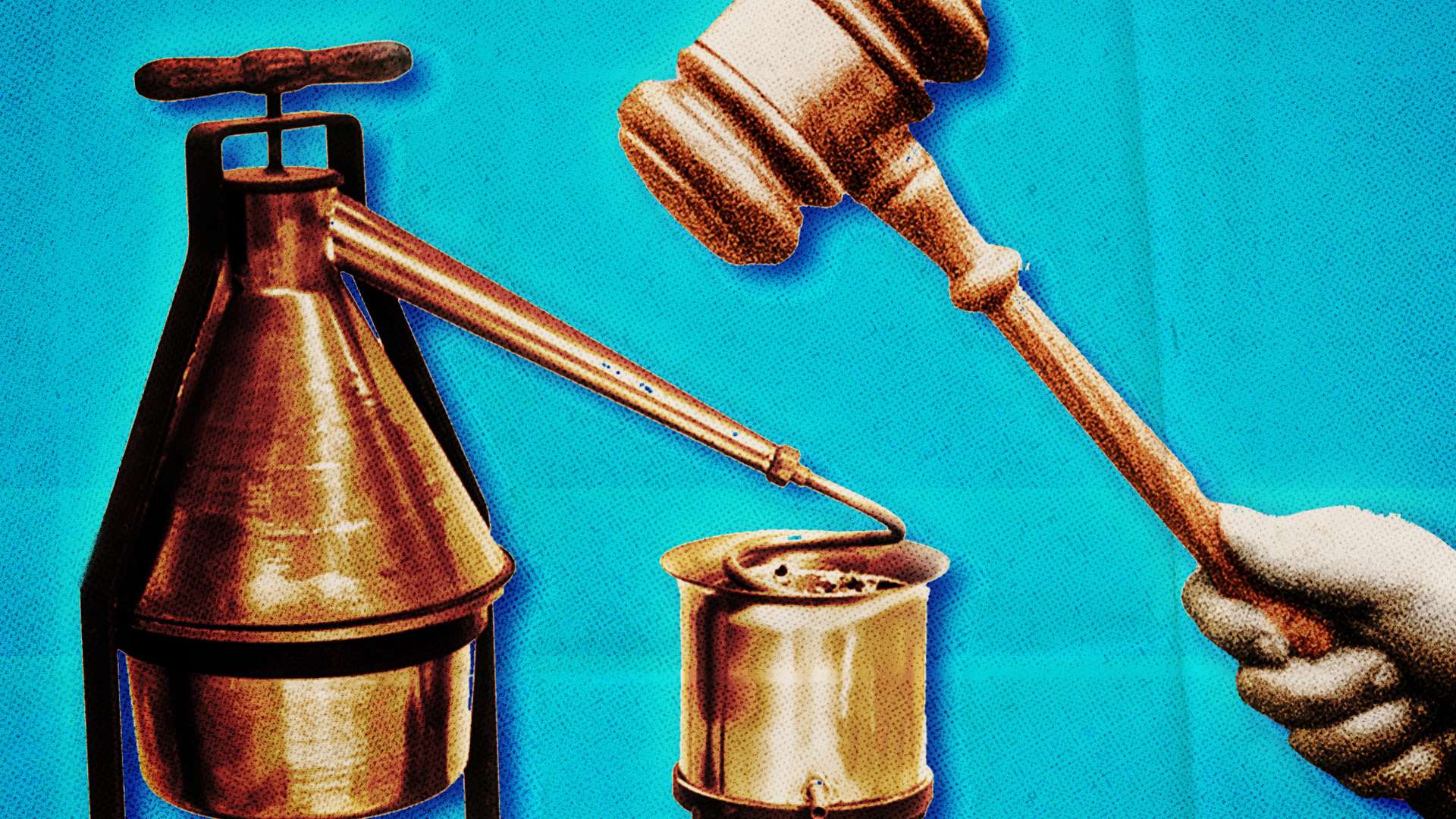
Photo via Reason

Trump Administration Urges SCOTUS To Uphold Federal Ban on Distilling Liquor at Home

Read the original at Reason ↗
Cite

Root, D. (2026, October 20). Trump Administration Urges SCOTUS To Uphold Federal Ban on Distilling Liquor at Home. Reason. https://reason.com/2026/10/20/trump-administration-urges-scotus-to-uphold-federal-ban-on-distilling-liquor-at-home/

Dated from the outlet's own feed. Check the original for its byline.

Reason · collected 2026-10-20 · by Damon Root

Quick Summary

The U.S. Supreme Court has agreed to review Department of Justice v. McNutt, a case challenging the federal ban on home distilling enacted in 1868. The Fifth Circuit previously ruled this ban unconstitutional, arguing it exceeds congressional authority and is not necessary for tax collection. The Trump administration argues that the judiciary should defer more to Congress's regulatory judgment, maintaining that the ban serves legitimate government purposes under the Necessary and Proper Clause.
Written by AI on 2026-10-20, from this article's own text only (the story summary below draws on all the coverage).
See how they differ ↓

AI analysis

Story summary

The Supreme Court has agreed to review a 160-year-old federal law banning distilling alcohol at home, with oral arguments expected later this term. The case stems from challenges brought by both Scott McNutt and members of the Texas-based Hobby Distillers Association, arguing the ban is an overreach of Congress’s power under the Constitution. Government attorneys argue that the prohibition prevents evasion of federal excise taxes on commercial distilling. Two circuit courts have issued conflicting rulings: the Fifth Circuit found the ban unconstitutional, while the Sixth Circuit upheld it. The case could potentially strike down a Reconstruction-era law, sparking debate over congressional authority and tax regulations.

Written for “Supreme Court Reviews Home Distillation Ban” on 2026-11-22, grounded in this article and the 2 other(s) covering the same event.

How they differ

3 outlets covered “Supreme Court Reviews Home Distillation Ban”.

What each outlet says

One AI summary per outlet of its latest article on this story, written from that article alone and checked against it. Open the article for the outlet's own words.

ReasonThis outlet20 Oct

The U.S. Supreme Court has agreed to review Department of Justice v. McNutt, a case challenging the federal ban on home distilling enacted in 1868. The Fifth Circuit previously ruled this ban unconstitutional, arguing it exceeds congressional authority and is not necessary for tax collection. The Trump administration argues that the judiciary should defer more to Congress's regulatory judgment, maintaining that the…

Trump Administration Urges SCOTUS To Uphold Federal Ban on Distilling Liquor at Home (this article)
Washington Examiner19 Oct

The Supreme Court has decided to review a challenge against a federal law that prohibits home alcohol distillation, which has been in place for 160 years. The court will hear Department of Justice v. Scott McNutt during its current term, considering whether this regulation exceeds the federal government’s authority. This case is one of two pending disputes over the ban; the Court chose to address the appeal…

Supreme Court takes up challenge to 160-year-old ban on distilling alcohol at home →
New York Post19 Oct

The Supreme Court has decided to review a 1868 law banning distillation of spirits in private homes, initiated as part of tax reforms during Reconstruction. Plaintiffs argue this law is unconstitutional and an overreach by Congress, while government attorneys maintain it prevents tax evasion by commercial producers. Two federal circuit courts recently issued conflicting rulings on the legality of home distilling…

Supreme Court agrees to review a Reconstruction-era ban on distilling spirits in private homes →

Where they agree and split

Framing

How the first headlines put it

Stated as fact2
The headlines (2)

Supreme Court takes up challenge to 160-year-old ban on distilling alcohol at home Washington Examiner · stated as fact

Supreme Court agrees to review a Reconstruction-era ban on distilling spirits in private homes New York Post · stated as fact

The full story: what happened, how it changed, and all 3 articles →

Compared with similar articles

This article reads unscored and hedges 9% of its claims. Each row says how that neighbour differs.
Washington Examiner
Hedges 1 of 3 claims Outlet record 67/100
New York Post
Hedges 1 of 10 claims Outlet record 66/100

Story

Supreme Court Reviews Home Distillation Ban
Politics · 3 article(s) covering the same event. Compare every outlet's account →
How this article was measured signals, leaning charts, publisher record, byline, topics and claims

Signals How these are calculated →

Claims extracted
23
sentences that state something as happening or true
Uncertain
9%
2 of 23 hedged ("reportedly", "may", "according to")
Leaning
withheld
no quote in the article backed the model's score
Publisher signals
67/100
Reason's corrections and hedging, across everything collected from it. Not a measure of accuracy.
Outlets on this story
3
Politics
Same framing elsewhere
1
articles that frame the event the way this one does
Analyzed 2026-10-20 · how these are computed

How this is being covered How these are calculated →

Article leaning vs. publisher reliability
Source leaning vs. consistency

Publisher

Reason · 1471 article(s) · 4 correction(s) detected
Running correction rate · 4 correction(s)

Who wrote this

Damon Root
12 article(s) here · 1 carrying a prediction
But that may be about to change.
McNamara acknowledged that state law "wouldn't apply to the United States if it took land in its own name."
Yesterday, the justices heard oral arguments in a case that could further insulate federal officials from facing any civil liability for their misdeeds.
2026-11-10 · mixed framing · A Bad Day at SCOTUS for Government Accountability
In a recent edition of this newsletter, I asked whether Justice Samuel Alito would come to regret making "the same mistake" as Justice Ruth Bader Ginsburg, who famously declined to retire from the U.S. Supreme Court when the Democrats still had control of the Senate and Barack Obama was still president.
Is it any wonder that Locke's radical case for self-ownership would appeal to a young woman like Wollstonecraft, who longed to break free from the sexist laws and cultural strictures that held her back?
2026-10-29 · assertive framing · When Mary Wollstonecraft Read John Locke
The 5th Circuit also denied that the federal ban on home distilling could be saved by the government's appeal to the Necessary and Proper Clause, which says that Congress has the authority "To make all Laws which shall be necessary and proper for carrying into Execution the foregoing Powers, and all other Powers vested by this Constitution in the Government of the United States, or in any Department or Officer thereof.
So declared a recent attention-grabbing headline at Politico, which probably caused a blood pressure spike among those readers who got the mistaken impression that the retirement under consideration might be imminent.
2026-10-06 · mixed framing · Alito Talks Retirement
But you may be forgiven if you didn't realize the justices had actually gone away on a summer break.
2026-10-01 · assertive framing · 2 Supreme Court Cases to Watch This Month
Last year, President Donald Trump issued an executive order directing federal officials to create new systems that would allow state and local authorities to check the immigration status of both registered voters and would-be voters who were seeking to register.
2026-09-29 · assertive framing · A Limited Supreme Court Win for Trump's Voter Database
Last month, the U.S. Supreme Court ruled 6–3 that the executive branch may begin to implement President Donald Trump's executive order that seeks to restrict the use of mail-in ballots in the fast-approaching midterm elections this November.
Also by Damon Root
Nothing else under this byline is closely related to this article, so these are simply their most recent.
All 12 articles by Damon Root →

Topics

Congress Department of Justice Supreme Court The U.S. Supreme Court's the 5th Circuit

Subjects

the 5th Circuit ORG · 6× Congress ORG · 5× Trump PERSON · 3× Comstock PERSON · 2× Supreme Court ORG · 2× Damon Root PERSON · 1× Department of Justice ORG · 1× McNutt PERSON · 1× Reason ORG · 1× The U.S. Supreme Court's ORG · 1×

Narrative

In United States v. Comstock (2010), a 7–2 Supreme Court embraced the Necessary and Proper Clause as sufficient constitutional grounding for the Adam Walsh Child Protection and Safety Act, which had empowered federal officials to order the indefinite civil commitment of "sexually dangerous" individuals who had already finished serving their prison sentences.
framing: assertive · carried by 1 article(s) · first seen 2026-10-20
The 5th Circuit also denied that the federal ban on home distilling could be saved by the government's appeal to the Necessary and Proper Clause, which says that Congress has the authority "To make all Laws which shall be necessary and proper for carrying into Execution the foregoing Powers, and all other Powers vested by this Constitution in the Government of the United States, or in any Department or Officer thereof.

Claims (23 extracted, 2 hedged)

The U.S. Supreme Court's 2026–2027 term just got a whole lot boozier. asserted
term → get → ?
On Monday, the justices agreed to hear arguments later this year or next in the case of Department of Justice v. McNutt. asserted
justices → agree → McNutt
At issue is whether the 1868 federal ban on distilling liquor at home is unconstitutional because it exceeds the lawful regulatory power of the federal government. asserted
it → distil → government
If any modern Supreme Court case ever deserved its own drinking game, this one is it. asserted
one → deserve → game
You’re reading Injustice System from Damon Root and Reason. asserted
You → read → Root
In April, the U.S. Court of Appeals for the 5th Circuit found the federal ban on home distilling to be unconstitutional because Congress lacked the proper authority to issue such a ban in the first place. asserted
Congress → find → place
It was not a legitimate exercise of the congressional authority "To Lay and collect Taxes," the appellate court reasoned, because "the purpose of a tax is to raise revenue for the government;" yet this law "amount[s] to an anti-revenue provision" that only "prevents distilled spirits from coming into existence." asserted
that → lay → existence
And if it does not exist, of course, the government cannot tax it. asserted
government → exist → it
The 5th Circuit also denied that the federal ban on home distilling could be saved by the government's appeal to the Necessary and Proper Clause, which says that Congress has the authority "To make all Laws which shall be necessary and proper for carrying into Execution the foregoing Powers, and all other Powers vested by this Constitution in the Government of the United States, or in any Department or Officer thereof. uncertain
which → deny → Department
But the federal ban on home distilling cannot be "necessary" to the execution of the enumerated taxing power, the 5th Circuit argued, because the provisions of federal law at issue "tax nothing, and are distinct from the regulation of distilling alcoholic products that is permitted by federal tax law." Nor did the 5th Circuit find the ban to be "proper." asserted
ban → tax → law
"By purporting to ban activity without a plain connection to the exercise of Congress's taxation power," it held, "Congress has essentially—and 'improperly'—invaded the reserved police and regulatory power of the states. asserted
Congress → purport → states
The Trump administration lost this case at the 5th Circuit and has now successfully urged the justices to hear its appeal. asserted
administration → lose → appeal
In its petition seeking review, the Trump administration faulted the 5th Circuit for its overeagerness to "second-guess" the "legislative judgment" of Congress. asserted
administration → seek → Congress
Instead, the Trump administration argued, the federal judiciary owes a great deal more deference to the federal government's regulatory priorities in a case like this. asserted
judiciary → argue → this
"A law is necessary and proper if it is 'convenient' or 'useful' for carrying an enumerated power into effect, and 'plainly adapted' to that legitimate end," the Justice Department's brief argued. asserted
brief → carry → end
This case may lead to an interesting divide among the Supreme Court's more conservative members. uncertain
case → lead → members
In United States v. Comstock (2010), a 7–2 Supreme Court embraced the Necessary and Proper Clause as sufficient constitutional grounding for the Adam Walsh Child Protection and Safety Act, which had empowered federal officials to order the indefinite civil commitment of "sexually dangerous" individuals who had already finished serving their prison sentences. asserted
who → embrace → sentences
Chief Justice John Roberts joined the majority opinion in that case, while Justice Samuel Alito voted in concurrence. asserted
Alito → join → concurrence
In other words, they both endorsed a broad view of congressional power under the Necessary and Proper Clause. asserted
they → endorse → Clause
By contrast, Justice Clarence Thomas, joined by the late Justice Antonin Scalia, voted in dissent. asserted
Thomas → join → dissent
The Comstock ruling, Thomas protested, "comes perilously close to transforming the Necessary and Proper Clause into a basis for the federal police power that 'we always have rejected.' asserted
we → protest → that
" Are we about to see a similar Alito-Thomas split over the proper reach of federal power in this case? asserted
we → see → case
Will one or more of them play the Scalia part and similarly reject the Trump administration's broad reading of the Necessary and Proper Clause? asserted
one → play → Clause
Give feedback · no sign-in needed

No sign-in needed for now. Your note is sent without a name, so it cannot be answered.

History Support