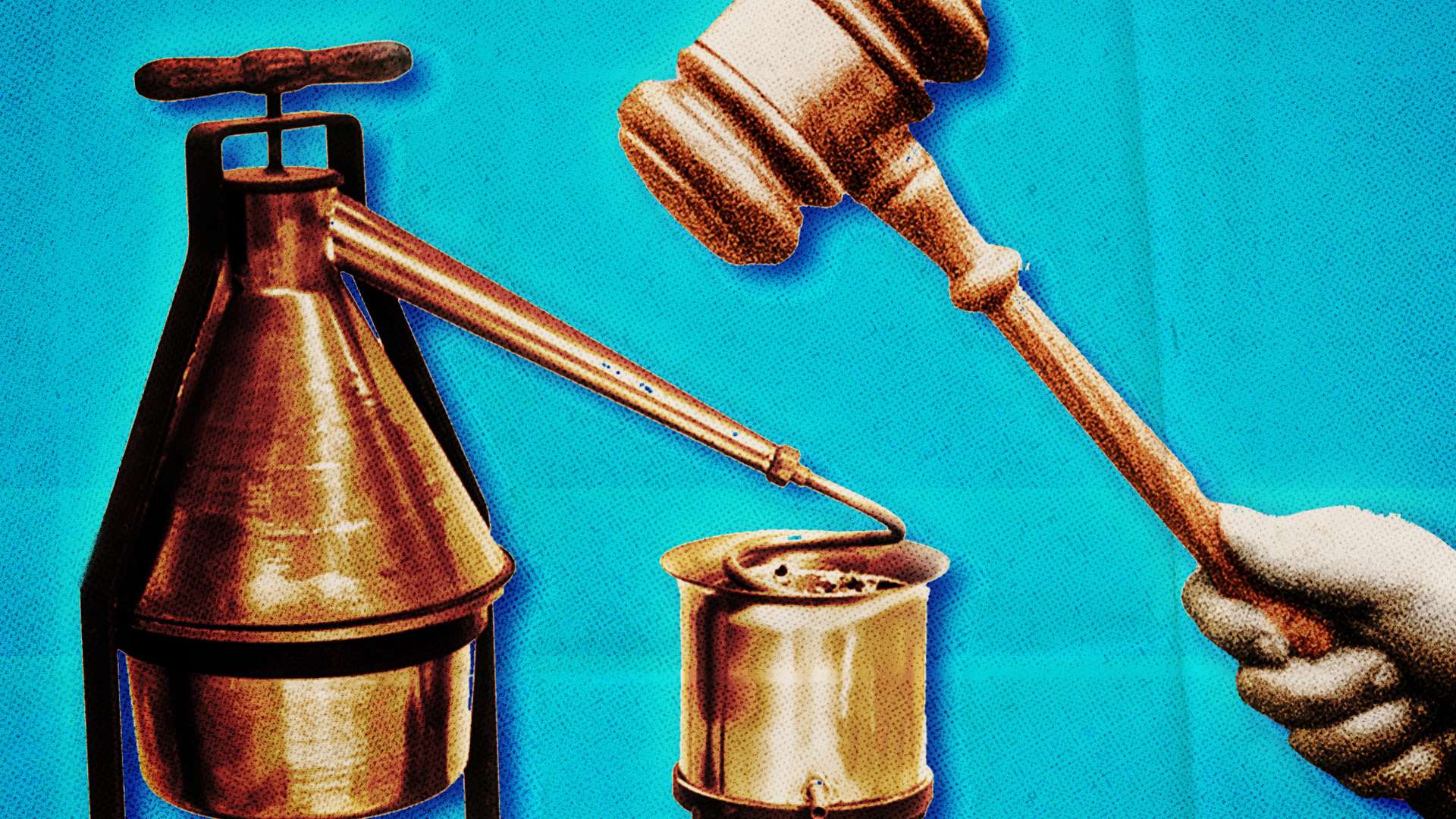
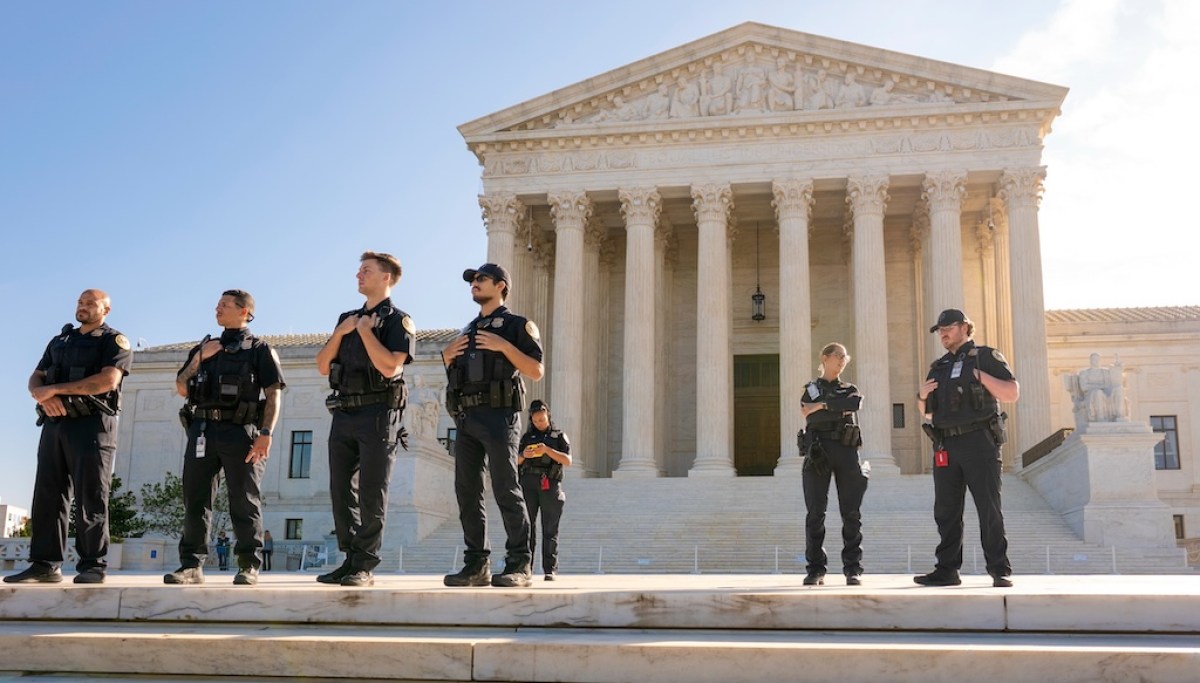
Photo via New York Post

Supreme Court agrees to review a Reconstruction-era ban on distilling spirits in private homes

Read the original at New York Post ↗
Cite

Associated Press. (2026, October 19). Supreme Court agrees to review a Reconstruction-era ban on distilling spirits in private homes. New York Post. https://nypost.com/2026/10/19/us-news/supreme-court-agrees-to-review-a-reconstruction-era-ban-on-distilling-spirits-in-private-homes/

Dated from the outlet's own feed. Check the original for its byline.

New York Post · collected 2026-10-19 · by Associated Press

Quick Summary

The Supreme Court has decided to review a 1868 law banning distillation of spirits in private homes, initiated as part of tax reforms during Reconstruction. Plaintiffs argue this law is unconstitutional and an overreach by Congress, while government attorneys maintain it prevents tax evasion by commercial producers. Two federal circuit courts recently issued conflicting rulings on the legality of home distilling bans; the Supreme Court will now examine the Fifth Circuit's decision in favor of lifting these restrictions.
Written by AI on 2026-10-19, from this article's own text only (the story summary below draws on all the coverage).
See how they differ ↓

AI analysis

Story summary

The Supreme Court has agreed to review a 160-year-old federal law banning distilling alcohol at home, with oral arguments expected later this term. The case stems from challenges brought by both Scott McNutt and members of the Texas-based Hobby Distillers Association, arguing the ban is an overreach of Congress’s power under the Constitution. Government attorneys argue that the prohibition prevents evasion of federal excise taxes on commercial distilling. Two circuit courts have issued conflicting rulings: the Fifth Circuit found the ban unconstitutional, while the Sixth Circuit upheld it. The case could potentially strike down a Reconstruction-era law, sparking debate over congressional authority and tax regulations.

Written for “Supreme Court Reviews Home Distillation Ban” on 2026-11-22, grounded in this article and the 2 other(s) covering the same event.

How they differ

3 outlets covered “Supreme Court Reviews Home Distillation Ban”.

What each outlet says

One AI summary per outlet of its latest article on this story, written from that article alone and checked against it. Open the article for the outlet's own words.

New York PostThis outlet19 Oct

The Supreme Court has decided to review a 1868 law banning distillation of spirits in private homes, initiated as part of tax reforms during Reconstruction. Plaintiffs argue this law is unconstitutional and an overreach by Congress, while government attorneys maintain it prevents tax evasion by commercial producers. Two federal circuit courts recently issued conflicting rulings on the legality of home distilling…

Supreme Court agrees to review a Reconstruction-era ban on distilling spirits in private homes (this article)

Washington Examiner19 Oct

The Supreme Court has decided to review a challenge against a federal law that prohibits home alcohol distillation, which has been in place for 160 years. The court will hear Department of Justice v. Scott McNutt during its current term, considering whether this regulation exceeds the federal government’s authority. This case is one of two pending disputes over the ban; the Court chose to address the appeal…

Supreme Court takes up challenge to 160-year-old ban on distilling alcohol at home →
Reason20 Oct

The U.S. Supreme Court has agreed to review Department of Justice v. McNutt, a case challenging the federal ban on home distilling enacted in 1868. The Fifth Circuit previously ruled this ban unconstitutional, arguing it exceeds congressional authority and is not necessary for tax collection. The Trump administration argues that the judiciary should defer more to Congress's regulatory judgment, maintaining that the…

Trump Administration Urges SCOTUS To Uphold Federal Ban on Distilling Liquor at Home →

Where they agree and split

Framing

How the first headlines put it

Stated as fact2
The headlines (2)

Supreme Court takes up challenge to 160-year-old ban on distilling alcohol at home Washington Examiner · stated as fact

Supreme Court agrees to review a Reconstruction-era ban on distilling spirits in private homes New York Post · stated as fact

The full story: what happened, how it changed, and all 3 articles →

Compared with similar articles

This article reads unscored and hedges 10% of its claims. Each row says how that neighbour differs.
Reason
Hedges 2 of 23 claims Outlet record 67/100
Washington Examiner
Hedges 1 of 3 claims Outlet record 67/100

Story

Supreme Court Reviews Home Distillation Ban
Politics · 3 article(s) covering the same event. Compare every outlet's account →
How this article was measured signals, leaning charts, publisher record, byline, topics and claims

Signals How these are calculated →

Claims extracted
10
sentences that state something as happening or true
Uncertain
10%
1 of 10 hedged ("reportedly", "may", "according to")
Leaning
not political
takes no side on a contested political question
Publisher signals
66/100
New York Post's corrections and hedging, across everything collected from it. Not a measure of accuracy.
Outlets on this story
3
Politics
Same framing elsewhere
1
articles that frame the event the way this one does
Analyzed 2026-10-19 · how these are computed

How this is being covered How these are calculated →

Article leaning vs. publisher reliability
Source leaning vs. consistency

Publisher

New York Post · 21936 article(s) · 42 correction(s) detected
Running correction rate · 42 correction(s)

Who wrote this

Associated Press
820 article(s) here · 1 carrying a prediction
Advertisement Before the meeting, seven countries proposed launching negotiations on a rulebook that could prevent or limit the ability of machines to kill without human control or accountability.
NATO Secretary-General Mark Rutte, speaking to reporters in Warsaw on Saturday, called the airspace violation “dangerous” and said all allies stood “in full solidarity with Poland.” “NATO will defend every inch of Polish territory,” Rutte said.
If they fail to comply, the White House warns, their contracts could be terminated and their future work with the federal government suspended.
The US district court judge Hector Gonzalez said in a written ruling that agents may have made a procedural error in serving an arrest warrant on Oscar Belgal before he was given a notice to appear in immigration court.
Peru’s Geophysical Institute and Abdel Vega, the mayor of Carhuamayo near the epicenter, said there were no reports of victims or material damage.
2026-11-21 · assertive framing · Magnitude 6.7 earthquake shakes Peru’s Andes
MLB’s five-year collective bargaining agreement expires at 11:59 p.m. EST on Dec. 1 and management is expected to immediately lock out players in the sport’s 10th work stoppage since 1972.
Agrochemical maker Bayer will pay up to $7.25 billion over two decades to resolve thousands of claims from U.S. cancer patients asserting the company should have warned people that its popular weed killer Roundup could cause lymphoma, according to a settlement approved Friday by a Missouri judge.
The fourth-round pick from Clemson would make his first NFL start if Smith can’t go, but that doesn't appear to be the case this week.
The legislation’s sweeping changes would shorten the timeline to start big energy projects and make sure data centers pay for the energy they use. Anger over data centers and rising electricity prices helped usher in a wave of Democrats pledging to clamp down on the energy-hungry behemoths. Advertisement The 62-33 vote is the first major action by Congress since midterm elections that soundly repudiated President Trump and congressional Republicans.
Advertisement Led by France and the United Kingdom, the multinational force is a non-NATO military initiative of the so-called Coalition of the Willing, a wider political group of 37 nations supporting Ukraine.
Wire or desk byline, not an individual reporter.
Also by Associated Press
Nothing else under this byline is closely related to this article, so these are simply their most recent.
All 820 articles by Associated Press →

Topics

Congress Fifth Circuit Reconstruction Supreme Court The Supreme Court

Subjects

Congress ORG · 4× Fifth Circuit ORG · 2× Supreme Court ORG · 2× The Supreme Court ORG · 2× Associated Press ORG · 1× John Ream PERSON · 1× Newark GPE · 1× Ohio GPE · 1× Texas GPE · 1× the Sixth U.S. Circuit Court of Appeals ORG · 1×

Narrative

A Fifth Circuit panel ruled in favor of different plaintiffs — members of the Texas-based Hobby Distillers Association — and concluded that statutory prohibitions on in-home distilling are outside the scope of Congress’ taxing power under the Constitution.
framing: assertive · carried by 1 article(s) · first seen 2026-10-19
They warn that lifting the ban would violate Supreme Court precedent and erode congressional powers.

Claims (10 extracted, 1 hedged)

Supreme Court agrees to review a Reconstruction-era ban on distilling spirits in private homes asserted
Court → agree → homes
The Supreme Court agreed on Monday to consider whether Congress had the constitutional authority to impose a ban on distilling spirits in private homes more than 150 years ago. asserted
Congress → agree → homes
Plaintiffs challenging the prohibition on home distilling claim the 1868 law is an antiquated relic of Reconstruction-era politics. uncertain
law → challenge → politics
They argue that Congress overstepped its taxation powers when it enacted the home distilling ban as part of a tax reform measure designed to curb fraud by commercial distillers. asserted
it → argue → distillers
Government attorneys counter that Congress properly restricted where spirits can be distilled to prevent producers from evading federal excise taxes. asserted
spirits → counter → taxes
They warn that lifting the ban would violate Supreme Court precedent and erode congressional powers. asserted
lifting → warn → powers
Separate challenges to the law divided two federal circuit courts, which issued conflicting decisions in April, only 11 days apart. asserted
which → divide → April
A three-judge panel from the Sixth U.S. Circuit Court of Appeals upheld the federal ban in a case brought by John Ream, a brewpub owner from Newark, Ohio, who wants to distill whisky at home for his personal consumption. asserted
who → uphold → consumption
A Fifth Circuit panel ruled in favor of different plaintiffs — members of the Texas-based Hobby Distillers Association — and concluded that statutory prohibitions on in-home distilling are outside the scope of Congress’ taxing power under the Constitution. asserted
prohibitions → rule → Constitution
The Supreme Court agreed to review the Fifth Circuit decision, which was the Justice Department’s preference. asserted
which → agree → decision
Give feedback · no sign-in needed

No sign-in needed for now. Your note is sent without a name, so it cannot be answered.

History Support