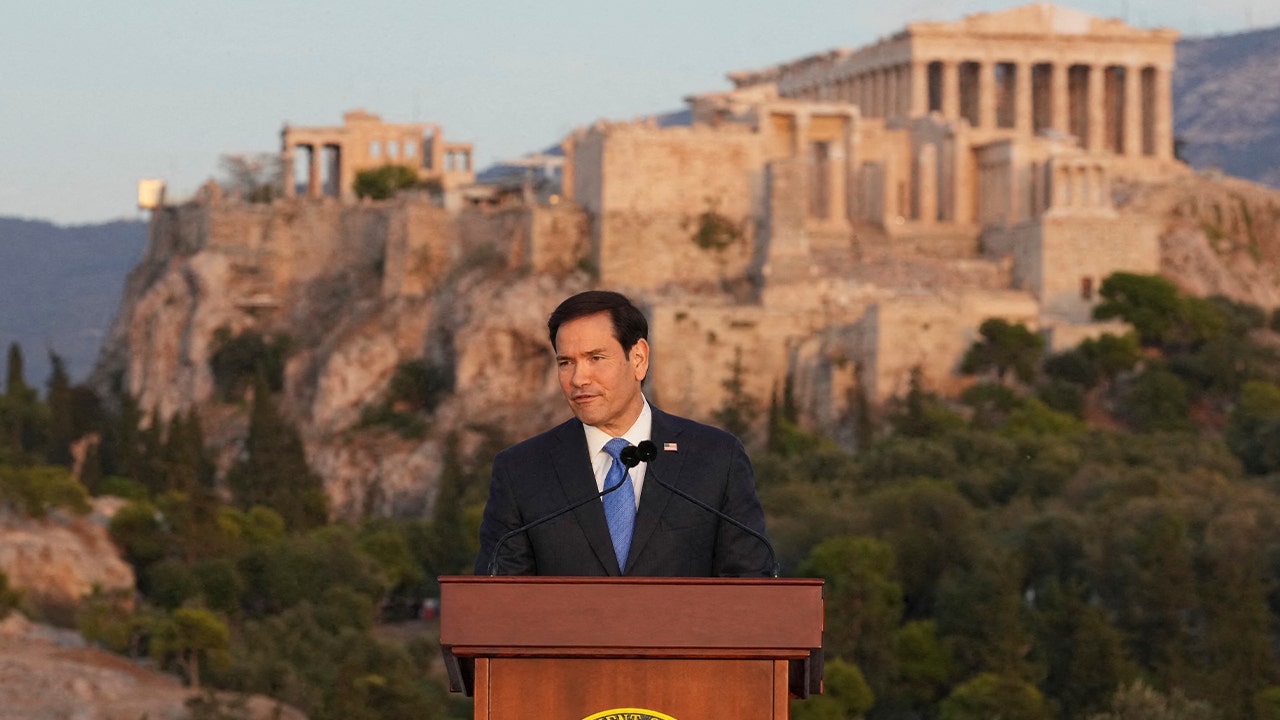
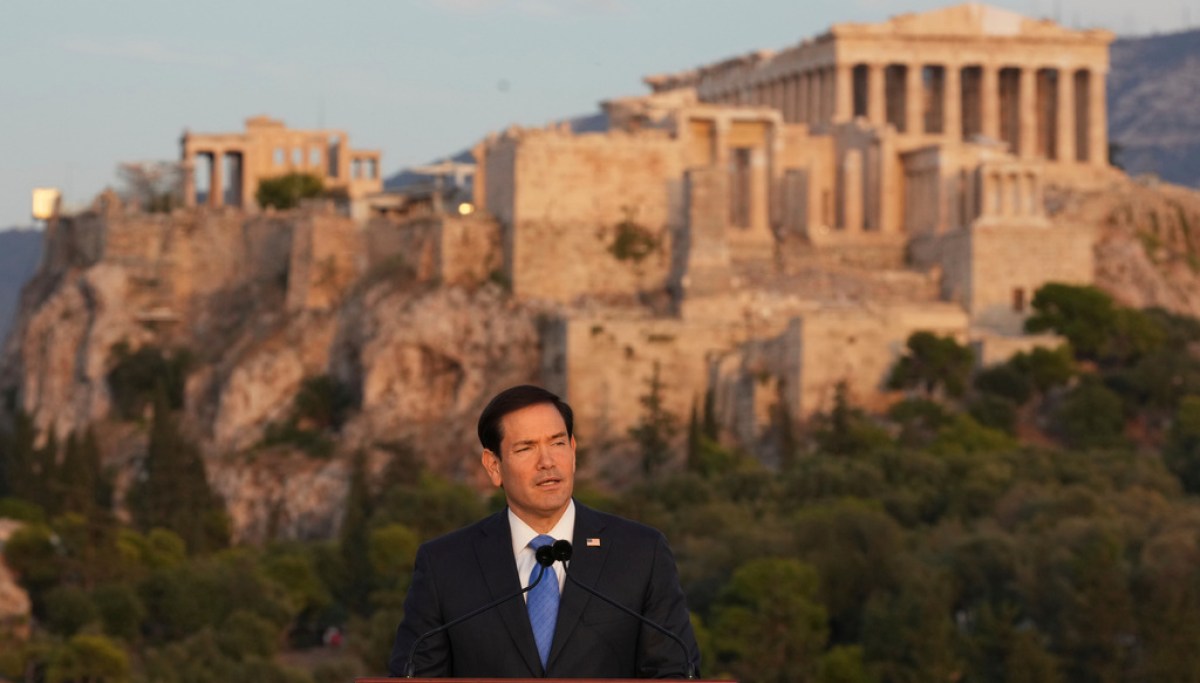
Photo via New York Post

Marco Rubio: We must fight to defend Western Civilization

Read the original at New York Post ↗
Cite

Rubio, M. (2026, October 7). Marco Rubio: We must fight to defend Western Civilization. New York Post. https://nypost.com/2026/10/07/opinion/marco-rubio-we-must-fight-to-defend-western-civilization/

Dated when The Aporia collected the article, usually within hours of publication. Check the original for its exact date and byline.

New York Post · collected 2026-10-07 · by Marco Rubio analysis

Quick Summary

On Wednesday, U.S. Secretary of State Marco Rubio delivered a speech in front of the Acropolis in Greece, emphasizing the importance of defending Western civilization. He highlighted ancient Greek contributions such as democracy and philosophical ideas while stressing the enduring values of individuality, curiosity, and exploration that originated from this period.
Written by AI on 2026-10-08, from this article's own text only (the story summary below draws on all the coverage).
See how they differ ↓

AI analysis

Story summary

On October 7, 2026, US Secretary of State Marco Rubio delivered a speech in Athens near the Acropolis, calling on Western nations to return to their founding democratic values and civilizational roots. Rubio emphasized historical themes like ancient Greek virtues, linking them to President Trump’s "America First" agenda and urging for renewed ambition and power against contemporary threats from Russia, China, and Iran. The State Department framed his speech as a major address on democracy's future. However, his rhetoric drew criticism both domestically and internationally; an article in the Washington Examiner argued that Rubio overstated ancient Greece's influence, while Iranian officials dismissed his civilizational narrative as irrelevant to their current political context. Additionally, historian Ted Widmer critiqued the speech for ignoring modern issues like climate change and scientific research funding. Despite these criticisms, Rubio highlighted recent defense spending commitments by NATO members and stressed the importance of a strong alliance in confronting today's global challenges. The speech sought to reinvigorate Western confidence but faced significant pushback over its historical interpretation and current relevance.

Written for “Rubio Speech Greece Western Values” on 2026-11-20, grounded in this article and the 16 other(s) covering the same event.

How they differ

11 outlets covered “Rubio Speech Greece Western Values”.

What each outlet says

One AI summary per outlet of its latest article on this story, written from that article alone and checked against it. Open the article for the outlet's own words.

New York PostThis outlet7 Oct

On Wednesday, U.S. Secretary of State Marco Rubio delivered a speech in front of the Acropolis in Greece, emphasizing the importance of defending Western civilization. He highlighted ancient Greek contributions such as democracy and philosophical ideas while stressing the enduring values of individuality, curiosity, and exploration that originated from this period.

Marco Rubio: We must fight to defend Western Civilization (this article)4 articles from New York Post on this story
Washington Examiner9 Oct

Marco Rubio delivered a speech in Greece emphasizing Western civilization's unique traits such as individuality and curiosity. However, the article critiques Rubio’s assertion by highlighting parallel examples from non-Western cultures like Buddha's pursuit of enlightenment, Genghis Khan's ambition, and Ibn al Haytham's scientific inquiries. The critique argues that while these qualities are not exclusive to the…

What Rubio gets wrong about the West →2 articles from Washington Examiner on this story
Evening Standard8 Oct

US Senator Marco Rubio, speaking in Portugal and Greece, emphasized the need for NATO countries to increase their defence spending without viewing it as hostile. He praised some nations like Germany for stepping up, while noting others are lagging behind. Rubio stressed that NATO's strength is crucial for deterring threats from Russia and China, urging all member states to contribute to the alliance’s military…

US calls for allies to hike defence spending ‘not a hostile thing’, says Rubio →2 articles from Evening Standard on this story
The Guardian12 Oct

In his October 7 speech in Athens, US Secretary of State Marco Rubio discussed the importance of rediscovering values tied to exploration and conquest to preserve Western civilization. Criticizing the decline of these values, he suggested they are crucial for avoiding irrelevance and decline. However, historian Ted Widmer critiques Rubio’s perspective, arguing it misrepresents historical figures like Jefferson and…

Marco Rubio is promoting troubling ideas about ‘Western civilization’ | Ted Widmer →2 articles from The Guardian on this story
The Hindu7 Oct

Secretary of State Marco Rubio plans to deliver a speech in Athens, Greece, on October 7, 2026, near the Acropolis, calling for Western nations to embrace their democratic roots and values that shaped global dominance. The speech aims to rally Americans and Europeans to renew their commitment to democracy amid concerns about declining adherence to traditional principles. Protesters, numbering around 1,500, organized…

Rubio, in Greece, set to call for the West to restore founding democratic principles and values →
The Straits Times7 Oct

On October 7, US Secretary of State Marco Rubio delivered a speech in Athens emphasizing ancient Greek values like heroism, honor, and duty to support President Donald Trump's "America First" policy. According to excerpts provided by the State Department, Rubio argued that prioritizing national interests is not selfish but necessary for maintaining Western dominance. He also highlighted the strategic alliance…

Rubio to link ancient Greek values to 'America First' speech in Athens →
Show 4 more outlets
BBC7 Oct

US Secretary of State Marco Rubio delivered a speech at the Acropolis in Athens, warning about the decline of Western civilization due to internal issues rather than external threats like terrorism or Iran's regime. He urged nations to revive ancient Greek values and rebuild alliances while maintaining national identities. Rubio emphasized the importance of patriotism and criticized contemporary trends such as…

Western civilisation at risk of 'atrophy, servitude and decline', Rubio says →
National Post8 Oct

U.S. Secretary of State Marco Rubio delivered a speech in Athens emphasizing America’s commitment to national power while urging Europe to increase its defense efforts. Speaking at Pnyx hill near the Acropolis, Rubio praised ancient Greece for its contributions to Western civilization but also warned that Western nations face a critical choice between asserting their power and facing decline. He highlighted…

Rubio praises U.S.’s ‘unapologetic pursuit of national power’, calls on Europe to ‘rekindle the fire’ →
Fox News8 Oct

Senator Marco Rubio delivered a speech in Athens at the Pnyx hillside, emphasizing the historical significance of ancient Greece to Western civilization. He argued that the West is facing critical decisions that will determine its future dominance or decline. Highlighting the contributions of classical Greek philosophy and governance, Rubio stressed the importance of qualities like individuality, curiosity, and…

SEC MARCO RUBIO: The West forgot what made it great. We must rediscover our roots before we lose them →
Al Jazeera10 Oct

US Secretary of State Marco Rubio delivered a speech in Athens invoking ancient Western civilization, comparing contemporary threats faced by modern nations to historical conflicts like the Greco-Persian Wars. His remarks were met with criticism and derision from Iranian officials who accused him of using an "America First" narrative to justify military actions against Iran. Iran’s Ministry of Foreign Affairs…

‘Anachronism’: Rubio’s civilisational rhetoric prompts pushback from Iran →

Where they agree and split

Agreed

AI · cited, from two or more outlets

  • Marco Rubio delivered a speech near the Acropolis in Athens on October 7, 2026.16
  • Rubio's speech invoked ancient Greek values and history to argue for Western nations' renewed commitment to democracy and national power.17

Disputed

Picked by our model, which is sometimes wrong

  • The Straits Times described Rubio as linking ancient Greek values to the 'America First' agenda, while The Guardian suggested his speech was not a defense of democracy like Pericles's.26

Framing

How the first headlines put it

  • The Hindu framed the event around restoring democratic principles and values, whereas Al Jazeera highlighted the anachronistic nature of Rubio’s civilisational rhetoric.15
  • The New York Post emphasized the inflection point in Western civilization, while The Guardian suggested that Rubio's ideas about 'Western civilization' are troubling.38
Attributed to a source3
Stated as fact6
The headlines (9)

Western civilisation at risk of 'atrophy, servitude and decline', Rubio says BBC · attributed to a source

Defence spending hike a sign ‘Europe can awaken from long slumber’, says Rubio Evening Standard · attributed to a source

US 'unapologetic' in 'pursuit of national power,' Rubio says Semafor · attributed to a source

Rubio, in Greece, set to call for the West to restore founding democratic principles and values The Hindu · stated as fact

Marco Rubio to call for the West to return to civilizational roots, restore founding democratic values New York Post · stated as fact

Rubio to link ancient Greek values to 'America First' speech in Athens The Straits Times · stated as fact

WATCH LIVE: Rubio speaks in Greece about Western civilization Washington Examiner · stated as fact

Rubio in Greece digs into past to tout Trump’s ‘America first’ approach The Guardian · stated as fact

Rubio praises U.S.’s ‘unapologetic pursuit of national power’, calls on Europe to ‘rekindle the fire’ National Post · stated as fact

The full story: what happened, how it changed, and all 17 articles →

Compared with similar articles

This article reads leans right and hedges 0% of its claims. Each row says how that neighbour differs.
The Hindu
Hedges 4 of 29 claims Outlet record 60/100
New York Post
Leans strongly right further right than this Hedges 5 of 35 claims Outlet record 66/100
BBC News
Hedges 0 of 18 claims Outlet record 65/100
Evening Standard
Hedges 1 of 33 claims Outlet record 64/100
National Post
Leans strongly right further right than this Hedges 1 of 20 claims Outlet record 60/100
Fox News
Leans strongly right further right than this Hedges 2 of 41 claims Outlet record 67/100
New York Post
Leans strongly right further right than this Hedges 1 of 20 claims Outlet record 66/100
Washington Examiner
Leans left further left than this Hedges 5 of 56 claims Outlet record 67/100
Al Jazeera
Leans strongly left further left than this Hedges 2 of 44 claims Outlet record 60/100
The Guardian
Leans left further left than this Hedges 3 of 44 claims Outlet record 64/100

Story

Rubio Speech Greece Western Values
Politics · 17 article(s) covering the same event. Compare every outlet's account →
How this article was measured signals, leaning charts, publisher record, byline, topics and claims

Signals How these are calculated →

Claims extracted
65
sentences that state something as happening or true
Uncertain
0%
0 of 65 hedged ("reportedly", "may", "according to")
Leaning
Leans right
of the writing, not the subject · beta estimate
Publisher signals
66/100
New York Post's corrections and hedging, across everything collected from it. Not a measure of accuracy.
Outlets on this story
17
Politics
Same framing elsewhere
1
articles that frame the event the way this one does
Analyzed 2026-10-08 · how these are computed

How this is being covered How these are calculated →

Article leaning vs. publisher reliability
Source leaning vs. consistency

Publisher

New York Post · 21382 article(s) · 41 correction(s) detected
Running correction rate · 41 correction(s)

Who wrote this

Marco Rubio
2 article(s) here · 1 carrying a prediction
The decisions we make in the next decade will define the next century – and determine whether our civilization maintains its place at the head of the world, or resigns itself to a future of servitude and decline.
Here in Athens, we found the first full realization of all the essential traits that would come to define the West: fierce individuality and relentless ambition; daring exploration and invention; a yearning for discovery, for adventure, risk and glory; an insatiable curiosity about the world and the principles by which it operates, a hunger to know the mysteries of nature and grasp the secrets of the cosmos; an impatience with the notion of impossibility, chafing at all boundaries, at all limits, straining to peer into the depths of the unknown.
Also by Marco Rubio
Nothing else under this byline is closely related to this article, so these are simply their most recent.

Topics

Acropolis Athenians Athens Greek Greeks

Subjects

Greeks NORP · 4× Acropolis GPE · 3× Athens GPE · 3× Greek NORP · 3× Athenians NORP · 2× Western NORP · 2× Christ PERSON · 1× Greece GPE · 1× Marco Rubio PERSON · 1× State ORG · 1×

Narrative

Here in Athens, we found the first full realization of all the essential traits that would come to define the West: fierce individuality and relentless ambition; daring exploration and invention; a yearning for discovery, for adventure, risk and glory; an insatiable curiosity about the world and the principles by which it operates, a hunger to know the mysteries of nature and grasp the secrets of the cosmos; an impatience with the notion of impossibility, chafing at all boundaries, at all limits, straining to peer into the depths of the unknown.
framing: assertive · carried by 1 article(s) · first seen 2026-10-08
Here in Athens, we found the first full realization of all the essential traits that would come to define the West: fierce individuality and relentless ambition; daring exploration and invention; a yearning for discovery, for adventure, risk and glory; an insatiable curiosity about the world and the principles by which it operates, a hunger to know the mysteries of nature and grasp the secrets of the cosmos; an impatience with the notion of impossibility, chafing at all boundaries, at all limits, straining to peer into the depths of the unknown.
2026-10-08 · New York Post
Marco Rubio: We must fight to defend Western Civilization · assertive framing

Claims (65 extracted, 0 hedged)

In front of the legendary Acropolis in Greece on Wednesday, Secretary of State Marco Rubio gave a stirring defense of Western civilization — and why we must fight to defend it. asserted
we → give → it
The Greeks of antiquity have an almost mystical hold on our memory. asserted
Greeks → have → memory
They call us back to them again and again. asserted
They → call → them
Four-hundred-and-eighty years before Christ, the armies of Xerxes arrived in this city, and they put its sanctuaries to the torch. asserted
they → arrive → torch
Most Athenians had by then evacuated by ship to a nearby island. asserted
Athenians → evacuate → island
But there was a handful of them that refused to leave their home. asserted
that → be → home
So instead they barricaded themselves in the rocky fortress of the Acropolis to fight an extraordinary last stand, heaving massive stones down the cliffs onto the Persian invaders and holding the greatest empire of that age at bay. asserted
empire → barricade → bay
They were eventually overwhelmed. asserted
They → overwhelm → ?
The Persians plundered the temples, burned the shrines and razed the Acropolis to the ground. asserted
Persians → plunder → ground
But when the Athenians returned, they gathered the broken remains of the old Acropolis and buried them in the hill where it had stood, and decades later, under Pericles, they raised the Parthenon. asserted
they → return → Parthenon
For 25 centuries since, the Parthenon has stood. asserted
Parthenon → stand → centuries
Empires have risen and fallen beneath its shadow, and the progeny of the men who built it, the sons of Athens and Rome, have carried their civilization with them to the ends of the earth — two and a half centuries after the founding of the American republic, halfway across the world from where I stand now. asserted
I → rise → world
Athens gave us democracy. asserted
Athens → give → democracy
Plato and Aristotle gave us Western philosophy, our ideas of law, of virtue, of citizenship and republican government were shaped in the Greek city-states. asserted
ideas → give → states
Even much of our political vocabulary — words like “democracy,” “tyranny,” the word “politics” itself — found its origins here. asserted
much → find → origins
But the things we owe to this place as Americans and as Westerners are actually far, far deeper. asserted
we → owe → Westerners
These institutions and ideas were the outward expression of more fundamental qualities we see in the ancient Greeks, qualities that can’t be reduced to any particular political system or theory. asserted
that → see → system
Here in Athens, we found the first full realization of all the essential traits that would come to define the West: fierce individuality and relentless ambition; daring exploration and invention; a yearning for discovery, for adventure, risk and glory; an insatiable curiosity about the world and the principles by which it operates, a hunger to know the mysteries of nature and grasp the secrets of the cosmos; an impatience with the notion of impossibility, chafing at all boundaries, at all limits, straining to peer into the depths of the unknown. asserted
it → find → unknown
The Greeks did not just shape history. asserted
Greeks → shape → history
The Greeks gave us history itself. asserted
Greeks → give → history
Much of what we know about many ancient civilizations comes almost entirely from the records of Greek explorers and historians, explorers and historians who didn’t just chronicle the histories of their own people, but ventured outward to observe and record the sagas of foreign peoples and cultures all across the world. asserted
who → know → world
It paved the way for the Gospel of Jesus Christ to find fertile soil in Europe and flourish into the empire of Christendom. asserted
Gospel → pave → Christendom
It gave birth to a civilization marked not just by a common culture. asserted
It → give → culture
It was marked by a common anthropology, a common view of man and of his place in the universe. asserted
It → mark → universe
Its descendants would share not just the idea of a natural order but a distinctive understanding of virtue, of destiny, of fate, of truth, goodness, and beauty, of a code that dictates how men ought to live, of objective standards and ideals to strive towards. asserted
men → share → standards
The ancient Greek city-states were filled with intense passion and rivalry and faction and conflict. asserted
states → fill → passion
But from that constant struggle for distinction, from that came the great flowering of art and philosophy, and political and intellectual energy that would transform a collective of Mediterranean cities to the birthplace of the greatest civilization in the world. asserted
that → come → world
The thumos — as the ancient Greeks called it, the fire of passion, strength, courage, pride — is the heart of great civilization. asserted
Greeks → call → civilization
Without it, nations lose their will to fight, the will to strive, the will to survive. asserted
nations → lose → will
Ashamed of legacy Today, too much of the West has forgotten this quality. asserted
much → forget → quality
Over time, we in the West came to feel ashamed of the very things that made us exceptional. asserted
us → come → things
We felt embarrassed that our achievements set us apart from the rest of the world. asserted
us → feel → world
Our prosperity somehow became a source of guilt. asserted
prosperity → become → guilt
We no longer believed we deserved and had earned our greatness. asserted
we → believe → greatness
“Nationalism” became a dirty word. asserted
Nationalism → become → ?
And so we tore down our monuments. asserted
we → tear → monuments
We condemned our own history, and in too many places, we taught our children to be ashamed of the countries they would inherit. asserted
they → condemn → countries
In the process, we opened our borders and outsourced our industry and allowed our militaries to wither and to decay. asserted
militaries → open → industry
And with every passing year, we seemed to outsource more of our sovereignty, transferring our decisions to global bureaucracies far beyond the reach of our control. asserted
we → pass → control
But others were all too happy to fill the vacuum left behind by our weakness. asserted
others → fill → weakness
…and 25 more, not listed.
Give feedback · no sign-in needed

No sign-in needed for now. Your note is sent without a name, so it cannot be answered.

History Support