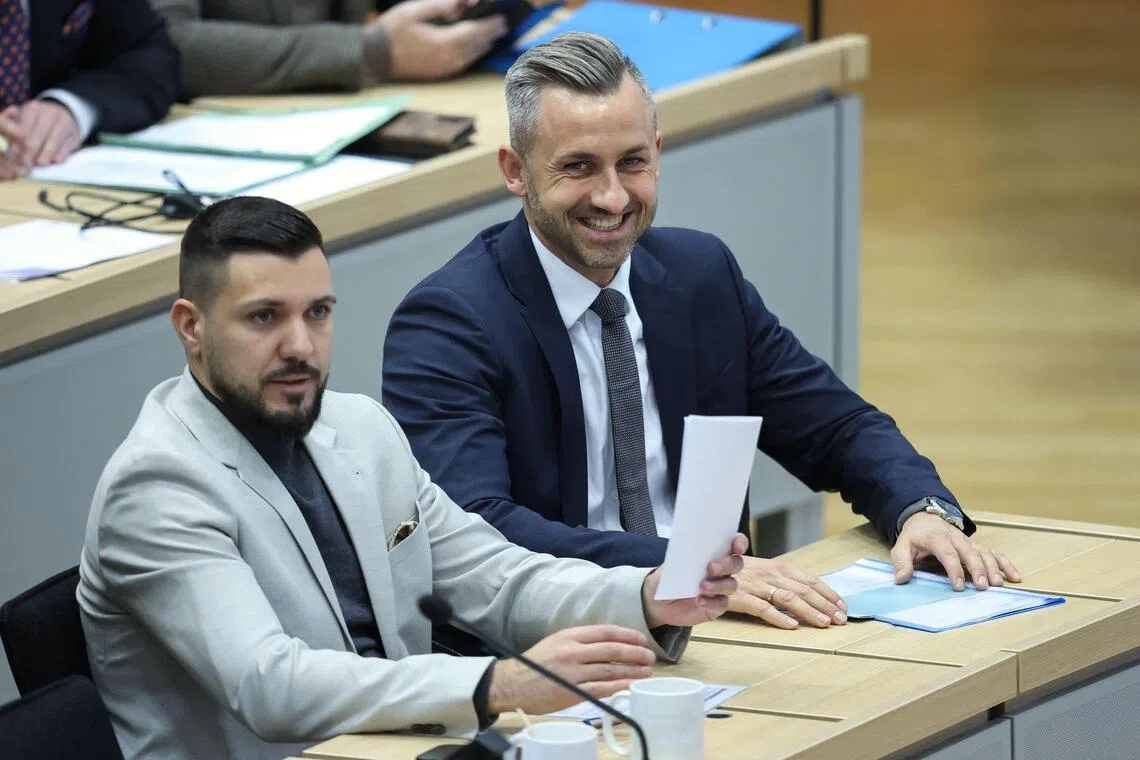
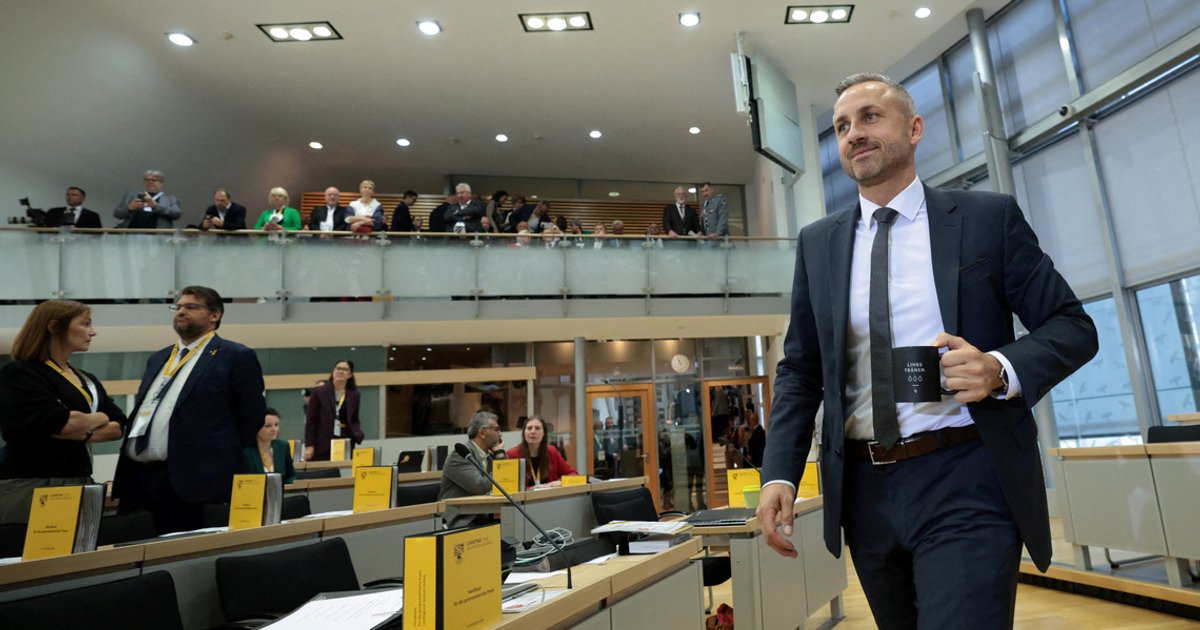
Photo via The Guardian

State parliament elects Germany’s first far-right speaker since second world war

Read the original at The Guardian ↗
Cite

Berlin, K. C. i. (2026, October 6). State parliament elects Germany’s first far-right speaker since second world war. The Guardian. https://www.theguardian.com/world/2026/oct/06/germany-afd-first-far-right-tobias-rausch-speaker-since-war

Dated when The Aporia collected the article, usually within hours of publication. Check the original for its exact date and byline.

The Guardian · collected 2026-10-06 · by Kate Connolly in Berlin

Quick Summary

No summary of this article yet; the story summary below covers the event.
See how they differ ↓

AI analysis

Story summary

On October 6, Tobias Rausch, a member of Germany's far-right party Alternative for Germany (AfD), was elected as the Speaker of the state parliament in Saxony-Anhalt. This marks the first time since World War II that a far-right party has held such an important position in post-war German history. The AfD won nearly 44% of votes in September, easily surpassing the center-right CDU led by Chancellor Friedrich Merz, who is unpopular among many voters.

The election took place amidst concerns from activist groups and migrant communities about potential cooperation with the AfD, which has been classified as a "confirmed extremist" organization by domestic intelligence agencies. About 400 protesters gathered outside the parliament building in Magdeburg to oppose any collaboration with the far-right party. Despite these protests, Rausch won the election comfortably, securing 48 out of 82 votes cast.

While this victory is seen as a symbolic win for the AfD, forming a government remains challenging due to a lack of majority support from other parties. The AfD's stance on restricting immigration and restoring ties with Russia has caused significant debate and concern among both German citizens and international observers.

Written for “German Far Right Wins Power” on 2026-11-20, grounded in this article and the 5 other(s) covering the same event.

How they differ

4 outlets covered “German Far Right Wins Power”.

What each outlet says

One AI summary per outlet of its latest article on this story, written from that article alone and checked against it. Open the article for the outlet's own words.

The Straits Times10 Oct

In Germany, Chancellor Friedrich Merz has warned about extremism entering the parliamentary system, reflecting growing concerns over the rise of the far-right Alternative for Germany (AfD). This week, four lawmakers from mainstream parties in Saxony-Anhalt defied orders to abstain from voting, allowing the AfD to secure its first regional assembly speaker position. The incident highlights potential cracks in the…

Germany's firewall against the far-right AfD feels the heat →3 articles from The Straits Times on this story
The Hindu6 Oct

In eastern Germany, Ola Akhras and her family are reconsidering their future after the far-right AfD won a regional election, making them question whether they feel welcome anymore. The article focuses on how the political shift affects migrants like Ms. Akhras, who fled Syria in 2018 and now feels unsafe due to growing hostility towards immigrants since Germany welcomed over a million refugees in 2015. The AfD's…

Far-right election win leaves migrants questioning their future in eastern Germany →
BBC6 Oct

A month after Germany's far-right AfD won a significant victory in Saxony-Anhalt, Tobias Rausch, an AfD candidate, was elected as the speaker of the regional parliament. This is the first time since World War II that a far-right party has held this position. The election took place with support from nine MPs across different parties, including five from the hard-left BSW and four unidentified MPs. Protesters outside…

AfD candidate elected speaker of German regional parliament for first time →

Where they agree and split

Framing

How the first headlines put it

Stated as fact4
The headlines (4)

Germany’s AfD poised to preside over state assembly for first time The Straits Times · stated as fact

Far-right election win leaves migrants questioning their future in eastern Germany The Hindu · stated as fact

AfD candidate elected speaker of German regional parliament for first time BBC · stated as fact

State parliament elects Germany’s first far-right speaker since second world war The Guardian · stated as fact

The full story: what happened, how it changed, and all 6 articles →

Compared with similar articles

This article reads leans right and hedges 8% of its claims. Each row says how that neighbour differs.
BBC News
Leans left further left than this Hedges 1 of 16 claims Outlet record 65/100
The Straits Times
Leans left further left than this Hedges 1 of 17 claims Outlet record 64/100
The Hindu
Leans left further left than this Hedges 2 of 32 claims Outlet record 60/100
The Straits Times
Leans left further left than this Hedges 1 of 17 claims Outlet record 64/100
“While both articles describe events occurring on October 6, 2026, involving the AfD party in Saxony-Anhalt's state parliament, they discuss different aspects: Article A focuses on the struggle to form a government, while Article B reports on the election of a far-right speaker and deputy.”
Al Jazeera
Hedges 1 of 16 claims Outlet record 60/100
“Article A reports on the election of a far-right speaker in Saxony-Anhalt's regional parliament, while Article B discusses Chancellor Friedrich Merz's response to political extremism after local elections, covering different aspects and times.”
The Straits Times
Leans strongly left further left than this Hedges 4 of 31 claims Outlet record 64/100
“Article A reports on the election of a far-right speaker in Saxony-Anhalt's parliament, while Article B discusses broader implications and reactions to the rise of AfD across Germany.”

Story

German Far Right Wins Power
Politics · 6 article(s) covering the same event. Compare every outlet's account →
How this article was measured signals, leaning charts, publisher record, byline, topics and claims

Signals How these are calculated →

Claims extracted
36
sentences that state something as happening or true
Uncertain
8%
3 of 36 hedged ("reportedly", "may", "according to")
Leaning
Leans right
of the writing, not the subject · beta estimate
Publisher signals
64/100
The Guardian's corrections and hedging, across everything collected from it. Not a measure of accuracy.
Outlets on this story
6
Politics
Same framing elsewhere
1
articles that frame the event the way this one does
Analyzed 2026-10-06 · how these are computed

How this is being covered How these are calculated →

Article leaning vs. publisher reliability
Source leaning vs. consistency

Publisher

The Guardian · 3712 article(s) · 8 correction(s) detected
Running correction rate · 8 correction(s)

Who wrote this

Kate Connolly in Berlin
8 article(s) here · 1 carrying a prediction
Nearly 40% of the 4,000 women who responded to the survey said they had been addressed with suggestive comments and sexualised remarks, while 15% reported being harassed with mobile phone pictures taken against their will and in some cases altered using AI.
Kuznetsov, who will be identified in the trial opening on Wednesday just as Serhii K due to German privacy laws, was referenced by his full name in an extradition order.
Five politicians from the BSW, a small leftwing party that echoes the AfD’s stances on Russia and immigration, had already said they would vote for Rausch.
“The world could learn a thing or two from a sports changing room …
Elif Eralp launched her election bid last autumn with the blunt statement: “People like me are actually not supposed to become mayor in this country.”
Merz, who has vowed his fractious coalition government will plough ahead with an unpopular reform agenda, held an early meeting in Berlin with the Christian Democratic Union (CDU)’s leadership on Monday.
Siegmund, 35, said it would not engage in “games” such as a minority government.
Polls have opened in the east German state of Saxony-Anhalt, where the populist, far-right, anti-immigration Alternative für Deutschland (AfD) is predicted to emerge on top in an election that could have a groundbreaking effect on Germany’s political landscape.
Also by Kate Connolly in Berlin
Nothing else under this byline is closely related to this article, so these are simply their most recent.
All 8 articles by Kate Connolly in Berlin →

Topics

AfD BSW German Germany The Alternative für Deutschland

Subjects

AfD ORG · 13× Rausch PERSON · 7× BSW ORG · 5× Germany GPE · 4× CDU ORG · 3× Saxony-Anhalt GPE · 3× German NORP · 2× Tillschneider PERSON · 2× The Alternative für Deutschland ORG · 1× Tobias Rausch PERSON · 1×

Narrative

Before the vote, Eva von Angern of the leftwing Die Linke party and the longest-serving member of the Saxony-Anhalt parliament, drew parallels between Rausch’s election to the post of speaker, and Hermann Göring’s use of that role in the Reichstag in the 1930s to facilitate Adolf Hitler’s rise to power.
framing: assertive · carried by 1 article(s) · first seen 2026-10-06
Five politicians from the BSW, a small leftwing party that echoes the AfD’s stances on Russia and immigration, had already said they would vote for Rausch.

Claims (36 extracted, 3 hedged)

The Alternative für Deutschland has become Germany’s first far-right party to secure the position of speaker of a regional parliament since the second world war. asserted
Alternative → become → war
Tobias Rausch, a former estate agent, was elected in the first round of voting on Tuesday in Saxony-Anhalt. asserted
Rausch → elect → Anhalt
He won 48 out of the 82 votes cast. asserted
He → win → votes
Later in the day, Hans-Thomas Tillschneider, part of the AfD’s more extreme wing, was elected as Rausch’s deputy. asserted
Tillschneider → elect → deputy
The AfD, which is classed as “rightwing extremist” by the eastern state’s intelligence agency, won nearly 44% of votes in elections last month, dealing a hammer blow to Germany’s chancellor, Friedrich Merz, and his centre-right Christian Democrats (CDU). asserted
which → class → chancellor
Rausch’s election to the role of president of the parliament – and its speaker – took place at the inaugural gathering of members in the state capital, Magdeburg. asserted
election → take → capital
Twenty-nine voted against Rausch and five abstained. asserted
five → vote → Rausch
The AfD parliamentary group holds 39 seats, narrowly short of an absolute majority. asserted
group → hold → majority
Five politicians from the BSW, a small leftwing party that echoes the AfD’s stances on Russia and immigration, had already said they would vote for Rausch. asserted
they → echo → Rausch
Tuesday’s result means that four other MPs voted for the 35-year-old in the secret ballot. asserted
MPs → mean → ballot
The willingness of politicians to break the “firewall” – a moral agreement among other parties to shun the AfD – gives the party a chance of being able to form a government in the state – a feat it had looked unlikely to pull off. asserted
it → break → state
The BSW’s support for Rausch came after the party’s founder, Sahra Wagenknecht, declared it was time to do away with “firewall idiocy”. asserted
it → come → idiocy
Her deputy, Christian Leye, said the “firewall is not working” and the votes of nearly 44% of electors could not be ignored. uncertain
votes → say → electors
“We need an intelligent way of dealing with the AfD and that means dealing with the content of their programme instead of a firewall,” Leye told German media. asserted
Leye → need → media
It was not immediately clear who was behind Tillschneider’s election because the BSW had said it would refuse to vote for him. asserted
it → say → him
He received 44 votes. asserted
He → receive → votes
As the architect of the AfD’s “radical” manifesto, he is lined up to become culture and science minister in the state. asserted
he → line → state
He has referred to the Russian president, Vladimir Putin, as “a real man with a sound set of values” and accused immigrants of “streaming in here in masses … wanting to squander our money”. asserted
He → refer → money
Tillschneider is a scholar of Islamic studies who has described Islam as a “fungus” growing on the “German oak”. asserted
who → describe → oak
His family emigrated from Romania to Germany in the 1980s. asserted
family → emigrate → 1980s
In his acceptance speech, Rausch promised to represent all voices and “take different opinions seriously and to try to take decisions in a transparent way”. asserted
Rausch → promise → way
He was applauded by his own parliamentary group and the ranks of the BSW. asserted
He → applaud → BSW
The other MPs did not respond. asserted
MPs → respond → ?
Rausch was one of the key figures in a nepotism scandal over AfD MPs employing family members in parliament. asserted
MPs → employ → parliament
He denied claims that several of his siblings and a brother-in-law were working in the state parliament but confirmed he was employing several players from the football club where he is a member. uncertain
he → deny → club
He is a close ally and confidant of Ulrich Siegmund, the AfD’s lead candidate, who is positioning himself to take over as leader of Saxony-Anhalt. asserted
who → position → Anhalt
He has yet to say which parties or politicians have agreed to cooperate with the AfD, only that “negotiations are going well”. asserted
negotiations → have → AfD
The AfD claims to be courting members of the CDU to break the firewall, a claim CDU leaders deny. uncertain
leaders → claim → claim
The BSW says it will support an AfD-led parliament only if a nonpartisan figure is appointed to lead it, a position the AfD rejects. asserted
AfD → say → it
Siegmund has until December to form a government. asserted
Siegmund → have → government
Opposition MPs raised alarm over the breaching of the firewall. asserted
MPs → raise → firewall
“Whoever has invested a representative of extremist and anti-constitutional party with this office will bear responsibility for the consequences,” said Green MP Susan Sziborra-Seidlitz, to loud applause. asserted
Seidlitz → invest → applause
The result of the Saxony-Anhalt poll, along with two other regional elections in September, has piled huge pressure on Merz, who pledged on taking office in 2025 that he would halve the AfD’s support by boosting the economy and reducing immigration. asserted
he → pile → immigration
Instead, the CDU’s support has more or less halved and that of the AfD has surged to 30% in national polls. asserted
that → halve → polls
Before the vote, Eva von Angern of the leftwing Die Linke party and the longest-serving member of the Saxony-Anhalt parliament, drew parallels between Rausch’s election to the post of speaker, and Hermann Göring’s use of that role in the Reichstag in the 1930s to facilitate Adolf Hitler’s rise to power. asserted
Angern → serve → power
She claimed that the negative consequences of the AfD’s win in the state were already being felt in lower tourist numbers and teachers withdrawing job applications. asserted
teachers → claim → applications
Give feedback · no sign-in needed

No sign-in needed for now. Your note is sent without a name, so it cannot be answered.

History Support