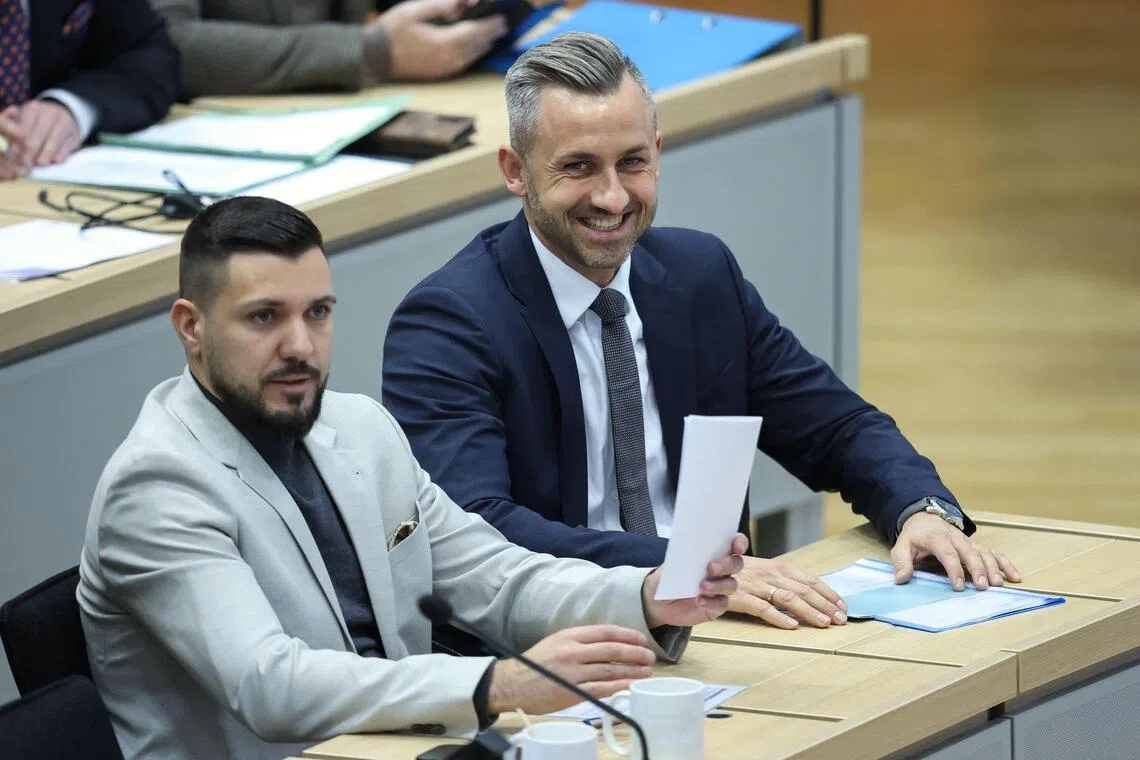
Photo via The Straits Times

Germany's far-right AfD struggles to form first state government after landmark win

Read the original at The Straits Times ↗
Cite

The Straits Times. (2026, October 6). Germany's far-right AfD struggles to form first state government after landmark win. The Straits Times. https://www.straitstimes.com/world/europe/germanys-far-right-afd-struggles-to-form-first-state-government-after-landmark-win

Dated when The Aporia collected the article, usually within hours of publication. Check the original for its exact date and byline.

The Straits Times · collected 2026-10-06 · by The Straits Times

Quick Summary

In Saxony-Anhalt, Germany, the far-right Alternative for Germany (AfD) faces difficulties forming a state government despite winning a significant portion of the September 6 election. The party secured enough votes to become the largest faction but lacks an absolute majority by three seats, preventing it from immediately establishing a government or naming Ulrich Siegmund as state premier without more support. The AfD's struggle highlights its broader challenge in converting electoral gains into executive power due to mainstream parties' refusal to cooperate under the "firewall" policy.
Written by AI on 2026-10-06, from this article's own text only (the story summary below draws on all the coverage).
See how they differ ↓

AI analysis

Story summary

On October 6, Tobias Rausch, a member of Germany's far-right party Alternative for Germany (AfD), was elected as the Speaker of the state parliament in Saxony-Anhalt. This marks the first time since World War II that a far-right party has held such an important position in post-war German history. The AfD won nearly 44% of votes in September, easily surpassing the center-right CDU led by Chancellor Friedrich Merz, who is unpopular among many voters.

The election took place amidst concerns from activist groups and migrant communities about potential cooperation with the AfD, which has been classified as a "confirmed extremist" organization by domestic intelligence agencies. About 400 protesters gathered outside the parliament building in Magdeburg to oppose any collaboration with the far-right party. Despite these protests, Rausch won the election comfortably, securing 48 out of 82 votes cast.

While this victory is seen as a symbolic win for the AfD, forming a government remains challenging due to a lack of majority support from other parties. The AfD's stance on restricting immigration and restoring ties with Russia has caused significant debate and concern among both German citizens and international observers.

Written for “German Far Right Wins Power” on 2026-11-20, grounded in this article and the 5 other(s) covering the same event.

How they differ

4 outlets covered “German Far Right Wins Power”.

What each outlet says

One AI summary per outlet of its latest article on this story, written from that article alone and checked against it. Open the article for the outlet's own words.

The Straits TimesThis outlet6 Oct

In Saxony-Anhalt, Germany, the far-right Alternative for Germany (AfD) faces difficulties forming a state government despite winning a significant portion of the September 6 election. The party secured enough votes to become the largest faction but lacks an absolute majority by three seats, preventing it from immediately establishing a government or naming Ulrich Siegmund as state premier without more support. The…

Germany's far-right AfD struggles to form first state government after landmark win (this article)3 articles from The Straits Times on this story
The Hindu6 Oct

In eastern Germany, Ola Akhras and her family are reconsidering their future after the far-right AfD won a regional election, making them question whether they feel welcome anymore. The article focuses on how the political shift affects migrants like Ms. Akhras, who fled Syria in 2018 and now feels unsafe due to growing hostility towards immigrants since Germany welcomed over a million refugees in 2015. The AfD's…

Far-right election win leaves migrants questioning their future in eastern Germany →
BBC6 Oct

A month after Germany's far-right AfD won a significant victory in Saxony-Anhalt, Tobias Rausch, an AfD candidate, was elected as the speaker of the regional parliament. This is the first time since World War II that a far-right party has held this position. The election took place with support from nine MPs across different parties, including five from the hard-left BSW and four unidentified MPs. Protesters outside…

AfD candidate elected speaker of German regional parliament for first time →

Where they agree and split

Framing

How the first headlines put it

Stated as fact4
The headlines (4)

Germany’s AfD poised to preside over state assembly for first time The Straits Times · stated as fact

Far-right election win leaves migrants questioning their future in eastern Germany The Hindu · stated as fact

AfD candidate elected speaker of German regional parliament for first time BBC · stated as fact

State parliament elects Germany’s first far-right speaker since second world war The Guardian · stated as fact

The full story: what happened, how it changed, and all 6 articles →

Compared with similar articles

This article reads leans left and hedges 6% of its claims. Each row says how that neighbour differs.
The Straits Times
Leans left Hedges 1 of 17 claims Outlet record 64/100
The Hindu
Leans left Hedges 2 of 32 claims Outlet record 60/100
The Guardian
Leans right further right than this Hedges 3 of 36 claims Outlet record 64/100
“While both articles describe events occurring on October 6, 2026, involving the AfD party in Saxony-Anhalt's state parliament, they discuss different aspects: Article A focuses on the struggle to form a government, while Article B reports on the election of a far-right speaker and deputy.”
BBC News
Leans left Hedges 1 of 16 claims Outlet record 65/100
“While both articles describe events related to the AfD's activities in Saxony-Anhalt, they report on different occurrences: Article A covers the party's struggle to form a government after an election win, while Article B reports on the election of Tobias Rausch as parliament speaker.”

Story

German Far Right Wins Power
Politics · 6 article(s) covering the same event. Compare every outlet's account →
How this article was measured signals, leaning charts, publisher record, byline, topics and claims

Signals How these are calculated →

Claims extracted
17
sentences that state something as happening or true
Uncertain
6%
1 of 17 hedged ("reportedly", "may", "according to")
Leaning
Leans left
of the writing, not the subject · beta estimate
Publisher signals
64/100
The Straits Times's corrections and hedging, across everything collected from it. Not a measure of accuracy.
Outlets on this story
6
Politics
Same framing elsewhere
1
articles that frame the event the way this one does
Analyzed 2026-10-06 · how these are computed

How this is being covered How these are calculated →

Article leaning vs. publisher reliability
Source leaning vs. consistency

Publisher

The Straits Times · 5570 article(s) · 7 correction(s) detected
Running correction rate · 7 correction(s)

Who wrote this

The Straits Times
3829 article(s) here · 1 carrying a prediction
The European leaders were meeting as part of the so-called coalition of the willing, which regularly gathers to discuss ways to protect a postwar Ukraine from future Russian aggression.
US peace negotiator Jared Kushner, at the same event, also said that he and fellow negotiator Steve Witkoff had “gotten the Russians comfortable with the concept that any security guarantee for Ukraine would be based on Article 5”.
Takaichi’s China trip this week was her first since suggesting in 2025 that Japan might intervene militarily if China attempted to take Taiwan by force.
But while some believe the success of the meeting could have a stabilising effect on an international order in turmoil, the broad consensus among analysts is that this first-of-its-kind meeting worked more as a confidence-building exercise between the rival nations rather than an immediate, concrete cure to the world’s ills.
Iraqi security forces will deploy in Jurf al-Sakhar, a stronghold of the Kataib Hezbollah armed group, on Friday, security officials told a press conference, under a compromise deal designed to ease tensions with Iran's most powerful Shi'ite militia ally in the country.
Some analysts said the outcome of the Shenzhen summit may actually diminish Trump’s stature on the world stage as he enters the lame-duck phase of his presidency, while bolstering two of Washington’s main adversaries.
Whether or not the allegation is true, “just the news will definitely influence people’s opinions of women who have broken the ceiling or are trying to.” Asian American women working in tech, civil rights advocacy and academia have felt a sense of dread that this ordeal will diminish how their peers are viewed and treated in their workplaces. It is a reminder that no accomplishments will completely dispel centuries-old stereotypes.
Three killed in missile strikes on Kyiv, mayor says, in biggest attack on bridges
The Bill is backed by both the oil and gas industry and clean energy groups, but opposed by many major environmental organisations. The measure now proceeds to the House of Representatives, where Speaker Mike Johnson, a supporter of the initiative, has predicted he has the votes to pass it. But members on both sides of the aisle, including Minority Leader Hakeem Jeffries, have said they want to make changes to the Bill. Some Republicans, including Representative Chip Roy, policy chair of the ultraconservative House Freedom Caucus, have wavered in their support, saying they have concerns about the legislation’s electric transmission provisions. Some progressive Democrats, meanwhile, have said they oppose the Senate version of the Bill, contending it would weaken environmental laws. Representative Bruce Westerman, the chairman of the House Natural Resources Committee, said on Nov 19 he doubted there would be time to make changes to the Bill before Congress’s term expires at the end of December. “If the Senate gets it done then I think that’s what we’ll have to pass in the House,” Westerman said in an interview before the vote.
Their complaint alleged that supervisors had warned that objections would result in “trouble.”
Also by The Straits Times
Nothing else under this byline is closely related to this article, so these are simply their most recent.
All 3829 articles by The Straits Times →

Topics

AfD German Germany MAGDEBURG Saxony-Anhalt

Subjects

AfD ORG · 12× BSW ORG · 6× Germany GPE · 5× Siegmund PERSON · 5× German NORP · 2× MAGDEBURG GPE · 2× Rausch PERSON · 2× Saxony-Anhalt GPE · 2× Alternative for Germany ORG · 1× Ulrich Siegmund PERSON · 1×

Narrative

Founded in 2013 as a eurosceptic movement, the AfD won over voters with an increasingly hardline opposition to immigration after around a million people fled to Germany in 2015. The party has since become a dominant political force in much of eastern Germany, especially among voters disillusioned with the mainstream parties, though many remain strongly opposed to cutting any deals with the AfD. About 400 protesters gathered peacefully on Tuesday outside the state parliament in Magdeburg and read aloud Germany's constitution ahead of the session, with dozens holding up a long red banner that read: "No cooperation with the extreme right." SYMBOLIC VICTORY Tuesday's inaugural sitting, which the state constitution requires to take place within 30 days of the election, nevertheless offered the AfD a symbolic victory.
framing: assertive · carried by 1 article(s) · first seen 2026-10-06
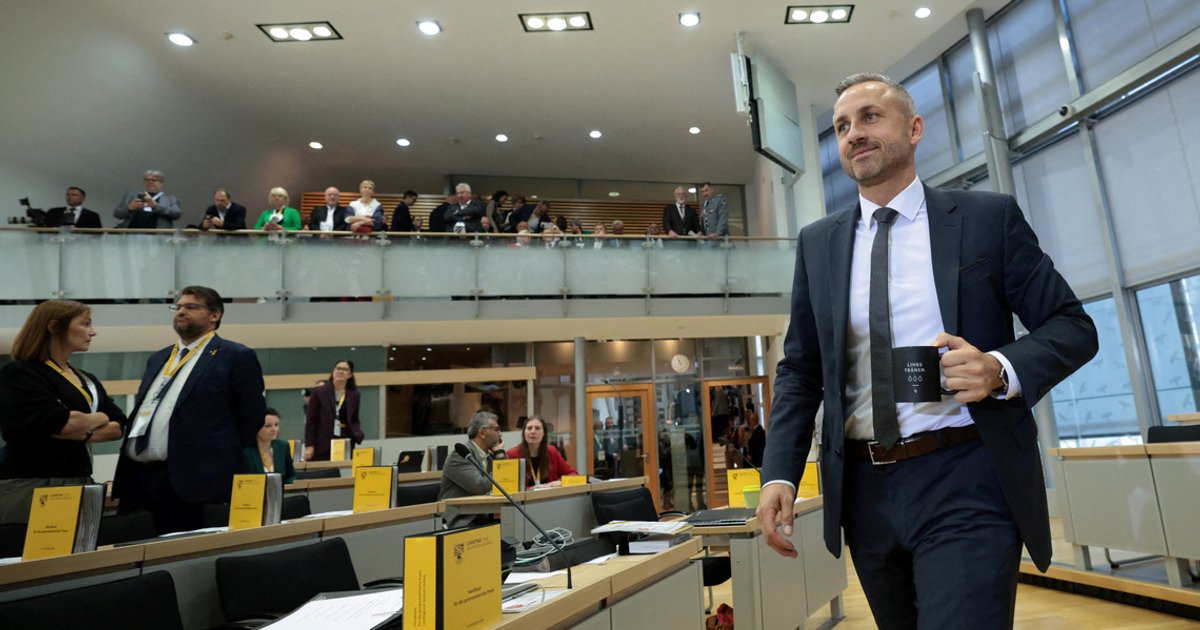
The far-right Alternative for Germany convened for the first sitting of the Saxony-Anhalt state parliament on Tuesday but, a month after its landmark election win, the party still lacks a clear path to forming what would be its first state government.

Claims (17 extracted, 1 hedged)

Germany's far-right AfD struggles to form first state government after landmark win MAGDEBURG, Germany, Oct 6 - asserted
AfD → struggle → win
The far-right Alternative for Germany convened for the first sitting of the Saxony-Anhalt state parliament on Tuesday but, a month after its landmark election win, the party still lacks a clear path to forming what would be its first state government. asserted
what → convene → path
Despite winning the vote in the September 6 election in the eastern German state, the AfD fell three seats short of the absolute majority that candidate Ulrich Siegmund had aimed for. asserted
Siegmund → win → that
Siegmund said before Tuesday's sitting that he aimed to win parliamentary backing to become state premier in a first round of voting that he said would only take place in December, giving him more time to build support. asserted
he → say → support
He did not elaborate. asserted
He → elaborate → ?
The party has so far failed to secure enough support from potential partners or publicly win over defectors from rivals, leading to a stalemate in its efforts to form a government. asserted
party → fail → government
'FIREWALL' COMPLICATIONS The impasse underlines a challenge that has dogged the AfD for years: translating growing electoral support into executive power in a political system where mainstream parties have refused to cooperate with it under the "firewall" policy. asserted
parties → underline → policy
Founded in 2013 as a eurosceptic movement, the AfD won over voters with an increasingly hardline opposition to immigration after around a million people fled to Germany in 2015. The party has since become a dominant political force in much of eastern Germany, especially among voters disillusioned with the mainstream parties, though many remain strongly opposed to cutting any deals with the AfD. About 400 protesters gathered peacefully on Tuesday outside the state parliament in Magdeburg and read aloud Germany's constitution ahead of the session, with dozens holding up a long red banner that read: "No cooperation with the extreme right." SYMBOLIC VICTORY Tuesday's inaugural sitting, which the state constitution requires to take place within 30 days of the election, nevertheless offered the AfD a symbolic victory. asserted
constitution → found → victory
Tobias Rausch, a 35-year-old real estate entrepreneur and Siegmund confidant, was elected president of the state parliament with support from the left-wing populist BSW, becoming the first AfD member to hold one of the highest offices in a German state legislature. asserted
Rausch → elect → legislature
Rausch used his inaugural speech to call on lawmakers to work together, adding that "the days of political firewalls should be a thing of the past". asserted
days → use → past
The AfD's success in Saxony-Anhalt and two other state elections in September has put Chancellor Friedrich Merz's struggling government under pressure and raised questions within his conservatives about the effectiveness of the firewall. asserted
success → put → firewall
The AfD has been working for weeks to win over lawmakers from Merz's party, whose support halved from the last state election, but no defections have been announced so far. asserted
defections → work → election
Tuesday's vote was also closely watched for signs of whether the AfD can reliably count on the BSW, the only party that has not explicitly ruled out cooperation, though it has rejected the idea of joining the AfD in a coalition government. asserted
it → watch → government
The BSW, which like the AfD opposes mass immigration and wants to restore energy ties with Russia, has said it would abstain in any vote for Siegmund for state premier. asserted
it → oppose → premier
That could lead to the AfD forming a minority government with passive tolerance from the BSW, under a model seen in neighbouring Thuringia, though Siegmund has previously rejected such a setup as making him too reliant on the smaller party. uncertain
him → lead → party
Siegmund has also floated the possibility of new elections if he does not secure the required majority the first time around. asserted
he → float → majority
In Tuesday's secret ballot to become state parliament leader, Rausch secured 48 votes, suggesting he attracted support not only from his own party and the BSW - totalling 44 votes - but also from at least four other lawmakers. asserted
he → become → lawmakers
Give feedback · no sign-in needed

No sign-in needed for now. Your note is sent without a name, so it cannot be answered.

History Support