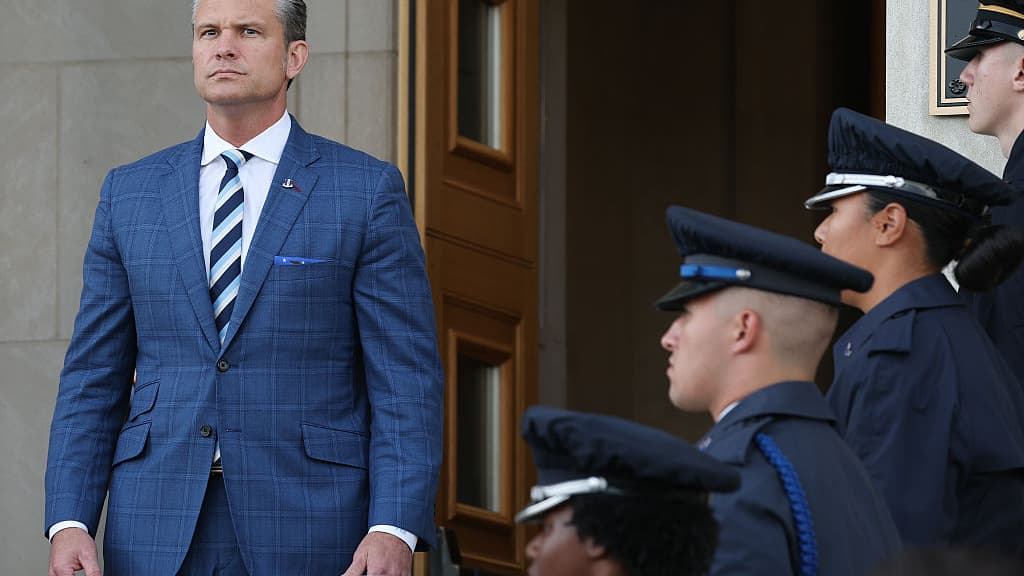
Photo via TIME

What the Pentagon’s Sweeping Polygraph Hunt Has Revealed

Read the original at TIME ↗
Cite

Schneid, R. (2026, September 6). What the Pentagon’s Sweeping Polygraph Hunt Has Revealed. TIME. https://time.com/article/2026/09/06/what-the-pentagon-s-sweeping-polygraph-hunt-has-revealed/

Dated when The Aporia collected the article, usually within hours of publication. Check the original for its exact date and byline.

TIME · collected 2026-09-06 · by Rebecca Schneid

Quick Summary

Pentagon investigators administered polygraph tests to around 50 members of the Joint Staff in August as part of an investigation into unauthorized disclosures about the nation's dwindling weapons stockpiles, which include long-range precision-guided missiles and air-defense interceptors. The investigation was sparked by reports from multiple outlets that US supplies of certain critical munitions had fallen dangerously low, with some sources estimating that missile interceptor inventories have dropped to around 1,000 for Patriot systems and 250 for THAAD systems. Defense Secretary Pete Hegseth's announcement of a joint task force with the Department of Justice to identify and prosecute leakers was likely in response to these reports, which were denied by President Trump as "treasonous statements" that would lead to long-term jail sentences for those responsible. The exact numbers of US weapons stockpiles are classified, but experts warn that disclosing such information could be valuable to US adversaries.
Written by AI on 2026-09-06, from this article's own text only (the story summary below draws on all the coverage).
See how they differ ↓

AI analysis

Story summary

About 50 members of the US military's Joint Staff, including high-ranking officials and civilian employees, were subjected to polygraph tests in August as part of an investigation into leaks about the country's munitions stockpiles. The polygraphs were conducted after news reports revealed that the US was rationing munitions, particularly long-range missiles and Patriot interceptors, due to supply concerns amid the war with Iran. President Trump had previously denied the reports, saying the US has a "lot of ammunition" but acknowledging a need for more sophisticated supplies.

The investigation is part of a larger effort by the Pentagon and Justice Department to identify and prosecute people suspected of leaking sensitive government information to the press. The use of polygraph tests in this case was rare, with officials noting that only a small number of people have access to classified information about munitions stockpiles. No one failed the questions related to the leaks, according to sources.

The move has been seen as an attempt to intimidate others who might consider leaking sensitive information in the future. The Joint Staff is responsible for coordinating operations and policy with combatant commanders around the world, making it a critical component of the US military's planning and advisory structure.

Written for “Pentagon Leaks Investigation” on 2026-11-21, grounded in this article and the 8 other(s) covering the same event.

How they differ

8 outlets covered “Pentagon Leaks Investigation”.

What each outlet says

One AI summary per outlet of its latest article on this story, written from that article alone and checked against it. Open the article for the outlet's own words.

TimeThis outlet6 Sep

Pentagon investigators administered polygraph tests to around 50 members of the Joint Staff in August as part of an investigation into unauthorized disclosures about the nation's dwindling weapons stockpiles, which include long-range precision-guided missiles and air-defense interceptors. The investigation was sparked by reports from multiple outlets that US supplies of certain critical munitions had fallen…

What the Pentagon’s Sweeping Polygraph Hunt Has Revealed (this article)
The Straits Times5 Sep

Top US military officials are being polygraph-tested in an effort to identify who leaked classified information about US munitions stockpiles. According to reports, around 50 members of the Joint Staff at the Pentagon are undergoing lie-detector tests as part of an investigation into the leak. The testing is a rare move, with some analysts noting that it's unusual for polygraphs to be used in a wide-scale…

Top US military officials face lie-detectors in hunt over classified stockpiles leak: Reports →2 articles from The Straits Times on this story
The Dispatch4 Sep

A commentary piece from The Dispatch critiques the Department of Defense's leadership for claiming to be the most transparent department in history, calling it a "bald-faced misrepresentation" and expressing admiration for their "chutzpah". No specific numbers or data are mentioned. The article takes a critical tone, questioning the integrity of government officials' statements. It is written from an opinion…

The Department of Defensiveness →
CBS News5 Sep

Some of the highest-ranking officials in the U.S. military, including Central Command officials and combatant commanders, were subjected to polygraph tests over leaked classified details about the nation's munitions stockpiles. According to sources, several dozen people were given the tests earlier this summer, but no one failed. The tests were part of a leak probe sparked by President Trump's fury over the…

Top military officials faced polygraphs over leaks on munitions, sources say →
New York Post5 Sep

High-ranking military officials, approximately 50 from the War Department, were polygraphed last month to identify a leaker of classified information about the country's munitions stockpile. No one failed the lie-detector tests intended to pinpoint the individual responsible for releasing sensitive details. President Trump was reportedly "furious" about the leaks and has dismissed concerns that the US military is…

Pentagon polygraphed several dozen top military officials in hunt for leakers: reports →
Sydney Morning Herald5 Sep

US government investigators have subjected around 50 members of the US military's Joint Staff to polygraph tests in an effort to identify leaks to journalists. The tests were conducted in August and focused on whether staff had disclosed classified information about the Iran war, including a shortage of crucial munitions. Between 1500 and 2000 officers and officials work for the Joint Staff. Pentagon spokesperson…

‘Treasonous’: Pentagon forces staff to take polygraphs in hunt for leaks to journalists →
Show 2 more outlets
Washington Examiner5 Sep

The Pentagon has subjected some high-ranking military officials and civilian employees to polygraph tests as part of an effort to identify leaks about U.S. munitions stockpiles being depleted by the war with Iran. According to reports, no one failed the questions related to the leaks in August when the examinations were conducted. The investigation follows a joint task force established by Defense Secretary Pete…

Pentagon issues polygraph tests in hunt for leakers of munition shortages: Report →
Dawn6 Sep

The Pentagon is conducting polygraph tests on around 50 members of its Joint Staff, including senior military officers and civilian employees, as part of an investigation into leaks about US munitions stockpiles. The testing aims to identify who revealed classified information about depleted ammunition supplies following months of fighting in Iran. The wide-scale use of lie detectors is rare for a leak…

Top US military officials face lie detectors in leak hunt →

Where they agree and split

Framing

How the first headlines put it

Attributed to a source2
Stated as fact2
The headlines (4)

Top military officials faced polygraphs over leaks on munitions, sources say CBS News · attributed to a source

Pentagon polygraphed several dozen top military officials in hunt for leakers: reports New York Post · attributed to a source

The Department of Defensiveness The Dispatch · stated as fact

Pentagon subjects 50 members of the joint staff to polygraph tests in expanded leak hunt The Straits Times · stated as fact

The full story: what happened, how it changed, and all 9 articles →

Compared with similar articles

This article reads unscored and hedges 14% of its claims. Each row says how that neighbour differs.
New York Post
Centre Hedges 4 of 12 claims Outlet record 66/100
The Sydney Morning Herald
Hedges 3 of 24 claims Outlet record 61/100
The Straits Times
Centre Hedges 1 of 3 claims Outlet record 64/100
The Straits Times
Centre Hedges 1 of 11 claims Outlet record 64/100
Washington Examiner
Hedges 5 of 12 claims Outlet record 67/100
Dawn
Leans left Hedges 1 of 14 claims Outlet record 66/100
CBS News
Leans right Hedges 5 of 36 claims Outlet record 66/100
The Dispatch
Leans left Hedges 0 of 2 claims Outlet record 61/100
“Article A mentions general transparency issues and misrepresentations, while Article B reports on a specific investigation involving polygraph tests and unauthorized disclosures”
CBS News
Hedges 1 of 18 claims Outlet record 66/100
“Article A describes a polygraph investigation, while Article B mentions an investigation into a 'leak' and its impact on information coming out of the Pentagon”
CBS News
Hedges 0 of 3 claims Outlet record 66/100
“Article A describes a broader investigation involving polygraph tests, while Article B focuses on Rep. Crow's lack of knowledge about the investigation and Defense Secretary Hegseth's alleged motives”

Story

Pentagon Leaks Investigation
Crime & Law · 9 article(s) covering the same event. Compare every outlet's account →
How this article was measured signals, leaning charts, publisher record, byline, topics and claims

Signals How these are calculated →

Claims extracted
69
sentences that state something as happening or true
Uncertain
14%
10 of 69 hedged ("reportedly", "may", "according to")
Leaning
withheld
no quote in the article backed the model's score
Publisher signals
60/100
TIME's corrections and hedging, across everything collected from it. Not a measure of accuracy.
Outlets on this story
9
Crime & Law
Same framing elsewhere
1
articles that frame the event the way this one does
Analyzed 2026-09-06 · how these are computed

How this is being covered How these are calculated →

Article leaning vs. publisher reliability
Source leaning vs. consistency

Publisher

TIME · 1081 article(s) · 2 correction(s) detected
Running correction rate · 2 correction(s)

Who wrote this

Rebecca Schneid
39 article(s) here · 1 carrying a prediction
According to the U.S. Centers for Disease Control and Prevention (CDC), it’s estimated that the outbreak began in mid- to late-February, two to three months before the outbreak was detected and declared an emergency by the World Health Organization (WHO) in mid-May.
The President also expressed confidence that the bill would create jobs and help drive the economy, writing: “Importantly, hundreds of thousands of Blue Collar Workers will be positively affected, BIG TIME, by the passage of this Bill.”
He went on to say that the course would close on Nov. 15 to undergo renovations, which would take 15 months to complete.
The incident raised questions about what might have led to the historic event—only the second nationwide ground stop since 9/11—and what authorities were doing to prevent it from happening again.
It’s the first of several steps necessary to determine the next Prime Minister—but a potentially months-long process could leave Benjamin Netanyahu in power for the foreseeable future.
Trump’s unsubstantiated fraud claims come nearly two weeks after he told reporters on Oct. 27 that he would respect the election results “if they’re honest elections.” As results came in throughout Nov. 3 and into Nov. 4, Trump seemed to accept the outcome.
2026-11-09 · mixed framing · Trump Casts Doubt on Midterm Election Results
Experts tell TIME that the threats themselves might be the point—launching a fear campaign meant to disrupt systems and put millions of people on edge.
2026-11-08 · assertive framing · Europe’s Bomb Threats Raise Fears of Hybrid Warfare
Experts weigh in on what may have prompted the shifts.
But in recent weeks the election forecaster twice shifted the race toward Democrats as polls showed Hamilton narrowing the gap with Marshall, moving it first to “Lean Republican” on September 23 and then to a true “Toss Up” on Oct. 6. Republicans took notice in the past two months, diverting resources from swing-state Senate battles like that in North Carolina to defend Marshall’s seat.
The Trump Administration has said that construction could begin as early as next week.
Also by Rebecca Schneid
Nothing else under this byline is closely related to this article, so these are simply their most recent.
All 39 articles by Rebecca Schneid →

Topics

Defense Iran Pentagon The New York Times U.S.

Subjects

U.S. GPE · 8× Pentagon ORG · 5× Iran GPE · 4× Trump PERSON · 4× CSIS ORG · 2× Hegseth PERSON · 2× Pete Hegseth PERSON · 2× TIME ORG · 2× Defense ORG · 1× The New York Times ORG · 1×

Narrative

Spokesman Sean Parnell said in a statement to TIME that the Pentagon does not comment on investigative matters but “takes all leaks of classified national security information extremely seriously and investigates accordingly.” “Securing classified information is critical to ensuring the security of the United States and of our troops deployed around the world,” the statement said.
framing: assertive · carried by 1 article(s) · first seen 2026-09-06
They suggested that its inventory would likely dwindle further amid the ongoing war with Iran.
2026-09-06 · TIME
What the Pentagon’s Sweeping Polygraph Hunt Has Revealed · assertive framing

Claims (69 extracted, 10 hedged)

Pentagon investigators administered polygraph tests to dozens of military officers and civilian employees in August as part of an investigation into disclosures about the nation’s dwindling weapons stockpiles. asserted
investigators → administer → stockpiles
The polygraph tests, first reported by The New York Times last week, followed Defense Secretary Pete Hegseth’s announcement in July that the Pentagon was forming a joint task force with the Department of Justice to identify and prosecute what he called the “unauthorized disclosure of sensitive” information to the press. asserted
he → report → press
Spokesman Sean Parnell said in a statement to TIME that the Pentagon does not comment on investigative matters but “takes all leaks of classified national security information extremely seriously and investigates accordingly.” “Securing classified information is critical to ensuring the security of the United States and of our troops deployed around the world,” the statement said. asserted
statement → say → world
The August interrogations included some 50 members of the Joint Staff, according to the Times. uncertain
interrogations → include → Times
CBS News also reported that several dozen officials were tested earlier this summer, including those from the U.S. Central Command. asserted
officials → report → Command
Why did the Pentagon polygraph dozens of officials? asserted
Pentagon → polygraph → officials
Sources familiar with the matter told multiple outlets this summer that U.S. supplies of certain critical munitions—including long-range precision-guided missiles and air-defense interceptors—had fallen dangerously low. asserted
supplies → tell → missiles
They suggested that its inventory would likely dwindle further amid the ongoing war with Iran. uncertain
inventory → suggest → Iran
Sources told The Washington Post that Trump clashed with Hegseth over the matter during a visit to Camp David on July 31, claiming that he had been “misled on extreme munitions shortages that now threaten to limit military options with Iran.” asserted
that → tell → Iran
“The U.S. has massive amounts of ‘munitions,’ especially of certain types,” Trump wrote in his post. asserted
Trump → have → post
“Additionally, large amounts are being manufactured and shipped to the U.S. as needed.” asserted
amounts → manufacture → U.S.
“The ‘leakers’ of these treasonous statements are being hunted down,” he added. asserted
he → hunt → statements
“Long term jail sentences will be sought!” asserted
sentences → seek → ?
In a separate post that same day, he denied that he’d fought with Hegseth, calling the reports “completely unfounded rumors.” asserted
he → deny → reports
“I am extremely happy with the job that Pete Hegseth is doing,” he said. asserted
he → do → that
Trump intensified his attacks on the coverage on Sept. 3, calling media outlets who reported on the shortages “treasonous scum” who refuse to “accurately report” on the conflict with Iran. asserted
who → intensify → Iran
Despite Trump’s repeated denials of a broad munitions shortage, the Center for Strategic and International Studies (CSIS) estimated in late July that missile interceptor inventories have dropped—with Patriot inventories now under 1,000 and THAAD inventories at about 250. asserted
inventories → repeat → 250
Exact figures about the U.S. weapons cache are classified—and that’s for a good reason, according to Harrison Mann, a former defense intelligence official and a senior fellow with the advocacy group Win Without War. uncertain
that → classify → War
“That is valuable information to any U.S. adversary,” he tells TIME. asserted
he → tell → TIME
“Obviously, if they know that we're out of ammo in some significant way, it changes deterrence calculations for U.S. adversaries.” asserted
it → know → adversaries
At the same time, however, he argues that any shortage would likely be clear to the public and to Iran. asserted
shortage → argue → Iran
“Smart people can put together pretty accurate estimates of what the U.S. has used up between looking at what's been produced, which isn't necessarily a closely guarded secret, and looking at what has been expended on the battlefield,” he says. asserted
he → put → battlefield
“Maybe not with the same amount of fidelity [as Pentagon officials], but the Iranians can tell when they're not getting hit by as many standoff munitions, and certainly everyone can tell when U.S. and partners have run out of interceptors.” asserted
U.S. → tell → interceptors
Mark Cancian, a senior adviser with the CSIS Defense and Security Department, says he and his colleague created CSIS’s July report on dwindling munitions using only “unclassified” sources. asserted
he → say → sources
“If two people at a think tank can do this analysis with entirely unclassified sources, then the Chinese, with tens of thousands of intelligence operatives, and way better sources of information can get much better numbers,” Cancian says. asserted
Cancian → do → numbers
What Pentagon polygraph rules require—and what the tests found The Pentagon adheres to specific guidelines and restrictions when administering polygraph tests. asserted
Pentagon → require → tests
They are most commonly used in pre-employment and vetting for intelligence agencies like the National Security Agency and the Defense Intelligence Agency. asserted
They → use → Agency
They are also administered when personnel are seeking or maintaining access to top-secret, special-access, or other sensitive information—as well as in the event of unauthorized disclosures of classified information. asserted
personnel → administer → information
Pentagon rules require an examinee’s written consent and allow the person to end the examination at any time. asserted
person → require → time
For an issue-specific counterintelligence examination, investigators must have interviewed the person, reasonably believe that the person knew about or was involved in the matter, pursue other investigative avenues as thoroughly as circumstances permit, and determine that the polygraph is essential to the investigation. asserted
polygraph → interview → investigation
The Defense Secretary is also required to establish a process for monitoring the “responsible and effective” use of polygraphs and to make information about their use available to congressional defense committees. asserted
information → require → committees
The Pentagon has not released enough information to determine whether investigators followed all those requirements. asserted
investigators → release → requirements
It also has not disclosed the investigation’s findings. asserted
It → disclose → findings
CBS News, however, reported that no one had failed the questions meant to determine whether any officials had leaked information to the media. asserted
officials → report → media
It also said that the polygraph tests included a wide range of questions pertaining to national security. asserted
tests → say → security
Specifically, The New York Times reported that officials were asked if they had disclosed classified information to members of the press, according to information provided by its sources close to the investigation, and if they had provided information about diminished munitions stocks. uncertain
they → report → stocks
People familiar with the effort told the Times that the tests appeared intended not only to identify a leaker but also to deter officials who might leak classified information to the media in the future. uncertain
who → tell → future
While the use of polygraphs is not unheard of, the sheer number of people targeted during this investigation is uncommon, officials told CBS News. asserted
officials → target → News
David Pozen, a law professor at Columbia University, pointed TIME toward his article for the Harvard Law Review that assesses information leaks within the federal government. asserted
that → point → government
“Periodically, task forces have recommended that the White House take concerted steps to facilitate leak investigations, such as regularizing the use of polygraphs and requiring government employees who speak with the press to provide advance notice, followed by summaries of what was discussed,” he wrote. asserted
he → recommend → summaries
…and 29 more, not listed.
Give feedback · no sign-in needed

No sign-in needed for now. Your note is sent without a name, so it cannot be answered.

History Support