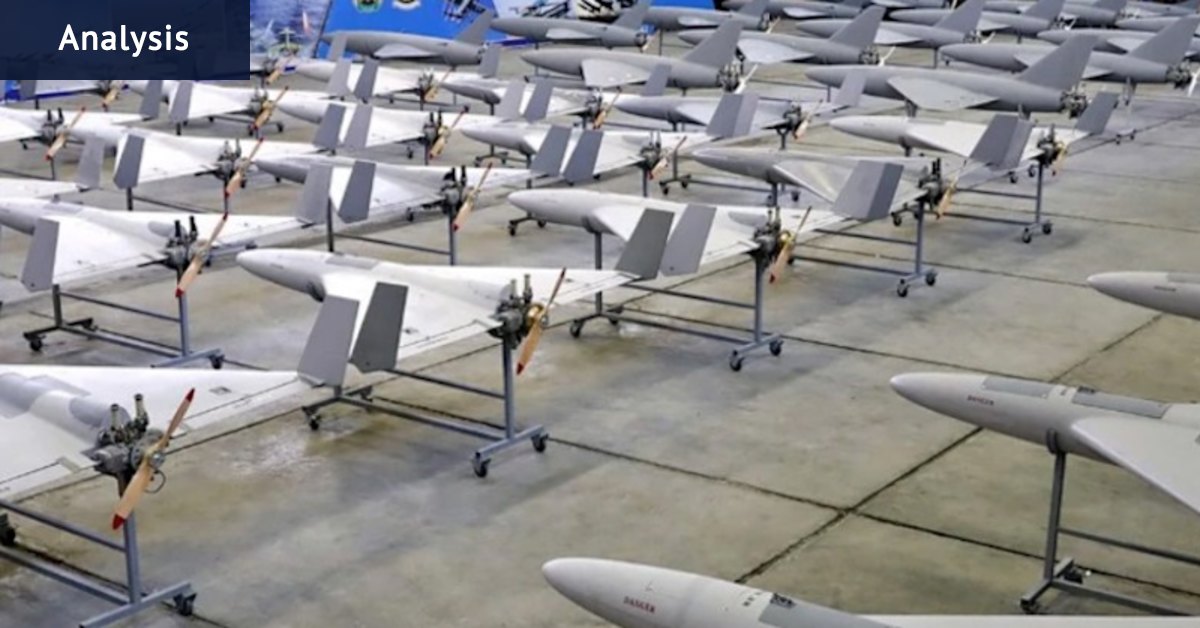
Photo via The Sydney Morning Herald

How cheap drones are upending the big business of defence

Read the original at The Sydney Morning Herald ↗
Cite

Zappone, C. (2026, September 5). How cheap drones are upending the big business of defence. The Sydney Morning Herald. https://www.smh.com.au/business/the-economy/how-cheap-drones-are-upending-the-big-business-of-defence-20260729-p60jp2.html?ref=rss&utm_medium=rss&utm_source=rss_feed

Dated when The Aporia collected the article, usually within hours of publication. Check the original for its exact date and byline.

The Sydney Morning Herald · collected 2026-09-05 · by Chris Zappone

Quick Summary

The defense industry is being disrupted by cheap drones that are pushing down financial costs and forcing a rethink from militaries and governments. According to analyst Lesia Bidochko, some countries are practicing "drone Keynesianism" by building stocks of drones to meet government-directed goals. The US is looking to emulate this model through its "Drone Dominance" program, which incentivizes small suppliers to innovate quickly in response to battlefield needs. Major Western defense companies are struggling to keep up with the pace and cost of drone production, favoring traditional approaches over innovative ones.
Written by AI on 2026-09-05, from this article's own text only (the story summary below draws on all the coverage).
See how they differ ↓

AI analysis

Story summary

Drones are dramatically altering military strategies, particularly in the ongoing conflict between Ukraine and Russia, where cheap drones overwhelm traditional defense systems. For instance, Kyiv plans to launch up to 1,000 drones nightly against Russia's infrastructure. This shift is causing significant disruptions: Russian airports experienced an average of 32 closures per day in August 2022 alone, surpassing the full-year total for 2025 by a factor of six. Moreover, this technological shift challenges traditional defense manufacturing, favoring smaller, more agile companies over established primes. As Russia's economy struggles and civilian infrastructure faces constant threats from Ukrainian drone attacks, both sides face escalating costs and risks, with no clear path to victory.

Written for “War in Ukraine” on 2026-11-20, grounded in this article and the 7 other(s) covering the same event.

How they differ

7 outlets covered “War in Ukraine”.

What each outlet says

One AI summary per outlet of its latest article on this story, written from that article alone and checked against it. Open the article for the outlet's own words.

Sydney Morning HeraldThis outlet5 Sep

The defense industry is being disrupted by cheap drones that are pushing down financial costs and forcing a rethink from militaries and governments. According to analyst Lesia Bidochko, some countries are practicing "drone Keynesianism" by building stocks of drones to meet government-directed goals. The US is looking to emulate this model through its "Drone Dominance" program, which incentivizes small suppliers to…

How cheap drones are upending the big business of defence (this article)
CBC9 Sep

The Ukrainian government has been launching drone attacks on Russian territory, causing widespread disruptions and increasing anxiety among ordinary Russians. According to reports, more than 380 Ukrainian drones have been intercepted by Russia's air defenses, but two civilians were killed in overnight strikes. The attacks have led to fuel shortages and long lines at gas stations in Russia, with some videos showing…

Ukraine has been trying to bring the war to Russia. More Russians are beginning to feel it →2 articles from CBC on this story
The Guardian6 Sep

Serhii Beskrestnov, defense technology adviser to Volodymyr Zelenskyy, warns of mutual destruction if the war with Russia continues. According to Beskrestnov, neither side can prevail in the escalating conflict, which has become a "war of cities" and is increasingly targeting civilians. Ukraine plans to launch 1,000 drones per night against Russian economic and military targets, while Russia threatens to knock out…

‘Nobody will win’: Zelenskyy adviser warns of mutual destruction if war with Russia continues →
The Independent6 Sep

Ukrainian local newspapers are struggling to stay alive amidst the ongoing war with Russia. Since February 2022, over 300 publications have closed and around 28% of Ukrainian outlets have shut down due to safety concerns and economic difficulties. According to Oksana Brovko, CEO of the Association of Independent Regional Press Publishers of Ukraine, local journalists have taken on the role of war correspondents…

‘Overnight we all became war correspondents’: Ukraine’s local newspapers face battle to stay alive →
The Straits Times6 Sep

Russia has been launching near-constant drone attacks on Kyiv, disrupting daily life for its 3 million residents. The attacks have caused power and water outages, and in recent days, civilians have been injured or killed by the strikes. For residents like Vitaliia Poliakova, who was injured in a drone strike last Thursday, the situation is becoming increasingly difficult to cope with, especially as winter…

How escalating attacks are upending daily life in Kyiv →
CBS News8 Sep

Lithuania is preparing for a potential Russian invasion by training its civilian population in military-style survival skills and defense tactics, including the use of drones. The country's Minister of Defense Robertas Kaunas expressed confidence in Lithuania's ability to defend itself despite being close to Russia ally Belarus. At least 2 people were reported killed in Kyiv, Ukraine, which has been under attack…

Lithuania training civilians to defend against a Russian invasion →
Show 1 more outlets
Euronews10 Sep

Ukrainian drone operations forced 32 Russian airports to close an average of 32 times a day in August, with summer totals already exceeding all of 2025, according to industry data from Osprey Flight Solutions. The closures, which have been the most disruptive month for Russian civil aviation since its invasion of Ukraine began in early 2022, were due to the activation of Russia's "Kover" air defence protocol…

'The days of safety are over': Russian airports face record closures →

Where they agree and split

Framing

How the first headlines put it

Stated as fact2
The headlines (2)

How cheap drones are upending the big business of defence Sydney Morning Herald · stated as fact

‘Nobody will win’: Zelenskyy adviser warns of mutual destruction if war with Russia continues The Guardian · stated as fact

The full story: what happened, how it changed, and all 8 articles →

Compared with similar articles

This article reads leans left and hedges 8% of its claims. Each row says how that neighbour differs.
Dawn
Hedges 3 of 27 claims Outlet record 67/100
“The articles cover different conflicts (Ukraine-Russia vs KP police) and mention different terrorist groups, indicating distinct events”
The Straits Times
Hedges 0 of 9 claims Outlet record 64/100
“Article A mentions drones in general, while Article B refers to a specific incident of fully autonomous killer drones killing three Ukrainians”
CBC News
Hedges 3 of 49 claims Outlet record 60/100
“Article A mentions drone warfare and its effects in the Ukraine-Russia conflict, while Article B describes a specific incident of drone attacks on Russian military facilities and air defences intercepting Ukrainian drones”
The Hindu
Leans right further right than this Hedges 1 of 11 claims Outlet record 60/100
“Article A reports on a new U.S. tariff taking effect, while Article B discusses the impact of cheaper drones on defense industries and military strategies”
ABC News (AU)
Hedges 0 of 19 claims Outlet record 67/100
“Article A describes a specific drone attack on Ukraine's SBU headquarters, while Article B mentions drone warfare and its effects in general terms without referencing the same incident”
The Hindu
Leans left Hedges 5 of 58 claims Outlet record 60/100
“Article A mentions drone warfare in general and its impact on defense manufacturing, while Article B specifically discusses Ukraine's use of Starlink technology for military purposes”
South China Morning Post
Hedges 0 of 6 claims Outlet record 62/100
“Although both articles mention drone strikes, they describe different aspects of the conflict and do not detail the same specific incident.”
The Guardian
Hedges 7 of 36 claims Outlet record 64/100
“Article A discusses the effects of drone warfare in general, including their role in the Ukraine-Russia conflict, while Article B focuses on a specific warning by Zelenskyy's adviser about the escalating war and plans to launch drones for strikes”
The Straits Times
Hedges 1 of 38 claims Outlet record 64/100

Story

War in Ukraine
World · 8 article(s) covering the same event. Compare every outlet's account →
How this article was measured signals, leaning charts, publisher record, byline, topics and claims

Signals How these are calculated →

Claims extracted
59
sentences that state something as happening or true
Uncertain
8%
5 of 59 hedged ("reportedly", "may", "according to")
Leaning
Leans left
of the writing, not the subject · beta estimate
Publisher signals
61/100
The Sydney Morning Herald's corrections and hedging, across everything collected from it. Not a measure of accuracy.
Outlets on this story
8
World
Same framing elsewhere
1
articles that frame the event the way this one does
Analyzed 2026-09-05 · how these are computed

How this is being covered How these are calculated →

Article leaning vs. publisher reliability
Source leaning vs. consistency

Publisher

The Sydney Morning Herald · 7728 article(s) · 16 correction(s) detected
Running correction rate · 16 correction(s)

Who wrote this

Chris Zappone
23 article(s) here · 1 carrying a prediction
But its journey back to the top will depend on how things operate on its factory floor – now and far into the future.
We will provide immediate updates as we have them.”
Describing the outsourcing move as “part of the business model for Qantas for some time,” Transport Minister Catherine King said: “I think that we saw the last time that it engaged in this sort of level of outsourcing during COVID, that it did a significant amount of damage to its social license.” Qantas said on Tuesday it will eliminate 850 local jobs, and send them to professional services firm Accenture, to “modernise its back-end systems, processes and data”, with back office functions “mostly” shifted to India.
Qantas will cut 850 local jobs after inking a deal with professional services firm Accenture to “modernise its back-end systems, processes and data”.
“Routes that may have been marginal, for some time that have been subsidised by more profitable routes, are really being examined closely and capacity reduced on some of those routes.
It marks the start of the airline’s travel to WSI, where it will fly three times weekly from Auckland.
The first commercial flight from Australia’s newest international airport will take off this morning from Western Sydney International, bound for the Gold Coast.
Once Western Sydney International Airport opens on Sunday, the true strength of demand for flights from Australia’s newest airport will start to show.
In the latest case, the business and property division of Britain’s High Court heard how VietJet has resisted paying, and even halted flights of aircraft to Singapore where they would have been seized under court orders.
“So if you’re a member of the public who sees a drone flying in an area that a BRINC DFR product is being deployed in, you could Google that, find the agency, find the flight,” he said.
Also by Chris Zappone
Qantas to cut 850 local jobs as it shifts roles to India
2026-11-09 · The Sydney Morning Herald
Nothing else under this byline is closely related to this article, so these are simply their most recent.
All 23 articles by Chris Zappone →

Topics

Iran Russia Ukraine Western iPhones

Subjects

Ukraine GPE · 3× Boeing ORG · 2× Iran GPE · 2× Russia GPE · 2× British NORP · 1× Jay Guthrie PERSON · 1× John Maynard Keynes PERSON · 1× Lesia Bidochko PERSON · 1× Ukrainian NORP · 1× Western NORP · 1×

Narrative

“What you need is a load of mini primes, where you build that framework agreement (with the defence departments), but there’s still the man-in-the-shed mentality,” where new features can be tried quickly. The learning curve around drone economics is steep, and Guthrie said that, typically, nations’ defence departments stick with the primes “because it’s easy” and the framework for contracts is already in place.
framing: assertive · carried by 1 article(s) · first seen 2026-09-05
Economist John Maynard Keynes believed governments could solve economic problems through massive, sustained spending on production.
2026-09-05 · The Sydney Morning Herald
How cheap drones are upending the big business of defence · assertive framing

Claims (59 extracted, 5 hedged)

The lower price and high impact of drone warfare is pushing down the financial costs of aerial bombardment, forcing a rethink from militaries and governments. asserted
price → push → militaries
At the same time, the blistering pace of drone innovation is also disrupting traditional defence manufacturing by lowering the barriers and opening the door to favour smaller, more nimble companies. asserted
pace → blister → companies
Drones have come to define the Ukraine-Russia conflict and their effects are playing out daily in the Middle East. asserted
effects → come → East
Salvos of drones are overwhelming conventional air defence systems; swarms of cheap drones are being shot down with expensive Western-made missiles; and inexpensive small drones are taking on tanks. asserted
drones → overwhelm → tanks
In the process, long-standing practices of how defence gear is designed, built, and sold are being repriced at a lower cost, much in the way computers, once the province of university labs in the 1960s, became ubiquitous PCs in the 1990s, then laptops, and iPhones. asserted
computers → stand → 1990s
In the defence world, this has created a gap in capabilities between drone-savvy militaries and ones relying on high-tech, expensive weapons of the past. asserted
this → create → past
Nations quickly building stocks of drones to meet government-directed goals are practicing what Ukrainian analyst Lesia Bidochko describes as “drone Keynesianism”. asserted
Bidochko → build → Keynesianism
Economist John Maynard Keynes believed governments could solve economic problems through massive, sustained spending on production. uncertain
governments → believe → production
For companies, the goal shifts from marketing complex and elegant systems to fielding drone units that can deliver on a battlefield. asserted
that → shift → battlefield
Today, for example, Ukraine incentivises 500 small suppliers to work fast and respond to near-daily changes on the battlefield. asserted
Ukraine → incentivise → battlefield
The government creates the market, allowing small companies to focus on rapid innovation while literally “under fire”. asserted
companies → create → fire
The US is looking to emulate this model through its “Drone Dominance” program. asserted
US → look → program
Jay Guthrie, a British ex-service member who has spent time in Ukraine, said drones can be simultaneously “low cost” to build and deploy and “high impact” in what they destroy. asserted
they → spend → what
At the same time, large legacy defence companies can’t produce drones at the speed or cost needed to be effective on a modern battlefield, he said. asserted
he → produce → battlefield
Major Western defence companies are “all looking at the 100 per cent solution” made up of “a really shiny drone that looks really pretty when it takes off”. asserted
it → look → drone
“But in reality, at the end of the day, it’s going to end up a big lump of plastic anyway, so it doesn’t need to be shiny. asserted
it → go → plastic
Just robust enough to get to the target,” he said. asserted
he → get → target
Iran pioneered the strategy of building cheaper drones that could seek to overwhelm Israeli and US defences. uncertain
that → pioneer → defences
Iran built thousands of Shahed drones, costing a fraction of the price of US interceptor missiles. asserted
Iran → build → missiles
The Ukrainians played catch-up after Russia expanded its war against Kyiv in 2022. asserted
Russia → play → 2022
The rise of drones is also changing the big business of defence procurement because drones can be produced quickly and at low cost by smaller companies rather than the traditional corporate giants, which rely on long-lead times, that supply militaries. asserted
that → change → militaries
While there some large-scale makers of civilian drones, smaller nimble drone players have been driving much of the disruption in the defence sector. asserted
players → drive → sector
Guthrie notes that it takes Western-based defence companies 18 months to two years to incorporate major innovations The technology of drones – cheap electronics, 3D-printed parts, rapidly updated designs – is transforming part of the defence industry dominated for decades by major companies known as “prime subcontractors”. asserted
technology → note → subcontractors
Companies such as Boeing, Lockheed Martin, Airbus, and Thales act as systems integrators, which manage “complex supply chains and manage risk around delivery of major projects”, he said. asserted
he → act → projects
The prime contractors can see the shift. asserted
contractors → see → shift
Some are learning from it. asserted
Some → learn → it
Boeing, for instance, is trialling an ultra-low cost guidance system, which could be used on drones and missiles, “to dramatically reduce per-unit costs and enable precision munition employment at scale across programs”. uncertain
which → trialle → programs
Guthrie, who works for UK-based Merlin Power Defence, said that at issue is the scale of the companies doing the production. asserted
scale → work → production
“What you need is a load of mini primes, where you build that framework agreement (with the defence departments), but there’s still the man-in-the-shed mentality,” where new features can be tried quickly. The learning curve around drone economics is steep, and Guthrie said that, typically, nations’ defence departments stick with the primes “because it’s easy” and the framework for contracts is already in place. asserted
framework → need → place
But the prime contractors have “many investors and the need to return an investment”. asserted
contractors → have → investment
So what is a $10 drone becomes about $200 because everyone has a “piece of the pie”, said Guthrie. asserted
Guthrie → become → pie
Small and medium enterprises, he says, are more agile. asserted
he → say → ?
They can build. asserted
They → build → ?
They can innovate. asserted
They → innovate → ?
They’ve got fewer people on their shoulders saying: “You need to make a big profit out of it”. asserted
You → get → it
Melbourne start-up Freespace Operations uses ArduPilot, an open-source autopilot system to guide its drones, says co-founder chief technology officer Leonard Hall. “This whole industry is based on that simple factor,” Hall said. asserted
Hall → use → factor
Freespace Operations doesn’t build combat drones, but drones designed to lift equipment, some used for defence, to “last for years”. asserted
Operations → build → years
Hall said that if not for open-source autopilot code, it would cost $100 million to code the autopilot before his company’s drone could be tested. uncertain
drone → say → autopilot
Instead, “open source allows small companies to share the developmental burden of the impossible task”. asserted
companies → allow → task
To take advantage of the rapid development once it’s done. asserted
it → take → development
…and 19 more, not listed.
Give feedback · no sign-in needed

No sign-in needed for now. Your note is sent without a name, so it cannot be answered.

History Support