Photo via Noahpinion

Are we watching the U.S. go bankrupt?

Read the original at Noahpinion ↗
Cite

Smith, N. (2026, August 24). Are we watching the U.S. go bankrupt? Noahpinion. https://www.noahpinion.blog/p/are-we-watching-the-us-go-bankrupt

Dated when The Aporia collected the article, usually within hours of publication. Check the original for its exact date and byline.

Noahpinion · collected 2026-08-24 · by Noah Smith commentary

Quick Summary

Market analysts and investors are concerned about rising long-term interest rates, which could signal expectations of higher inflation or a loss of confidence in the US government's ability to repay its debts. The yield on 30-year US Treasury bonds jumped by 6 basis points (0.06%) recently, causing worries that it may be a sign of trouble ahead. According to economist John Cochrane, unsustainable fiscal policies can lead bond investors to demand higher interest rates as a risk premium, potentially triggering a global sovereign debt retrenchment. The Trump administration has attempted to intervene in the market by buying long-term bonds, but the yields have bounced back up despite this effort.
Written by AI on 2026-08-24, from this article's own text only (the story summary below draws on all the coverage).
See how they differ ↓

AI analysis

Story summary

The US has surpassed $40 trillion in national debt for the first time, according to the US Treasury Department. This milestone marks 20 years of government spending that grew under both President Donald Trump and President Joe Biden. During Trump's first term, he approved $8.4 trillion worth of debt, while Biden approved $4.3 trillion worth of debt. The Committee for a Responsible Federal Budget estimates that the government has added $1.8 trillion to its debt in the current fiscal year alone. As a result, government watchdog groups had anticipated for weeks that the US would surpass the $40 trillion threshold after it reached $39 trillion in March.

The rapid growth of national debt has raised concerns among economists and politicians about the country's economic future. Some experts warn that a loss of confidence in the US government could lead to higher interest rates, inflation, and even bankruptcy. In response to the growing debt, the Treasury Department recently announced $5 billion in bond buybacks to calm investors, but this move has been criticized as merely treating symptoms rather than addressing the underlying problem.

The national debt is projected to continue growing in the coming years, with some estimates suggesting that it could reach $50 trillion by 2030. This has significant implications for the country's economic stability and ability to fund social programs and infrastructure projects.

Written for “US National Debt Crisis” on 2026-11-20, grounded in this article and the 5 other(s) covering the same event.

How they differ

5 outlets covered “US National Debt Crisis”.

What each outlet says

One AI summary per outlet of its latest article on this story, written from that article alone and checked against it. Open the article for the outlet's own words.

NoahpinionThis outlet24 Aug

Market analysts and investors are concerned about rising long-term interest rates, which could signal expectations of higher inflation or a loss of confidence in the US government's ability to repay its debts. The yield on 30-year US Treasury bonds jumped by 6 basis points (0.06%) recently, causing worries that it may be a sign of trouble ahead. According to economist John Cochrane, unsustainable fiscal policies can…

Are we watching the U.S. go bankrupt? (this article)
The Dispatch28 Aug

The U.S. government attempted to sell 30-year bonds and was met with reluctance from investors, resulting in a 5.2 percent interest rate, the highest in two decades. The Treasury Department's auction of these bonds sold for $22 billion. In response to investor unease, Washington announced bond buybacks worth billions of dollars to calm the market. This move suggests that instead of reducing its borrowing, the…

Can the U.S. Avoid a Dangerous Debt Spiral? →2 articles from The Dispatch on this story
The Guardian20 Aug

The US Treasury Department announced that the country's gross national debt has surpassed $40 trillion for the first time, reaching a record high of $40.047 trillion as of Tuesday afternoon. The debt has grown by over $8.4 trillion under Donald Trump and $4.3 trillion under Joe Biden, with a significant portion going towards Covid-19 relief spending. In fiscal year 2026, an additional $1.8 trillion has been added to…

US gross national debt tops $40tn for first time →
Reason.com25 Aug

A discussion of the US national debt hitting $40 trillion is featured in this podcast episode, where editors and writers from Reason magazine examine how the debt doubled in less than a decade and why federal spending continues to outpace revenue. The conversation also touches on various other topics, including the impact of President Trump's trade war with Canada and the growth of data centers. According to Nick…

How Did America Get $40 Trillion in Debt? →

Where they agree and split

The full story: what happened, how it changed, and all 6 articles →

Compared with similar articles

This article reads leans left and hedges 11% of its claims. Each row says how that neighbour differs.
The Dispatch
Leans right further right than this Hedges 0 of 3 claims Outlet record 61/100
NPR
Leans left Hedges 3 of 46 claims Outlet record 60/100
“Article A mentions a 'sharp sell-off' in the bond market with unspecified implications, while Article B refers to a specific increase of 6 basis points (0.06%) in the yield on 30-year U.S. Treasury bonds”

Story

US National Debt Crisis
Economy/Business · 6 article(s) covering the same event. Compare every outlet's account →
How this article was measured signals, leaning charts, publisher record, byline, topics and claims

Signals How these are calculated →

Claims extracted
37
sentences that state something as happening or true
Uncertain
11%
4 of 37 hedged ("reportedly", "may", "according to")
Leaning
Leans left
expected in commentary, which argues a position · beta estimate
Publisher signals
not measured
these signals count newsroom corrections; Commentary has none to count
Outlets on this story
6
Economy/Business
Same framing elsewhere
1
articles that frame the event the way this one does
Analyzed 2026-08-24 · how these are computed

How this is being covered How these are calculated →

Article leaning vs. publisher reliability
Source leaning vs. consistency

Publisher

Noahpinion · 59 article(s) · 0 correction(s) detected
No corrections detected for this publisher. That may mean careful reporting, or simply that nothing has been checked.

Who wrote this

Noah Smith
46 article(s) here · 1 carrying a prediction
But that victory might prove ephemeral; inflation is creeping back up.
2026-11-18 · assertive framing · Roundup #91: Rocketing into the technofuture
Sasha’s and Diogo’s roundabout, seemingly improbable route to stunning success is actually more common in the tech world than you might think.
2026-11-16 · assertive framing · Bumbition
Foreigners from countries where politics is less contentious, like Japan, will never know this joy.
2026-11-14 · assertive framing · I’m feeling more optimistic about American politics
I was busy with rabbit stuff today, so my next post will be delayed until tomorrow!
I’ve always been a China bull — I’ve always believed that China’s economic growth would be robust, that they would master advanced technologies, and that their geopolitical influence would grow.
2026-11-08 · assertive framing · Why I’m becoming a China bear
It was the best possible outcome — Donald Trump has made so many mistakes, engaged in such flagrant corruption, and committed such egregious acts that for his party not to have been punished at the polls would have boded poorly for America’s future.
2026-11-06 · assertive framing · For the Democrats, now comes the hard part
At an estimated $1.5 to $2 trillion, it will be one of the biggest IPOs of all time, rivaling SpaceX, and possibly the biggest.
2026-11-02 · mixed framing · Anthropic’s moat is Claude
The original “Kirk and Spock” series, which aired in the 1960s, was more of a technological vision — the idea that one day we would zip around the cosmos getting into adventures, as easily as we’d zip around the world in a boat today.
2026-10-31 · assertive framing · Farewell, my Captain
It’s far too early to tell how much AI will eventually speed up the growth of total factor productivity.
2026-10-29 · assertive framing · A golden age of science is coming
“No man could bind him, no, not with chains…neither could any man tame him” — Mark 5:3—4 When I was 14 or 15 — I don’t quite remember — I first got access to the World Wide Web.
2026-10-25 · assertive framing · The internet breaks
Also by Noah Smith
Bumbition
2026-11-16 · Noahpinion
Nothing else under this byline is closely related to this article, so these are simply their most recent.
All 46 articles by Noah Smith →

Topics

American Fed U.S. U.S. Treasury treasury

Subjects

U.S. GPE · 7× Trump PERSON · 3× Fed ORG · 2× U.S. Treasury ORG · 2× treasury ORG · 2× American NORP · 1× John Cochrane PERSON · 1× Scott Bessent PERSON · 1× Uncle Sam PERSON · 1× the US Treasury Department’s ORG · 1×

Narrative

The beginning of a global sovereign debt retrenchment would show up first in a feeling of limited demand…Investors, seeing trouble demand a larger risk premium for longer term debt…Moving to short maturity structures is a classic symptom of trouble ahead.
framing: assertive · carried by 1 article(s) · first seen 2026-08-24
It could signal expectations of higher inflation.
2026-08-24 · Noahpinion
Are we watching the U.S. go bankrupt? · assertive framing

Claims (37 extracted, 4 hedged)

— The Sun Also Rises Lots of people are worried about rising long-term interest rates. asserted
Lots → rise → rates
Short-term interest rates are controlled by the central bank. asserted
rates → control → bank
But the Fed doesn’t usually intervene in the market for longer-term bonds, so when these interest rates move around, it means the market is telling us something. asserted
market → intervene → something
So a lot of people were worried when the yield on 30-year U.S. Treasury bonds jumped by 6 basis points (0.06%) the other day. asserted
yield → worry → points
Well, remember that when interest rates go up, it means bond prices went down. asserted
prices → remember → ?
Which means that fewer people wanted to buy U.S. government bonds. asserted
people → mean → bonds
It could signal expectations of higher inflation. uncertain
It → signal → inflation
When future money will be worth less, bond investors demand higher interest rates today. asserted
investors → demand → rates
Higher inflation also means the Fed will probably raise interest rates. asserted
Fed → mean → rates
It could signal a loss of confidence in the U.S. government. uncertain
It → signal → government
If people think there’s a possibility that the U.S. won’t repay its debts, they will charge a higher risk premium to hold that debt. asserted
they → think → debt
These doubting investors are sometimes called “bond vigilantes”. asserted
investors → doubt → ?
Bond vigilantes could be scared by soaring U.S. debt levels and deficits, and/or by irresponsible geopolitical and economic policies from the Trump administration. uncertain
vigilantes → scar → administration
Here’s John Cochrane on the specter of the bond vigilantes: asserted
Cochrane → ’ → vigilantes
Unsustainable fiscal policies can only go on so long. asserted
policies → go → ?
Eventually bond investors decide that the US will not in the end do the right thing after trying everything else, and default, expropriation, taxation, capital controls, or sharp inflation is on its way. asserted
default → decide → way
They stop buying long-term bonds especially, and look to the comfort of short term bonds… asserted
They → stop → bonds
The beginning of a global sovereign debt retrenchment would show up first in a feeling of limited demand…Investors, seeing trouble demand a larger risk premium for longer term debt…Moving to short maturity structures is a classic symptom of trouble ahead. asserted
Moving → show → trouble
Among the people who were scared by the rise in interest rates, apparently, were the Trump administration. asserted
administration → scar → rates
Higher long-term interest rates mean higher mortgage rates,1 which make American voters mad. asserted
voters → mean → ?
They also make it harder for the U.S. government to finance its enormous deficits. asserted
government → make → deficits
So Treasury Secretary Scott Bessent announced that the government was intervening in the bond market, with a program to buy long-term U.S. Treasury bonds. asserted
government → announce → bonds
This pushed up bond prices — and pushed down interest rates — for exactly one day, but then the bond markets bounced right back:2 asserted
markets → push → day
US Treasuries fell a day after the Trump administration’s surprise decision to increase buybacks of longer-dated bonds… asserted
Treasuries → fall → bonds
The 30-year yield on Thursday rose over seven basis points to as much as 5.27%, where it was just ahead of the US Treasury Department’s announcement early Wednesday. asserted
it → rise → announcement
So are we watching the collapse of confidence in the U.S. government? asserted
we → watch → government
The underlying trends of excessive borrowing and boneheaded policies do bear keeping an eye on, and collapses of investor confidence can happen fast once they begin. asserted
they → underlie → confidence
But it’s unlikely that a true sovereign debt crisis has begun. asserted
crisis → ’ → ?
One reason I’m not terrified by the rise in long-term rates is that it’s not actually that big of a rise! asserted
it → terrify → rise
In stories about rising rates, you see a lot of charts about how it’s a global phenomenon: asserted
it → rise → charts
This has interesting implications, but first, notice that except for Japan, most of the rise was actually in 2021-2023. asserted
most → have → 2021
So whatever happened to make bond investors demand higher rates, most of it happened years ago. asserted
most → happen → it
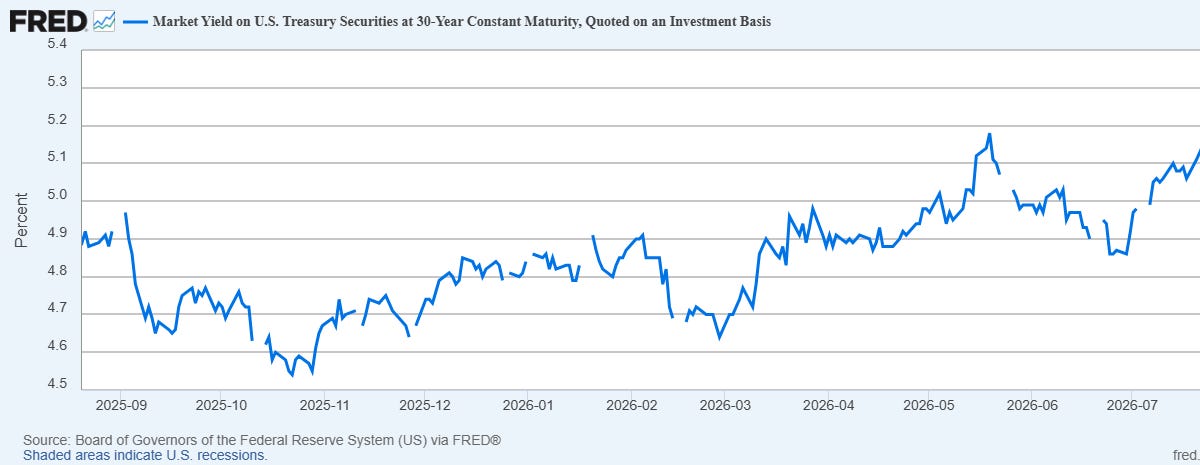
Here’s just the U.S., zoomed out to cover the last decade: asserted
U.S. → ’ → decade
Long-term rates fell in 2019 and bottomed out during the pandemic, then in 2022 and 2023 they had a big sustained rise. asserted
they → fall → rise
That could be the beginning of a catastrophic rise, and of course when you’re carrying as much debt as the U.S. government is, even a small increase in borrowing costs can be a headache if it’s sustained over a long period of time. uncertain
it → carry → time
But I just can’t look at that little wiggle in 2026 and see evidence of a bond market collapse. asserted
I → look → collapse
You should be very worried about the U.S. national debt, but this rise in rates should only make you a tiny bit more worried, if at all. asserted
you → make → rates
Give feedback · no sign-in needed

No sign-in needed for now. Your note is sent without a name, so it cannot be answered.

History Support