On July 21, 2026, Emily Vandamme, a doctor with Medecins Sans Frontieres (MSF), was getting ready to enter the suspect ward, the small building that houses patients with suspected Ebola who are awaiting their test results.
asserted
who → get → results
Because all possible Ebola cases go through this process, the small building often holds some of the most critically ill patients in the entire facility.
asserted
building → go → facility
The exhausted night team had just been forced to leave the ward after more than an hour inside.
asserted
team → force → hour
Their masks were soaked with sweat, and their goggles were so fogged that they could not safely care for patients.
uncertain
they → soak → patients
Vandamme knew a woman inside who had just given birth and was bleeding out fast, but she could not rush into the ward.
uncertain
she → know → ward
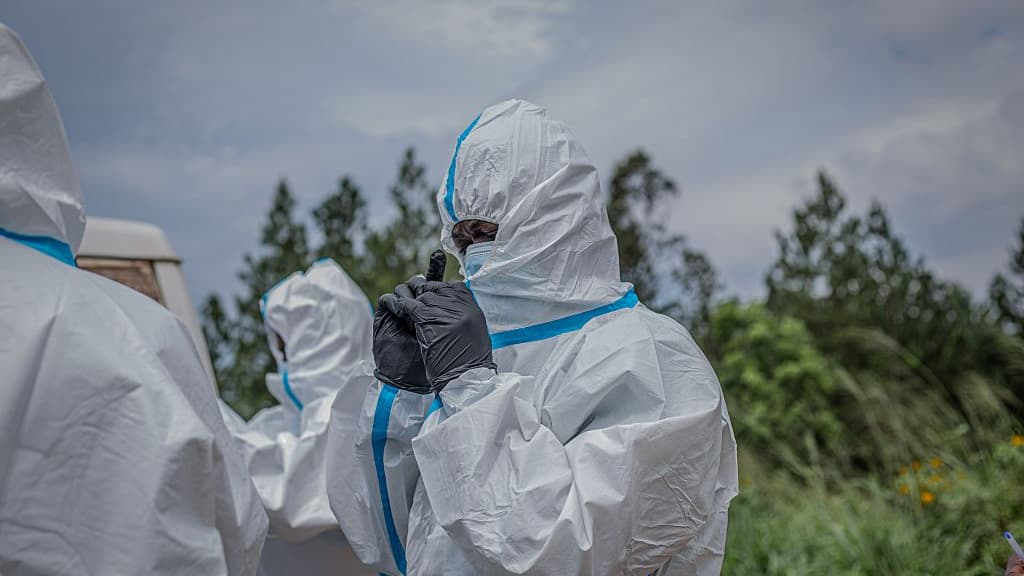
Entering the red zone, where infectious patients are isolated, requires a meticulous dressing ritual in which safety and focus are paramount.
asserted
safety → enter → which
So, despite urgent calls coming from inside the treatment area, Vandamme had to remain completely calm while putting on her protective gear, which resembled a spacesuit.
asserted
which → come → spacesuit
Every layer had to be checked, and she needed to hydrate and be disinfected, a process that takes at least 15 minutes.
asserted
that → have → minutes
Rushing leads to mistakes, and around Ebola, a single misstep can be deadly.
asserted
misstep → lead → Ebola
When she finally entered along with her Congolese colleague, Daniel Lomonobo Anigiza, she found the woman in shock and covered in blood.
asserted
woman → enter → blood
Agitated and barely aware of her surroundings, the patient reached for the medical workers, who had to stop her from tearing their suits or pulling off their masks.
asserted
who → reach → masks
“Luckily, I’m quite tall, so she couldn’t reach my face,” Vandamme said.
asserted
Vandamme → ’m → face
Another heavily pregnant woman and her 17-month-old son, Bahati Prince, were in good shape but had watched the scene in horror.
asserted
woman → watch → horror
Next to them were three other patients, all in critical condition owing to a severe drop in blood sugar, a common complication in advanced Ebola cases.
asserted
all → owe → cases
“We were two doctors, facing four emergencies at once,” Emily recalled, speaking anxiously and in great detail, as though reliving every moment.
asserted
Emily → face → moment
Because there was only room for two people to put on their protective gear in the buffer room, they had to face the mayhem that day, at least initially, on their own.
asserted
they → be → own
While Daniel attended to the sugar-deprived patients, Emily tried to stabilise the new mother and insert an intravenous drip.
asserted
Emily → attend → drip
Her newborn daughter was bundled up on a chair in the corner.
asserted
daughter → bundle → corner
When reinforcements finally arrived, a midwife and a nurse took over the mother’s care and Emily was able to turn her attention to the baby.
asserted
Emily → arrive → baby
“I was afraid to look, but to my surprise she was warm and pink, doing amazingly well,” she said.
asserted
she → look → surprise
Vandamme cradled the little girl to keep her warm, while trying to arrange an urgent transfer to another hospital, hoping it would give her a fighting chance.
asserted
it → cradle → chance
There, she might be able to receive an experimental Ebola treatment as part of a clinical trial.
uncertain
she → receive → trial
At that time, only five babies in similar circumstances were known to have survived Ebola, an MSF gynaecologist had informed her.
asserted
gynaecologist → know → her
Emily urged the team outside the ward to prepare an ambulance.
asserted
Emily → urge → ambulance
“Just as I walk back into the room with her newborn baby, the mom passes away,” she said.
asserted
she → walk → baby
“All we could think was: ‘We’ve lost the mother, but we have to do everything we can to save her baby'.
uncertain
we → think → baby
Before they could act, one of the three patients with low blood sugar suddenly collapsed and died.
uncertain
one → act → sugar
Moments earlier, the young man had been eating and walking around, seemingly revived by a dose of glucose.
asserted
man → eat → glucose
Vandamme was still holding the newborn, desperately looking for someone to take her.
asserted
Vandamme → hold → her
Fortunately, a home nurse who had already survived Ebola — and was thus largely immune — arrived.
asserted
who → survive → Ebola
The woman often stayed in the clinic to care for the infected children.
asserted
woman → stay → children
By then, Vandamme was covered in blood and was told by the team outside to exit and be disinfected.
asserted
Vandamme → cover → team
As she made her way toward the exit, breathing heavily through the saturated mask and barely seeing through her goggles, she noticed the pregnant woman, the mother of Bahati Prince, weeping frantically.
asserted
woman → make → Prince
The young man who had just died had collapsed in front of her.
asserted
who → die → her
Now, out of nowhere, her son's condition had taken a turn for the worse.
asserted
condition → take → worse
She was clutching the barely responsive toddler, begging Vandamme to help.
asserted
She → clutch → Vandamme
Despite the risk, Vandamme could not bring herself to abandon them.
uncertain
Vandamme → bring → them
She asked a nurse to disinfect her bloodstained sleeves inside the red zone, then managed to insert an IV with lifesaving glucose and fluids into the boy.
asserted
She → ask → boy
Slowly, he began to respond, and Vandamme rushed to the exit.
asserted
Vandamme → begin → exit
“Once we were outside, my coworkers and I just stared at each other blankly, trying to grasp what we just had witnessed,” she said.
asserted
she → star → what
…and 177 more, not listed.
 The Aporia