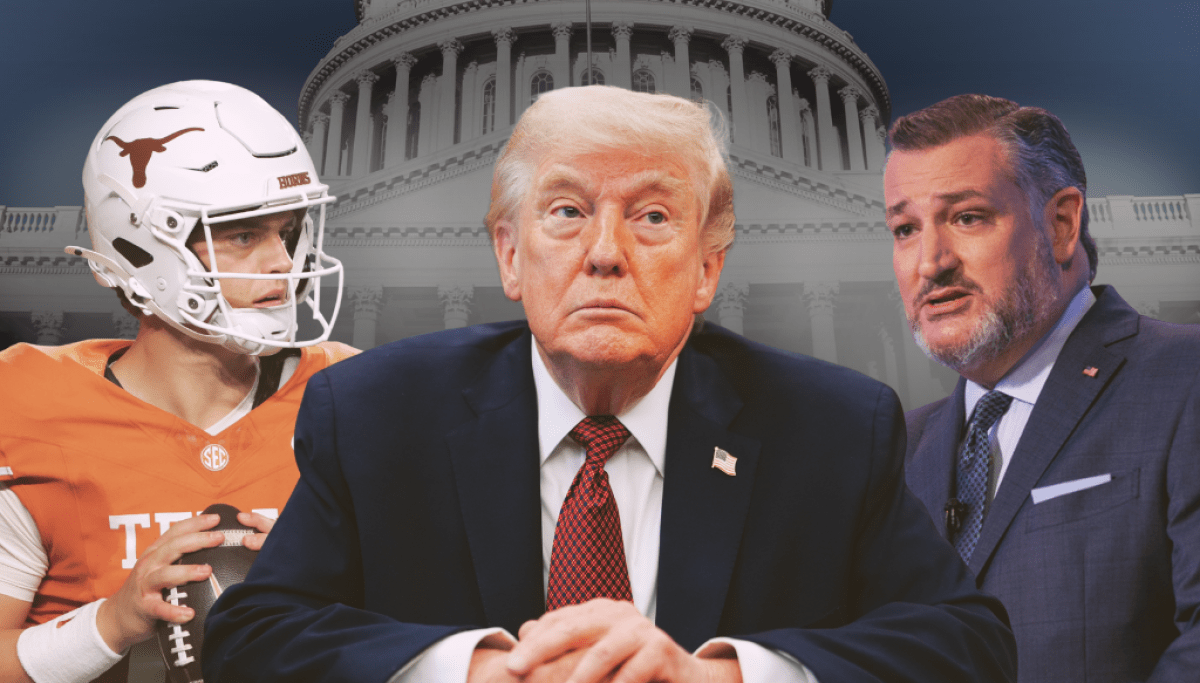
President Donald Trump and House Republican leaders are making a final push to pass the Protect College Sports Act before the lame-duck session ends.
asserted
session → make → Act
Their revised version of the bill could make it easier for big-name schools to move to the richest athletic conferences.
uncertain
schools → revise → conferences
The House Rules Committee announced Friday a revised bill that could reach the floor the week after Thanksgiving.
uncertain
that → announce → Thanksgiving
That leaves Republicans a small window before the House leaves for holiday recess on Dec. 17.
asserted
House → leave → Dec.
If the bill doesn’t pass by then, it will have to start over in January in a new Congress, where Democrats will control the House after their midterm election wins.
asserted
Democrats → pass → wins
Recommended Stories
Trump has repeatedly urged Congress to pass the bill, and at a White House news conference Friday he warned of dire consequences if it doesn’t.
asserted
it → urge → consequences
“Every college is going to go bankrupt if we don’t get a bill done,” Trump said.
asserted
Trump → go → ?
The president said colleges are “going crazy” with spending and claimed one school lost $500 million this year.
asserted
school → say → million
At a White House roundtable in March, he said Penn State’s athletic department lost $535 million, Florida State lost $440 million, and Rutgers lost $95 million.
asserted
Rutgers → say → million
Trump also criticized a 17-year-old quarterback being paid $12 million, apparently referring to Michigan’s Bryce Underwood.
asserted
Trump → criticize → Underwood
Former Alabama football coach Nick Saban and New York Yankees President Randy Levine back the bill, according to Trump, who said he sees “tremendous bipartisan support” for it.
uncertain
he → back → it
The biggest change in the House version, released Friday evening, raises the cap on conference membership from 20 schools to 22.
asserted
change → release → 22
Four Atlantic Coast Conference schools — Florida State, North Carolina, Clemson, and Florida — sent letters asking House lawmakers for the change.
asserted
schools → send → change
The Southeastern Conference and the Big Ten each have 16 members in revenue-generating sports, and both are reportedly considering ACC schools for future expansion.
uncertain
both → have → expansion
North Carolina led the ACC lobbying effort against the bill’s realignment restrictions, according to emails obtained by Front Office Sports, pushing for the independence requirement to be removed and for conferences to be allowed up to 22 schools.
uncertain
conferences → lead → schools
UNC officials believed ACC Commissioner Jim Phillips personally lobbied lawmakers to keep the realignment clause in the bill.
asserted
Phillips → believe → bill
The higher cap could help win votes from Florida, North Carolina, and Virginia, whose delegations have 53 House seats combined.
uncertain
delegations → help → seats
What else changed
The House version makes several other changes to the Senate bill.
asserted
version → change → bill
A conference earning $600 million that tries to merge with or acquire another conference would face antitrust scrutiny, down from the Senate’s $700 million threshold.
asserted
that → earn → threshold
Every name, image, and likeness deal involving a school, its employees, volunteers, conference, or affiliated entities would count against the school’s revenue-sharing cap.
asserted
deal → involve → cap
Colleges and universities averaging at least $50 million a year in media rights revenue could no longer use student fees to fund athletics, a change that could appeal to lawmakers representing historically Black colleges and universities and smaller conferences.
uncertain
that → average → colleges
The revised bill would also let only current or former athletes file civil lawsuits under the law and would add seats for mid-sized conferences and an athlete to its 24-member Congressional Commission on the Future of College Athletics.
asserted
athletes → let → Athletics
Hurdles in the House
The Congressional Black Caucus, which has nearly 60 members, still opposes the bill.
asserted
which → have → bill
It cites Republican redistricting that eliminated several majority-Black districts in Southern states after the Supreme Court’s ruling in Louisiana v. Callais, and it says the bill doesn’t do enough for HBCUs.
asserted
bill → cite → HBCUs
The team of Sen. Ted Cruz (R-TX), the bill’s lead author, has been talking directly with caucus members and has also reached out to other House Democrats.
asserted
team → talk → Democrats
Some House conservatives also worry the bill could hurt schools and conferences by opening the door for athletes to unionize.
uncertain
athletes → worry → door
Some Republicans have asked for an outright ban on classifying athletes as employees and a cap on international players.
asserted
Republicans → ask → players
House Majority Leader Steve Scalise (R-LA) and Reps. Tim Walberg (R-MI) and Brett Guthrie (R-KY) acknowledged in a statement that the bill “in its current form faces real challenges” but said the House would bring it to the floor with “narrow” changes.
“Congress needs to pass strong antitrust protections to end the Wild West atmosphere that exists today,” they said.
asserted
they → acknowledge → atmosphere
Cruz said he expects the House to pass the bill with “an overwhelming bipartisan vote” the week after Thanksgiving.
asserted
House → say → Thanksgiving
The senator said he has discussed the plan with House Speaker Mike Johnson (R-LA) and that there is “plenty of time” for the Senate to vote on an amended version before the session ends.
asserted
session → say → version
Cruz made a similar pitch in a video posted to X, calling college sports “utter chaos” and warning that half or more of roster and scholarship spots could disappear within five years if Congress doesn’t act.
uncertain
Congress → make → years
“For many student athletes, this is their only ticket to college,” Cruz said in the video, adding that he is “spending a lot of time urging the House to take it up and pass it.”
asserted
he → say → it
What comes next
Amendments to the House bill are due Wednesday.
asserted
Amendments → come → bill
The Rules Committee will likely meet next week, and floor votes could follow if a rule is approved.
uncertain
rule → meet → ?
Any House changes would send the bill back to the Senate, which is scheduled to leave for the holidays Dec. 18.
asserted
which → send → holidays
The House returns Nov. 30 for a final three-week session.
asserted
House → return → session
Any changes the House makes would need another Senate vote before both chambers leave for the holidays.
asserted
chambers → make → holidays
The NCAA has urged its members to lobby lawmakers, warning in a letter that the bill could come up as early as Nov. 30.
uncertain
bill → urge → Nov.
“Given the short time period, it is imperative member schools contact their representatives as soon as possible,” the letter said.
asserted
letter → give → representatives
Most House Democrats have opposed the bill, and some Republicans want changes of their own.
asserted
Republicans → oppose → own
…and 25 more, not listed.
 The Aporia