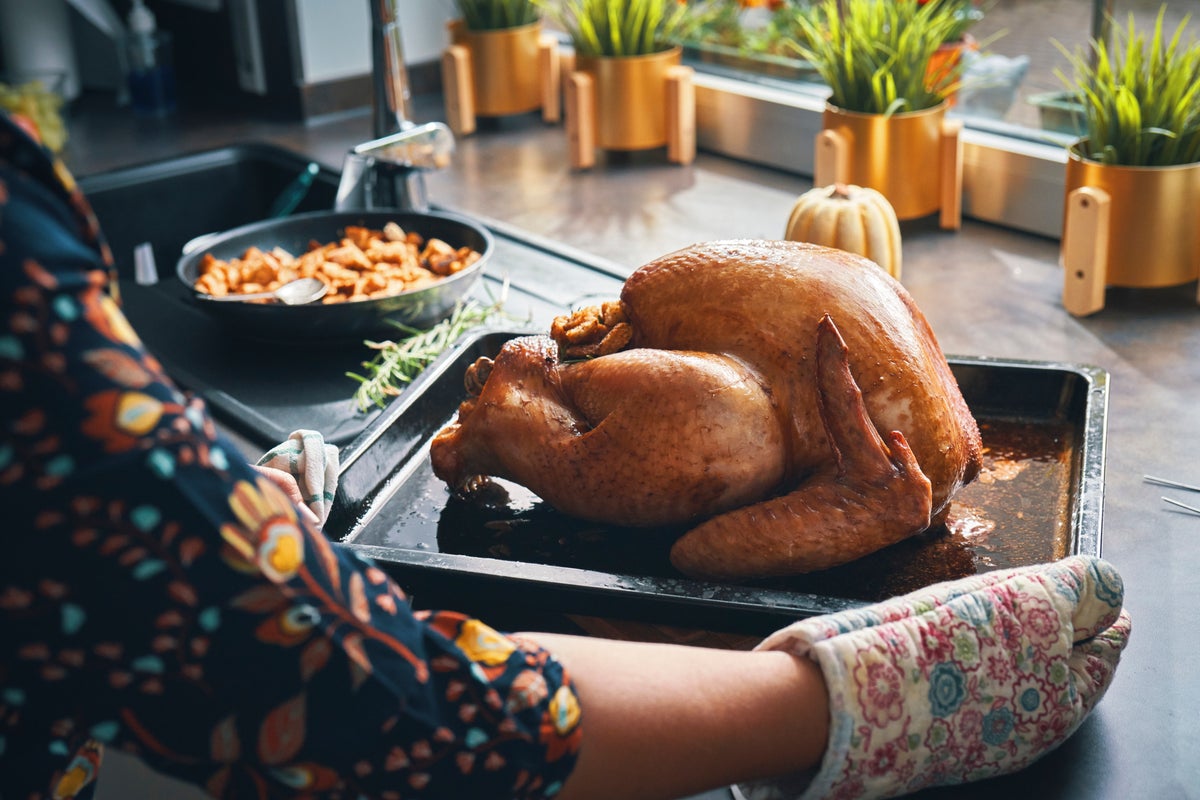
One of the most quintessential American things is having roasted turkey on the table at a Thanksgiving feast.
asserted
One → have → feast
While that remains the norm, Americans are eating much less of this kind of poultry today than in the past.
asserted
Americans → remain → past
Annual consumption has fallen by more than 25% over the past three decades, while demand for chicken has soared.
asserted
demand → fall → chicken
I’m a business school professor who has written about the economics of various holidays.
asserted
who → ’m → holidays
I find turkeys fascinating, because even though I live in an urban area, a large group of wild turkeys has taken over my backyard.
asserted
group → find → backyard
And I can offer several good explanations for the turkey slump.
asserted
I → offer → slump
Receding since the late 1990s
Domesticated turkeys, unlike their wild cousins, are a big business.
asserted
turkeys → recede → cousins
More than US$5 billion worth of the birds were sold in 2025.
asserted
worth → sell → 2025
That’s no chicken feed.
asserted
That → ’ → ?
However, it’s the latest sign of the industry’s decline.
asserted
it → ’ → decline
U.S. consumers are drifting away from eating turkey.
asserted
consumers → drift → turkey
Back in 1995, the average American consumed 17.7 pounds (8 kilograms) of turkey each year.
asserted
American → consume → turkey
By 2025, consumption had fallen to just 13.2 pounds (6 kg).
asserted
consumption → fall → pounds
While turkey consumption started to recede in the late 1990s, it began accelerating around 2008, when the Great Recession was underway.
asserted
Recession → start → 2008
Occasionally, turkey production ticks upward a little, as happened in 2026 as demand for niche products like turkey jerky rose, but the long-term picture is one of steady decline.
asserted
picture → tick → decline
It’s not like Americans are eating less poultry overall.
asserted
Americans → ’ → poultry
Chicken consumption has steadily grown during this turkey slump, rising about 50% from 69 pounds (31 kg) in 1995 to 104 pounds (47 kg) in 2025.
asserted
consumption → grow → 2025
In other words, we’re eating almost eight times more chicken than turkey.
asserted
we → eat → turkey
More costly at every step in the supply chain
Government agencies, researchers and some pundits have identified two possible explanations for why Americans are eating less turkey.
asserted
Americans → identify → turkey
Turkey often costs more than chicken, except when it goes on sale just before Thanksgiving.
asserted
it → cost → Thanksgiving
Over the past 25 years, wholesale turkey prices per pound averaged about 10% higher than chicken, according to U.S. Department of Agriculture data.
uncertain
prices → average → data
That price, which is what big retailers typically pay, affects what you owe at checkout.
asserted
you → pay → checkout
For example, just before the 2026 Thanksgiving sales began, a Bell & Evans fresh whole turkey was going for $4.99 a pound, while a Bell & Evans fresh whole chicken cost $3.49 a pound at my local supermarket.
asserted
chicken → begin → supermarket
That’s $1.50 a pound difference, which is significant in an economy where many people feel economically pinched.
asserted
people → ’ → economy
Nationally, you will see similar price differences, with fresh turkey being more expensive than fresh chicken.
asserted
turkey → see → chicken
Both turkeys and chickens are fed a diet of corn and soybeans.
asserted
turkeys → feed → corn
However, turkeys consume a higher percentage of soybeans.
asserted
turkeys → consume → soybeans
And soybeans currently cost about twice as much as corn.
asserted
soybeans → cost → corn
The latest data shows turkey feed costs are up almost 80%, without accounting for inflation, since 2000, while chicken feed costs have climbed only 60%.
asserted
costs → show → 2000
The second reason has to do with the size of today’s families.
asserted
reason → have → families
The typical Bell & Evans whole chicken my grocery store sells weighs approximately 4 pounds, while its fresh turkeys tend to range between 10 and 12 pounds.
asserted
turkeys → sell → pounds
Big birds are handy if you have a lot of mouths to feed, but American families have shrunk over time.
asserted
families → have → time
Today the average household includes only 2.5 people.
asserted
household → include → people
The extra half-person does not represent children who are picky eaters or people who don’t like eating meat.
asserted
who → represent → meat
It just means the typical family has between two and three people.
asserted
family → mean → people
That means cooking a 10-pound turkey results in 4 pounds of food per person, which is far more than almost anyone who is not a competitive food eater can consume.
asserted
who → mean → person
Cooking a 4-pound chicken, however, results in a more manageable 1.2 pounds of poultry per eater after getting rid of the bones, which make up about a quarter of a chicken.
asserted
which → cook → chicken
In simple terms, buying a whole chicken often results in one or two meals per person.
asserted
buying → buy → person
Cooking a whole turkey often yields enough meat to produce meals for an entire week.
asserted
Cooking → cook → week
First, a 10-pound turkey costs a lot more than a 4-pound chicken.
asserted
turkey → cost → chicken
…and 13 more, not listed.
 The Aporia