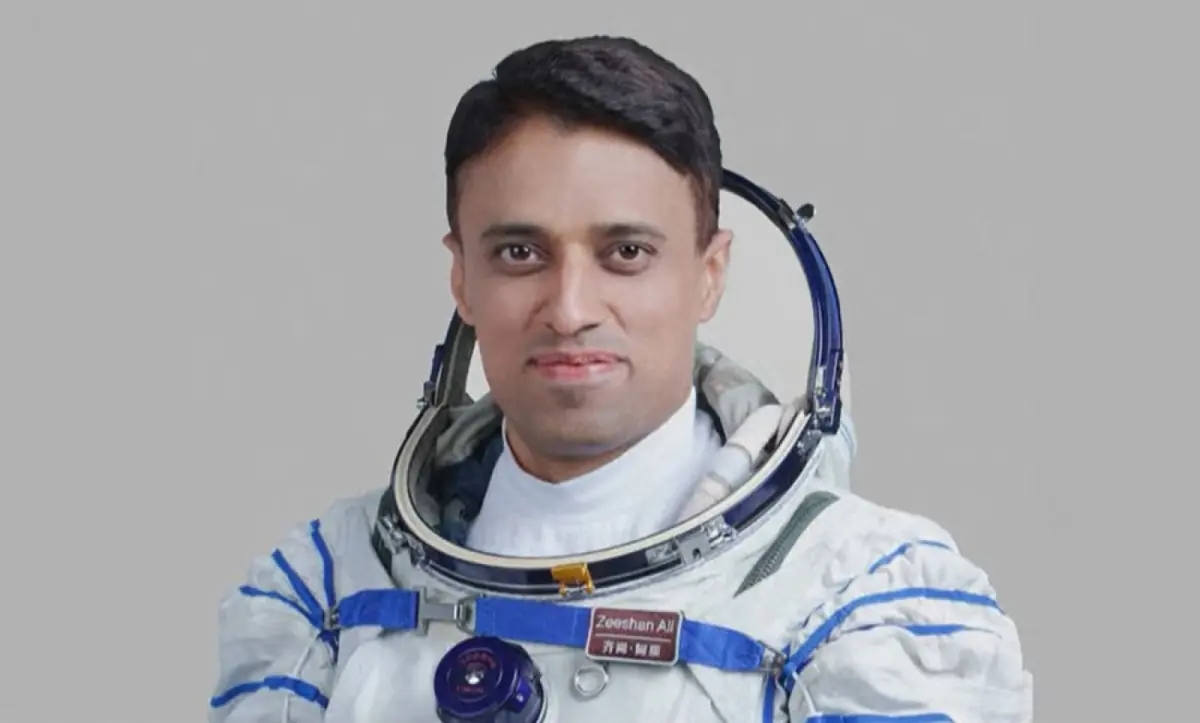
On the screen at the front of the auditorium, a Chinese rocket carrying Muhammad Zeeshan Ali, Pakistan’s first astronaut, rose on a column of orange flames.
asserted
rocket → carry → flames
As the rocket lifted off, Pakistan’s national anthem began.
asserted
anthem → lift → ?
The audience, which had been slouching in their seats, rose row by row and sang along.
asserted
which → slouch → row
Recommended Stories
list of 4 items- list 1 of 4Pakistan’s Zeeshan Ali set for historic flight to China’s space station
- list 2 of 4Which countries have sent people to space?
- list 3 of 4Pakistani astronaut to join China’s next space station mission
- list 4 of 4Pakistani astronaut launches into space aboard Chinese rocket
While many took out their phones to record the historic moment, Zainab Abbasi’s eyes remained fixed on the giant screen.
“I had my phone out
asserted
I → set → phone
I was so caught up in the moment that I forgot to record, and I was just standing there with my phone closed,” Abbasi, 21, told Al Jazeera.
asserted
Abbasi → forget → Jazeera
As the rocket climbed higher, the hall erupted in applause and chants of “Pakistan Zindabad” (“Long live Pakistan”).
asserted
Pakistan → climb → applause
The Long March-2F rocket lifted off from the Jiuquan Satellite Launch Centre in northwest China, carrying Chinese astronauts Tang Hongbo and Wu Yi, alongside Ali, a 40-year-old Pakistan Air Force pilot.
asserted
rocket → lift → Ali
But within two minutes of liftoff, the hall fell silent.
asserted
hall → fall → liftoff
No one spoke.
asserted
one → speak → ?
On the screen, the rocket had shrunk to a dot.
asserted
rocket → shrink → dot
“There was, I think, anticipation and also, for me specifically, a sort of, you know, underlying anxiety,” Abbasi told Al Jazeera.
asserted
Abbasi → be → Jazeera
On January 28, 1986, the US space shuttle Challenger broke apart 73 seconds after liftoff, killing all seven crew members.
asserted
Challenger → break → members
About 10 minutes after Wednesday’s launch, the Shenzhou-24 spacecraft separated from the rocket and entered orbit, according to the China Manned Space Agency (CMSA).
uncertain
spacecraft → separate → Agency
The silence lasted several minutes, until one of the hosts congratulated the audience on a successful launch.
asserted
one → last → launch
People got up, greeted one another or headed for the doors.
asserted
People → get → doors
A few hours later, CMSA and SUPARCO confirmed that the spacecraft had docked at China’s Tiangong space station at 8:56am (03:56 GMT).
asserted
spacecraft → confirm → 8:56am
The crew were expected to enter the station at about 11:45am (06:45 GMT).
asserted
crew → expect → 11:45am
A hall before dawn
The auditorium had been packed by 5am (00:00 GMT).
asserted
auditorium → pack → 5
Those unable to find a seat sat on the floor or stood along the walls.
asserted
Those → find → walls
Tayyaba Riaz, a final-year mathematics student at NUST, said every seat was taken when she arrived at about 4:20am (23:20 GMT Tuesday).
asserted
she → say → 4:20am
Originally from Chitral in Pakistan’s northwest, she lives in a university hostel.
asserted
she → live → hostel
When she asked hostel authorities to leave early in the morning, she said they asked where she was going.
asserted
she → ask → morning
“I was like, ‘I am going to witness a history,’” she said, giggling.
asserted
she → go → history
Many in the auditorium held glossy cards bearing Ali’s portrait in a spacesuit and the words “Pakistan’s First Manned Space Mission”.
asserted
Many → hold → spacesuit
Paper flags of Pakistan and China rested on laps, while green and white balloons lined the stage.
asserted
balloons → rest → stage
The screen carried a livestream of the launch.
asserted
screen → carry → launch
There was a brief moment of hilarity when, just before liftoff, a YouTube advertisement appeared, causing mild panic that the critical moment might be missed.
uncertain
moment → be → panic
She lives 40km (25 miles) away and had left home at 7pm (14:00 GMT) on Tuesday to spend the night at her aunt’s house nearby.
asserted
She → live → house
Her interest in astronomy began around 2018, when she was 13, after the cartoon series Beyblade introduced her to constellations.
asserted
series → begin → constellations
Her family, particularly her father, has always supported her, even if they do not always understand her passion, she said.
asserted
she → support → passion
“When I was a child and interested in space, becoming an astronaut felt like a far-off dream only available to a child in America and not in Pakistan,” she said.
asserted
she → become → Pakistan
Ahzam Farooq, a physics undergraduate at NUST and vice president of the society, used to wake at 3am to watch rocket launches.
asserted
Farooq → use → launches
“My parents used to ask, ‘What is there in this?’ like it will never be us,” he said.
asserted
he → use → this
Adan Athar, a second-year space sciences student at the Institute of Space Technology (IST) in Islamabad, is from Faisalabad and a founding member of the Faisalabad Astronomical Society.
asserted
Athar → found → Society
She told Al Jazeera she was the first in her family to take an interest in space.
asserted
she → tell → space
“Yes, they were very supportive, and they think I will be the next astronaut,” she said with a shy smile.
asserted
she → think → smile
Fifty years of stargazing
But it is not only Pakistan’s youth following Ali’s journey.
Saif-ul-Islam Qureshi, a 72-year-old electronics engineer, has been watching the sky for at least 50 years.
asserted
Qureshi → follow → years
“I was 12 years old when I started this hobby with my small binocular, and then my first observation was the Big Dipper in the sky,” he told Al Jazeera.
asserted
he → start → Jazeera
Qureshi helped found PakAstronomers, the group Abbasi belongs to.
asserted
Abbasi → find → PakAstronomers
It was initially called the Pakistan Astronomy Society.
asserted
It → call → ?
…and 18 more, not listed.

 The Aporia