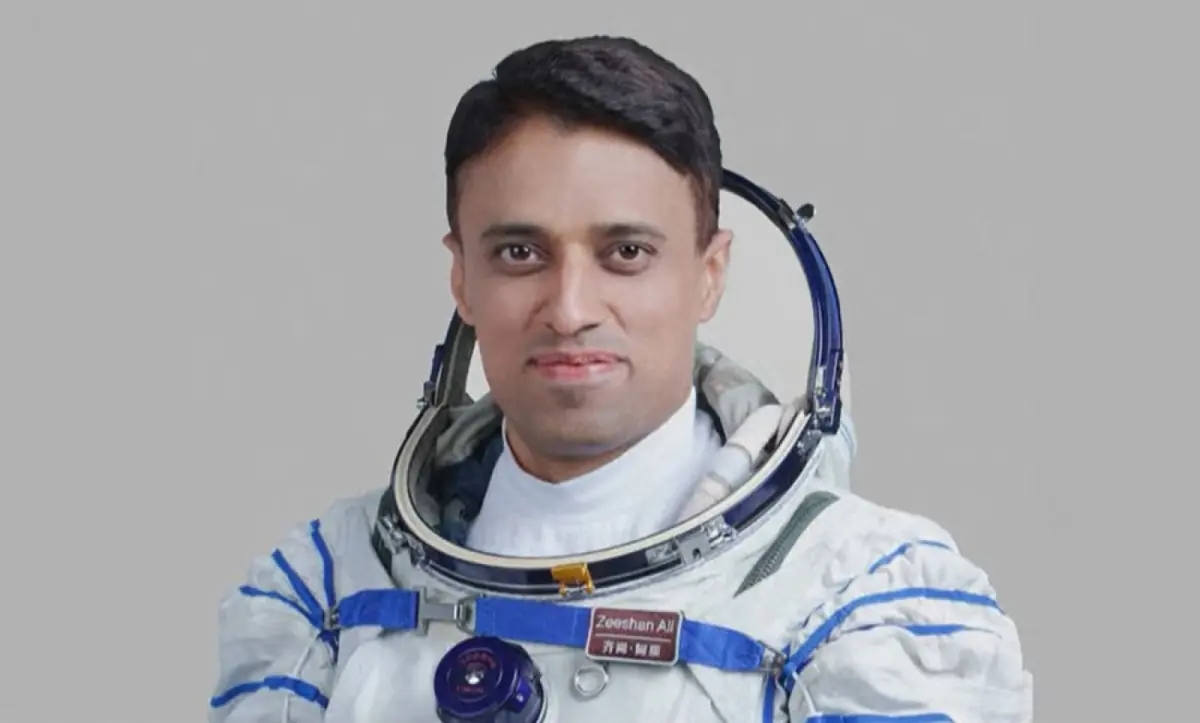
Pakistan is poised to send an astronaut into space for the first time on Wednesday, when an air force pilot joins China’s Shenzhou-24 mission to the country’s Tiangong space station.
asserted
pilot → poise → station
Muhammad Zeeshan Ali, 40, will fly as a payload specialist alongside commander Tang Hongbo and flight engineer Wu Yi.
asserted
Ali → fly → Hongbo
The spacecraft is scheduled to launch from the Jiuquan Satellite Launch Center in northwest China at 8:18am Beijing time (00:18 GMT), or 5:18am in Pakistan.
asserted
spacecraft → schedule → Pakistan
Recommended Stories
list of 4 items- list 1 of 4Pakistani astronaut to join China’s next space station mission
- list 2 of 4NASA announces astronauts for Artemis III spaceflight, scheduled for 2027
- list 3 of 4Four astronauts return to earth after an eight-month space mission
- list 4 of 4Africa’s space ambitions are moving from policy to practice
Speaking at a news conference in Jiuquan on Tuesday, China Manned Space Agency (CMSA) spokesperson Zhang Jingbo said the mission would mark the first joint flight by Chinese and foreign astronauts in the country’s crewed space programme.
After reaching orbit, the spacecraft will carry out a rapid, autonomous rendezvous lasting about three and a half hours before docking with the forward port of the station’s Tianhe core module
asserted
spacecraft → join → module
, Zhang said.
asserted
Zhang → say → ?
He will return to Earth on board the Shenzhou-23 spacecraft after a short joint flight, while Zhu Yangzhu, a member of that crew, remains in orbit for a year, Zhang said.
asserted
Zhang → return → year
Pakistan’s Space and Upper Atmosphere Research Commission (SUPARCO) has said Ali will spend about a week on the station.
asserted
Ali → say → station
“I want to assure you that I am not flying for myself.
asserted
I → want → myself
I carry the name of Pakistan on my shoulder, the hopes of 250 million Pakistanis,” Ali told reporters during the crew’s conversation with the media.
asserted
Ali → carry → media
The two pilots
Ali and Khurram Daud, a second Pakistani selected for astronaut training, are Pakistan Air Force pilots.
asserted
Ali → select → training
They were selected through a three-stage process that began with screening in Pakistan and included medical, psychological and technical assessments.
asserted
that → select → assessments
CMSA named them reserve astronauts on April 22 earlier this year.
asserted
CMSA → name → April
Prime Minister Shehbaz Sharif met them in Islamabad the following day, and on April 24, China’s Space Day, they joined the Astronaut Center of China in Beijing for training.
asserted
they → meet → training
Before leaving, Daud asked Pakistanis to pray for him in a video released by the Ministry of Information and Broadcasting.
asserted
Daud → leave → Information
“My message to you all is to pray for me, so that I can complete this training and this mission well, and make my nation and my country proud,” he said in Urdu.
asserted
he → pray → Urdu
Planning Minister Ahsan Iqbal, who is in China for the launch, paid tribute to both men on X on Tuesday.
asserted
who → pay → Tuesday
“They trained in centrifuges and simulators, in emergency drills and in a new language.
asserted
They → train → language
Both performed exceptionally well in training.
asserted
Both → perform → training
Though Zeeshan Ali will fly tomorrow both have already made Pakistan proud,” he wrote.
asserted
he → fly → ?
Thanking his instructors, SUPARCO and CMSA, at Tuesday’s news conference, Ali said: “No matter who flies, we have already made the history together.”
asserted
we → thank → history
Daud was not named in the crew, and it is not yet clear whether he will fly on a later mission.
asserted
he → name → mission
In written responses to Al Jazeera, SUPARCO said the backup astronauts would serve as experts to help carry the programme forward.
asserted
astronauts → write → programme
Zhang said Ali would take part in the crew’s daily work but would mainly oversee China-Pakistan experiments, install samples and equipment and conduct tests in orbit.
asserted
Ali → say → orbit
The mission will include four joint science projects in biotechnology and materials, Zhang said.
asserted
Zhang → include → biotechnology
Ali will also conduct an experiment involving cyanobacteria, photosynthetic microorganisms.
asserted
Ali → conduct → cyanobacteria
Pakistan’s Information Ministry said in April that the experiments would cover materials science, fluid physics, life sciences and biotechnology, with potential applications in climate resilience, food security and industrial innovation.
asserted
experiments → say → resilience
Qamarul Islam, a space scientist and former senior official in the state-affiliated Institute of Space Technology (IST) in Islamabad, said the experiments had been shortlisted after SUPARCO invited research institutes in Pakistan to submit proposals.
asserted
SUPARCO → affiliate → proposals
“Primarily these experiments are the experiments of the research institutes, universities and others, from Pakistan,” he told Al Jazeera.
asserted
he → tell → Jazeera
SUPARCO said the station was a fully equipped laboratory.
asserted
station → say → ?
It added in its response that Ali’s week in orbit was meant to start and install the experiments, and to record data confirming that the equipment had survived launch loads and vibrations and was safely installed in microgravity.
asserted
equipment → add → microgravity
“Completing the four experiments takes between six and 12 months,” it said.
asserted
it → complete → months
Training for orbit
According to Zhang, preparations focused on professional skills, crew coordination and language.
uncertain
preparations → train → skills
“We focus on Chinese commands and technical terms to ensure accurate execution,” he said, in the English interpretation of his remarks.
asserted
he → focus → remarks
In a promotional video by the Chinese space agency, Ali, who described himself as a fighter pilot, said centrifuge, rescue and survival, and emergency procedures training were part of his preparation.
asserted
training → describe → preparation
“But the real challenge, honestly speaking, was mastering the Chinese language, because all the switches, all the software, all the programmes, all the voice announcements, everything is in Chinese.
asserted
everything → speak → Chinese
So we had to learn that and master that technical Chinese,” he said.
asserted
he → have → Chinese
SUPARCO and CMSA signed their astronaut agreement in Islamabad in February 2025.
asserted
SUPARCO → sign → February
Ali said the two countries had since moved quickly.
asserted
countries → say → ?
“The two great nations of China and Pakistan have turned a pilot into an astronaut in a remarkably short span of time,” he said.
asserted
he → turn → time
A new milestone
This year marks 75 years of diplomatic ties between the two neighbours.
asserted
milestone → mark → neighbours
…and 28 more, not listed.

 The Aporia