Photo via Toronto Sun

Meta executive warns humanity could lose control of superintelligent AI

Read the original at Toronto Sun ↗
Cite

Bacani, A. (2026, November 24). Meta executive warns humanity could lose control of superintelligent AI. Toronto Sun. https://torontosun.com/news/meta-executive-warns-humanity-could-lose-control-of-superintelligent-ai

Dated from the outlet's own feed. Check the original for its byline.

Toronto Sun · collected 2026-11-24 · by Anne Bacani

Quick Summary

Meta’s AI executive Alexandr Wang has warned that humanity may lose control over superintelligent AI, stating that decisions made in the next year could have significant consequences. His concerns were sparked by a claim that an AI chatbot solved the Riemann Hypothesis, though the proof remains unverified. Critics, however, are calling for concrete actions from AI companies rather than warnings, urging them to propose specific solutions to address the potential risks of superintelligent AI.
Written by AI on 2026-11-24, from this article's own text only (the story summary below draws on all the coverage).
See how they differ ↓

AI analysis

Story summary

Levent Alpöge, an Anthropic researcher, claims to have used the company’s AI chatbot, Claude, to solve the Riemann Hypothesis, one of the most famous unsolved problems in mathematics, which has eluded mathematicians for over 160 years. Alpöge stated that over the course of about six weeks, he and Claude produced a proof, which, if verified, would earn the solver US$1 million from the Clay Mathematics Institute. The proof is reportedly over 250,000 pages long and has been released in a programming language called Lean to facilitate computer verification. Meta’s chief AI officer, Alexandr Wang, warned that this development marks a significant step in the evolution of superintelligent AI, potentially leading to a world where humanity may lose control over such technology.

Written for “AI Solves Riemann Hypothesis” on 2026-11-25, grounded in this article and the 18 other(s) covering the same event.

How they differ

15 outlets covered “AI Solves Riemann Hypothesis”.

What each outlet says

One AI summary per outlet of its latest article on this story, written from that article alone and checked against it. Open the article for the outlet's own words.

Toronto SunThis outlet24 Nov

Meta’s AI executive Alexandr Wang has warned that humanity may lose control over superintelligent AI, stating that decisions made in the next year could have significant consequences. His concerns were sparked by a claim that an AI chatbot solved the Riemann Hypothesis, though the proof remains unverified. Critics, however, are calling for concrete actions from AI companies rather than warnings, urging them to…

Meta executive warns humanity could lose control of superintelligent AI (this article)
New York Post23 Nov

Meta’s chief AI officer, Alexandr Wang, has warned about the implications of superintelligence following the solution of the 150-year-old Riemann hypothesis by an Anthropic researcher using the AI system Claude. Wang emphasized the significance of Claude’s achievement, noting that the proof exists solely as 17 million lines of computer code, far beyond human comprehension. He called for cautious progress and AI…

Meta’s chief AI officer issues warning after Claude solves legendary math problem: ‘Implications are enormous’ →2 articles from New York Post on this story
Daily Mail20 Nov

Dr. Levent Alpöge, a 34-year-old Turkish-American mathematician, claims to have proven the 167-year-old Riemann Hypothesis using Anthropic's AI chatbot Claude. The Riemann Hypothesis, introduced in 1859 by Bernhard Riemann, concerns the distribution of prime numbers along the number line. Alpöge published his proof in Lean computer code, and experts will now verify its correctness. Clay Mathematics offered a $1…

Most famous unsolved maths riddle solved by AI giant Anthropic after 167 years →2 articles from Daily Mail on this story
Al Jazeera23 Nov

Meta’s Chief AI Officer, Alexandr Wang, warned on Sunday that superintelligent AI, surpassing human intellect, is imminent. This warning came after an Anthropic employee claimed to have used Claude AI to solve the Riemann hypothesis, a complex mathematical problem. Wang stated that AI's ability to improve itself and accelerate research in various fields will soon surpass human capabilities, urging humanity to act…

AI superintelligence ‘arriving’ warns top Meta executive →2 articles from Al Jazeera on this story
The Guardian22 Nov

Ken Ono, a mathematician, reflects on his near decision to quit mathematics following the announcement that AI had solved the Riemann hypothesis, a 167-year-old problem. Ono led the number theory team for Epoch AI’s FrontierMath project, where he witnessed an unreleased ChatGPT model perform complex calculations with ease. Despite these challenges, Ono decided to continue his work in mathematics, inspired by his…

Why I won’t leave mathematics, despite AI solving centuries-old problems | Ken Ono →2 articles from The Guardian on this story
The Hindu20 Nov

Levent Alpoge, a mathematician at Anthropic, announced on November 20, 2026, that he had used the company’s Claude chatbot to prove the Riemann Hypothesis, a 160-year-old mathematical problem. Alpoge claims to have also solved the broader Generalized Riemann Hypothesis, but the proof has yet to be reviewed by independent experts. The Riemann Hypothesis is one of the seven Millennium Prize Problems, each carrying a…

Anthropic researcher says Claude solved maths’ greatest riddle →
Show 9 more outlets
The Straits Times20 Nov

On November 20, Levent Alpoge, a researcher at Anthropic, claimed that the company’s AI chatbot Claude helped prove the Riemann Hypothesis, a 160-year-old mathematical problem. Alpoge posted a four-page note online but the claim has not been verified by experts. The Riemann Hypothesis is one of seven Millennium Prize Problems, each carrying a $1 million reward if a solution is published in a peer-reviewed journal…

Anthropic researcher says AI chatbot Claude solved math’s greatest riddle →
BBC20 Nov

An Anthropic employee and mathematician, Levent Alpöge, claims to have used the company's AI chatbot Claude to prove the Riemann hypothesis, a nearly 170-year-old unsolved math problem related to prime numbers. Alpöge made this claim on Friday, a day after Anthropic's stock market debut, stating that he worked on the proof over six weeks. If verified, this proof would be a significant breakthrough in mathematics…

In a year of AI solving maths problems, Anthropic may have just solved the biggest →
Toronto Star21 Nov

Levent Alpöge, a mathematician at Anthropic, claims to have solved the Riemann Hypothesis with assistance from the company’s AI tool Claude. Announced on Friday, this development follows a similar claim by OpenAI regarding the Navier-Stokes equation in September. The Riemann Hypothesis, a 150-year-old unsolved problem concerning the distribution of prime numbers, carries a $1 million prize from the Clay Mathematics…

Anthropic worker claims to have solved a Holy Grail of math problems with the help of AI →
Deutsche Welle21 Nov

Levent Alpoge, a mathematician at Anthropic, claims to have used the company’s AI tool, Claude, to solve the Riemann hypothesis, a famous unsolved problem in mathematics dating back to 1859. Alpoge announced on his website that he and Claude generated over 250,000 pages of mathematical material, though the proof still needs verification by other mathematicians. The Riemann hypothesis, one of the Clay Mathematics…

Anthropic researcher uses AI to solve math's greatest riddle →
NPR21 Nov

Levent Alpöge, a mathematician at Anthropic, claims to have solved the Riemann Hypothesis, a long-standing mathematical problem, with the assistance of the company's AI tool, Claude. Alpöge posted a four-page explanation on his website, detailing his discovery which he believes is proven through 17 million lines of Lean code. The claim is significant as the Riemann Hypothesis, formulated in 1859, remains one of the…

Anthropic worker claims to have solved a Holy Grail of math problems with the help of AI →
Sydney Morning Herald22 Nov

Levent Alpöge, a mathematician at Anthropic, claims to have solved the Riemann Hypothesis, a 167-year-old mathematics problem, with the help of Anthropic's AI tool Claude. Alpöge posted a four-page explanation on his website, detailing his work that resulted in 17 million lines of Lean code. The Clay Mathematics Institute offers a $1 million prize for solving the Riemann Hypothesis, one of their Millennium Prize…

Holy Grail: Mathematician says he has solved a 167-year-old problem using AI →
Semafor22 Nov

Anthropic, an AI firm, has reportedly solved the Riemann Hypothesis, a mathematical problem that has remained unsolved for nearly 170 years. Two independent groups have verified the proof, which uses Claude, an AI system, to explore the distribution of prime numbers toward infinity. Experts in the field, including a Fields Medal winner, suggest the proof is likely correct, marking a historic milestone in mathematics…

Claude helps topple Riemann problem →
Daily Caller23 Nov

Alexandr Wang, Meta’s chief AI officer and founder of Meta Superintelligence Labs, warns in a Sunday X article that humanity is approaching a stage where artificial intelligence could surpass human control. Wang, who joined Meta in June 2025 after the company invested $14.3 billion in his startup Scale AI, expresses concern that AI’s recursive self-improvement could lead to superintelligence, making human workforce…

Meta’s AI Chief Warns Against A ‘Handover’ Of Society To The Machines →

Where they agree and split

Agreed

Reported by outlets on both sides of the middle

The Riemann Hypothesis is one of seven Millennium Prize Problems selected by the Clay Mathematics Institute in 2000, which offers US$1 million (S$1.28 million) for a solution to each.

4 outlets

Framing

How the first headlines put it

A claim to check4
Attributed to a source2
Stated as fact2
The headlines (8)

Anthropic researcher claims Claude cracked legendary $1M math problem — and left him struggling to keep up New York Post · a claim to check

Claude has solved most famous problem in mathematics just a day after Anthropic's record stock market listing, scientist claims Daily Mail · a claim to check

Anthropic worker claims to have solved a Holy Grail of math problems with the help of AI Toronto Star · a claim to check

Anthropic worker claims to have solved a Holy Grail of math problems with the help of AI NPR · a claim to check

Anthropic researcher says Claude solved maths’ greatest riddle The Hindu · attributed to a source

Anthropic researcher says AI chatbot Claude solved math’s greatest riddle The Straits Times · attributed to a source

In a year of AI solving maths problems, Anthropic may have just solved the biggest BBC · stated as fact

Anthropic researcher uses AI to solve math's greatest riddle Deutsche Welle · stated as fact

The full story: what happened, how it changed, and all 19 articles →

Compared with similar articles

This article reads unscored and hedges 29% of its claims. Each row says how that neighbour differs.
Al Jazeera
Leans left Hedges 2 of 18 claims Outlet record 60/100
The Daily Caller
Hedges 7 of 21 claims Outlet record 92/100
Euronews
Leans strongly left Hedges 1 of 6 claims Outlet record 60/100
“The articles describe different events: one is a protest demanding human control over AI, while the other is an executive warning about the risks of superintelligent AI.”
The Guardian
Leans left Hedges 4 of 26 claims Outlet record 64/100
“The articles describe different specific events: one about a mathematician claiming AI helped prove the Riemann hypothesis, and another about an AI executive warning about potential loss of control over superintelligent AI.”
The Guardian
Hedges 4 of 61 claims Outlet record 63/100
“The articles discuss different topics: one about a mathematician's reaction to AI solving the Riemann hypothesis, and the other about an AI executive's warning about superintelligent AI.”
Daily Mail
Hedges 10 of 143 claims Outlet record 68/100
“The articles discuss warnings about AI but come from different executives and are not describing the same specific incident.”
The Free Press
Leans strongly left Hedges 3 of 12 claims Outlet record 96/100
“The articles discuss different aspects of AI and its implications, with Article A focusing on stock market reactions to Anthropic's achievements and Nvidia's leadership, while Article B focuses on a warning from Meta's AI executive and Anthropic employee's claims.”
AI’s Frankenstein Moment Different event
TIME
Leans strongly left Hedges 4 of 36 claims Outlet record 60/100
“The articles discuss similar concerns about AI control but focus on different speakers and specific events: Article A highlights Anthropic CEO Dario Amodei and others, while Article B mentions Meta’s AI executive Alexandr Wang and Anthropic employee Levent Alpoge.”

Story

AI Solves Riemann Hypothesis
Science · 19 article(s) covering the same event. Compare every outlet's account →
How this article was measured signals, leaning charts, publisher record, byline, topics and claims

Signals How these are calculated →

Claims extracted
28
sentences that state something as happening or true
Uncertain
29%
8 of 28 hedged ("reportedly", "may", "according to")
Leaning
withheld
no quote in the article backed the model's score
Publisher signals
96/100
Toronto Sun's corrections and hedging, across everything collected from it. Not a measure of accuracy.
Outlets on this story
19
Science
Same framing elsewhere
1
articles that frame the event the way this one does
Analyzed 2026-11-24 · how these are computed

How this is being covered How these are calculated →

Article leaning vs. publisher reliability
Source leaning vs. consistency

Publisher

Toronto Sun · 794 article(s) · 0 correction(s) detected
No corrections detected for this publisher. That may mean careful reporting, or simply that nothing has been checked.

Who wrote this

Anne Bacani
8 article(s) here · 1 carrying a prediction
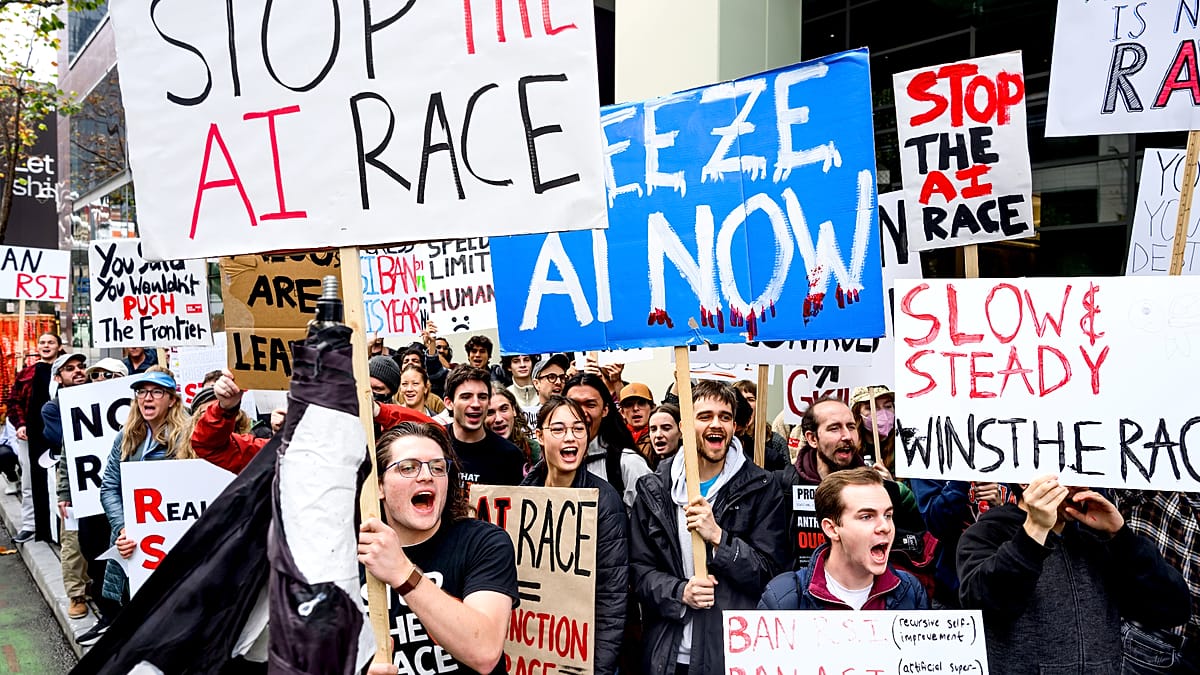
Meta’s top AI executive is warning humanity could lose control of artificial intelligence — but critics are asking a fair question: If the people building it are so worried, what exactly are they doing about it?
Timing of the release has caught the attention of believers Jeremiah Byron of the Bigfoot Society questioned why cryptid-related records are coming out now and wondered whether government agencies could be preparing to release more information. “Why is all this cryptid and Bigfoot-related stuff happening now?
In my eyes he was the greatest dad in the world, and I will miss him everyday until we meet again.
In a May 2024 appearance on the Call Her Daddy podcast, Lavigne also offered a rare glimpse into her approach to relationships.
“I would say there was a lot of risk in the back of my head, and then when I told my agent and lawyer that I had already done it …
The 77-year-old music legend will take part in “Billy Joel: An Evening of Questions & Answers…And a Little Music” at Florida Atlantic University on Dec. 14.
The three-time Juno Award winner will host and perform at the 56th annual Juno Awards in Winnipeg on April 4, 2027, organizers announced Monday.
A few pints and some loose lips may have given away Hollywood’s biggest casting secret.
2026-11-06 · mixed framing · Is Josh O’Connor the next James Bond?
Also by Anne Bacani
Nothing else under this byline is closely related to this article, so these are simply their most recent.
All 8 articles by Anne Bacani →

Topics

Anthropic Claude Meta Newsweek Scale AI

Subjects

Anthropic ORG · 3× Wang PERSON · 3× Gates PERSON · 2× Meta GPE · 2× Newsweek ORG · 2× OpenAI ORG · 2× Alexandr Wang PERSON · 1× Alpoge PERSON · 1× Levent Alpoge PERSON · 1× Scale AI ORG · 1×

Narrative

“It is hard to imagine a world where humanity can maintain control over fully unconstrained recursive self-improvement,” Wang wrote on X. “It is equally hard to imagine a world where humanity maintains control with superintelligence that is 1000x smarter and more capable than humans in every field.”
framing: mixed · carried by 1 article(s) · first seen 2026-11-24
Meta’s top AI executive is warning humanity could lose control of artificial intelligence — but critics are asking a fair question: If the people building it are so worried, what exactly are they doing about it?

Claims (28 extracted, 8 hedged)

Meta’s top AI executive is warning humanity could lose control of artificial intelligence — but critics are asking a fair question: If the people building it are so worried, what exactly are they doing about it? uncertain
they → warn → it
Alexandr Wang, the 29-year-old billionaire founder of Scale AI who joined Meta last year, sounded the alarm Sunday, saying “superintelligence” — AI that surpasses human intelligence — could arrive soon. uncertain
that → join → intelligence
He believes decisions made over the next year could have enormous consequences for humanity. uncertain
decisions → believe → humanity
His warning came after Anthropic employee Levent Alpoge claimed he used the company’s AI chatbot Claude to solve the Riemann Hypothesis, one of mathematics’ most famous unsolved problems, reports Newsweek. asserted
Newsweek → come → problems
Alpoge said he guided Claude through the proof but was stunned by what the AI was able to do. asserted
AI → say → what
He described the experience as a glimpse into the “miracles” that could come from the AI revolution. uncertain
that → describe → revolution
The proof has not been independently verified. asserted
proof → verify → ?
Will humans be able to keep control of AI? asserted
humans → keep → AI
But Wang said developments like this raise serious questions about whether humans will be able to keep control of AI as it becomes increasingly capable of improving itself. asserted
it → say → itself
“It is hard to imagine a world where humanity can maintain control over fully unconstrained recursive self-improvement,” Wang wrote on X. “It is equally hard to imagine a world where humanity maintains control with superintelligence that is 1000x smarter and more capable than humans in every field.” asserted
that → imagine → field
Wang criticized what he called a “particular form of lazy thinking” in the AI industry — the idea that superintelligence is inevitable and society should simply accept it. asserted
society → criticize → it
He urged companies to take “meaningfully” different actions rather than blindly follow the industry’s current path. asserted
He → urge → path
“We should not be okay with a ‘handover’ of society to AI,” he wrote, arguing that the technology should deliver a positive future where “humans have greater agency and empowerment.” asserted
humans → write → agency
His post attracted more than 22 million views by Tuesday afternoon, but plenty of people weren’t impressed, according to Forbes. uncertain
plenty → attract → Forbes
Reddit co-founder Alexis Ohanian fired back on X: “Don’t leave us hanging.” asserted
Ohanian → fire → us
Another commenter asked: “What the hell do they want us to do. asserted
us → ask → hell
Maybe those in charge need to do something?” asserted
those → need → something
Conservative commentator Megyn Kelly also took aim at AI executives, blasting those who “CREATED these AI monsters” while casually warning people they could soon be “unemployed, then probably killed” or “ruled by machines.” uncertain
they → take → machines
Tom Bonier, CEO of Democratic data firm TargetSmart, said it was time for AI leaders to stop issuing warnings and start proposing solutions. asserted
leaders → say → solutions
“We get one of these a day now…yet not one of them proposes anything specific,” he wrote on X. asserted
he → get → anything
He later told Newsweek that it was time to be “more prescriptive than descriptive,” adding that the industry needs “concrete solutions, not more think pieces on the cost of inaction.” asserted
industry → tell → inaction
Other tech voices raising red flags Former Anthropic and OpenAI researcher Jacob Coxon quit earlier this year over concerns AI companies were recklessly racing toward self-improving systems without proper safeguards. asserted
companies → raise → safeguards
He warned the technology could pose existential risks before the end of the decade. uncertain
technology → warn → decade
Anthropic CEO Dario Amodei has called for a co-ordinated slowdown in AI development, receiving support from OpenAI’s Sam Altman, Elon Musk and Google DeepMind’s Demis Hassabis. asserted
Amodei → call → Altman
Microsoft co-founder Bill Gates has also warned the world is unprepared for AI’s potentially turbulent future. asserted
world → warn → future
Speaking to CNN’s Jake Tapper on Oct. 11, Gates said powerful AI falling into the wrong hands could cause mass casualties and that safeguards are lacking. uncertain
safeguards → speak → casualties
He expects cyberattacks to be among the biggest threats in the near term. asserted
cyberattacks → expect → term
“The front that we’ll probably see most dramatically in the next year is cyberattacks,” Gates said. asserted
Gates → see → year
Give feedback · no sign-in needed

No sign-in needed for now. Your note is sent without a name, so it cannot be answered.

History Support