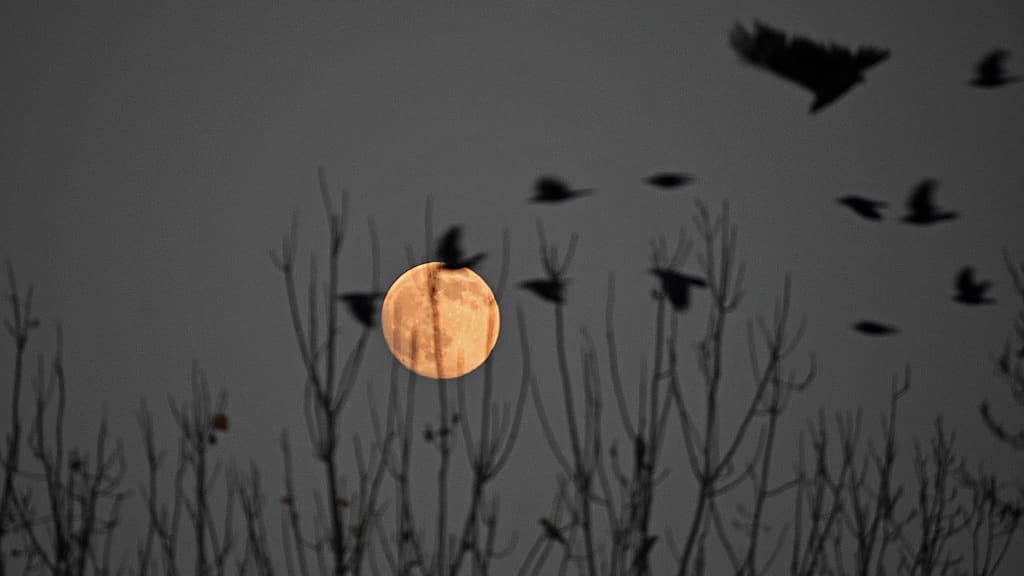
Photo via Daily Mail

Look up tonight for something super! The first of four consecutive supermoons will light up skies - as our lunar satellite appears 30% brighter and 14% larger than usual

Read the original at Daily Mail ↗
Cite

Leatham, X. (2026, November 24). Look up tonight for something super! The first of four consecutive supermoons will light up skies - as our lunar satellite appears 30% brighter and 14% larger than usual. Daily Mail. https://www.dailymail.com/sciencetech/article-16318179/supermoons-skies-lunar-satellite-brighter-larger.html?ns_mchannel=rss&ns_campaign=1490&ito=1490

Dated from the outlet's own feed. Check the original for its byline.

Daily Mail · collected 2026-11-24 · by Xantha Leatham

Quick Summary

No summary of this article yet; the story summary below covers the event.
See how they differ ↓

AI analysis

Story summary

The Beaver Supermoon, the first of four consecutive supermoons in 2026, reached peak illumination at 2:53 PM GMT on Tuesday, November 24. Although the moon technically peaked during daylight, the best views were expected after sunset, around 4 PM GMT in London, when the moon would be fully visible and larger and brighter than usual, appearing up to 14% larger and 30% brighter than an average full moon. Weather forecasts in London were not promising, but clear skies would offer stunning views, especially from locations like Hampstead Heath and the London Eye. The term "Beaver Moon" stems from the beavers' activity in late fall, building their winter homes, symbolizing the start of preparations for colder months ahead.

Written for “Beaver Supermoon 2026” on 2026-11-25, grounded in this article and the 2 other(s) covering the same event.

Compared with similar articles

This article reads unscored and hedges 17% of its claims. Each row says how that neighbour differs.
Evening Standard
Hedges 3 of 33 claims Outlet record 64/100
New York Post
Hedges 0 of 9 claims Outlet record 66/100
TIME
Hedges 1 of 20 claims Outlet record 60/100
“The articles discuss the same general phenomenon but refer to different specific dates and occurrences within the series of supermoons.”

Story

Beaver Supermoon 2026
Science · 3 article(s) covering the same event. See how they differ ↑
How this article was measured signals, leaning charts, publisher record, byline, topics and claims

Signals How these are calculated →

Claims extracted
23
sentences that state something as happening or true
Uncertain
17%
4 of 23 hedged ("reportedly", "may", "according to")
Leaning
not political
takes no side on a contested political question
Publisher signals
68/100
Daily Mail's corrections and hedging, across everything collected from it. Not a measure of accuracy.
Outlets on this story
3
Science
Same framing elsewhere
1
articles that frame the event the way this one does
Analyzed 2026-11-24 · how these are computed

How this is being covered How these are calculated →

Article leaning vs. publisher reliability
Source leaning vs. consistency

Publisher

Daily Mail · 12952 article(s) · 27 correction(s) detected
Running correction rate · 27 correction(s)

Who wrote this

Xantha Leatham
21 article(s) here · 1 carrying a prediction
Tonight, a Beaver Supermoon will climb into Britain's skies, appearing noticeably bigger and brighter than usual.
But new research suggests many women may actually experience their own version of the male refractory period, leaving them more interested in sleep than sex after climax.
Analysis by the King's Fund found that while trainee numbers have soared, growth in the number of fully qualified permanent GPs has largely stalled There were also regional differences in the number of fully qualified permanent GPs per patient, with London and the East of England having around a fifth fewer than the South West. Niamh Buckingham, policy adviser at the King's Fund, said: 'The public have been promised that more care will be delivered closer to home, yet the reality is fewer qualified permanent GPs per patient than a decade ago. '
A giant hidden planet could be lurking at the edge of our Solar System, scientists have claimed.
As AI becomes increasingly embedded in everyday life and we rely on cutting-edge technology more and more, you could be forgiven for thinking the tide is turning against the humble human.
The relentless rise in the world's carbon emissions may finally be slowing, according to a major new report.
The author is believed to have installed mirrors upstairs so he could practise performances and perfect the voices and mannerisms of his characters.
They are noticeably bigger than native ladybirds and may bite if handled, leaving a red mark.
If you've ever wondered why your pooch turns into a trembling wreck the moment a firework goes off, a new audio simulation may finally provide the answer.
Doing so could help families weather everything from extreme storms and widespread power outages to terrorist attacks and even a nuclear emergency.
Also by Xantha Leatham
Nothing else under this byline is closely related to this article, so these are simply their most recent.
All 21 articles by Xantha Leatham →

Topics

365 Astronomy Britain Sana'a Yemen the Met Office

Subjects

the Met Office ORG · 2× 365 Astronomy ORG · 1× Alan Jones PERSON · 1× BBC Weather ORG · 1× Britain GPE · 1× California GPE · 1× England GPE · 1× Jones PERSON · 1× Sana'a GPE · 1× Yemen GPE · 1×

Narrative

'If skies stay clear, keep an eye out for this beautiful full moon rising after sunset and shining bright throughout the night.' Visitors looking out from a pod of the London Eye yesterday ahead of tonight's super moon, also known as the Beaver moon The lunar spectacle reaches peak illumination at 2.53pm today, but the best views are likely to come after sunset when it climbs above the horizon.
framing: assertive · carried by 1 article(s) · first seen 2026-11-24
Tonight, a Beaver Supermoon will climb into Britain's skies, appearing noticeably bigger and brighter than usual.

Claims (23 extracted, 4 hedged)

The moon is about to put on one of its most dazzling displays of the year. asserted
moon → put → year
Tonight, a Beaver Supermoon will climb into Britain's skies, appearing noticeably bigger and brighter than usual. asserted
Supermoon → climb → skies
The lunar spectacle reaches peak illumination at 2.53pm today, but the best views are likely to come after sunset when it climbs above the horizon. asserted
it → reach → horizon
Since the moon's orbit around Earth is not perfectly circular, a supermoon occurs when a full moon coincides with its closest approach to our planet. asserted
moon → occur → planet
This can make it appear up to 14 per cent larger and 30 per cent brighter than an average full moon. asserted
it → make → moon
'Look up tonight for November's full moon, known as the Beaver moon,' the Met Office said. asserted
Office → look → moon
'Named to mark the time of year when beavers prepare for winter and communities would get ready for the colder months ahead. asserted
communities → name → months
'If skies stay clear, keep an eye out for this beautiful full moon rising after sunset and shining bright throughout the night.' Visitors looking out from a pod of the London Eye yesterday ahead of tonight's super moon, also known as the Beaver moon The lunar spectacle reaches peak illumination at 2.53pm today, but the best views are likely to come after sunset when it climbs above the horizon. asserted
it → stay → horizon
Pictured: The moon rising behind St Paul's Cathedral yesterday The Met Office said people living in certain areas of the UK - especially in Eastern England - will have a better chance of spotting the spectacle November's full moon is also sometimes referred to as the Frost Moon because it arrives as colder weather begins to take hold over the Northern Hemisphere. asserted
weather → picture → Hemisphere
'For those hoping to capture the spectacle, watching it rise above the horizon could offer the best photo opportunity,' Alan Jones, astronomy expert at 365 Astronomy, said. ' uncertain
Jones → hop → Astronomy
An optical illusion can make the moon appear even bigger, particularly when framed against familiar landmarks,' Mr Jones said that for eager skywatchers armed only with a smartphone, it could also offer one of the best photo opportunities of the year. uncertain
it → make → year
'One of the best ways to make your photograph stand out is to include something in the foreground, particularly when the moon is rising,' he said. asserted
he → make → foreground
'It gives the image more perspective and makes it look much more impressive. ' asserted
it → give → perspective
Another simple trick is to lower your camera exposure. asserted
trick → lower → exposure
This helps bring out the details on the lunar surface rather than leaving you with a bright white circle.' asserted
This → help → circle
He also recommends steadying your phone against a wall, railing or tripod to prevent motion blur. asserted
He → recommend → blur
November's supermoon (pictured from Sana'a, Yemen), is the first of four appearing in consecutive months. asserted
supermoon → picture → months
A supermoon occurs when a full moon coincides with its closest approach to our planet. asserted
moon → occur → planet
According to BBC Weather, tonight is expected to be largely overcast, with bands of rain moving through at times. uncertain
bands → accord → times
The clearest skies are likely to be found across parts of eastern England. asserted
skies → find → England
Elsewhere, some breaks in the cloud may develop over Northern Ireland and western Scotland, although patches of low cloud, mist and fog could still form and limit visibility. uncertain
patches → develop → visibility
If you miss tonight's supermoon, don't worry – there are three more expected in the next few months. asserted
you → miss → months
The next will be the Cold moon on December 24, which falls on Christmas Eve, followed by the Wolf moon on January 22. asserted
which → fall → January

Give feedback · no sign-in needed

No sign-in needed for now. Your note is sent without a name, so it cannot be answered.

History Support