Photo via The Hub

Smith, Ford talk up Northern Shield pipeline but concede trade barriers persist between Alberta and Ontario

Read the original at The Hub ↗
Cite

The Hub Staff. (2026, November 24). Smith, Ford talk up Northern Shield pipeline but concede trade barriers persist between Alberta and Ontario. The Hub. https://thehub.ca/2026/11/24/smith-ford-talk-up-northern-shield-pipeline-but-concede-trade-barriers-persist-between-alberta-and-ontario/

Dated from the outlet's own feed. Check the original for its byline.

The Hub · collected 2026-11-24 · by The Hub Staff commentary

Quick Summary

Premiers Danielle Smith of Alberta and Doug Ford of Ontario discussed the proposed Northern Shield Energy Corridor pipeline during a Toronto Region Board of Trade event on Monday. They acknowledged that despite signing trade agreements last year, significant regulatory barriers remain between their provinces. Smith highlighted examples like the disparity in alcohol product availability between Alberta and Ontario stores, illustrating the complexity of removing internal trade barriers. Ford emphasized Ontario’s progress in removing trade exceptions and pointed out that Quebec still maintains its exemptions. The article reports that eliminating these barriers could potentially increase Canada’s GDP by about 7 percent, based on an International Monetary Fund estimate.
Written by AI on 2026-11-24, from this article's own text only (the story summary below draws on all the coverage).
See how they differ ↓

AI analysis

Story summary

Ontario Premier Doug Ford and Alberta Premier Danielle Smith spoke at a Toronto Region Board of Trade event on Monday, emphasizing their commitment to a proposed Northern Shield Energy Corridor pipeline connecting their provinces. However, both premiers highlighted ongoing internal trade barriers between their provinces, particularly noting issues with alcohol sales. Alberta stores sell more than 1,000 Ontario alcohol products, while the Liquor Control Board of Ontario (LCBO) stocks only 53 from Alberta. Despite signing a memorandum of understanding in 2025 to open up trade, both premiers agree that bureaucratic challenges persist in implementing free trade between provinces.

Written for “Ford, Smith Discuss Trade Barriers” on 2026-11-24, grounded in this article and the 5 other(s) covering the same event.

How they differ

4 outlets covered “Ford, Smith Discuss Trade Barriers”.

What each outlet says

One AI summary per outlet of its latest article on this story, written from that article alone and checked against it. Open the article for the outlet's own words.

The HubThis outlet24 Nov

Premiers Danielle Smith of Alberta and Doug Ford of Ontario discussed the proposed Northern Shield Energy Corridor pipeline during a Toronto Region Board of Trade event on Monday. They acknowledged that despite signing trade agreements last year, significant regulatory barriers remain between their provinces. Smith highlighted examples like the disparity in alcohol product availability between Alberta and Ontario…

Smith, Ford talk up Northern Shield pipeline but concede trade barriers persist between Alberta and Ontario (this article)
Global News23 Nov

Ontario Premier Doug Ford and Alberta Premier Danielle Smith discussed the ongoing challenges in achieving interprovincial free trade during a Toronto Region Board of Trade event on Monday. They highlighted specific barriers such as the difficulty in selling Alberta alcohol products through Ontario’s LCBO and bureaucratic restrictions on professional practice like those faced by out-of-province doctors in Alberta…

Premiers Ford, Smith say interprovincial trade remains complicated despite efforts →2 articles from Global News on this story
The Globe and Mail24 Nov

The leaders of Ontario and Alberta are complaining about ongoing internal trade barriers within Canada, despite efforts to promote interprovincial free trade. The Canadian Press reports this without additional details or quotes.

Ford, Smith complain about internal trade barriers →2 articles from The Globe and Mail on this story
Toronto Star23 Nov

Ontario Premier Doug Ford and Alberta Premier Danielle Smith discussed ongoing challenges in interprovincial trade during a Toronto Region Board of Trade event. They highlighted specific issues such as regulatory barriers for alcohol sales and professional licensing, citing examples like Ontario’s Liquor Control Board of Ontario (LCBO) only stocking 53 Alberta alcohol products while Alberta sells over 1,000 Ontario…

Premiers Ford, Smith say interprovincial trade remains complicated despite efforts →

Where they agree and split

Framing

How the first headlines put it

Attributed to a source1
Stated as fact3
The headlines (4)

Premiers Ford, Smith say interprovincial trade remains complicated despite efforts Toronto Star · attributed to a source

Premier Ford won’t agree to trade deal without auto, steel and manufacturing approval Global News · stated as fact

Ford, Smith tout potential pipeline partnership but point fingers on interprovincial trade The Globe and Mail · stated as fact

Smith, Ford talk up Northern Shield pipeline but concede trade barriers persist between Alberta and Ontario The Hub · stated as fact

The full story: what happened, how it changed, and all 6 articles →

Compared with similar articles

This article reads unscored and hedges 2% of its claims. Each row says how that neighbour differs.
The Globe and Mail
Hedges 1 of 28 claims Outlet record 51/100
CBC News
Hedges 0 of 8 claims Outlet record 70/100
“The articles discuss different topics and involve different key figures and locations.”
Global News
Hedges 0 of 25 claims Outlet record 63/100
Toronto Star
Leans right Hedges 0 of 26 claims Outlet record 65/100
The Globe and Mail
Hedges 0 of 2 claims Outlet record 51/100
Global News
Hedges 5 of 18 claims Outlet record 63/100
“While both articles mention Doug Ford speaking at the Toronto Region Board of Trade and Calgary Chamber of Commerce on the same day, Article A focuses on Ford's stance regarding a trade deal, whereas Article B discusses the Northern Shield pipeline and trade barriers between Alberta and Ontario.”

Story

Ford, Smith Discuss Trade Barriers
Economy/Business · 6 article(s) covering the same event. Compare every outlet's account →
How this article was measured signals, leaning charts, publisher record, byline, topics and claims

Signals How these are calculated →

Claims extracted
42
sentences that state something as happening or true
Uncertain
2%
1 of 42 hedged ("reportedly", "may", "according to")
Leaning
not political
takes no side on a contested political question
Publisher signals
not measured
these signals count newsroom corrections; Commentary has none to count
Outlets on this story
6
Economy/Business
Same framing elsewhere
1
articles that frame the event the way this one does
Analyzed 2026-11-24 · how these are computed

How this is being covered How these are calculated →

Article leaning vs. publisher reliability
Source leaning vs. consistency

Publisher

The Hub · 109 article(s) · 1 correction(s) detected
No corrections detected for this publisher. That may mean careful reporting, or simply that nothing has been checked.

Who wrote this

The Hub Staff
52 article(s) here · 1 carrying a prediction
RBC Economics estimates that one-time measures could bring the ceiling to 662,000 admissions, including people already in Canada who would gain permanent residence.
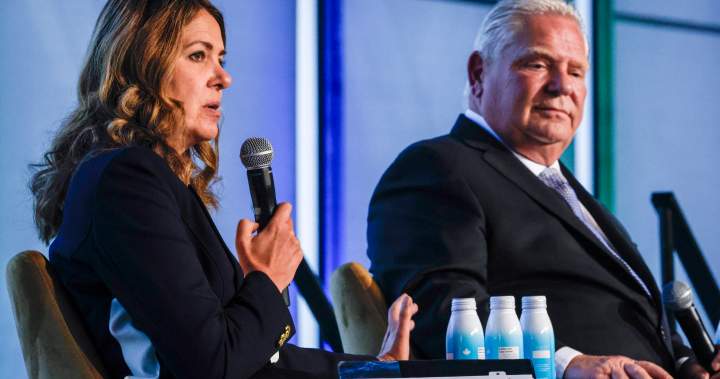
Alberta Premier Danielle Smith and Ontario Premier Doug Ford used a Toronto Region Board of Trade fireside chat on Monday to promote the proposed Northern Shield Energy Corridor, an oil pipeline that would link their provinces.
That would come three months after talks collapsed and U.S. President Donald Trump imposed 50 percent tariffs on roughly $28 billion worth of Canadian goods.
The Public Health Agency of Canada wrote off $331 million in expired or damaged medical supplies last fiscal year and will not finish clearing its pandemic surplus until the end of next fiscal year.
The House of Commons resumes report stage debate today on Bill C-31, the Budget 2025 Implementation Act, No. 2, after the government gave notice that it would seek to limit debate at report stage and third reading.
The Business Development Bank of Canada (BDC) will hold and manage the stake.
One official told the newspaper Canadians would see the move as a “slap in the face.”
Up to 90 per cent of military procurements could stay outside the new Defence Investment Agency, a defence industry group told MPs studying Bill C-40 on Thursday.
Where they broke: the word “power” The sharpest objection was not to resource development but to what the state would do with the proceeds.
At that rate, he said, “it would take 42 years to get this registry up and running.”
Wire or desk byline, not an individual reporter.
Also by The Hub Staff
Nothing else under this byline is closely related to this article, so these are simply their most recent.
All 52 articles by The Hub Staff →

Topics

Alberta Canada LCBO Ontario U.S.

Subjects

Ontario GPE · 8× Alberta GPE · 6× Ford PERSON · 5× Smith PERSON · 5× U.S. GPE · 3× Canada GPE · 2× LCBO ORG · 2× The Hub ORG · 2× Danielle Smith PERSON · 1× Doug Ford PERSON · 1×

Narrative

The session was co-hosted with the Calgary Chamber of Commerce and moderated by BNN Bloomberg’s Amanda Lang. It was part of a day-long forum on Alberta-Ontario economic ties, and it tested whether two provinces aligned on energy can also deliver on the internal-trade pledges they made after U.S. tariffs hit.
framing: assertive · carried by 1 article(s) · first seen 2026-11-24
Alberta Premier Danielle Smith and Ontario Premier Doug Ford used a Toronto Region Board of Trade fireside chat on Monday to promote the proposed Northern Shield Energy Corridor, an oil pipeline that would link their provinces.

Claims (42 extracted, 1 hedged)

Alberta Premier Danielle Smith and Ontario Premier Doug Ford used a Toronto Region Board of Trade fireside chat on Monday to promote the proposed Northern Shield Energy Corridor, an oil pipeline that would link their provinces. asserted
that → use → provinces
They also acknowledged that the trade agreements they signed last year have not cleared away the barriers between them. asserted
they → acknowledge → them
The session was co-hosted with the Calgary Chamber of Commerce and moderated by BNN Bloomberg’s Amanda Lang. It was part of a day-long forum on Alberta-Ontario economic ties, and it tested whether two provinces aligned on energy can also deliver on the internal-trade pledges they made after U.S. tariffs hit. asserted
tariffs → co → pledges
Smith used liquor to illustrate the gap. asserted
Smith → use → gap
Alberta stores sell more than 1,000 Ontario alcohol products, she said, while the Liquor Control Board of Ontario (LCBO) stocks 53 from Alberta. asserted
Board → sell → Alberta
Premiers can agree to open trade, she said, but they then run into “mountains and mountains of legislation, regulation and agency directives that act as individual barriers,” The Canadian Press reported. asserted
Press → agree → barriers
Trade deal meets regulatory reality asserted
deal → meet → reality
Smith’s second example came from her own province. asserted
example → come → province
The College of Physicians and Surgeons of Alberta, a self-governing regulator outside cabinet’s direct control, had limited doctors licensed elsewhere to treating 12 Alberta patients. asserted
College → govern → patients
That cap blocked the government’s plan to recruit physicians from across Canada for virtual appointments. asserted
cap → block → appointments
Smith said the college lifted the limit in April, and she offered both cases as evidence of how complicated the work is. asserted
work → say → evidence
Ontario and Alberta signed a memorandum of understanding to open trade in 2025, a few months after U.S. President Donald Trump launched his trade war against Canada. asserted
Trump → sign → Canada
Both provinces have also agreed to recognize each other’s regulated professions, including doctors, nurses and many skilled trades. asserted
provinces → agree → doctors
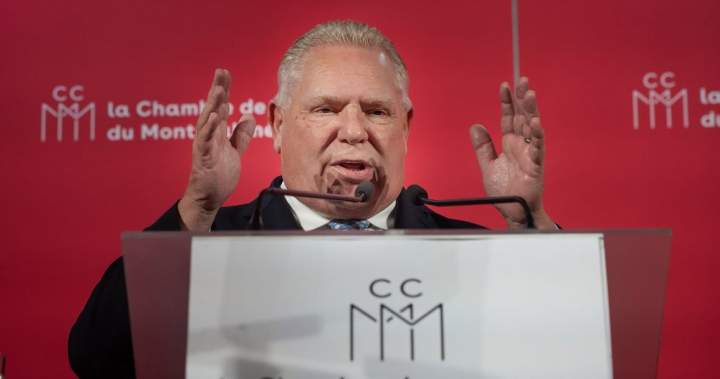
Ford said Ontario is the only province with no remaining trade exceptions. asserted
Ontario → say → exceptions
His government passed legislation in 2025 to drop them all, and Ford said Ontario has since signed 10 similar memorandums with other provinces and territories. asserted
Ontario → pass → provinces
He singled out Quebec for keeping its exemptions. asserted
He → single → exemptions
He also pointed to his government’s opening of alcohol sales to grocery and convenience stores, though the LCBO still controls the purchase and sale of spirits. asserted
LCBO → point → spirits
Smith conceded Alberta has more exemptions to cut. asserted
Alberta → concede → exemptions
Ford put the cost of internal barriers at $200 billion. asserted
Ford → put → billion
That is roughly in line with an International Monetary Fund estimate that the barriers act like a 9.5 percent tariff, and that removing them could lift real GDP by about 7 percent. uncertain
removing → act → percent
A Vox Pop Labs survey of 5,020 Canadian citizens, conducted in February and March and analyzed for The Hub by Trevor Tombe and Brooks DeCillia, found 88 percent believe removing interprovincial trade barriers would help their province’s economy. asserted
removing → conduct → economy
Albertans answered similarly. asserted
Albertans → answer → ?
A pipeline still on paper Northern Shield would carry about 500,000 barrels of crude a day roughly 3,300 kilometres from Hardisty, Alta., to refineries in Sarnia, Ont., without crossing the U.S. Ontario has published the proposed route and is leading a $17-million feasibility study. asserted
Ontario → carry → study
Ford has said taxpayer financing is on the table. asserted
financing → say → table
On Monday, Smith framed the line as a matter of energy security. asserted
Smith → frame → security
Ford said the Ontario section of the route has been mapped and that First Nations along it will need to be consulted. asserted
Nations → say → it
Saskatchewan backs the project. asserted
Saskatchewan → back → project
Manitoba, which the line would cross, has not signed on. asserted
line → cross → which
Premier Wab Kinew said in July he was willing to entertain the idea, but he has insisted that projects crossing his province begin with Indigenous partnership. asserted
projects → say → partnership
No private company has stepped forward to build it. asserted
company → step → it
Writing in The Hub, Heather Exner-Pirot, director of energy, natural resources and environment at the Macdonald-Laurier Institute, said the concept still needed to be fleshed out. asserted
concept → write → Institute
She argued that more than a decade of delays, protests and political rejections has left industry wary, leaving governments to take on the risk. asserted
decade → argue → risk
Of a separate West Coast line, she called public-led development “the second-best option, vastly superior to not building one at all.” asserted
she → call → one
The trade frustrations fit a wider pattern described by economist Charles Lammam, who argued in The Hub that regulatory burdens have piled up over decades under governments of every stripe. asserted
burdens → fit → stripe
He cited the Carney government’s reversal of several Trudeau-era rules as evidence: “When a Liberal government governs on deregulation, the diagnosis writes itself.” asserted
diagnosis → cite → itself
The Canadian Federation of Independent Business (CFIB) counts roughly 140,000 regulatory requirements in Ontario alone. asserted
Federation → count → Ontario
The lopsided liquor shelves suggest that political agreement by itself does not move goods across provincial lines. asserted
agreement → suggest → lines
The pipeline’s next tests are the feasibility study and Manitoba’s answer, and no financing has been confirmed. asserted
financing → confirm → ?
Alberta Premier Danielle Smith and Ontario Premier Doug Ford discussed the proposed Northern Shield Energy Corridor pipeline during a Toronto Region Board of Trade event, emphasizing the need for improved trade relations between their provinces. asserted
Smith → discuss → provinces
Despite signing trade agreements, they acknowledged ongoing barriers, such as regulatory challenges and limited interprovincial trade in goods like alcohol. asserted
they → sign → alcohol
…and 2 more, not listed.
Give feedback · no sign-in needed

No sign-in needed for now. Your note is sent without a name, so it cannot be answered.

History Support