U.S. Trade Representative Jamieson Greer said Sunday that Washington and Ottawa are “fairly close” to a tariff-relief deal.
asserted
Washington → say → deal
That would come three months after talks collapsed and U.S. President Donald Trump imposed 50 percent tariffs on roughly $28 billion worth of Canadian goods.
asserted
Trump → come → goods
Greer warned, however, that Canada’s warming trade ties with China worry both parties in Washington and run against the direction of U.S. policy.
asserted
ties → warn → policy
Ottawa sounded more cautious.
asserted
Ottawa → sound → ?
Trade Minister Dominic LeBlanc told Radio-Canada that progress has been made but Canada is not on the verge of signing.
asserted
Canada → tell → signing
Neither government has released a text or a list of tariff changes.
asserted
government → release → changes
Greer made the remarks in an interview with Fox News, The Canadian Press reported.
asserted
Press → make → News
He did not describe the terms under discussion.
asserted
He → describe → discussion
He called the talks constructive and noted that most goods crossing the border still enter duty-free.
asserted
goods → call → border
Washington’s aim, he said, is to protect the North American economy while landing a deal that works for both countries.
asserted
that → say → countries
Greer pointed to Ottawa’s decisions to cut tariffs on Chinese electric vehicles, steel and aluminum, saying the approach “goes a little bit backwards.”
asserted
approach → point → vehicles
He framed the gap as philosophical: the U.S. is trying to fix the costs of globalization, he said, while Canada is leaning further into it.
asserted
Canada → frame → it
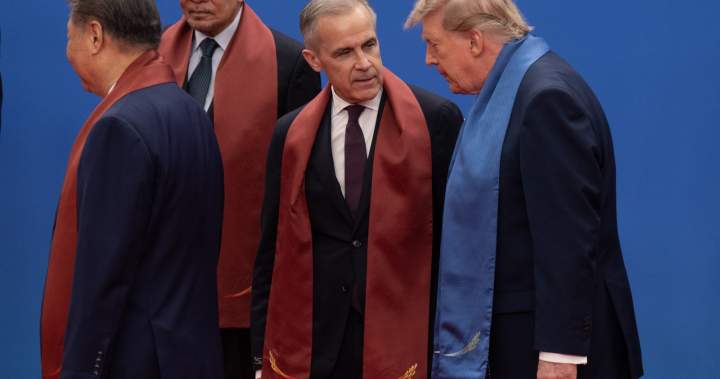
On Nov. 17 in Shenzhen, Prime Minister Mark Carney and Chinese President Xi Jinping agreed to expand a trade truce the two leaders struck in January.
asserted
leaders → agree → January
China will suspend additional tariffs on about $400 million a year of Canadian frozen pork and seafood from Jan. 1, 2027, through the end of 2028.
asserted
China → suspend → 2028
In return, Canada extended its tariff exemptions on certain Chinese steel and aluminum products by two years.
asserted
Canada → extend → years
It also added 32 more items for which Canadian supply is insufficient or unavailable.
asserted
supply → add → which
The January deal is the part Greer singled out first.
asserted
Greer → single → ?
Under it, Canada allowed up to 49,000 Chinese-made EVs a year into the country at a 6.1 percent tariff, down from 100 percent, in exchange for Chinese relief on canola.
asserted
Canada → allow → canola
How the talks broke down
Negotiations collapsed late on Aug. 21.
asserted
Negotiations → break → Aug.
Trump’s tariffs took effect the next day under Section 338 of the Tariff Act of 1930, a Depression-era provision never before used to impose tariffs.
asserted
tariffs → take → tariffs
They cover about 5 percent of Canada’s exports to the U.S.
asserted
They → cover → U.S.
The two sides still dispute who walked away.
asserted
who → dispute → ?
Carney said Washington added last-minute terms that would have reduced relief for Canadian-made vehicles, restricted Canada’s ability to strike trade deals with other countries, and weakened protections for culture and sovereignty.
asserted
that → say → culture
Greer has said Canada abandoned a near-final deal.
asserted
Canada → say → deal
The second of Carney’s objections foreshadows Greer’s complaint about China.
asserted
second → foreshadow → China
Ottawa retaliated on Sept. 8 with tariffs of 15 to 50 percent on roughly $30 billion of U.S. imports, a response the government described as dollar for dollar.
asserted
government → retaliate → dollar
Washington escalated again after the Canadian measures took effect, with Greer blaming Ottawa.
asserted
Greer → escalate → Ottawa
The retaliation carries its own cost at home.
asserted
retaliation → carry → home
University of Calgary economist Trevor Tombe estimates Canada’s counter-tariffs average about 30 percent across affected goods.
asserted
tariffs → estimate → goods
That works out to roughly 60 cents of response for every dollar of U.S. tariff, short of the government’s framing.
asserted
That → work → framing
He projects the measures will raise consumer prices by about a quarter of a percentage point, a hit of nearly $4 billion.
asserted
measures → project → billion
Households earning under $30,000 a year lose more than three times the share of disposable income lost by those earning over $150,000.
asserted
Households → earn → 150,000
What’s on the table
asserted
’s → ’ → table
According to people briefed on the talks, Global News reported that Ottawa’s framework is largely unchanged from August.
uncertain
framework → accord → August
Canada would drop its counter-tariffs if Washington removes or reduces the Section 338 tariffs.
asserted
Washington → drop → tariffs
The biggest obstacle remains the 25 percent U.S. tariff on Canadian autos.
asserted
obstacle → remain → autos
In August, the Americans offered to cut it to 15 percent with no carve-out for CUSMA-compliant vehicles.
asserted
Americans → offer → vehicles
Canada’s chief negotiator, Janice Charette, told a federal advisory committee that multiple issues remain unresolved.
asserted
issues → tell → committee
LeBlanc has said an interim deal could open the door to formal talks on the Canada-U.S.-Mexico Agreement (CUSMA).
uncertain
deal → say → Agreement
Trump announced in June that he would not renew CUSMA, leaving it subject to rolling annual reviews.
asserted
he → announce → reviews
…and 23 more, not listed.

 The Aporia