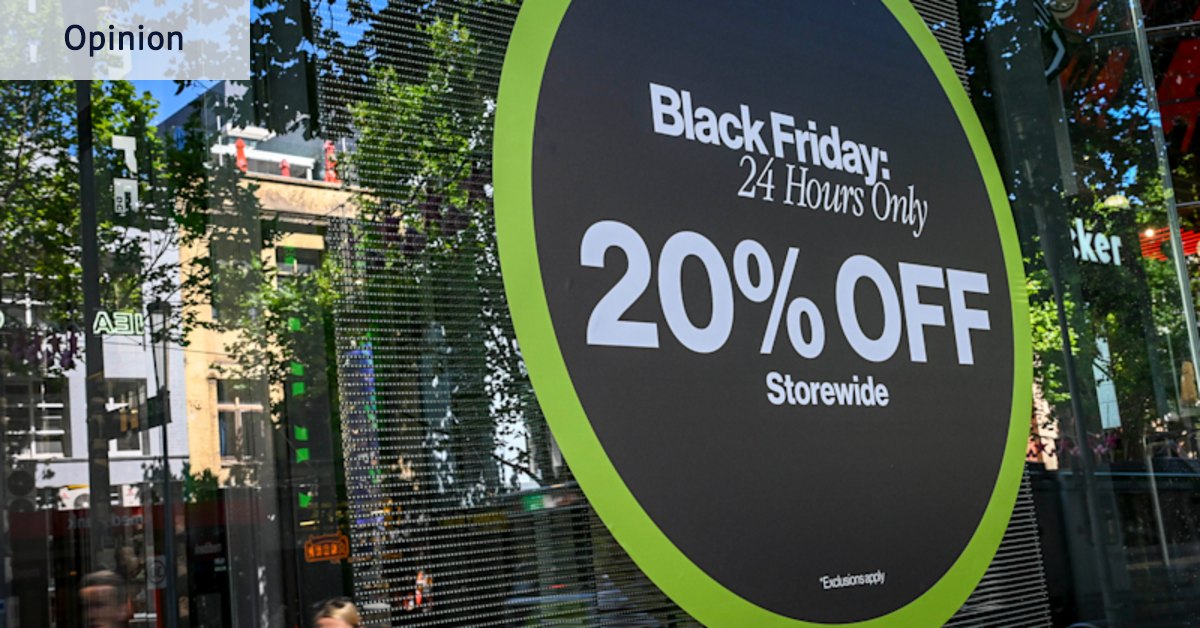
Photo via The Sydney Morning Herald

Who’s getting the best deal this Black Friday? It’s probably not you

Read the original at The Sydney Morning Herald ↗
Cite

Yong, M. (2026, November 24). Who’s getting the best deal this Black Friday? It’s probably not you. The Sydney Morning Herald. https://www.smh.com.au/money/saving/who-s-getting-the-best-deal-this-black-friday-it-s-probably-not-you-20261124-p61gpz.html?ref=rss&utm_medium=rss&utm_source=rss_feed

Dated from the outlet's own feed. Check the original for its byline.

The Sydney Morning Herald · collected 2026-11-24 · by Max Yong

Quick Summary

Australians spent $23.8 billion during last year’s Black Friday sales period, marking a 20% increase from a normal two-week period. Retailers often entice shoppers to spend more than intended through strategies like false discounts and limited-time offers, such as a 90% discount on a knife set that regularly sells for $99. The article emphasizes the importance of distinguishing between planned purchases that offer real savings and impulse buys that may not provide value.
Written by AI on 2026-11-24, from this article's own text only (the story summary below draws on all the coverage).

AI analysis

Story summary

As of November 24, 2026, Australians are expected to spend heavily during the Black Friday sales period, with $23.8 billion spent in the previous year during a two-week period. This amount is almost 20% higher than a normal fortnight and is equivalent to about 2.5 times the annual GDP of Fiji. Black Friday has surpassed Boxing Day as the leading sales period in Australia, becoming a significant fixture in the country's retail calendar.

Retailers exploit consumers in two primary ways: first, by encouraging shoppers to spend more than they initially intended due to enticing discounts and limited-time offers, such as a 40% off tag or a "only five units left" warning. Secondly, retailers often employ psychological tactics to make shoppers feel they are missing out on deals, leading to unnecessary purchases. For instance, ads might convince consumers to buy additional items like a robot vacuum cleaner, which they would not have purchased otherwise. This year, consumers are urged to consider the true value of Black Friday deals before making unplanned purchases.

Written for “Black Friday Deals” on 2026-11-26, grounded in this article and the 0 other(s) covering the same event.

Compared with similar articles

This article reads unscored and hedges 20% of its claims. Each row says how that neighbour differs.
ABC News (AU)
Hedges 10 of 44 claims Outlet record 66/100
“The articles discuss general advice and observations about Black Friday sales but do not describe the same specific incident or occurrence.”
NBC News
Hedges 4 of 94 claims Outlet record 72/100
“The articles discuss Black Friday sales but focus on different aspects: one highlights specific deals and products, while the other critiques the broader economic impact and consumer behavior.”
NBC News
Hedges 7 of 83 claims Outlet record 72/100
“The articles discuss Black Friday sales in general, but Article A focuses on the broader impact and spending trends, while Article B provides specific early deals and tracking information.”
Toronto Star
Hedges 4 of 34 claims Outlet record 65/100
“The articles discuss general trends and dilemmas surrounding Black Friday sales but do not describe the same specific incident or occurrence.”

Story

Black Friday Deals
Economy/Business · 1 article(s) covering the same event.
How this article was measured signals, leaning charts, publisher record, byline, topics and claims

Signals How these are calculated →

Claims extracted
40
sentences that state something as happening or true
Uncertain
20%
8 of 40 hedged ("reportedly", "may", "according to")
Leaning
not political
takes no side on a contested political question
Publisher signals
61/100
The Sydney Morning Herald's corrections and hedging, across everything collected from it. Not a measure of accuracy.
Outlets on this story
1
Economy/Business
Same framing elsewhere
1
articles that frame the event the way this one does
Analyzed 2026-11-24 · how these are computed

How this is being covered How these are calculated →

Article leaning vs. publisher reliability
Source leaning vs. consistency

Publisher

The Sydney Morning Herald · 8282 article(s) · 19 correction(s) detected
Running correction rate · 19 correction(s)

Who wrote this

Max Yong
2 article(s) here · 1 carrying a prediction
But if, like me, you intend to hunt for some good bargains this weekend, it might be worth stopping to think about who actually wins from these sales.
It may not sound like much, but that adds up to nearly $6 billion being spent on social media advertising each year.
Also by Max Yong
Nothing else under this byline is closely related to this article, so these are simply their most recent.

Topics

Australia Australians Black Friday CommBank iQ. Fiji

Subjects

ACCC ORG · 1× Australia GPE · 1× Australians NORP · 1× CommBank iQ. ORG · 1× Fiji GPE · 1× IKEA ORG · 1× JB Hi-Fi ORG · 1× Kmart ORG · 1× digiDirect ORG · 1× the Australian Competition and Consumer Commission ORG · 1×

Narrative

Once we’ve seen an enticing offer – complete with a 40 per cent off discount tag, an ‘only five units left’ warning, or a one-hour countdown timer – it’s easy to convince ourselves that we needed the item all along.
framing: assertive · carried by 1 article(s) · first seen 2026-11-24
But if, like me, you intend to hunt for some good bargains this weekend, it might be worth stopping to think about who actually wins from these sales.
2026-11-24 · The Sydney Morning Herald
Who’s getting the best deal this Black Friday? It’s probably not you · assertive framing

Claims (40 extracted, 8 hedged)

Last year, Australians spent $23.8 billion during the two-week Black Friday sales period – almost 20 per cent more than a normal fortnight, according to CommBank iQ. uncertain
Australians → spend → iQ.
That’s around 2.5 times the annual GDP of Fiji. asserted
That → ’ → Fiji
With Black Friday overtaking Boxing Day as the leading sales period, it has truly become a fixture in Australia’s retail calendar. asserted
it → overtake → calendar
But if, like me, you intend to hunt for some good bargains this weekend, it might be worth stopping to think about who actually wins from these sales. uncertain
who → intend → sales
There are two main ways that retailers can take advantage of us during Black Friday. 1. Making us spend more money than we wanted to. asserted
we → be → money
First, it is important to think about how much you are going to spend, and compare it with how much you would have spent if there wasn’t a sale at all. asserted
you → think → much
Economists call this a ‘counterfactual’. asserted
Economists → call → this
If you were already planning on buying a Nintendo Switch gaming console as your child’s Christmas present, getting it at a 20 per cent discount is a huge win. asserted
getting → plan → discount
However, if the Black Friday ads at JB Hi-Fi convince you to also buy a robot vacuum cleaner – that you otherwise wouldn’t have – they might be taking you for a ride. uncertain
they → convince → ride
Black Friday can be a great way to save money on everyday staples. asserted
Friday → save → staples
Just make sure you’re the one who is actually winning. asserted
who → make → ?
Of course, you are now the proud owner of a robot vacuum cleaner – and it may prove useful. uncertain
it → prove → cleaner
But if the item spends most of its life sitting in a cupboard instead of being used, that’s a good sign your impulse buy might’ve been a mistake. uncertain
buy → spend → cupboard
I’m sure we can all recall times we overestimated how useful a purchase might be. uncertain
purchase → ’m → times
Reflecting on these experiences can be a worthwhile exercise to keep us from repeating bad habits. asserted
Reflecting → reflect → habits
The difficulty with counterfactuals is that they can be tough to observe. asserted
they → observe → counterfactuals
Once we’ve seen an enticing offer – complete with a 40 per cent off discount tag, an ‘only five units left’ warning, or a one-hour countdown timer – it’s easy to convince ourselves that we needed the item all along. asserted
we → see → item
Retailers sometimes use tricks to make us feel like we’re getting a better deal than we really are. asserted
we → use → deal
It looks like an incredible 90 per cent saving – but in truth, it sells for $99 year-round anyway. asserted
it → look → 99
This sales technique relies on what economists call “anchoring”. asserted
economists → rely → what
The $99 sales price feels cheap relative to the listed cost of $1000. asserted
price → feel → 1000
But, at the end of the day, it’s still an expensive $99 purchase regardless of the high ‘anchor’ price, especially when you compare it to cheaper Kmart or IKEA alternatives. asserted
you → ’ → alternatives
Electronics store digiDirect was recently fined $99,000 for five infringements, including advertising a wireless keyboard for $149 (down from $229) despite it seldom being sold at the higher price. asserted
it → fin → price
Other tricks include ‘sitewide’ sales with large exclusions, countdown timers with discounts that don’t end at the stated time, and false claims of low stock levels. uncertain
that → include → levels
But just because the regulator is on the lookout doesn’t mean you should let your guard down. asserted
you → mean → guard
So, what should you do? asserted
you → do → what
First, write down a shopping list before you look at any sales. asserted
you → write → sales
Include Christmas presents and staples you intend to buy regardless of any sales. asserted
you → include → sales
Second, assign a budget based on what you can afford. asserted
you → assign → what
This will help set your expectations on a number that’s more meaningful to your own financial situation. asserted
that → set → situation
Third, try to recognise when retailers might be taking advantage of you. uncertain
retailers → try → you
Retail marketing teams know every trick in the book, so being aware of their tactics can help us avoid falling for them. asserted
us → know → them
If you feel like you’re getting anchored, compare a product across different brands and sellers. asserted
you → feel → brands
Remember that the percentage size of a discount shouldn’t determine whether you buy something. asserted
you → remember → something
All that matters is if it’s a good price for a product that you were already planning on buying, or it’s something you actually think you’ll use. asserted
you → matter → that
If you feel like you’re being pressured into an impulse buy, step away from your device and think about whether you truly need that purchase. asserted
you → feel → purchase
Forcing yourself to wait 24 hours before buying something can help with mental clarity. asserted
Forcing → force → clarity
In summary, Black Friday can be a great way to bring forward purchases and save money on everyday staples. asserted
Friday → bring → staples
Just make sure you’re the one who is actually winning – we don’t want any robot vacuum cleaners wasting away in the cupboard come 2027. asserted
cleaners → make → 2027
He previously taught at Melbourne University. asserted
He → teach → University

Give feedback · no sign-in needed

No sign-in needed for now. Your note is sent without a name, so it cannot be answered.

History Support