• Framework proposes breaking up both companies into six to eight entities
• Separate transmission, distribution and sales businesses envisaged to create competitive gas market; IMF backs reforms
•
asserted
IMF → break → reforms
Over Rs3tr in gas circular debt to be shifted to special purpose vehicle; domestic tariffs may rise
uncertain
tariffs → shift → vehicle
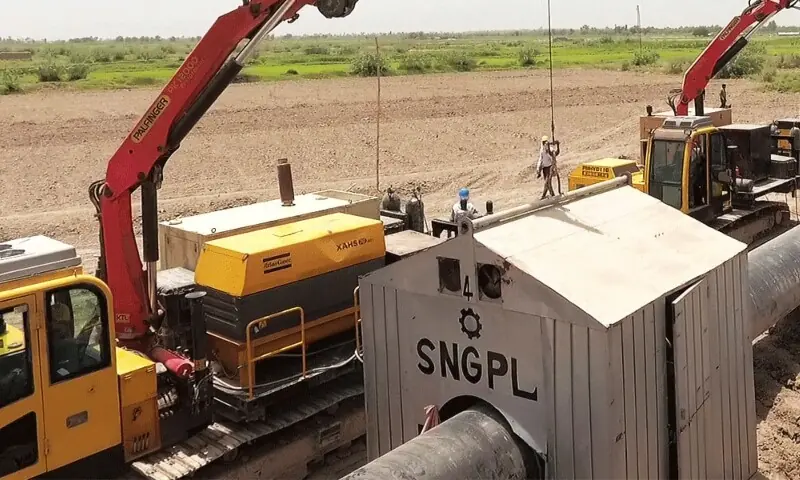
The government has finalised a plan to unbundle the two Sui gas companies into six to eight smaller entities, separating their transmission, distribution, and sales businesses to transform gas monopolies into a “competitive gas market” with the ultimate objective of achieving “energy security, price rationality, and an efficient, investment-friendly economy”.
asserted
government → finalise → security
Top petroleum division sources told journalists during a background briefing that a summary containing the reform framework had been submitted to Prime Minister Shehbaz Sharif for in-principle clearance and guidance on whether formal endorsement should be sought from the federal cabinet, the Council of Common Interests (CCI) or parliament.
asserted
endorsement → tell → Interests
The plan has been finalised with technical support from the World Bank, KPMG and Wood Mackenzie.
asserted
plan → finalise → Bank
It makes a departure from an earlier PML-N led botched attempt in 2016-17 to create four provincial distribution gas companies and a transmission company.
asserted
It → make → companies
The prime minister’s “authorisation” is required to engage transaction advisers, who would help implement the plan and guide the government through the remaining constitutional, legal, regulatory and financial requirements within five to six months.
asserted
who → require → months
The sources said the International Monetary Fund (IMF) was on board, as its clearance was necessary under the ongoing programme and the related gas circular debt management plan.
“We will be rolling out the transformation plan into the implementation stage by the fourth quarter of 2027,” a top official said.
asserted
official → say → 2027
More than Rs3 trillion in gas circular debt would be parked in a special purpose vehicle (SPV), following the model of the Power Holding Company Limited in the electricity sector.
asserted
trillion → park → sector
The SPV would be funded through a debt-servicing surcharge in consumer tariffs.
asserted
SPV → fund → tariffs
“The central structural reform is the legal and operational separation of the Sui companies’ transportation and distribution activities from their gas supply and marketing activities — the separation of molecules from pipes,” said the summary, a copy of which was seen by Dawn.
asserted
copy → say → Dawn
It said the separation would end the conflict of interest that allowed Sui Northern Gas Pipelines Limited (SNGPL) and Sui Southern Gas Company Limited (SSGCL) to act both as network operators obliged to give all users access and as gas suppliers with an interest in shutting out rivals.
asserted
Limited → say → rivals
The petroleum division has proposed at least four gas sales entities, with two competitive gas supply (CGS) companies for commercial and industrial consumers and two regulated gas supply (RGS) entities serving domestic consumers.
asserted
division → propose → consumers
The Sui companies would be required to free up 20 per cent of their supply and consumer portfolios for the CGS companies in the first year, followed by 10pc in each of the next two years to allow private participants to compete in the market.
asserted
participants → require → market
With 60pc chunk offloaded, the price regulation in the competitive regime would come to an end.
asserted
regulation → offload → end
The financial projections, based on the companies’ FY2025 accounts, show that transportation and CGS businesses would be profitable from the outset, while the RGS segment serving residential consumers would incur losses.
asserted
segment → base → losses
To address the issue, the government would gradually raise gas prices, reduce the number of domestic billing slabs from 12 to one and provide direct subsidies to vulnerable consumers in the protected category through the social safety net.
asserted
government → address → net
In SNGPL’s case, the transportation and CGS segments are projected to earn after-tax profits of Rs24bn and Rs36bn, respectively, while the RGS segment would post an after-tax loss of Rs158bn, with gas costs of Rs322bn far exceeding sales revenue of Rs224bn.
asserted
costs → project → Rs224bn
Domestic consumers currently pay an average of Rs1,268 per million cubic feet (MCF), against a break-even price of Rs2,152 per MCF — a “69.8pc increase required to reach break-even at the profit-before-tax level”.
asserted
consumers → pay → level
If prices are not raised, a subsidy of Rs150bn would be needed.
asserted
subsidy → raise → Rs150bn
Commercial and industrial consumers, by contrast, pay an average of Rs2,893 per MCF against a break-even price of Rs2,737, leaving room for a 5.4pc price reduction.
asserted
consumers → pay → reduction
For SSGCL, the projections allocate the cheapest gas from low-cost fields (Rs328 to Rs876 per MCF) to the RGS segment — the most favourable scenario for domestic supply.
asserted
projections → allocate → supply
Even so, the segment would incur an after-tax loss of Rs59bn, and its average sale price of Rs732 per MCF would need an 82.7pc increase to reach the break-even price of Rs1,337.
asserted
price → incur → Rs1,337
SSGCL’s transportation and CGS segments would earn after-tax profits of Rs27.4bn and Rs19.6bn, respectively, with room for a 7.4pc cut in CGS prices.
asserted
segments → earn → prices
The modelling concludes that the RGS segment remains structurally loss-making under any gas-cost allocation scenario because domestic tariffs are well below cost-recovery levels.
asserted
tariffs → conclude → levels
The plan seeks total capital expenditure of Rs736bn for SNGPL over six years, from FY2027 to FY2032, including a peak requirement of Rs165bn in 2030 for system augmentation and loss reduction.
asserted
plan → seek → augmentation
A similar requirement of Rs390bn has been estimated for SSGCL.
asserted
requirement → estimate → SSGCL
To meet these requirements, the plan proposes introducing a multi-year tariff based on the regulatory asset base methodology, following the model used by K-Electric.
asserted
plan → meet → Electric
 The Aporia