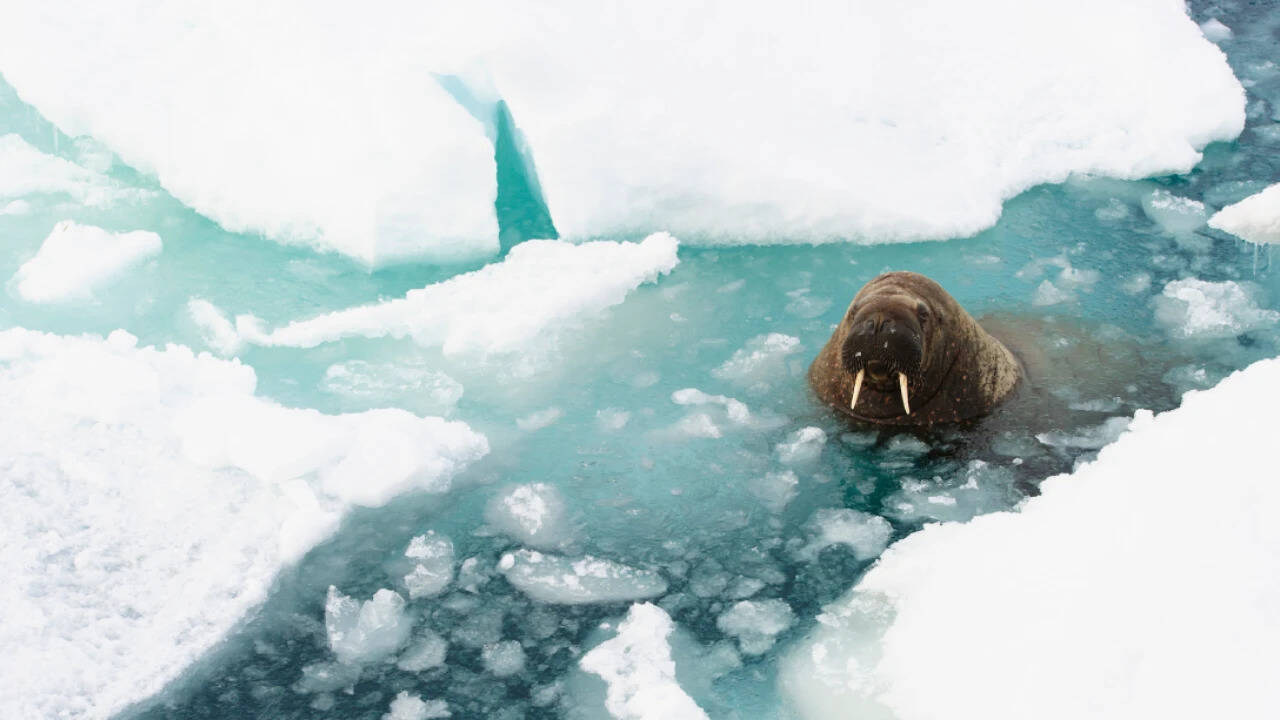
Along the coast of northwest Alaska, thousands upon thousands of Pacific walruses gather on narrow stretches of beach, their enormous bodies pressed against one another as far as the eye can see.
asserted
eye → gather → one
Some lie sprawled across the sand, others shuffle towards the water, while younger walruses squeeze their way through the crowd, trying to find a little space.
asserted
walruses → lie → space
What might look like a particularly crowded beach day is, in fact, a matter of survival for one of the Arctic's largest marine mammals.
uncertain
look → look → mammals
As the Arctic gets warmer and sea ice becomes increasingly unreliable, more than 200,000 Pacific walruses are now gathering on the shores near Point Lay, Alaska.
asserted
walruses → get → Lay
The animals once depended on floating sea ice to rest between feeding trips, but with that habitat disappearing, they have increasingly been forced onto land.
asserted
they → depend → land
Now,
an initiative by the Conservation Fund has permanently protected 47,473 acres around their largest North American gathering site, giving the animals and the Indigenous communities that depend on this landscape some much-needed protection.
asserted
that → protect → protection
Why do thousands of walruses gather on Alaska's coast?
asserted
thousands → gather → coast
The gathering, known as a haul-out, is part of the Pacific walrus's seasonal migration.
asserted
gathering → know → migration
These animals spend much of their time in the waters of the Bering and Chukchi seas, travelling between Alaska and Russia.
asserted
animals → spend → Alaska
While males generally remain in the Bering Sea throughout the year, females and their young move north through the Bering Strait towards the shallow feeding grounds of the Chukchi Sea.
asserted
females → remain → Sea
They dive into the shallow waters to search for clams and other invertebrates buried in the seabed, using their sensitive whiskers to locate food.
asserted
They → dive → food
But these feeding trips require energy, and the animals need somewhere to rest between dives.
asserted
animals → require → dives
For generations, floating sea ice provided just that.
asserted
ice → float → that
Mothers could rest with their calves on the ice, close to their feeding grounds, before returning to the water.
uncertain
Mothers → rest → water
But, Arctic’s sea ice is becoming increasingly unreliable; as temperatures rise and ice retreats further north, it can move beyond the shallow continental shelf where walruses usually feed.
asserted
walruses → become → shelf
This leaves the animals with fewer convenient resting places and forces them to swim longer distances between feeding grounds and resting spots.
asserted
This → leave → grounds
When the ice disappears, the animals gather on land instead.
asserted
animals → disappear → land
Point Lay, a small village in northwest Alaska, has become one of their most important destinations.
asserted
Lay → become → destinations
The large-scale gatherings began appearing here in 2007, initially involving a few thousand females and calves.
asserted
gatherings → appear → females
Today, the site attracts more than 200,000 walruses every autumn, making it the largest Pacific walrus haul-out in North America.
asserted
it → attract → America
With so many enormous animals packed into a relatively small stretch of land, even a minor disturbance can have devastating consequences.
asserted
disturbance → pack → consequences
The presence of boats, low-flying aircraft, tourists or other human activity can frighten the herd.
asserted
presence → fly → herd
When startled, thousands of animals may suddenly rush towards the water in what is known as a stampede.
uncertain
what → startle → stampede
Smaller walruses, especially calves and juveniles, can get caught beneath the adults and be crushed in the chaos.
asserted
walruses → catch → chaos
Such incidents have killed hundreds, and sometimes thousands, of young animals.
asserted
incidents → kill → animals
The irony is that the very land offering them refuge from disappearing sea ice can become dangerous when they are disturbed on it.
asserted
they → offer → it
Repeated disturbances can also cause walruses to abandon a haul-out altogether, leaving them with even fewer places to rest.
asserted
walruses → cause → places
The Conservation Fund steps in
This is where The Conservation Fund's latest initiative comes in.
asserted
initiative → step → ?
On November 18, the environmental non-profit announced that it had permanently protected 47,473 acres of land around Point Lay, including the barrier islands used by the walruses to gather.
asserted
it → announce → walruses
The agreement was reached with Cully Corporation, an Alaska Native corporation that owns the land.
asserted
that → reach → land
Rather than purchasing the entire property, The Conservation Fund secured a conservation easement, which places permanent restrictions on how the land can be developed or used.
asserted
land → purchase → restrictions
The arrangement protects the habitat from fragmentation and resource extraction, including potential coal and gravel development.
asserted
arrangement → protect → development
Conservation does not always mean taking land away from the people who own or depend on it.
asserted
who → mean → it
Cully Corporation retains ownership, while the protected status of the land limits activities that could threaten the walruses.
uncertain
that → retain → walruses
The Interior Alaska Land Trust will manage the easement, with increased stewardship intended to minimise both direct and accidental disturbances.
asserted
Trust → manage → disturbances
The agreement also takes into account the people who have called this landscape home for generations.
asserted
who → take → generations
The local Inupiaq community depends on the surrounding land and waters for subsistence, cultural practices and traditional ways of life.
asserted
community → depend → life
Residents will retain access to the natural resources they need, while the financial arrangement is intended to strengthen the corporation's position and reduce pressure to sell land for industrial development.
asserted
arrangement → retain → development
The initiative received support from several organisations, including the Wyss Foundation, Gordon and Betty Moore Foundation, Holdfast Collective and the National Fish and Wildlife Foundation through Walmart's Acres for America programme.
asserted
initiative → receive → programme
What does this mean for the walruses and the local community?
asserted
this → mean → walruses
…and 12 more, not listed.
 The Aporia