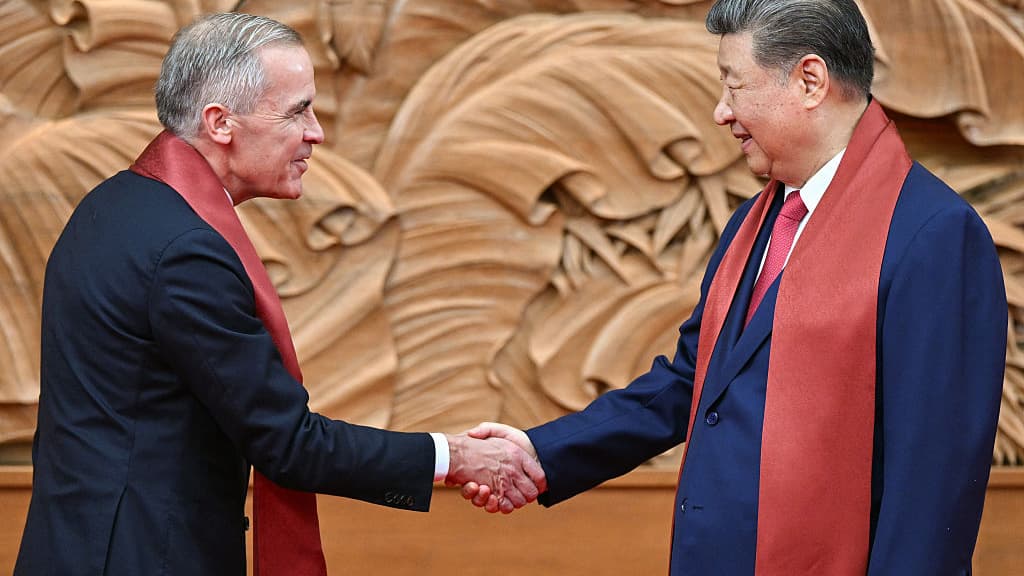
Photo via TIME

How Carney’s Shift Toward China Could Become Leverage in Stalled U.S. Trade Talks

Read the original at TIME ↗
Cite

Ventura, T. (2026, November 20). How Carney’s Shift Toward China Could Become Leverage in Stalled U.S. Trade Talks. TIME. https://time.com/article/2026/11/20/carney-shift-toward-china-leverage-stalled-trump-us-trade-talks/

Dated from the outlet's own feed. Check the original for its byline.

TIME · collected 2026-11-20 · by Tiago Ventura

Quick Summary

Canadian Prime Minister Mark Carney is emphasizing renewed trade relations with China to diversify Canada's economy and reduce reliance on the U.S., amid ongoing trade tensions. During the Asia-Pacific Economic Cooperation (APEC) summit in Shenzhen, Carney announced a new Canada-China trade pact that offers tariff relief on Canadian agricultural exports to China, in exchange for extended tariff exemptions for Chinese steel and aluminum products. Carney's strategy aims to leverage Canada's expanding international trade relationships as a counter to the U.S.'s leverage in trade negotiations, with experts suggesting this approach could challenge President Trump's stance that the U.S. holds the upper hand.
Written by AI on 2026-11-21, from this article's own text only (the story summary below draws on all the coverage).
See how they differ ↓

AI analysis

Story summary

Canadian Prime Minister Mark Carney met with U.S. President Donald Trump for a 20-minute discussion on the sidelines of the Asia-Pacific Economic Cooperation (APEC) summit in Shenzhen, China, on November 19, 2026. Foreign Affairs Minister Anita Anand described the relations as "productive and professional." Carney emphasized the importance of focusing on the electrification of vehicles rather than engaging in a trade war over tariffs, suggesting Canada should collaborate more with China in this sector. During the summit, Carney also indicated that Canada is diversifying its trade relationships to reduce reliance on the U.S., highlighting a three-month-long trade war between the two countries. The meeting with Trump did not produce significant progress, but Carney highlighted a more positive engagement with Chinese President Xi Jinping.

Written for “Mark Carney's Shift Toward China” on 2026-11-21, grounded in this article and the 2 other(s) covering the same event.

How they differ

3 outlets covered “Mark Carney's Shift Toward China”.

What each outlet says

One AI summary per outlet of its latest article on this story, written from that article alone and checked against it. Open the article for the outlet's own words.

TimeThis outlet20 Nov

Canadian Prime Minister Mark Carney is emphasizing renewed trade relations with China to diversify Canada's economy and reduce reliance on the U.S., amid ongoing trade tensions. During the Asia-Pacific Economic Cooperation (APEC) summit in Shenzhen, Carney announced a new Canada-China trade pact that offers tariff relief on Canadian agricultural exports to China, in exchange for extended tariff exemptions for…

How Carney’s Shift Toward China Could Become Leverage in Stalled U.S. Trade Talks (this article)
The Globe and Mail19 Nov

Foreign Affairs Minister Anita Anand reported that a 20-minute discussion between Prime Minister Mark Carney and U.S. President Donald Trump was productive for advancing Canadian interests. This meeting took place in Shenzhen, China, and Anand emphasized that Canada's relationship with Trump is both productive and professional.

Anand says relations with Trump are 'productive and professional' →
Toronto Star20 Nov

Mark Carney, during the New York Times’s DealBook summit in Shenzhen, China, expressed frustration with the U.S. over automotive tariffs, suggesting that Canada and others should focus on catching up with China in electric vehicle technology instead. After a 20-minute meeting with Donald Trump, Carney diplomatically noted that his trade negotiations with China were linear and professional, in contrast to the…

Mark Carney navigates the art of no deal with Donald Trump →

Compared with similar articles

This article reads leans strongly left and hedges 17% of its claims. Each row says how that neighbour differs.
Toronto Star
Hedges 1 of 29 claims Outlet record 64/100
“The articles discuss different aspects of Canada's trade relations with the U.S. and China, rather than the same specific event.”
CBC News
Hedges 0 of 9 claims Outlet record 72/100
“The articles describe different parts of the same broader situation, with Article A focusing on Carney's statement during a summit and Article B on the context and implications of Carney's trade mission to China.”
The Globe and Mail
Hedges 0 of 4 claims Outlet record 51/100
“While both articles mention Mark Carney's visit to China, Article A focuses on the specific outcome of trade talks and tariff reductions, while Article B discusses the broader strategic shift and diplomatic leverage gained from the visit. They describe different aspects of the same trip but not the same specific event.”
Toronto Star
Hedges 3 of 37 claims Outlet record 64/100
Toronto Star
Hedges 0 of 2 claims Outlet record 64/100
“The articles describe different aspects of the U.S.-Canada trade negotiations, not the same specific event.”
The Hindu
Leans right further right than this Hedges 1 of 9 claims Outlet record 78/100
“The articles describe related events but different specific meetings or statements made by Canadian Prime Minister Carney and Chinese President Xi Jinping at different times.”
CBC News
Hedges 0 of 3 claims Outlet record 72/100
“The articles discuss different aspects of Mark Carney's trade policies and strategies, without clearly describing the same specific incident or occurrence.”
CBC News
Leans right further right than this Hedges 2 of 47 claims Outlet record 72/100
“The articles describe different aspects of Prime Minister Carney's foreign policy and trade efforts, not the same specific incident.”
The Globe and Mail
Hedges 0 of 33 claims Outlet record 51/100
“Article A describes a meeting between Carney and Sheinbaum on the sidelines of the APEC summit, while Article B describes an interview with Carney discussing Canada's international trade strategy, which is a different event.”
BBC News
Leans strongly left Hedges 7 of 44 claims Outlet record 65/100
“The articles discuss related topics but describe different specific events: one focuses on Carney's signaling of looking to China for solutions during a visit, while the other focuses on a remote interview in Shenzhen discussing Canada's leverage in trade talks.”

Story

Mark Carney's Shift Toward China
Politics · 3 article(s) covering the same event. See how they differ ↑
How this article was measured signals, leaning charts, publisher record, byline, topics and claims

Signals How these are calculated →

Claims extracted
69
sentences that state something as happening or true
Uncertain
17%
12 of 69 hedged ("reportedly", "may", "according to")
Leaning
Leans strongly left
of the writing, not the subject · beta estimate
Publisher signals
60/100
TIME's corrections and hedging, across everything collected from it. Not a measure of accuracy.
Outlets on this story
3
Politics
Same framing elsewhere
1
articles that frame the event the way this one does
Analyzed 2026-11-21 · how these are computed

How this is being covered How these are calculated →

Article leaning vs. publisher reliability
Source leaning vs. consistency

Publisher

TIME · 1078 article(s) · 2 correction(s) detected
Running correction rate · 2 correction(s)

Who wrote this

Tiago Ventura
22 article(s) here · 1 carrying a prediction
Carney, who is promoting a “Canada Strong” platform as he aims to build economic resilience at home, touted the expansion of the trade arrangement with China as something that will deliver “greater certainty and prosperity for all Canadians.”
Edgar explains that targets of interest to the NSA can include “foreign governments, foreign terrorist organizations, but also other prominent foreign targets that might be of intelligence interest to the United States.”
An overnight Ukrainian missile attack has severely damaged the vital Kerch bridge linking occupied Crimea with Russia, delivering a symbolic blow to Russian President Vladimir Putin ahead of a summit in Asia where he is expected to meet President Donald Trump.
The Department of Justice (DOJ) has warned Democratic Senator Elizabeth Warren of Massachusetts that she could face "significant legal consequences" if she fails to preserve records related to potential Congressional investigations involving allies of President Donald Trump.
users may still “be unable to connect to multiple Microsoft 365 services.”
Kushner, Trump’s son-in-law, said the meeting with Putin would focus on the outcome of the Abu Dhabi discussions, which concluded Wednesday with plans for another prisoner exchange, but no concrete steps toward ending the war.
Defense Secretary Pete Hegseth could become the third Cabinet secretary to be impeached in U.S. history after a Republican lawmaker reintroduced a resolution forcing the House to take up the vote.
If Massie re-files his articles of impeachment against Hegseth as privileged, it would mean the House must take up the issue within two legislative days.
But the tide may now be turning.
The sweeping victory will reshape the final two years of President Donald Trump’s presidency and could have a significant impact on the 2028 presidential map.
2026-11-04 · assertive framing · Meet the Democratic Rising Stars Who Could Shape 2028
Also by Tiago Ventura
Nothing else under this byline is closely related to this article, so these are simply their most recent.
All 22 articles by Tiago Ventura →

Topics

APEC Canada Canadian China U.S.

Subjects

China GPE · 14× U.S. GPE · 12× Canada GPE · 9× Carney PERSON · 8× Canadian NORP · 5× APEC ORG · 3× Chinese NORP · 3× Trump PERSON · 2× Washington GPE · 2× Mark Carney PERSON · 1×

Narrative

Canadian Prime Minister Mark Carney is placing particular focus on renewing relations with China as he aims to deepen international trade ties and diversify from U.S. reliance amid a three-month-long trade war with the U.S. When asked what cards Canada holds in its ongoing talks with Washington, Carney, who recently announced a new partnership with the E.U., pointed to the country's budding relationships elsewhere.
framing: assertive · carried by 1 article(s) · first seen 2026-11-21
Carney, who is promoting a “Canada Strong” platform as he aims to build economic resilience at home, touted the expansion of the trade arrangement with China as something that will deliver “greater certainty and prosperity for all Canadians.”

Claims (69 extracted, 12 hedged)

Canadian Prime Minister Mark Carney is placing particular focus on renewing relations with China as he aims to deepen international trade ties and diversify from U.S. reliance amid a three-month-long trade war with the U.S. When asked what cards Canada holds in its ongoing talks with Washington, Carney, who recently announced a new partnership with the E.U., pointed to the country's budding relationships elsewhere. asserted
who → place → relationships
“Our cards are that everyone else in the world wants to deal with us,” he said Wednesday during a remote interview with the New York Times from Shenzhen, China, where he was among the world leaders attending the Asia-Pacific Economic Cooperation (APEC) summit. asserted
he → want → summit
"If the U.S. doesn't want to do the deal, we're busy.” asserted
we → want → deal
His remarks came in the wake of President Donald Trump's claim that the U.S. holds “all the cards” after trade talks collapsed in August, leading to both sides enforcing heavy retaliatory tariffs. uncertain
sides → come → tariffs
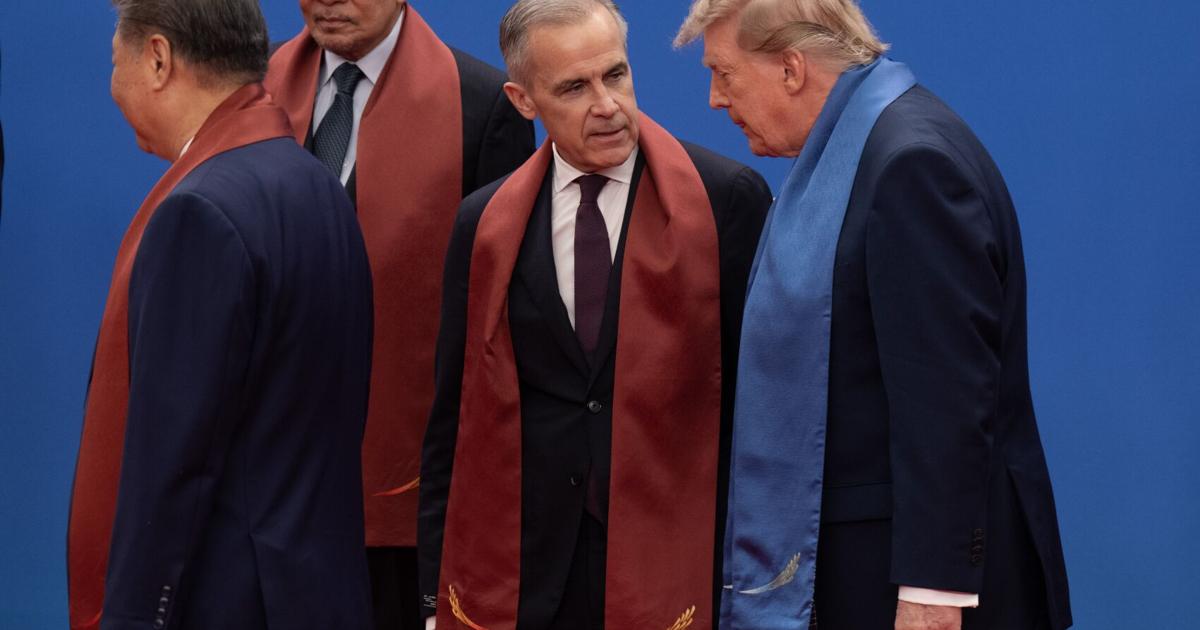
Carney and Trump had a meeting on the sidelines of APEC, but aside from a commitment to “continue” negotiations and stay in close contact, no progress was made. asserted
progress → have → contact
However, Carney painted his meeting with Chinese President Xi Jinping in a much more positive light. asserted
Carney → paint → light
Ahead of the summit, Carney and Xi announced a Canada-China trade pact, which provided additional tariff relief on Canadian food and agricultural exports into China, and in return saw Canada agree to extend tariff exemptions for certain Chinese steel and aluminum products by two years. asserted
Canada → announce → years
Carney, who is promoting a “Canada Strong” platform as he aims to build economic resilience at home, touted the expansion of the trade arrangement with China as something that will deliver “greater certainty and prosperity for all Canadians.” asserted
that → promote → Canadians
He also praised the negotiation process with China, saying: “They’re very professional. asserted
They → praise → China
They move forward in a very linear fashion.” asserted
They → move → fashion
In an eight-day tour that took him from a European summit in Ireland to the Philippines, Cambodia, and finally China for the APEC gathering, Carney forged ahead with his plan to diversify Canada's economy away from its dependence on the U.S., which by far remains the country's largest trading partner. asserted
which → take → U.S.
Experts say Canada's progress in deepening its economic relationships with China could challenge Trump's insistence that Washington holds the upper hand in trade negotiations. uncertain
Washington → say → negotiations
“Part of the Trump Administration’s [belief] is that everybody needs the U.S. more than anything else, and therefore the U.S. has maximum leverage,” says Jennifer Hillman, co-director of the Institute of International Economic Law at Georgetown University. asserted
Hillman → need → University
“What this is clearly saying is that Canada can afford to be less willing to give the U.S. whatever it asks for [in negotiations], because they have other options. asserted
they → say → options
China has the world's second-largest economy, behind only the U.S., giving it the potential to become a much larger market for Canadian goods than some of the other countries Carney has sought to deepen relations with. asserted
Carney → have → relations
“China represents a very big market and the potential of a really big trading partner,” says Lori Turnbull, a professor in the Faculty of Management at Dalhousie University, noting it could be a leverage point in U.S. negotiations. uncertain
it → represent → negotiations
“Doing a deal with a country like China is something that [the U.S.] will care about because of the size of China's economy and its competitive relationship with the U.S.” asserted
U.S. → do → U.S.
Carney's latest push to strengthen trade ties with Beijing forms part of a months-long effort to renew Canada-China relations. asserted
push → strengthen → relations
In January, he met with Xi to forge what he called a “new strategic partnership,” agreeing to allow in up to 49,000 Chinese electric vehicles at a tariff of 6.1%, rather than the previous 100% levy. asserted
he → meet → levy
China agreed to lower tariffs on Canadian agricultural products, including canola seeds, a major Canadian export. asserted
China → agree → seeds
While Canada's closer relationship with China could strengthen its hand in negotiations, experts also warn that it could backfire. uncertain
it → strengthen → negotiations
Turnbull points to the latest agreement to extend tariff exemptions on Chinese steel and aluminum as a potential source of tension with Washington. asserted
Turnbull → point → Washington
“Things like reducing tariffs on select steel and aluminum products coming from China is something that might make the U.S. and not just Donald Trump, but also [U.S. Trade Representative] Jamieson Greer angry,” she suggests. uncertain
she → reduce → China
Steel, aluminum, and auto tariffs were among the major points of contention when U.S.-Canada trade negotiations broke down in August, with both sides accusing each other of walking back commitments. asserted
sides → break → commitments
Carney, however, has played down concerns that Canada's growing trade relationship with China is a major issue for Trump. asserted
relationship → play → Trump
“In my conversation with the President, he’s tried to understand where we are with China, where we’re going with China,” said Carney during a news conference in Shenzhen. asserted
Carney → try → Shenzhen
“I shouldn’t speak for him, but in his hierarchy of issues, it’s not the top issue at all.” asserted
it → speak → issues
Meanwhile, some Canadian officials have voiced concerns on expanding trade with China. asserted
officials → voice → China
Ontario Premier Doug Ford warned Carney on Monday against opening the door for more Chinese-made EV vehicles in Canada, arguing the “government’s focus needs to be on protecting Canadian auto workers, not undermining them by importing even more state-subsidized cheap Chinese cars.” asserted
focus → warn → cars
Michael Chong, a lawmaker from Canada’s Conservative Party, during a press conference on Wednesday supported maintaining a dialogue with Beijing, but described Carney’s budding strategic partnership with China as a “risky gambit,” citing potential “national security” concerns. asserted
Chong → support → concerns
In 2025, Ottawa identified China as one of the main perpetrators of foreign interference and espionage against Canada alongside other countries such as Russia and Iran. asserted
Ottawa → identify → Russia
The Canadian government’s own analysis of Canada-China relations also points out that there are "associated risks” in broader trade cooperation in key areas, such as “prevalent and persistent intellectual property theft, and the risk of diversion of sensitive goods and technologies intended for civilian use for military purposes and applications.” asserted
analysis → point → purposes
Carney said ahead of his Asia trip that he would raise concerns about foreign interference in his meeting with Xi. asserted
he → say → Xi
"The advantage of these meetings is you can raise issues directly and frankly,” he told reporters in Montreal on Nov. 10. asserted
he → raise → Nov.
Carney added that he would stress the importance Canada places on "the non-interference in our affairs by China and other countries.” asserted
Canada → add → China
In a press briefing during the APEC summit, Carney emphasized that Canada's trade with China is largely focused on commodities, rather than sensitive technologies such as advanced semiconductors. asserted
trade → emphasize → semiconductors
“We are exporting canola, we are exporting pork. asserted
we → export → pork
We are exporting halibut,” Carney said, also citing liquefied natural gas and oil. asserted
Carney → export → gas
Experts point out that Canada could pursue deeper cooperation with other international partners in sectors where a closer relationship with China would be more difficult, including defense and advanced technology. “ uncertain
relationship → point → defense
[Canada] is not going to partner with China on defense, security, AI, and digital technology, things like that would be very difficult. asserted
things → go → that
…and 29 more, not listed.
Give feedback · no sign-in needed

No sign-in needed for now. Your note is sent without a name, so it cannot be answered.

History Support