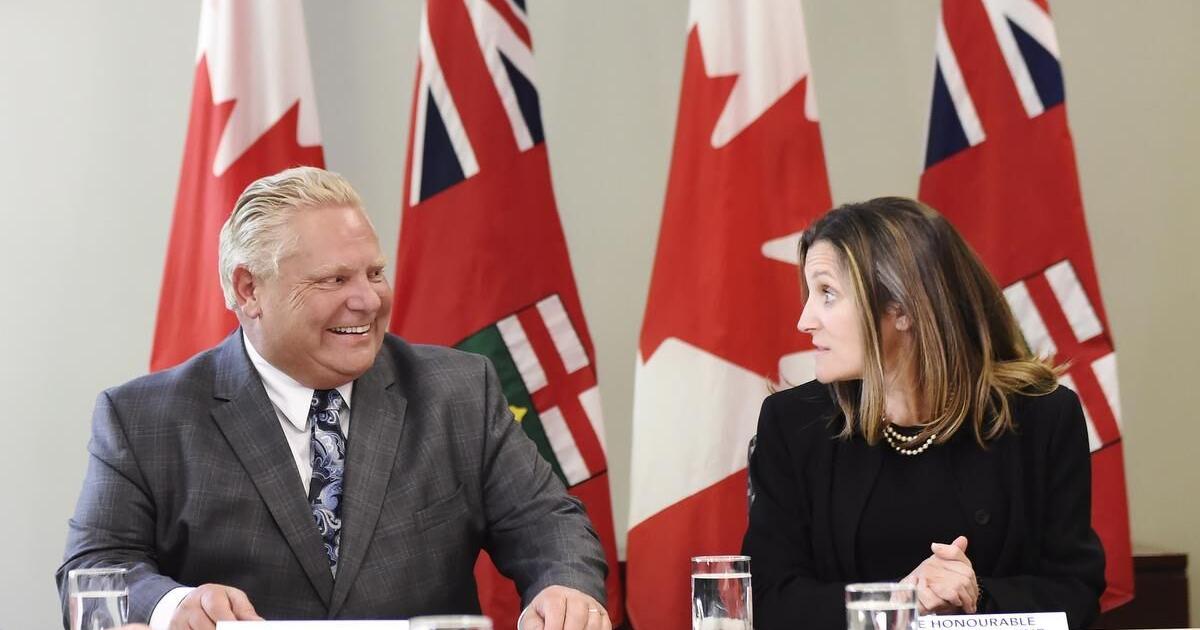
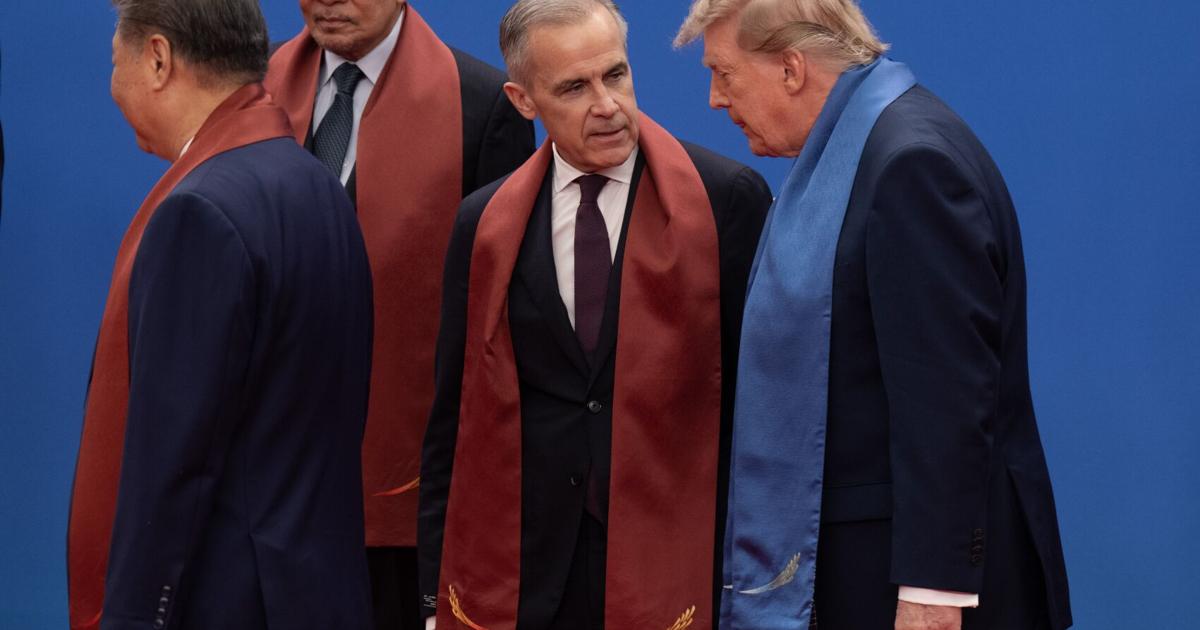
Photo via Toronto Star

Mark Carney navigates the art of no deal with Donald Trump

Read the original at Toronto Star ↗
Cite

Delacourt, S. (2026, November 20). Mark Carney navigates the art of no deal with Donald Trump. Toronto Star. https://www.thestar.com/politics/political-opinion/mark-carney-navigates-the-art-of-no-deal-with-donald-trump/article_d76b9b2d-8c7a-4217-9eca-9160b112ab8b.html

Dated from the outlet's own feed. Check the original for its byline.

Toronto Star · collected 2026-11-20 · by Susan Delacourt

Quick Summary

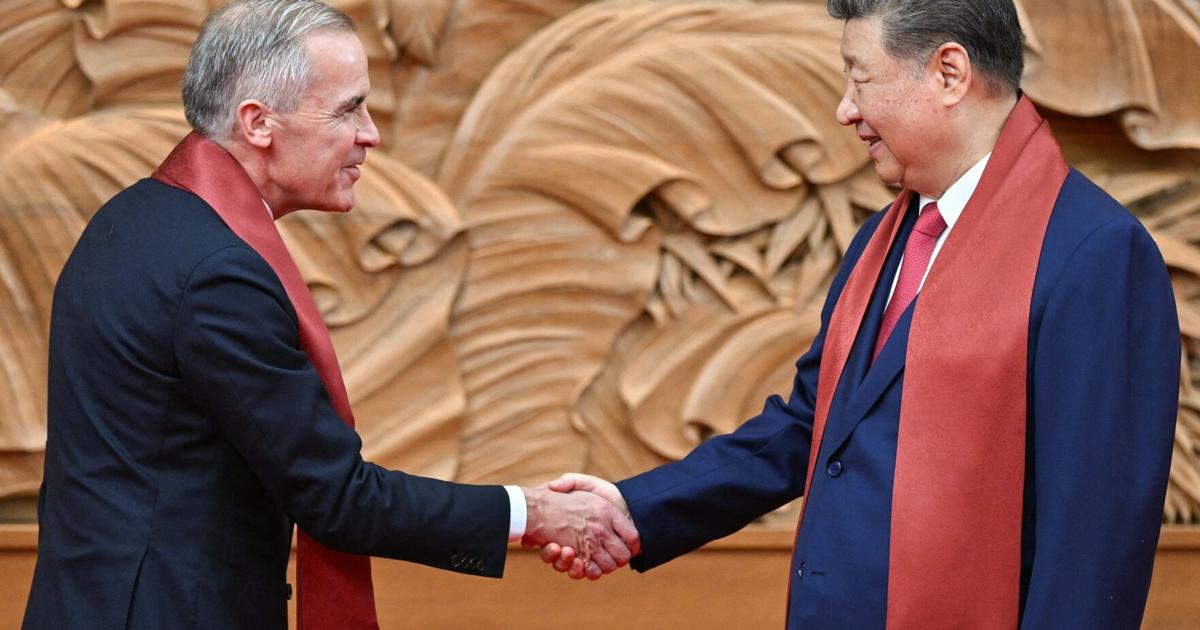
Mark Carney, during the New York Times’s DealBook summit in Shenzhen, China, expressed frustration with the U.S. over automotive tariffs, suggesting that Canada and others should focus on catching up with China in electric vehicle technology instead. After a 20-minute meeting with Donald Trump, Carney diplomatically noted that his trade negotiations with China were linear and professional, in contrast to the unpredictable nature of negotiations with the U.S. He also shared a joke highlighting the stark differences in how Canada approaches trade with China versus the U.S., indicating a preference for rational and predictable negotiations.
Written by AI on 2026-11-20, from this article's own text only (the story summary below draws on all the coverage).
See how they differ ↓

AI analysis

Story summary

Canadian Prime Minister Mark Carney met with U.S. President Donald Trump in Shenzhen, China, on the sidelines of the Asia-Pacific Economic Cooperation summit on November 17, 2026. The meeting, which lasted nearly 20 minutes, included discussions on Canada's growing trade relations with China, which Carney stated were not a top priority for Trump. Carney emphasized that Canada primarily exports commodities to China, rather than sensitive technologies. Foreign Affairs Minister Anita Anand confirmed that the meeting was "productive and professional," and helped raise Canadian interests. Carney’s focus on strengthening ties with China is seen as a strategic move to diversify Canada's trade partnerships amid a three-month-long trade war with the U.S.

Written for “Mark Carney Meets Trump In China” on 2026-11-21, grounded in this article and the 7 other(s) covering the same event.

How they differ

6 outlets covered “Mark Carney Meets Trump In China”.

What each outlet says

One AI summary per outlet of its latest article on this story, written from that article alone and checked against it. Open the article for the outlet's own words.

Toronto StarThis outlet20 Nov

Mark Carney, during the New York Times’s DealBook summit in Shenzhen, China, expressed frustration with the U.S. over automotive tariffs, suggesting that Canada and others should focus on catching up with China in electric vehicle technology instead. After a 20-minute meeting with Donald Trump, Carney diplomatically noted that his trade negotiations with China were linear and professional, in contrast to the…

Mark Carney navigates the art of no deal with Donald Trump (this article)2 articles from Toronto Star on this story
The Globe and Mail19 Nov

Foreign Affairs Minister Anita Anand reported that a 20-minute discussion between Prime Minister Mark Carney and U.S. President Donald Trump was productive for advancing Canadian interests. This meeting took place in Shenzhen, China, and Anand emphasized that Canada's relationship with Trump is both productive and professional.

Anand says relations with Trump are 'productive and professional' →2 articles from The Globe and Mail on this story
CBC18 Nov

Mark Carney, the Canadian Prime Minister, addressed criticism from the White House about Canada's growing trade ties with China, stating that these relations are not a top concern for U.S. President Donald Trump. Carney made these comments during a news conference in Shenzhen, ahead of the Asia-Pacific Economic Cooperation leaders' summit, emphasizing that Canada primarily exports commodities to China rather than…

Carney to meet with Trump at APEC, says Canada's trade ties with China are not U.S. president's top concern →
Global News18 Nov

Prime Minister Mark Carney met with U.S. President Donald Trump in Shenzhen, China, for a 20-minute discussion that included several senior officials from both countries. The meeting took place during the Asia-Pacific Economic Cooperation summit, where Canada and China had recently agreed to remove trade restrictions on products like Canadian pork and Chinese steel. Carney noted that Canada’s ability to secure new…

Carney meets Trump in China, discusses ‘complex’ trade deal →
Toronto Sun18 Nov

Prime Minister Mark Carney of Canada met with U.S. President Donald Trump in Shenzhen, China, a day after signing a trade deal with Chinese President Xi Jinping. The meeting between Carney and Trump, which was unscheduled, focused on ongoing trade discussions and the leaders agreed to stay in close contact. Carney had previously described the Canada-U.S. trade talks as having a "two steps forward, one step back"…

Carney meets Trump in Shenzhen a day after trade deal with Xi →
Time20 Nov

Canadian Prime Minister Mark Carney is emphasizing renewed trade relations with China to diversify Canada's economy and reduce reliance on the U.S., amid ongoing trade tensions. During the Asia-Pacific Economic Cooperation (APEC) summit in Shenzhen, Carney announced a new Canada-China trade pact that offers tariff relief on Canadian agricultural exports to China, in exchange for extended tariff exemptions for…

How Carney’s Shift Toward China Could Become Leverage in Stalled U.S. Trade Talks →

Compared with similar articles

This article reads unscored and hedges 8% of its claims. Each row says how that neighbour differs.
Toronto Star
Hedges 0 of 2 claims Outlet record 65/100
“The articles describe different events: one is about Dominic LeBlanc facing questions in a committee hearing regarding the collapse of trade talks, while the other is about Mark Carney's comments at a New York Times summit in Shenzhen, China.”
Toronto Sun
Hedges 1 of 21 claims Outlet record 96/100
“The articles describe different meetings between Carney and Trump, with the first article detailing a meeting focused on trade talks, while the second describes a meeting where Carney expressed views on electrification of vehicles relative to China.”
The Globe and Mail
Hedges 0 of 2 claims Outlet record 51/100
TIME
Leans strongly left Hedges 12 of 69 claims Outlet record 60/100
CBC News
Hedges 0 of 3 claims Outlet record 72/100
“The articles discuss different aspects of Mark Carney's activities and do not focus on the same specific incident or meeting.”
The Hub
Hedges 3 of 49 claims
“The articles describe different events: one focuses on Carney's comments about tariff talks and Chinese investment in Canada, while the other covers Carney's frustration with dealing with Trump's administration and a separate meeting with Trump in Shenzhen.”
Toronto Star
Leans strongly left Hedges 1 of 29 claims Outlet record 65/100
“The articles describe different meetings and statements made by Mark Carney. Article A focuses on a trade deal with China and comments made in Cambodia, while Article B discusses frustration with dealing with the U.S. administration and a focus on catching up with China on electrification of vehicles during a meeting with Trump in Shenzhen.”
Toronto Star
Hedges 0 of 2 claims Outlet record 65/100
“The articles describe different parts of the same day's events involving Trump and Carney but do not report on the same specific incident or outcome.”
Toronto Star
Hedges 5 of 58 claims Outlet record 65/100
“While both articles discuss Mark Carney's interactions during a New York Times event and meetings with Donald Trump, they describe different times or parts of the event, and Article B includes more extensive details about Carney's schedule and activities.”
Global News
Hedges 0 of 8 claims Outlet record 63/100
“The articles describe different meetings: Article A refers to a meeting where Carney discusses trade directly with Trump and other officials, while Article B describes a separate interaction with Andrew Ross Sorkin where Carney comments on the meeting with Trump.”

Story

Mark Carney Meets Trump In China
Politics · 8 article(s) covering the same event. See how they differ ↑
How this article was measured signals, leaning charts, publisher record, byline, topics and claims

Signals How these are calculated →

Claims extracted
37
sentences that state something as happening or true
Uncertain
8%
3 of 37 hedged ("reportedly", "may", "according to")
Leaning
not political
takes no side on a contested political question
Publisher signals
65/100
Toronto Star's corrections and hedging, across everything collected from it. Not a measure of accuracy.
Outlets on this story
8
Politics
Same framing elsewhere
1
articles that frame the event the way this one does
Analyzed 2026-11-20 · how these are computed

How this is being covered How these are calculated →

Article leaning vs. publisher reliability
Source leaning vs. consistency

Publisher

Toronto Star · 16516 article(s) · 32 correction(s) detected
Running correction rate · 32 correction(s)
2026-11-17
Correction
2026-10-26
Correction
2026-10-24
Correction
2026-10-07
Correction
2026-09-24
Correction

Who wrote this

Susan Delacourt
9 article(s) here · 1 carrying a prediction
On that subject, Carney also said he’d owned a Tesla but sold it — and for less than he expected to get.
All of those who have complained for years that Ottawa should be run more like a business are certainly seeing those wishes fulfilled now, under a prime minister who’s increasingly been cast as CEO of Canada Inc. If Carney’s government is serious about increasing the traffic between the private and public sectors, it may first have to reckon with a law Stephen Harper now admits he got partly wrong.
It’s in the budget’s culture section, too, that we see a government trying to fuse populism and patriotism with some measures that will go over well with many Canadians, making admission permanently free or discounted to people under 25 at museums, galleries, parks and for rail travel.
“I say: ‘I’m not sure my mother would understand what you just said,’ ” the finance minister explains.
But she tactfully drops suggestions that maybe Carney could have been tougher with Trump in the early days.
A Globe and Mail investigation into American involvement in Alberta’s looming referendum shows that the U.S. is far more than a spectator and confirms that its interest may not be entirely in keeping our federation intact. That is definitely new, no matter how one unnamed U.S. government official, as quoted in the story, reached for the example of Bill Clinton making the pitch for federalism ahead of the 1995 Quebec referendum. But that connection only reinforces just what different territory we’re in now — Donald Trump’s America doesn’t view Canada’s sovereignty, as previous administrations have, as inviolable. It means that we should also be keeping our eyes on Quebec if the province is headed to a referendum after Monday’s election.
“If this pipeline gets built it is projected to generate 268 billion in royalties and likely hundreds of billions more in associated economic activity and revenue,” Rath declared, adding in all-capital letters: “THIS MAKES ALBERTA INDEPENDENCE THAT MUCH MORE AFFORDABLE.”
It was immediately evident, within the span of two hours, which world view would be embraced by Canada’s prime minister.
Trump said on the eve of the speech that he would decide what to make of Canada and Europe’s strengthened alliance, and mete punishment accordingly.
Also by Susan Delacourt
Nothing else under this byline is closely related to this article, so these are simply their most recent.
All 9 articles by Susan Delacourt →

Topics

Canada Canadians China Tesla U.S.

Subjects

Carney PERSON · 16× Trump PERSON · 12× China GPE · 5× Canada GPE · 3× Shenzhen GPE · 3× U.S. GPE · 3× Canadians NORP · 2× Sorkin PERSON · 2× Tesla ORG · 2× Mark Carney PERSON · 1×

Narrative

“I don’t have it any more — sorry, Elon — and I didn’t get the resale value for it that I thought I would because they don’t quite have the cachet that they used to,” he said, in a sly dig at Tesla CEO Elon Musk, who was lined up to speak to the same summit not long after Carney.
framing: assertive · carried by 1 article(s) · first seen 2026-11-20
On that subject, Carney also said he’d owned a Tesla but sold it — and for less than he expected to get.
2026-11-20 · Toronto Star
Mark Carney navigates the art of no deal with Donald Trump · assertive framing

Claims (37 extracted, 3 hedged)

Every now and then, Mark Carney betrays some frustration about what it’s like to deal with Donald Trump’s administration. asserted
it → betray → administration
A bit of that emerged when Carney sat down for the New York Times’s DealBook summit on Wednesday. asserted
Carney → emerge → Wednesday
Talking to Andrew Ross Sorkin from Shenzhen, China, not long after a 20-minute meeting there with Trump, Carney said Canada is in the wrong automobile war. asserted
Canada → talk → war
Rather than fighting the U.S. on tariffs, he said, we should be fighting to catch up with China on the electrification of vehicles. asserted
we → fight → vehicles
“We are way behind in North America relative to China, as is Europe, and so we’re spending way too much time on a trade war around autos, as opposed to where is this sector going and how are we pooling our resources.” asserted
we → spend → resources
Carney and Trump discussed ‘the work underway to reach a mutually beneficial trade agreement,’ according to an official readout from the Canadians. uncertain
Carney → discuss → Canadians
Carney and Trump discussed ‘the work underway to reach a mutually beneficial trade agreement,’ according to an official readout from the Canadians. uncertain
Carney → discuss → Canadians
On that subject, Carney also said he’d owned a Tesla but sold it — and for less than he expected to get. asserted
he → say → less
“I don’t have it any more — sorry, Elon — and I didn’t get the resale value for it that I thought I would because they don’t quite have the cachet that they used to,” he said, in a sly dig at Tesla CEO Elon Musk, who was lined up to speak to the same summit not long after Carney. asserted
who → have → Carney
On both counts, Carney was essentially saying that before 2024, he was pretty sure he knew where the future of autos was headed. asserted
future → say → autos
Then along came Trump, tariffs, and Musk’s disruptive effects in general. asserted
Trump → come → ?
Carney actually arrived at that interview armed with a joke that was also a gentle poke at how things are going in Canada-U.S. relations. asserted
things → arrive → relations
After Sorkin introduced him and noted that Carney had spoken to Trump and Xi Jinping separately at the summit, Carney said, “I can report that the trade negotiations are going exceptionally well. asserted
negotiations → introduce → summit
We reached an agreement. asserted
We → reach → agreement
We’ve reduced tariffs on over 90 per cent of trade irritants.” asserted
We → reduce → irritants
Then, smiling, he added, “Of course I’m speaking about our trade negotiations with China. asserted
I → smile → China
They’re very professional. asserted
They → ’re → ?
They’ve moved forward in a very linear fashion, and it asserted
They → move → fashion
Now, if you’re asking about the United States, well, we continue to have a series of issues there.” asserted
we → ask → issues
Carney has circled this territory before, notably in the aftermath of the breakdown in trade talks with the U.S. last summer, when he spoke about how Trump kept coming up with different reasons for tariffs. asserted
Trump → circle → tariffs
But in this encounter, Carney diplomatically would not be drawn into a direct comparison of which leader he trusted more, Xi or Trump. asserted
he → draw → Xi
“We look for situations where there’s alignment and we trust alignment.” asserted
we → look → alignment
Nor did Carney go into great detail about what had taken place in the meeting with Trump in Shenzhen, beyond calling it a “very nice discussion.” asserted
what → go → it
He did, however, give a more general peek behind the curtain on what it’s like dealing with Trump one on one. asserted
it → give → one
“He’s very different inside the room is the short answer. asserted
answer → ’ → room
I mean, he’s a very personable individual,” Carney said. asserted
Carney → mean → ?
“He listens a lot more in private. asserted
He → listen → ?
I mean, he’s interested genuinely in your opinion, and it’s a reasonably direct conversation. asserted
it → mean → opinion
But Carney said he doesn’t forget that what those discussions come down to is whether there’s a deal or not, and right now, there is not one. asserted
come → say → what
It was a wide-ranging interview with Sorkin, touching on a variety of countries and topics, but the thread running through it was how Canada continues to handle a world that Trump has so disrupted. asserted
Trump → range → that
Carney was asked if the Democrats’ rout of Trump’s Republicans in the U.S. midterm elections earlier this month would change things. asserted
rout → ask → things
“I would say no is the short answer,” he replied. asserted
he → say → ?
Well in advance of the Shenzhen summit, Carney had ratcheted down expectations for any meeting he might have with Trump there. uncertain
he → ratchet → Trump
He also said, realistically, that in the larger context of what was happening at this summit — the trilateral meeting between Trump, Xi and Vladimir Putin, for instance — the Canada-U.S. file was not at the top of the president’s agenda. asserted
file → say → agenda
But the DealBook interview was Carney doing what has become a familiar workaround in dealing with Trump — telling influential Americans, very diplomatically, that their president is the cause of the rupture, and that it continues, even in “very nice discussions.” asserted
it → do → discussions
It’s a bit like how he dealt with the sale of his Tesla — not suggesting it was in protest against Musk or because of the declining cachet of the brand, but just a practical decision. asserted
it → ’ → brand
When Sorkin asked what prompted Carney to sell his Tesla, he replied, “I got a new job and I’m not allowed to drive anymore.” asserted
I → ask → job
Give feedback · no sign-in needed

No sign-in needed for now. Your note is sent without a name, so it cannot be answered.

History Support