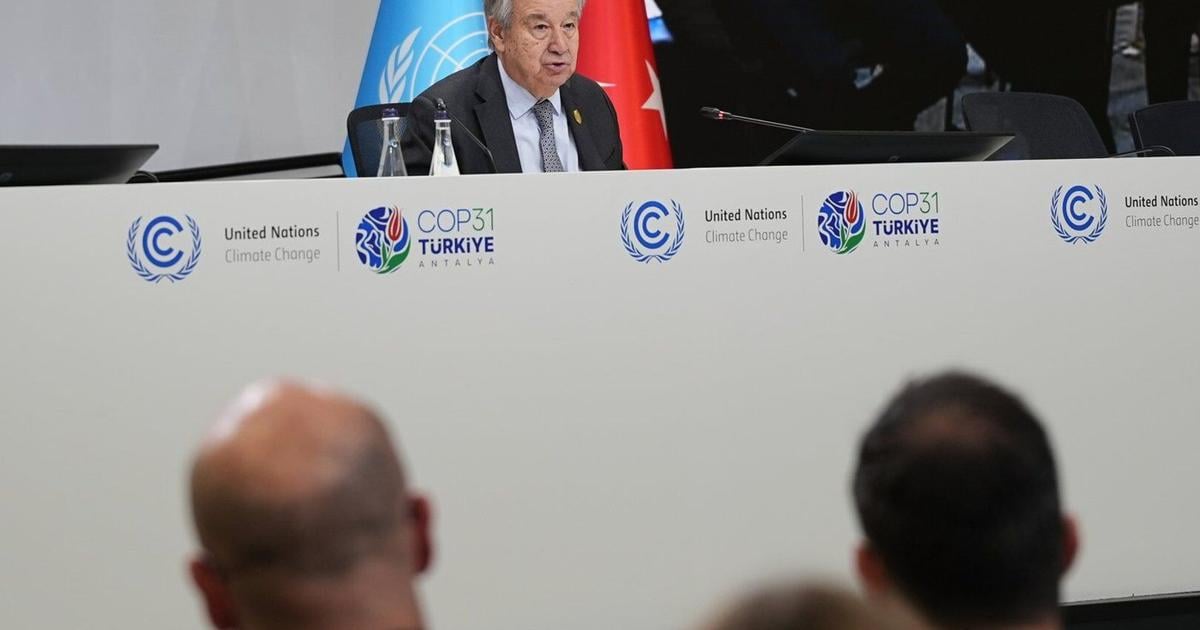
Photo via Toronto Star

Warming has gotten so out of hand, nations call for sucking carbon out of air somehow

Read the original at Toronto Star ↗
Cite

Borenstein, S. (2026, November 20). Warming has gotten so out of hand, nations call for sucking carbon out of air somehow. Toronto Star. https://www.thestar.com/news/world/warming-has-gotten-so-out-of-hand-nations-call-for-sucking-carbon-out-of-air-somehow/article_8a921387-52b4-547e-8f2b-30fc24de61e5.html

Dated from the outlet's own feed. Check the original for its byline.

Toronto Star · collected 2026-11-20 · by Seth Borenstein

Quick Summary

No summary of this article yet; the story summary below covers the event.
See how they differ ↓

AI analysis

Story summary

The 2026 UN Climate Talks (COP31) in Antalya, Turkey ended in discord on November 22, 2026, failing to secure a global agreement due to a dispute over fossil fuel limits. Nineteen US House Democrats attended the summit, despite President Donald Trump's absence. The talks broke down after the European Union and other nations rejected a draft agreement that did not include measures to phase out fossil fuels. The UK's Energy Secretary, Miatta Fahnbulleh, criticized the final draft as moving "backwards on the science." Key issues like fossil fuel limits and adaptation finance were dropped from the draft deal, causing disagreements, especially between oil-producing nations like Saudi Arabia and countries seeking more ambitious climate action.

Written for “COP31 Climate Talks Break Down Over Fossil Fuels” on 2026-11-22, grounded in this article and the 42 other(s) covering the same event.

How they differ

17 outlets covered “COP31 Climate Talks Break Down Over Fossil Fuels”.

What each outlet says

One AI summary per outlet of its latest article on this story, written from that article alone and checked against it. Open the article for the outlet's own words.

Toronto StarThis outlet22 Nov

Turkey's Environment Minister Murat Kurum released the final draft agreement for COP31 climate talks in Antalya on Sunday morning, omitting references to fossil fuels and the need to transition away from them. The draft, which gives delegates only three hours to review and suggest changes, does not explicitly address the primary sources of global warming emissions.

Turkey's final draft at UN climate talks doesn't mention the fossil fuels that cause global warming →4 articles from Toronto Star on this story
The Straits Times22 Nov

UN climate talks at COP31 in Antalya, Turkey, broke down on November 22 as the European Union and other parties rejected the final draft agreement. Turkey and Australia, the COP31 presidents, had issued multiple drafts attempting to balance the interests of vulnerable nations and fossil fuel-dependent economies. Despite recognizing the likelihood of global warming exceeding the 1.5°C threshold, the text failed to…

COP31 climate talks break down as EU, others reject deal →9 articles from The Straits Times on this story
Sydney Morning Herald22 Nov

Climate change negotiations led by Australian Minister Chris Bowen in Turkey concluded without a binding agreement due to disagreements over fossil fuel references and financial support for developing countries. The European Union and small island nations rejected a final agreement that did not explicitly call for transitioning away from fossil fuels, citing the urgent need to address climate change. The Saudi-led…

UN global climate talks led by Chris Bowen end in discord and recrimination →4 articles from Sydney Morning Herald on this story
The Hindu22 Nov

On November 22, 2026, the European Union rejected a climate deal at the COP31 conference in Türkiye because it did not explicitly mention fossil fuels. Ireland’s Climate and Energy Minister Darragh O’Brien stated that the EU would not endorse the deal, calling it a failure to address the main cause of climate change. The proposed deal required consensus from nearly 200 nations but faced significant opposition due to…

EU will ‘not endorse’ climate deal, throwing COP31 outcome into doubt →4 articles from The Hindu on this story
Times of India22 Nov

At the 2026 UN Climate Conference (COP31) in Antalya, Türkiye, participating countries have criticized the draft agreement for omitting references to fossil fuels and the phase-out of coal, oil, and gas. The draft, released by Türkiye’s environment minister Murat Kurum, includes a target for carbon capture and storage but lacks explicit commitments to reduce fossil fuel use. Panama has vowed to oppose the agreement…

COP31: Backlash after Türkiye's draft agreement omits fossil fuels →3 articles from Times of India on this story
Euronews22 Nov

At the ongoing COP31 climate conference in Antalya, Turkey, a new draft agreement was released on Sunday, attempting to secure a deal among nearly 200 nations. However, the draft avoids explicitly mentioning fossil fuels, a critical issue due to increasing global tensions and energy prices, causing significant division and pessimism among delegates. An EU official described the draft as a "backwards" step…

New COP31 draft deal tabled as countries scramble to salvage climate talks →3 articles from Euronews on this story
Show 11 more outlets
Al Jazeera22 Nov

Negotiators at the COP31 climate summit in Antalya, Turkey, are in a second day of extended talks over disagreements on fossil fuels. COP31 President Murat Kurum, Turkey’s environment minister, presented a new proposal aimed at addressing concerns from developing nations and major fossil fuel producers. The summit, originally scheduled to conclude on Friday, now has until Sunday morning to finalize a deal that…

Fossil fuel impasse pushes COP31 climate talks into second day of overtime →3 articles from Al Jazeera on this story
The Independent21 Nov

Negotiators at the United Nations climate conference, Cop31, in Turkey are extending their talks to avoid a disappointing outcome, as hopes for concrete plans to reduce fossil fuel use remain low. Civil society organizations have criticized developed nations for blocking progress and not committing new financial aid, highlighting the urgent need for action to prevent global temperatures from surpassing the 1.5…

Nations race to avoid making Cop31 ‘one of the most disappointing ever’ →2 articles from The Independent on this story
BBC22 Nov

At the UN COP31 summit in Turkey, negotiations for a global climate deal are at a critical point due to a dispute over references to phasing out fossil fuels. The original draft called for a faster phase-out but was revised to remove all mentions of coal, oil, and gas, leading to threats of a walkout by nations like Panama and Tuvalu. The summit, which had already extended its deadline, could end without a deal if…

Fossil fuel dispute threatens to derail COP31 climate deal →2 articles from BBC on this story
Daily Mail22 Nov

At the COP31 climate conference in Antalya, Turkey, tensions have escalated between the EU and Pacific nations on one side and Saudi Arabia and other oil-producing countries on the other, over the inclusion of fossil fuels in the final agreement. The conference, originally set to conclude on Friday, has now become the longest ever UN climate conference, extending beyond its scheduled closing time. The EU and…

COP31 on the brink of collapse as EU rejects UN climate deal amid row with Saudi Arabia over fossil fuels →2 articles from Daily Mail on this story
Daily Caller13 Nov

Nineteen House Democrats are traveling to Antalya, Turkey, from November 14 to 16 to attend the COP31 climate summit without President Donald Trump. Because the lawmakers were denied standard State Department travel assistance, the Sustainable Energy and Environment Coalition (SEEC) Institute is providing the financial funding for the trip. The report highlights the use of philanthropic funding to maintain…

Democrats Lean On Green Group To Reach UN Climate Talks Without Trump →
CBC19 Nov

Climate negotiators at the COP31 meeting in Antalya, Turkey, removed any mention of limiting fossil fuel use and a $120-billion US target for adaptation finance from a draft deal text published on Thursday. The revised draft also downplays the goal of transitioning away from fossil fuels, despite previous commitments made at COP28 in 2023. Turkey and Australia, co-hosts of the conference, argue that this year's…

Fossil fuel limits cut from latest draft of UN climate deal →
Reason20 Nov

Climate activist Mohamed Adow criticizes the 31st Conference of the Parties (COP31) in Turkey as the "worst COP ever," highlighting the conference's failure to produce concrete action on climate change. COP31, which concluded this weekend, saw discussions on the need for aggressive emission cuts of 18%, 45%, and 69% by 2030, 2035, and 2040 respectively, and demands for $305 billion annually in climate finance for…

Turkey Climate Change Conference Dubbed 'Worst COP Ever' →
ABC News (AU)22 Nov

At COP31 climate talks in Türkiye, nations are struggling to reach an agreement due to a disagreement over mentioning fossil fuels explicitly in the final deal. The conference, now in its second day past its deadline, faces pressure from nations demanding action on fossil fuels. The draft proposal, released early Sunday, calls for electrification and expanding clean energy use but avoids naming fossil fuels…

COP31 struggles to reach deal with parties at odds over fossil fuels →
Dawn22 Nov

The United Nations climate talks in Turkiye, COP31, are at risk of failing to reach a consensus agreement. Summit president Murat Kurum announced there would be no new draft text after several countries, including the European Union and Panama, rejected the current version as inadequate. The last collapse of climate talks occurred in Copenhagen in 2009. This year's failure comes amid global crises and increasing…

COP31 climate talks set to collapse without political deal →
Evening Standard22 Nov

At the United Nations Cop31 climate summit in Antalya, Turkey, the UK criticized the draft final agreement, describing it as “immensely disappointing” and failing to mention fossil fuels. Energy Secretary Miatta Fahnbulleh stated that the lack of bold ambition and mention of fossil fuels in the draft agreement moves the world backwards on climate science. The UK, alongside the EU and other nations, objected to the…

UK objects to final Cop31 deal which ‘moves us backwards on the science’ →
NBC News22 Nov

Climate action talks at COP31 in Antalya, Turkey, broke down on Sunday after delegates failed to agree on a new climate agreement draft. The dispute centered around the lack of commitment to phasing out fossil fuels, which the European Union and other nations deemed unacceptable. The summit, which began on November 9, ended without a consensus, marking the longest delay in COP history.

COP31 climate talks break down after angry dispute over fossil fuels →

Where they agree and split

Agreed

Reported by outlets on both sides of the middle

The draft maintains language directed at increasing the share of electricity in the world’s total final energy consumption to 35 per cent by 2035, a key goal of Bowen and Kurum at the COP.

6 outlets
Show 3 more

Panamanian environment minister Juan Carlos Navarro accused a “petroleum mafia” of holding the negotiations "hostage" and called for reforms to the climate talks process.

4 outlets

Facing blowback over fossil fuels, Turkey and Australia pointed to “electrification” as a way to cut heat-trapping emissions and bolster energy security.

4 outlets

Saudi Arabia has been among the main objectors to any wording on the “transition away from fossil fuels”, with insiders suggesting that the world’s largest oil exporter played a key role in blocking ambitious language.

4 outlets
The full story: what happened, how it changed, and all 43 articles →

Compared with similar articles

This article reads leans left and hedges 6% of its claims. Each row says how that neighbour differs.
Toronto Star
Leans strongly left further left than this Hedges 8 of 37 claims Outlet record 65/100
“The articles discuss different aspects of climate change and related policy measures, but do not describe the same specific event.”
The Hindu
Leans left Hedges 1 of 16 claims Outlet record 78/100
“The articles discuss different aspects of the COP31 climate conference, with Article A focusing on the removal of specific commitments from the draft cover text, while Article B discusses the likelihood of adopting carbon-suction technology due to the failure to stay within warming thresholds.”
CBC News
Leans left Hedges 0 of 26 claims Outlet record 60/100
“The articles describe different aspects of the UN climate talks, with Article A focusing on the removal of fossil fuel limits from the draft deal and Article B highlighting the discussion about the need for carbon dioxide removal technology due to the failure to limit warming. They cover related but distinct topics within the same broader context of the COP31 meeting.”
Toronto Star
Leans left Hedges 0 of 2 claims Outlet record 65/100
ProPublica
Leans strongly left further left than this Hedges 8 of 60 claims Outlet record 59/100
“The articles discuss related topics but do not describe the same specific event. Article A focuses on the conclusion of United Nations climate talks about the necessity of carbon capture technology, while Article B discusses an investigation into the reliance on carbon capture and storage technology.”
The Hindu
Leans strongly left further left than this Hedges 2 of 24 claims Outlet record 78/100
“The articles describe different aspects of the climate talks, one focusing on the necessity of carbon removal technology and the other on the draft agreement's language regarding fossil fuels.”
BBC News
Hedges 4 of 29 claims Outlet record 65/100
“Article A discusses the overall direction of climate talks, focusing on the inevitability of needing to remove carbon from the air, while Article B covers a specific dispute and deadlock over fossil fuel reduction during the COP31 summit, indicating a different specific event.”
The Straits Times
Leans left Hedges 1 of 19 claims Outlet record 64/100
“Article A describes the removal of fossil fuel references from the draft deal at COP31, while Article B discusses the conclusion that carbon removal technologies will be necessary due to the failure to meet warming thresholds, indicating different stages or aspects of the conference.”
The Hindu
Leans right further right than this Hedges 0 of 8 claims Outlet record 78/100
“While both articles discuss the same climate summit, they focus on different aspects of the event, with Article A emphasizing the need for carbon removal technology and Article B focusing on the push for deeper fossil fuel cuts. They do not describe the same specific incident.”
The Straits Times
Leans strongly left further left than this Hedges 1 of 36 claims Outlet record 64/100
“While both articles discuss UN climate talks, they focus on different aspects: one on the necessity of carbon removal technology and the other on the controversy over mentioning fossil fuels in the final agreement.”

Story

COP31 Climate Talks Break Down Over Fossil Fuels
Environment · 43 article(s) covering the same event. Compare every outlet's account →
How this article was measured signals, leaning charts, publisher record, byline, topics and claims

Signals How these are calculated →

Claims extracted
36
sentences that state something as happening or true
Uncertain
6%
2 of 36 hedged ("reportedly", "may", "according to")
Leaning
Leans left
of the writing, not the subject · beta estimate
Publisher signals
65/100
Toronto Star's corrections and hedging, across everything collected from it. Not a measure of accuracy.
Outlets on this story
43
Environment
Same framing elsewhere
1
articles that frame the event the way this one does
Analyzed 2026-11-22 · how these are computed

How this is being covered How these are calculated →

Article leaning vs. publisher reliability
Source leaning vs. consistency

Publisher

Toronto Star · 16786 article(s) · 32 correction(s) detected
Running correction rate · 32 correction(s)
2026-11-17
Correction
2026-10-26
Correction
2026-10-24
Correction
2026-10-07
Correction
2026-09-24
Correction

Who wrote this

Seth Borenstein
17 article(s) here · 1 carrying a prediction
ANTALYA, Turkey (AP) — Negotiators at the United Nations climate talks in Turkey will work an extra day in an attempt to reach a final agreement addressing global warming, though hopes are slim that additional discussions will result in any concrete plans to drastically slash the use of fossil fuels.
For the first time, United Nations climate talks are likely to conclude that the world will have to suck heat-trapping gases out of the air as well as cut carbon pollution because society has failed to keep Earth out of the warming danger zone.
Study quantifies how much big data centers pollute Harvard researchers looked at 403 of the largest U.S. data centers between May 2024 and April 2025 using available data and modeling to analyze their electricity use and emissions.
A goal introduced this year would increase the share of electricity in total global energy consumption from roughly 21% to 35% by 2035, preferably from renewable energy such as solar and wind.
The world has failed to slow or stop global warming trends in the past five years because plans weren’t realized and efforts that would have helped were canceled out, a report said Thursday.
Countries that want to wean themselves from the fossil fuels that cause climate change will get a road map aimed at guiding them on an economy-transforming journey toward renewable energies at the U.N. climate talks Tuesday.
If the overall carbon dioxide emission drop were due solely to a rise in renewables and a systemic drop in fossil fuel use, oil emissions “would slowly come up to a peak and then slowly decline afterward, whereas what we see this year is oil emissions are going up and then suddenly BANG, down 2%,” Peters said.
So we looked at all of the natural variables we thought could account for it, namely temperature, oxygen supply and food.
Log in El Niño is set to shape the season ahead with the federal government's official winter outlook and other meteorologists' forecasts pointing to a wetter and warmer few months for the United States, though not necessarily snowier.
Also by Seth Borenstein
Nothing else under this byline is closely related to this article, so these are simply their most recent.
All 17 articles by Seth Borenstein →

Topics

Berkeley Earth COP31 Paris U.N. United Nations

Subjects

United Nations ORG · 4× Paris GPE · 3× Berkeley Earth ORG · 2× Hausfather PERSON · 1× Inger Andersen PERSON · 1× Rob Jackson PERSON · 1× Stanford University ORG · 1× Turkey GPE · 1× U.N. ORG · 1× Zeke Hausfather PERSON · 1×

Narrative

Doing that will cost tens of trillions of dollars and rely on still unproven technology, but it’s the best the globe can hope for because it is now inevitable that the world will blow beyond the safe temperature threshold set by the 2015 Paris climate agreement and confirmed by subsequent scientific reports, scientists and United Nations officials said.
framing: assertive · carried by 1 article(s) · first seen 2026-11-22
For the first time, United Nations climate talks are likely to conclude that the world will have to suck heat-trapping gases out of the air as well as cut carbon pollution because society has failed to keep Earth out of the warming danger zone.

Claims (36 extracted, 2 hedged)

For the first time, United Nations climate talks are likely to conclude that the world will have to suck heat-trapping gases out of the air as well as cut carbon pollution because society has failed to keep Earth out of the warming danger zone. asserted
society → conclude → zone
Doing that will cost tens of trillions of dollars and rely on still unproven technology, but it’s the best the globe can hope for because it is now inevitable that the world will blow beyond the safe temperature threshold set by the 2015 Paris climate agreement and confirmed by subsequent scientific reports, scientists and United Nations officials said. asserted
scientists → do → reports
Earlier this year, a United Nations annual report acknowledged it’s certain that the planet will breach the Paris threshold of keeping long-term warming below 1.5 degrees Celsius (2.7 degrees Fahrenheit) since the mid 1800s. asserted
planet → acknowledge → 1800s
While that key temperature threshold is measured over a couple decades, short-term warning signs continue to mount. asserted
signs → measure → decades
October’s global average temperature set a record for highest above pre-industrial times for any month of the year, at 1.8 degrees Celsius (3.2 degrees Fahrenheit) higher, said scientists at Berkeley Earth, who also predict that 2026 will pass 2024 as the hottest year on record. asserted
2026 → set → record
The U.N. climate negotiations, known as COP31, are scheduled to end Friday in Turkey, though they rarely finish on time. asserted
they → know → time
Early drafts of the end-of-conference communique acknowledge that the world has failed at preventing 1.5 degrees of warming, will enter a period of decades of temperatures in a more dangerous zone and then somehow bend the curve back down below 1.5. asserted
world → acknowledge → 1.5
Doing that requires sharp cuts in carbon dioxide emissions and the removal of carbon from the atmosphere, according to the drafts. uncertain
Doing → do → drafts
Carbon dioxide emitted from the burning of fossil fuels such as coal, oil and gas traps heat in the atmosphere and causes the planet to warm. asserted
planet → emit → atmosphere
“Carbon removal is the magic eraser we’re left with when we’ve busted the world’s carbon budget, such as the 1.5C target,” Stanford University climate scientist and emissions tracker Rob Jackson said in an email. asserted
Jackson → leave → email
Is it likely to happen at the billion-ton scale needed to make a difference? asserted
it → happen → difference
Hundreds of billions of tons must be removed asserted
billions → remove → tons
The world needs to remove 320 billion metric tons (350 billion tons) of carbon dioxide from the atmosphere this century to bend the curve back down, United Nations Environment Programme Director Inger Andersen said at the climate conference this week. asserted
Andersen → need → conference
That’s eight years’ worth of global emissions, she said. asserted
she → ’ → emissions
Berkeley Earth climate scientist Zeke Hausfather calculated that it costs about $22 trillion to reduce global temperatures by every tenth of a degree Celsius (.18 degrees Fahrenheit) through carbon removal. asserted
it → calculate → removal
Even if the world were to peak at two or three tenths of a degree Celsius (.36 to .54 degrees Fahrenheit) above the Paris threshold — the most optimistic scenario — it would cost $44 to $66 trillion by 2100 to get back underneath the threshold, Hausfather said. asserted
Hausfather → peak → threshold
Planting more trees would not remove anywhere near enough carbon, experts said. asserted
experts → plant → carbon
In the past decade, increased tree planting and other nature-based solutions removed, at most, 2 billion metric tons of carbon dioxide, Andersen said. asserted
Andersen → increase → dioxide
So what’s needed are mechanical methods, such as huge devices resembling giant fans that suck carbon out of the air, some of which are being tested at pilot scale. asserted
some → need → scale
This nascent technology currently removes as much carbon dioxide in a year as fossil fuel burning plants put in the air every half hour, said Johan Rockström, director of the Potsdam Institute for Climate Impacts Research in Germany. asserted
Rockström → remove → Germany
And the current hope is that it could scale up to 5 billion metric tons by 2050, he said. uncertain
he → scale → 2050
This type of carbon removal is different than carbon capture and storage technology that some industries use to prevent their own pollution from escaping into the air. asserted
industries → use → air
The climate talks are also likely to encourage more of that type of carbon capture. asserted
talks → encourage → capture
The world will need to remove massive amounts of carbon dioxide, “but there’s not much point of thinking about that until we have deep emission reductions,” Climate Analytics CEO Bill Hare said at the conference. asserted
Hare → need → conference
That’s because unless policies around the world change, the world is heading for at least 2.7 degrees Celsius of warming by 2100, and there’s no way the world can remove enough carbon from the air to compensate for that, he said. asserted
he → ’ → that
Still, the world has to seriously consider carbon removal “because there really are no good outcomes above 1.5 degrees, ” Andersen said, noting that warming is already causing stronger heat waves, droughts, floods and extreme storms. asserted
warming → have → waves
She and others said carbon removal - sometimes called negative emissions - is not a replacement for steep emission cuts, but rather an addition to them. asserted
removal → say → them
“We need deep emission reductions. asserted
We → need → reductions
That is, and will always remain, the most important tool at our disposal,” said Denmark’s environment minister Samira Nawa. asserted
minister → remain → disposal
That’s why Denmark is aiming for a 110% reduction of emissions, going beyond net zero emissions to putting 10% less carbon in the air than what oceans and forests naturally take out. asserted
oceans → ’ → what
Denmark and Ethiopia, the chair of next year’s climate talks, are leading a newly formed coalition called the Group of Negative Emitters, or GONE. asserted
Denmark → lead → Emitters
Balancing bad news and hope Officials, analysts and scientists say humans have put the planet in a tough spot. asserted
humans → balance → spot
Because society has not heeded years of calls for steep emissions cuts, they say the planet is essentially stuck with relying on carbon removal. asserted
planet → heed → removal
“This is something I don’t think everyone has internalized yet. asserted
everyone → think → ?
If you’re a champion of 1.5 degrees C, then you’re also a champion of reaching net-negative emissions,” said World Resources Institute’s global climate and economics director Melanie Robinson. asserted
director → ’re → emissions
Even though he pointed out the difficulties in carbon removal, Rockström said, “we must keep this as our safe landing temperature, now that we fully understand how dangerous it is to exceed 1.5°C.” asserted
it → point → C

Give feedback · no sign-in needed

No sign-in needed for now. Your note is sent without a name, so it cannot be answered.

History Support