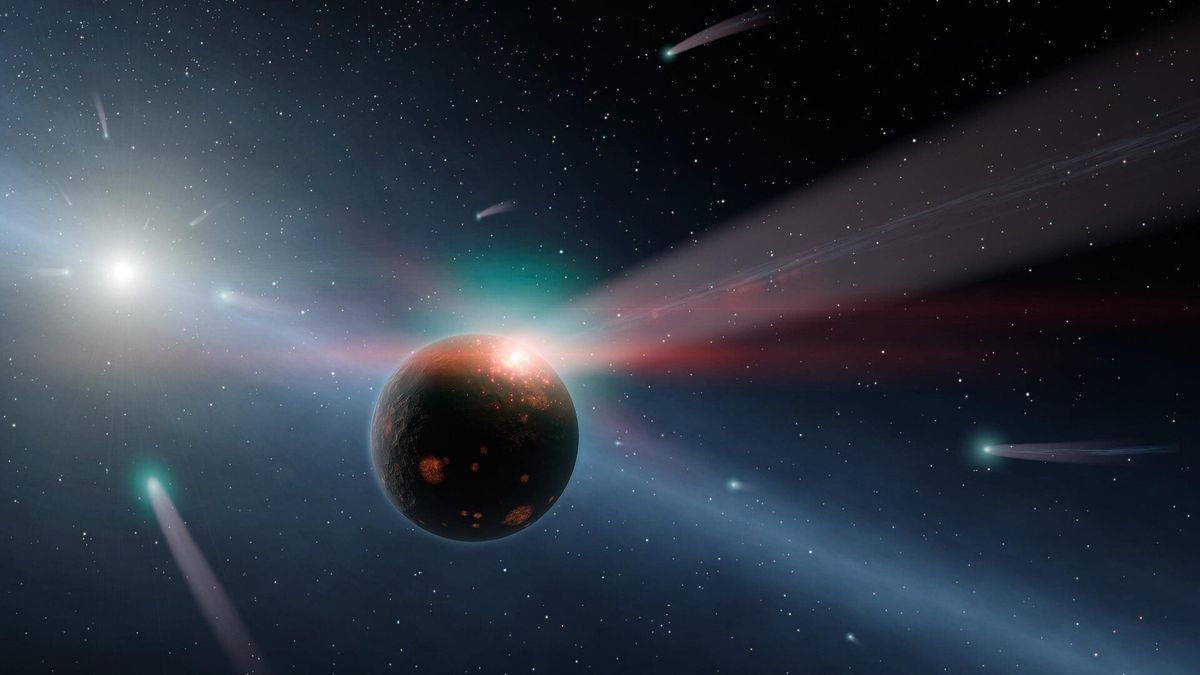
Photo via New York Post

Study claims long-held theory of origin of life on earth could be completely wrong

Read the original at New York Post ↗
Cite

Hussain, Z. (2026, November 2). Study claims long-held theory of origin of life on earth could be completely wrong. New York Post. https://nypost.com/2026/11/02/world-news/study-claims-long-held-theory-of-origin-of-life-on-earth-could-be-completely-wrong/

Dated from the outlet's own feed. Check the original for its byline.

New York Post · collected 2026-11-02 · by Zoe Hussain

Quick Summary

Researchers at the University of Cambridge challenge a long-held theory that comets brought essential molecules for life to Earth by demonstrating that the high-speed impacts would likely vaporize these molecules rather than deliver them intact. The study, published in Scientific Reports, suggests that while comets might have carried necessary prebiotic materials, their velocity and angle upon impact make it highly improbable for any significant amount of these materials to survive and seed life on Earth. Dr Richard Anslow notes that alternative sources like asteroids are more plausible due to the frequency and conditions of asteroid impacts, and speculates that Mars could potentially be a better candidate for comet-delivered prebiotic molecules because of its smaller size and thinner atmosphere.
Written by AI on 2026-11-02, from this article's own text only (the story summary below draws on all the coverage).
See how they differ ↓

AI analysis

Story summary

Scientists from the University of Cambridge have challenged a long-held theory that comets delivered the necessary organic compounds for life on Earth. The team's study, published in *Scientific Reports*, asserts that most comets travel too quickly and hit Earth at an angle that causes them to break apart upon impact, vaporizing any fragile organic molecules inside. Dr. Richard Anslow, lead author from Cambridge’s Institute of Astronomy, notes that the idea of comets as a “get out of jail free card” for life's origins is unlikely due to these conditions, suggesting that this theory may be incorrect. The research indicates that the building blocks of life arriving via comet impacts would likely be rare exceptions rather than common occurrences.

Written for “Decades Old Origin Of Life Theory Wrong” on 2026-11-21, grounded in this article and the 1 other(s) covering the same event.

How they differ

2 outlets covered “Decades Old Origin Of Life Theory Wrong”.

What each outlet says

One AI summary per outlet of its latest article on this story, written from that article alone and checked against it. Open the article for the outlet's own words.

New York PostThis outlet2 Nov

Researchers at the University of Cambridge challenge a long-held theory that comets brought essential molecules for life to Earth by demonstrating that the high-speed impacts would likely vaporize these molecules rather than deliver them intact. The study, published in Scientific Reports, suggests that while comets might have carried necessary prebiotic materials, their velocity and angle upon impact make it highly…

Study claims long-held theory of origin of life on earth could be completely wrong (this article)
Daily Mail2 Nov

Scientists from the University of Cambridge challenge a long-standing theory suggesting that comets delivered essential organic molecules necessary for life to Earth. Using new computer models focusing on hydrogen cyanide, they argue that most comets strike Earth too quickly and at an angle that vaporizes their contents upon impact, making it highly unlikely that comets could have regularly supplied the necessary…

Decades-old theory on how life on Earth started is WRONG, scientists claim →

Compared with similar articles

This article reads unscored and hedges 43% of its claims. Each row says how that neighbour differs.
Daily Mail
Hedges 13 of 34 claims Outlet record 69/100
404 Media
Hedges 9 of 41 claims Outlet record 95/100
“While both articles discuss a new scientific study challenging an old theory about comets and life on Earth, they focus on different aspects of the research. Article A mentions it briefly among other topics without specifics, while Article B delves into the details of the study's findings.”

Story

Decades Old Origin Of Life Theory Wrong
Science · 2 article(s) covering the same event. See how they differ ↑
How this article was measured signals, leaning charts, publisher record, byline, topics and claims

Signals How these are calculated →

Claims extracted
14
sentences that state something as happening or true
Uncertain
43%
6 of 14 hedged ("reportedly", "may", "according to")
Leaning
not political
takes no side on a contested political question
Publisher signals
66/100
New York Post's corrections and hedging, across everything collected from it. Not a measure of accuracy.
Outlets on this story
2
Science
Same framing elsewhere
1
articles that frame the event the way this one does
Analyzed 2026-11-02 · how these are computed

How this is being covered How these are calculated →

Article leaning vs. publisher reliability
Source leaning vs. consistency

Publisher

New York Post · 21831 article(s) · 42 correction(s) detected
Running correction rate · 42 correction(s)

Who wrote this

Zoe Hussain
105 article(s) here · 1 carrying a prediction
Cornell University President Michael Kotlikoff announced Monday that the school will conduct a “full review” of its Greek life system in the coming weeks to “consider the future of fraternities and sororities” on the Ithaca, NY campus.
Mayor Zohran Mamdani announced Monday that the NYPD’s controversial Strategic Response Group will be folded into an existing counterterrorism command and will no longer respond to protests.
“Due to today’s unfortunate circumstances,” the organization said in a social media post, “the SCACA Gun & Knife Show will be canceled for Sunday, November 15.
“And at the end, we don’t know what will happen to us,‘’ Zabala said, noting life’s uncertainties.
A 24-year-old woman set to give birth early next week lost her hardhat hubby in the deadly Brooklyn building collapse — and can’t find it in her heart yet to tell their 4-year-old son that Daddy is dead.
The money raised from the merchandise exceeds the shelter’s typical yearly donations of less than $20,000 by more than 14 times. “We never thought a raccoon would do this for us,” said Jeffrey Parker, Hanover County’s chief of animal protection.
Sigma Alpha Epsilon CEO Steve Mitchell also said the organization will take appropriate action to hold those accountable based on the investigation.
“My husband, Charlie Kirk, was killed in an act of political violence, something our two children and I will live with every day for the rest of our lives,” Erika Kirk said.
If you had it to do again, would you do it again?
Cops are also looking to talk with other walkers, joggers, drivers, or a food truck operator who may have security or dashcam footage that could help the investigation.
Also by Zoe Hussain
Nothing else under this byline is closely related to this article, so these are simply their most recent.
All 105 articles by Zoe Hussain →

Topics

Cambridge Institute of Astronomy Scientific Reports the University of Cambridge

Subjects

Anslow PERSON · 3× Cambridge GPE · 1× Institute of Astronomy ORG · 1× Richard Anslow PERSON · 1× Scientific Reports ORG · 1× the University of Cambridge ORG · 1×

Narrative

“Historically, scientists thought that comets were important for the origin of life on Earth, because they carried carbon- and nitrogen-bearing molecules, so these giant space snowballs were almost like a ‘get out of jail free card’ that brought all the molecules a planet would need to seed life,” lead author Dr Richard Anslow from Cambridge’s Institute of Astronomy said in a statement.
framing: mixed · carried by 1 article(s) · first seen 2026-11-02
A century-old theory that comets brought the building blocks of life to Earth may be completely wrong, according to a groundbreaking study.

Claims (14 extracted, 6 hedged)

A century-old theory that comets brought the building blocks of life to Earth may be completely wrong, according to a groundbreaking study. uncertain
comets → bring → study
Scientists have long believed that comets — giant icy space rocks packed with carbon- and nitrogen-bearing molecules — delivered a steady rain of prebiotics needed to seed life on Earth. asserted
comets → believe → Earth
But researchers at the University of Cambridge found that the chances of those life-building prebiotic molecules surviving a comet’s high-speed impact with Earth are actually slim, according to the study published in Scientific Reports last week. uncertain
molecules → find → Reports
“Historically, scientists thought that comets were important for the origin of life on Earth, because they carried carbon- and nitrogen-bearing molecules, so these giant space snowballs were almost like a ‘get out of jail free card’ that brought all the molecules a planet would need to seed life,” lead author Dr Richard Anslow from Cambridge’s Institute of Astronomy said in a statement. asserted
Anslow → think → statement
“It’s kind of a romantic idea, but our results suggest it’s highly unlikely,” Anslow said. asserted
Anslow → ’ → ?
Comets typically travel too fast and strike at too sharp an angle, causing the molecules to vaporize, researchers said. But even if some building blocks survived in a “one-off fluke,” there may not be a concentration high enough to create life. uncertain
blocks → travel → life
“It would really have to be a one-in-a-million occurrence, because not only would you need an impact at just the right speed and just the right angle, you would also need everything to happen after that point, in terms of the concentration and the speed at which the chemical origins of life got going,” said Anslow. asserted
Anslow → have → life
“We can’t rule out for certain that it happened that way. asserted
it → rule → ?
But it seems to be a really rare occurrence – at best, a one-off fluke.” asserted
it → seem → ?
Researchers said the molecular seeds of life could have come from several other places, such as asteroids, which hit Earth far more frequently. uncertain
which → say → Earth
Although cometary delivery of life-building molecules on Earth seems unlikely, scientists found that our neighbors in the solar system may be more habitable. uncertain
neighbors → build → system
Comets would be more likely to make it on the surface of Mars, which is smaller than Earth and has a thinner atmosphere, especially during the period of the solar system’s development when the space rocks were more common. asserted
rocks → make → development
“This is not to say it definitely happened on Mars, of course, but suggests it would be unlikely if it happened on Earth and didn’t happen on Mars,” Anslow said. uncertain
Anslow → say → Mars
“Or the other, perhaps more likely, alternative is that it didn’t happen on either planet.” asserted
it → happen → planet
Give feedback · no sign-in needed

No sign-in needed for now. Your note is sent without a name, so it cannot be answered.

History Support