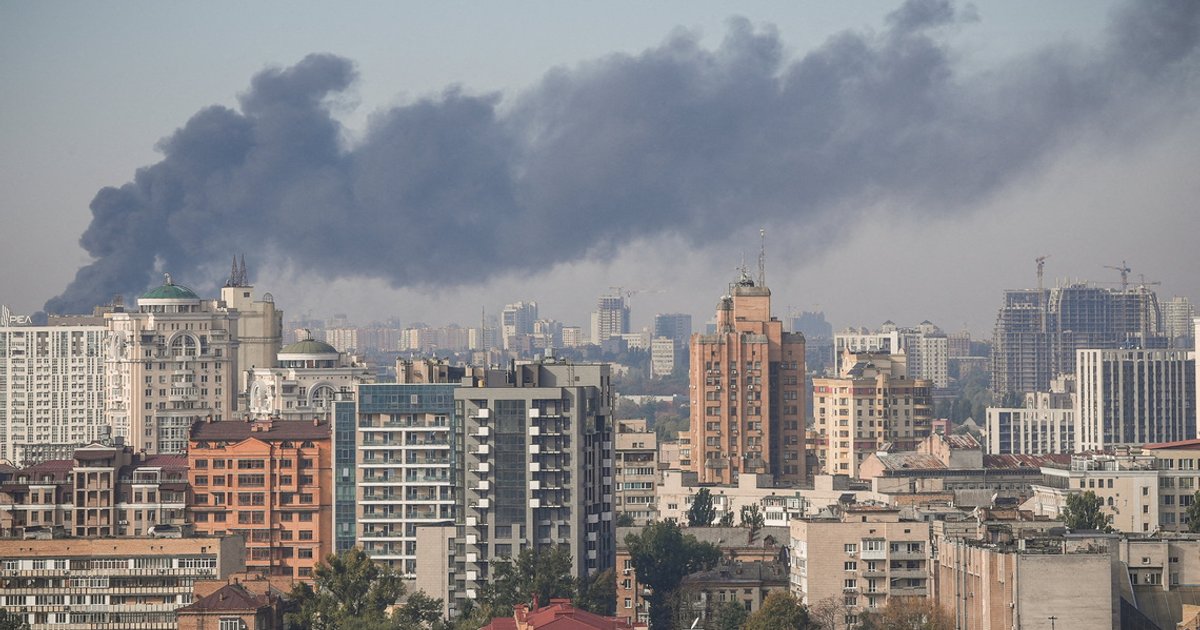
Photo via The Independent

Why Russia’s latest cyberattack on Ukraine is a desperate attempt to sow panic

Read the original at The Independent ↗
Cite

Butt, M. (2026, November 2). Why Russia’s latest cyberattack on Ukraine is a desperate attempt to sow panic. The Independent. https://www.independent.co.uk/news/world/europe/russia-ukraine-cyberattack-air-raid-alert-b3077374.html

Dated from the outlet's own feed. Check the original for its byline.

The Independent · collected 2026-11-02 · by Maira Butt

Quick Summary

On Sunday night, millions of Ukrainians received an emergency alert through a government app warning of imminent threats including radiation and chemical attacks in Kyiv. Shortly after, Russian officials claimed Ukraine had hacked its systems to spread misinformation about nuclear strikes. Both sides denied responsibility for these incidents, which were seen by experts as retaliatory cyberattacks. According to Ukrainian security service reports, over 16,000 Russian cyberattacks have been neutralized since the start of Russia’s invasion in February 2022. The article highlights how such attacks aim to cause panic and distrust rather than merely disrupt communication systems.
Written by AI on 2026-11-02, from this article's own text only (the story summary below draws on all the coverage).
See how they differ ↓

AI analysis

Story summary

On November 1, 2026, Ukraine’s air force announced that the country's public air raid alert app had been hacked. The hack caused the app to falsely warn residents in Kyiv and other areas about imminent nuclear attacks, radiation hazards, chemical threats, and street combat. While initial reports suggested the issue was isolated to Ukraine, Russian officials also reported their own emergency warnings app suffered a "massive cyberattack." Both sides accused each other of carrying out these attacks as tensions escalated following the end of a long truce between them. Ukrainian citizens received false alerts via multiple apps, leading to brief unease but not widespread panic, given their familiarity with frequent air raid drills. Cybersecurity experts note this incident represents an escalation in digital warfare tactics used by both countries.

Written for “Hacked Emergency Alert Apps Spread Fake Warnings” on 2026-11-21, grounded in this article and the 23 other(s) covering the same event.

How they differ

15 outlets covered “Hacked Emergency Alert Apps Spread Fake Warnings”.

What each outlet says

One AI summary per outlet of its latest article on this story, written from that article alone and checked against it. Open the article for the outlet's own words.

The IndependentThis outlet2 Nov

On Sunday night, millions of Ukrainians received an emergency alert through a government app warning of imminent threats including radiation and chemical attacks in Kyiv. Shortly after, Russian officials claimed Ukraine had hacked its systems to spread misinformation about nuclear strikes. Both sides denied responsibility for these incidents, which were seen by experts as retaliatory cyberattacks. According to…

Why Russia’s latest cyberattack on Ukraine is a desperate attempt to sow panic (this article)3 articles from The Independent on this story
BBC2 Nov

On Sunday night, Ukrainian citizens received alarming notifications through their phone’s alert app suggesting imminent nuclear strikes and chemical attacks from Russia. However, these alerts were soon identified as a hacking attempt by a suspected hacker group linked via Telegram, leading to doubts among recipients about the messages' authenticity. Within 15 minutes of the initial scare, Ukraine's Air Force…

Fake nuclear warning from hacked app sparks unease but not panic in Ukraine →2 articles from BBC on this story
The Straits Times1 Nov

Ukraine’s Air Force announced on November 1 that a public air raid alert app had been hacked, sending out false alerts about nuclear and chemical threats in Kyiv and other areas. The erroneous message incorrectly stated that Russia's Oreshnik hypersonic missile was deployed. In response to the incident, Ukraine’s Ministry for Digital Transformation clarified that while the app was down due to hacking, alternative…

Ukrainian air force says public air raid alert app sent erroneous alerts after being hacked →2 articles from The Straits Times on this story
Daily Mail2 Nov

Russian and Ukrainian hackers have engaged in a cyber attack that resulted in fake nuclear war alerts being issued to millions of people in both countries. Ukraine's air raid app, used daily by 6.7 million people, was targeted first, with messages warning of a hypersonic missile strike and chemical threats. Shortly after, Russian emergency networks were hit, sending out false warnings of imminent nuclear attacks…

Hacker wars: Rival Russian and Ukrainian cyber groups claim credit for attacks on each country's air raid systems that saw some civilians alerted to fake nuclear and chemical warfare →2 articles from Daily Mail on this story
Al Jazeera2 Nov

Russia and Ukraine have exchanged accusations over hacked emergency alert systems that falsely warned citizens about nuclear radiation, chemical threats, and imminent attacks. These incidents occurred shortly after a localized ceasefire in Kherson ended on Sunday. Both countries’ civil defense apps were compromised, sending alarming messages to users before authorities clarified the alerts as false. The Ukrainian…

Nuclear radiation in Russia, Ukraine? No, just hacked warning alerts →2 articles from Al Jazeera on this story
ABC News (AU)2 Nov

Ukraine’s public air raid alert system experienced hacking incidents that triggered false warnings about nuclear and chemical threats in certain regions. Meanwhile, Russia reported a significant cyberattack on its emergency services app. Both countries have noted these breaches but did not provide specific details on the extent of damage or ongoing response measures.

Ukrainian air raid alert app sends false warnings after being hacked →2 articles from ABC News (AU) on this story
Show 9 more outlets
The Guardian2 Nov

Hackers sent fake nuclear threat alerts through Ukraine's emergency app in Kyiv late Sunday night, causing panic and confusion among residents. The alert warned of potential nuclear radiation and chemical threats, written in both English with errors and Ukrainian. While many ignored the messages due to their suspicious nature, others were frightened into believing an imminent attack was underway. The Ukrainian…

Hackers send fake nuclear threat alert to Ukraine emergency app →2 articles from The Guardian on this story
The Hindu2 Nov

After a five-day truce that ended on November 1, 2026, both Russia and Ukraine reported cyberattacks on their emergency warning systems. Moscow’s emergencies ministry noted a “massive cyberattack” on its app designed to warn of drone attacks and other threats, while Ukraine suspected Russian involvement in hacks that posted false alerts about radiation dangers on its air raid alert system. The renewed hostilities…

Cyber attacks hit Russia, Ukraine after truce ends →
Fox News2 Nov

Ukraine officials reported that their air-raid alert system was hacked, leading to false alerts in Kyiv about radiation and chemical attacks on Sunday. The app warned residents not to go outside due to these alleged threats, though Ukraine’s Air Force later confirmed the messages were fake and there was no actual danger. Russia's Emergencies Ministry also announced a cyberattack that allowed for spreading…

Ukraine says air alert system hacked after false radiation warning in Kyiv →
Sydney Morning Herald2 Nov

On Sunday night, Ukraine’s public air raid alert app was hacked and sent false alerts about nuclear, chemical threats, and street combat to users in Kyiv and other areas. The Ukrainian Air Force acknowledged the breach within 10 minutes, assuring there was no actual radiation threat and advising calm. About an hour later, all-clear messages were issued as normal operations resumed through alternative alert systems…

‘Stay calm’: Ukraine says public air raid alert app sent false alerts after being hacked →
NBC News2 Nov

On Sunday night, Ukrainian residents received false emergency alerts warning of nuclear danger, radiation threats, and street combat through their Air Alert application, which authorities confirmed had been hacked. Hours later, Russia reported that its own alert system was also targeted in a cyberattack, amid the end of a humanitarian ceasefire between Ukraine and Russia. Both countries’ systems were temporarily…

Fake alerts warn of nuclear danger as Ukraine and Russia report emergency app hacks →
CBC2 Nov

On Sunday, emergency alert systems in Ukraine and Russia faced cyberattacks that spread false alarms through mobile apps. In Ukraine, users received warnings about high radiation levels in Kyiv, while Russian authorities reported similar fake alerts on their app. Both countries' officials advised caution and confirmed the Ukrainian system was restored quickly without impacting military operations. Authorities in…

Ukraine, Russian alert systems hit by cyberattacks that spread alarming messages →
New York Post2 Nov

Emergency alert apps in Ukraine and Russia were hacked overnight, spreading false warnings of nuclear attacks. In Ukraine, the air raid alert channel confirmed unauthorized breaches that led to alarming posts about high radiation levels and chemical attacks in Kyiv. Similar incidents occurred in Russia, where users received fake alerts urging them to stock up on food and take shelter due to supposed nuclear launches…

Hackers breach emergency alert apps in Ukraine and Russia with fake warnings of nuclear attacks →
CBS News2 Nov

On Sunday night, emergency alert apps in Ukraine and Russia were hacked, sending false warnings about radiation, chemical attacks, and nuclear strikes to users. In Ukraine, the Air Alert app sent out these messages at 10:47 p.m., causing panic before being confirmed as fake by the Ukrainian Air Force ten minutes later. Similarly, Russia’s Emergencies Ministry app was compromised around 2:45 a.m. Moscow time, sending…

Hacked alert apps send Ukrainians, Russians fake attack warnings →
Times of India2 Nov

Hackers sent fake emergency alerts through government mobile apps in both Ukraine and Russia, falsely warning about nuclear threats and high radiation levels. In Ukraine, the messages appeared in multiple languages with grammatical errors; one reference was made to a Russian ballistic missile. While there were no reports of widespread panic, Ukrainian authorities temporarily suspended their app before restoring it…

Fake nuclear threat alert sent to Ukrainians after emergency app hacked →

Compared with similar articles

This article reads leans left and hedges 12% of its claims. Each row says how that neighbour differs.
The Independent
Leans left Hedges 4 of 33 claims Outlet record 59/100
The Straits Times
Hedges 0 of 7 claims Outlet record 64/100
Al Jazeera
Hedges 2 of 10 claims Outlet record 60/100
ABC News (AU)
Hedges 0 of 3 claims Outlet record 67/100
The Sydney Morning Herald
Hedges 1 of 19 claims Outlet record 61/100
The Independent
Hedges 4 of 41 claims Outlet record 59/100
The Guardian
Hedges 0 of 9 claims Outlet record 64/100
Al Jazeera
Hedges 2 of 39 claims Outlet record 60/100
The Guardian
Hedges 4 of 33 claims Outlet record 64/100
BBC News
Hedges 1 of 3 claims Outlet record 65/100

Story

Hacked Emergency Alert Apps Spread Fake Warnings
Technology · 24 article(s) covering the same event. See how they differ ↑
How this article was measured signals, leaning charts, publisher record, byline, topics and claims

Signals How these are calculated →

Claims extracted
33
sentences that state something as happening or true
Uncertain
12%
4 of 33 hedged ("reportedly", "may", "according to")
Leaning
Leans left
of the writing, not the subject · beta estimate
Publisher signals
59/100
The Independent's corrections and hedging, across everything collected from it. Not a measure of accuracy.
Outlets on this story
24
Technology
Same framing elsewhere
2
articles that frame the event the way this one does
Analyzed 2026-11-02 · how these are computed

How this is being covered How these are calculated →

Article leaning vs. publisher reliability
Source leaning vs. consistency

Publisher

The Independent · 4787 article(s) · 10 correction(s) detected
Running correction rate · 10 correction(s)

Who wrote this

Maira Butt
87 article(s) here · 1 carrying a prediction
Two-thirds of migrant workers surveyed by ALQST between March and May 2026 said they had not received their wages for months at a time, while a quarter said they had been falsely reported as absent from work - putting them at risk of deportation.
Six state-of-the-art mobile maternity units, a kidney dialysis and general purpose clinic, have been waiting to enter Gaza for up to two years but charities have been told by Israel that they are “dual use” and therefore could be taken by Hamas.
“The President has been clear that the greatest naval blockade in history, Operation Economic Outcast, and the new Operation Iron Gate will continue with full effect.
France has warned Germany that it could trigger a nuclear conflict with Russia if it does not define how it would use its newly acquired long-range missiles.
A large-scale prisoner swap has also been agreed during the discussions and may take place between the next two to three weeks, according to Russian news agency TASS citing Russian Lieutenant-General Alexander Zorin.
She was then provided with housing after media coverage, but was told she could not leave the country while her case was pending.
France has warned Germany that it could trigger a nuclear conflict with Russia if it does not define how it would use its newly acquired long-range missiles.
Donald Trump’s special envoy Steve Witkoff and Jared Kushner are expected to be mediating between the two warring sides.
She was in the wrong place at the wrong time,” Jacek Gursz, the mayor of Chodzież, told TVN24.
Also by Maira Butt
Nothing else under this byline is closely related to this article, so these are simply their most recent.
All 87 articles by Maira Butt →

Topics

Russia Russian Ukraine Ukrainian Ukrainians

Subjects

Russia GPE · 6× Ukraine GPE · 4× Ukrainian NORP · 4× Russian NORP · 3× BBC ORG · 1× Kyiv GPE · 1× SBU ORG · 1× Telegram ORG · 1× Ukrainians NORP · 1× Volodymyr Karasteliov PERSON · 1×

Narrative

Speaking to the BBC, Oleksandr Merezhko, chair of the Ukrainian parliament’s foreign affairs committee and a member of Volodymyr Zelensky’s Servant of the People party, said that the country and its people are prepared for all scenarios.
framing: assertive · carried by 2 article(s) · first seen 2026-11-02
On Sunday night, millions of Ukrainians were sent an alert to their phones that would usually spark panic and fear.

Claims (33 extracted, 4 hedged)

On Sunday night, millions of Ukrainians were sent an alert to their phones that would usually spark panic and fear. asserted
that → send → panic
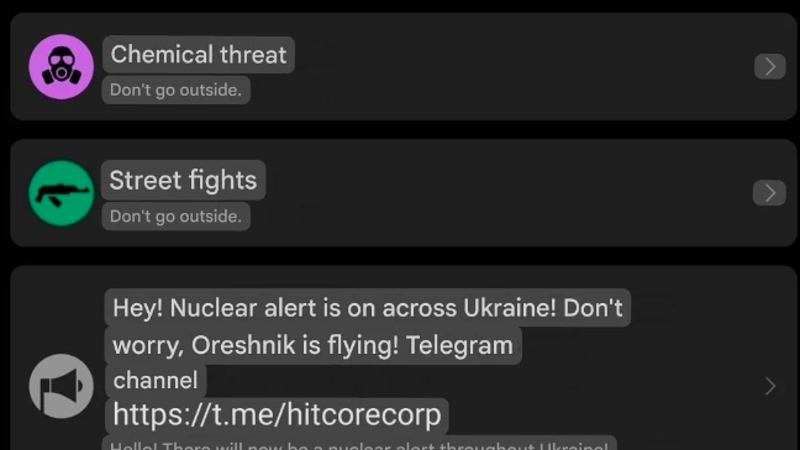
Citizens were told that there was an imminent threat of radiation, chemical attacks and fighting on the streets of Kyiv through an app used to by the government to issue nationwide notifications in emergencies. asserted
Citizens → tell → emergencies
It was quickly followed up with a clarification that the system had likely been hacked by Russia and that no such threat existed. asserted
threat → follow → Russia
“The Air Alarm application has probably been subjected to hostile interference,” read a follow-up message on Telegram. asserted
message → subject → Telegram
Shortly after, Russia told its citizens that Ukraine had hacked its systems to warn its people of imminent nuclear strikes. asserted
Ukraine → tell → strikes
Neither countries have claimed responsibility and it is unclear where or how the incidents were sparked. uncertain
incidents → claim → responsibility
But they have been widely interpreted by officials and analysts as tit-for-tat attacks, started by Russia. asserted
they → interpret → Russia
A hacker within the Ukrainian “hacktivist” community told the BBC that the breach of the Russian alert system was likely to be a “retaliatory attack” by Ukraine. asserted
breach → tell → Ukraine
The ensuing chaos has laid bare the increasingly devastating impact of cyberattacks. asserted
chaos → ensue → cyberattacks
According to the Ukrainian security service (SBU) , citing its cybersecurity department, more than 16,000 Russian cyber attacks and “critical cyber incidents” had been neutralised between the start of the war in February 2022 and July this year. uncertain
attacks → accord → February
Brigadier general Volodymyr Karasteliov referred to one large-scaled DDoS arrack that lasted three hours against a nationwide Ukrainian television channel. asserted
that → refer → channel
“The botnet generated up to 200,000 requests per minute from nodes in Asia, Europe, and the United States,” he said. asserted
he → generate → Asia
“The attack targeted the website's application layer, with hackers imitating the behaviour of real users in an attempt to overload the server with complex requests and make the site unavailable.” asserted
site → target → requests
According to research published in PLOS in April 2024, Russia ranked as the number one hotspot for cybercriminals worldwide, followed by Ukraine. uncertain
Russia → accord → Ukraine
Cybersecurity firm CybelAngel noted that the attacks between Russia and Ukraine are largely asymmetric. asserted
attacks → note → Russia
The company’s REACT team recorded 1,651 cyber incidents targeting Ukrainian entities with 575 targeting Russian entities between January 2025 and January 2026. asserted
team → record → January
“The asymmetry isn’t new, since the prior twelve months looked nearly identical in shape and scale,” it said. asserted
it → look → shape
Experts told The Independent that the attacks serve a more sinister purpose than simply the disruption of communication systems. asserted
attacks → tell → systems
“A message from your air raid alert system generates emotion straight away, almost like a phishing email, with that sense of panic and urgency, and you respond and react,” says Adam Pilton, cyber security adviser at Heimdal. asserted
Pilton → generate → Heimdal
“That’s exactly why the air raid systems were hit. asserted
systems → ’ → ?
The attack strikes at the point where people trust their government.” asserted
people → strike → government
He compares the incident to the cyber attack on ASOS a few weeks ago, explaining that when communication is disrupted from official platforms, it leads to uncertainty and confusion for civilians. asserted
it → compare → civilians
“If you can’t trust communications that purportedly come from official platforms, whether a business or your government, then what can you trust? asserted
you → trust → what
That’s exactly the purpose of this attack, to erode trust,” he says. asserted
he → ’ → trust
Pilton reiterates that the purpose of the strikes is to sow panic and uncertainty despite claims that the systems are legitimate targets as communication platforms. uncertain
systems → reiterate → platforms
“Russia has claimed that this is not an actual air raid system but just a communication platform. asserted
this → claim → ?
Whether that’s true or not is irrelevant. asserted
’s → ’ → ?
What matters is that people look to their leaders to understand what’s happening,” he explains. asserted
he → matter → leaders
If they receive an official communication, they will follow it. asserted
they → receive → it
That’s different from the media, which they’ll take with a pinch of salt and probably look a bit further. asserted
they → ’ → salt
Speaking to the BBC, Oleksandr Merezhko, chair of the Ukrainian parliament’s foreign affairs committee and a member of Volodymyr Zelensky’s Servant of the People party, said that the country and its people are prepared for all scenarios. asserted
country → speak → scenarios
“It's a very unpleasant fact but it is part of cyber war and people in Ukraine understand that. asserted
people → understand → that
It is possible and we are quite prepared for such possibilities,” he said. asserted
he → prepare → possibilities
Give feedback · no sign-in needed

No sign-in needed for now. Your note is sent without a name, so it cannot be answered.

History Support