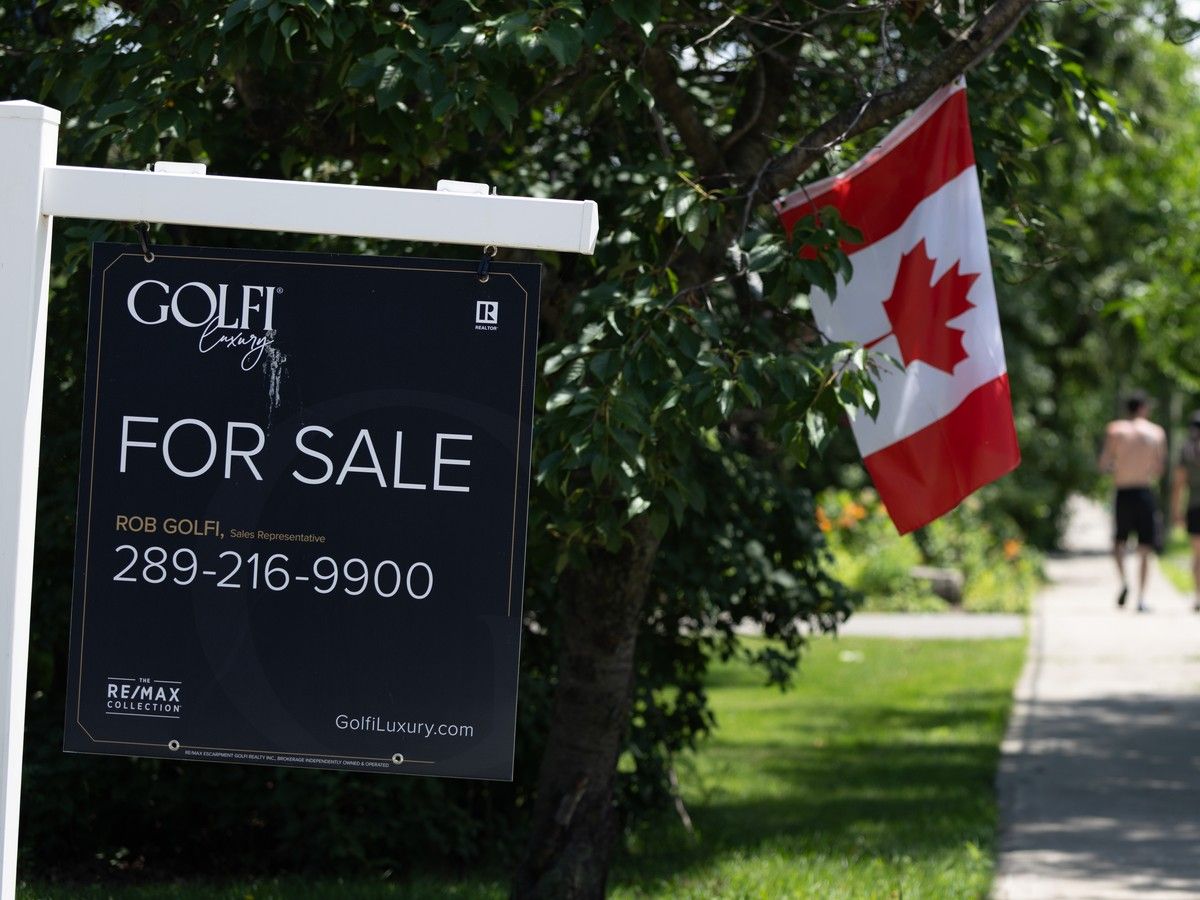
Here’s how much you need to earn to afford a home in Canada’s major cities

Read the original at National Post ↗
Cite

Hutchings, E. (2026, October 22). Here’s how much you need to earn to afford a home in Canada’s major cities. National Post. https://nationalpost.com/news/canada/heres-how-much-you-need-to-earn-to-afford-a-home-in-canadas-major-cities

Dated from the outlet's own feed. Check the original for its byline.

National Post · collected 2026-10-22 · by Ellie Hutchings

Quick Summary

Ratehub analyzed housing affordability in Canada’s major cities by calculating the minimum annual income needed to buy an average home. In September, Halifax saw the largest improvement with a required income of $119,040, down from $123,200 in August. Vancouver remained the least affordable city, requiring an annual income of $221,750 to afford an average-priced home. Regina was the most affordable at $81,000 annually for a similar home. The analysis attributed these changes primarily to falling home prices and modest declines in mortgage costs, though it noted that affordability improvements were minimal and unlikely to significantly impact potential buyers this fall.
Written locally by qwen2.5:14b on 2026-10-22, using this article's own text rather than the other coverage of the same event (that is the story summary below).

AI analysis runs on qwen2.5:14b, locally

Story summary

Ratehub, an online financial comparison platform, has ranked 13 Canadian cities based on housing affordability. The analysis calculates the minimum annual income needed to buy an average-priced home with a 10% down payment in each city. In September, Halifax recorded the largest improvement in affordability, requiring only $119,040 annually—down from $123,200 in August. Ottawa saw the second-largest improvement, dropping to $134,770, and Victoria followed with a decrease of $1,840 to $183,510. The least affordable city was Vancouver, where an average home price is $1,075,900, requiring the highest income needed to qualify for a mortgage. Ratehub attributes falling home prices as the primary factor behind improved affordability but notes that modest declines in required incomes are unlikely to significantly impact most buyers this fall.

Written for “Home Affordability In Canada” on 2026-10-22, grounded in this article and the 0 other(s) covering the same event.
Why this leaning score
This article does not take a side on a contested political question, so it has no leaning score. That is an answer rather than a gap: a match report or a rescue can be warmly or critically written without being left or right, and scoring it anyway is how approval of a subject gets recorded as a political position.
No political leaning scored for article 98899 · logged 2026-10-22

Story

📰 Home Affordability In Canada
Economy/Business · 1 article(s) covering the same event.

Compared with similar articles

Nothing to compare against. No article is close enough to this one for the pipeline to have linked or judged the pair.
How this article was measured signals, leaning charts, publisher record, byline, topics and claims

Signals How these are calculated →

Claims extracted
18
sentences that state something as happening or true
Uncertain
17%
3 of 18 hedged ("reportedly", "may", "according to")
Leaning
not political
takes no side on a contested political question
Publisher signals
60/100
National Post's corrections and hedging, across everything collected from it. Not a measure of accuracy.
Outlets on this story
1
Economy/Business
Same framing elsewhere
1
articles that frame the event the way this one does
Analyzed 2026-10-22 · how these are computed

How this is being covered How these are calculated →

Article leaning vs. publisher reliability
Source leaning vs. consistency

Publisher

National Post · 1058 article(s) · 2 correction(s) detected
Running correction rate · 2 correction(s)

Who wrote this

Ellie Hutchings
16 article(s) here · 1 carrying a prediction
🔮 The analysis also looked at national real estate data on mortgage rates as well as the mortgage stress test to determine how much a prospective buyer would need to earn to qualify for a mortgage on an average-priced home in their local market.
🔮 On Friday, Carney will attend another rally in Edmonton and visit Red Deer with Alberta Premier Danielle Smith, all as part of his efforts to drum up support for keeping Alberta in Confederation.
🔮 The statement added that the nations will “continue to support efforts to deliver on these elections.”
🔮 The latest Fraser Institute study is the second in a two-part series looking at whether Canada’s economic growth will outpace that of the U.S. in the 21st century.
🔮 Americans once spent US$1 billion on prescription drugs from Canada, but new import rules might mean they no longer spend anything at all.
🔮 A U.S. mayor has taken to social media to send a message to Canadians boycotting travel to the United States: Minneapolis misses them.
🔮 And though the dairy-related import ban is more limited, the CSA warns it could impact whey protein products, certain other whey products, molasses and non-alcoholic beer.
🔮 “I don’t know how many people move to the U.S., whether it’s business or entertainment or hockey, and I don’t know the exact number, but I would tell you that over 90 per cent of them become American citizens.
🔮 Speaking to reporters outside the Oval Office, Trump also confirmed that he would officially rename the technology “super intelligence” instead of artificial intelligence “because it’s not artificial.”
Also by Ellie Hutchings
Nothing else under this byline is closely related to this article, so these are simply their most recent.
All 16 articles by Ellie Hutchings →

Topics

Canada Canadian Fredericton Halifax Ratehub

Subjects

Ratehub ORG · 5× Fredericton GPE · 2× Canada GPE · 1× Canadian NORP · 1× Halifax ORG · 1× Ottawa GPE · 1× Toronto GPE · 1× Vancouver GPE · 1× Victoria GPE · 1× Winnipeg GPE · 1×

Narrative

Ratehub said that falling home prices were responsible for the improvement in affordability, but added that modest declines in the income required to qualify for a mortgage and in monthly mortgage payments aren’t likely to make a significant difference for most home buyers this fall.
framing: assertive · carried by 1 article(s) · first seen 2026-10-22
🔮 The analysis also looked at national real estate data on mortgage rates as well as the mortgage stress test to determine how much a prospective buyer would need to earn to qualify for a mortgage on an average-priced home in their local market.

Claims (18 extracted, 3 hedged)

Ratehub, an online financial comparison platform, ranked 13 of Canada’s cities according to housing affordability by calculating the minimum annual income needed to buy an average home with a 10 per cent down payment, a 25-year amortization, $4,000 in annual property taxes and a monthly heating bill of $150. uncertain
Ratehub → rank → 150
The analysis also looked at national real estate data on mortgage rates as well as the mortgage stress test to determine how much a prospective buyer would need to earn to qualify for a mortgage on an average-priced home in their local market. asserted
buyer → look → market
The data revealed that Halifax recorded the largest improvement in affordability of any Canadian market in September, with the required income for an average home falling to $119,040 — $4,160 less than the $123,200 needed in August, according to Ratehub. uncertain
income → reveal → Ratehub
Ottawa saw the second largest affordability improvement, with the required annual income falling by $2,630 from $137,400 to $134,770. asserted
income → see → 134,770
Victoria ranked third, with the average income needed to buy an average home falling from $185,350 to $183,510, a decrease of $1,840. asserted
income → rank → 1,840
The least affordable city in September was Vancouver, where the average home price was $1,075,900, and the income required to buy was $221,750, down $980 from August. asserted
income → require → August
This is followed by Toronto, where prospective buyers needed to earn $191,320 annually in September to afford an average-priced home costing $917,600. asserted
buyers → follow → 917,600
At the other end of the scale, Regina was the most affordable city, with prospective buyers needing an annual income of $81,000 to buy an average-priced home worth $343,900 in September. asserted
buyers → need → September
Fredericton ranked as the second most affordable city, but it was also the only market to see affordability worsen between August and September. asserted
affordability → rank → August
The annual income required to buy an average home there rose slightly from $84,840 to $84,940. asserted
income → require → 84,940
However, Ratehub noted that while affordability technically decreased in Fredericton, it did so to such a minor extent that home buyers were unlikely to notice the difference. asserted
buyers → note → difference
Though it saw a $200 increase in the average home price, this added just $3 to the average monthly mortgage payment, the report said. asserted
report → see → payment
Other relatively affordable markets included Winnipeg, Edmonton and St. John’s, N.L., where prospective buyers needed annual incomes of $90,270, $95,000 and $95,980 respectively to afford an average-priced home. asserted
buyers → include → home
Elsewhere, the annual income needed to afford an average home fell to $153,050 in Hamilton, Ont., to $126,050 in Montreal, and to $124,320 in Calgary. asserted
income → need → Calgary
Ratehub said that falling home prices were responsible for the improvement in affordability, but added that modest declines in the income required to qualify for a mortgage and in monthly mortgage payments aren’t likely to make a significant difference for most home buyers this fall. asserted
declines → say → buyers
The report said that a softer housing market combined with high gas prices and economic uncertainty could put further downward pressure on prices before the end of the year. uncertain
market → say → year
But for mortgage costs to ease significantly, both home prices and mortgage rates typically need to decrease. asserted
prices → ease → ?
While house prices fell in almost all markets in September, Ratehub noted that fixed mortgage rates inched higher during the month. asserted
rates → fall → month

💬Give feedback
🕘History 🎫Support