Several New South Wales MPs say they want their own bodies turned into “human compost” after Australian-first laws were passed allowing the unusual practice.
asserted
laws → say → practice
The laws, passed on Wednesday, provide a third legal option other than burial and cremation for the treatment of bodies.
asserted
laws → pass → bodies
The private member’s bill was introduced by independent Sydney MP Alex Greenwich, who travelled to Germany and the US to research the practice, which is allowed in some parts of both countries.
asserted
which → introduce → countries
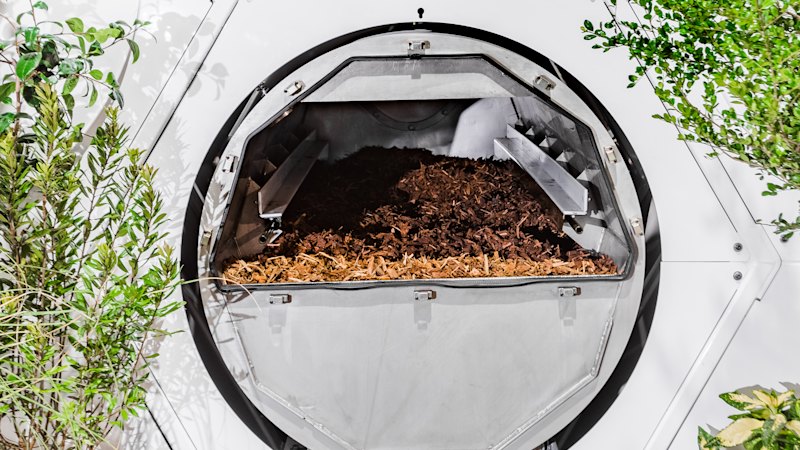
The practice, known as natural organic reduction, terramation or human composting, involves placing the body in a temperature-controlled vessel with organic matter such as alfalfa, straw or mulch.
asserted
practice → know → alfalfa
Once inside, the vessel is turned or rocked to circulate air.
asserted
vessel → turn → air
The introduced matter reacts with the air and feeds the body’s naturally occurring microbes to rapidly decompose the body.
asserted
matter → introduce → body
The process creates heat that, after about 30 days, transforms the body into soil.
asserted
that → create → soil
When rested for about 30 days more, the vessel contains about 110kg of “dry, rich soil that is fertile and free of pathogens”, Greenwich told the legislative assembly earlier this year.
asserted
Greenwich → rest → assembly
In the legislative council on Wednesday, John Ruddick, a Libertarian MP, said he backed what Greens MP Dr Amanda Cohn said in supporting the bill: he thought it was likely he would choose terramation over a burial plot or cremation.
asserted
he → say → plot
A lot of people may not choose it …
uncertain
lot → choose → it
I am pretty sure that I will put in my will that I wish to be terramated,” Ruddick said.
asserted
Ruddick → put → will
“I like the idea of being buried somewhere and having a nice big gum tree grow there for 100 years.
asserted
tree → like → years
“The idea of being cremated or buried has always freaked me out.
asserted
idea → cremate → me
The Labor MP Cameron Murphy also said: “I look forward to being able to utilise this service in the long-distant future after it becomes law”.
asserted
it → say → future
Liberal MP Susan Carter urged the government to consider when it implemented the bill how to ensure the dead were respected.
asserted
dead → urge → bill
“Terramation should not simply become a human compost bin,” she said.
asserted
she → become → ?
“Like all the many ways in which we approach death, it should help those who remain to mourn, and the respect shown to that person in life should continue into death.
asserted
respect → approach → death
“It is important for that person, for their family, and for the whole way in which we go forward as a society.”
asserted
we → go → society
Emma Hurst MP, the Animal Justice MP who introduced the bill into the legislative council, told parliament on Wednesday that terramation had significant environmental benefits.
asserted
terramation → introduce → benefits
She said it could avoid the need for large burial plots and can be wholly carbon neutral, compared with cremation, which she said was energy intensive and released substantial greenhouse gas emissions.
uncertain
she → say → emissions
“Terramation provides possibilities to grow living things, like trees and plants, in honour of a life,” Hurst said.
asserted
Hurst → provide → life
“Because terramation is a slow process, there are multiple opportunities for ceremonies, including for the laying of the body in the vessel and for opening the vessel after a body has been terramated.
asserted
body → be → vessel
“Facilities overseas have allowed families to visit during the terramation process.
asserted
families → allow → process
It is a natural and gentle process that, for some, can help with grieving.”
asserted
that → help → grieving
The bill passed on Wednesday gives the NSW government 18 months to create regulations to control the practice, which would be limited to specialised facilities.
asserted
which → pass → facilities
 The Aporia