That is 0 articles you have read today.
The Aporia is free and carries no advertising, so readers are the only
thing paying for it. If you are getting this much out of it, a small
donation is what keeps it independent.
Daily limit reached
You have read 0 articles today.
That is more than the 15 a day The Aporia gives away,
and well past what it can carry on nothing. Your allowance resets at
midnight.
There is no advertising here and nothing about you is sold, so readers
are the only thing paying for it. If the site is worth this much of
your day, it is worth a few dollars.
Everything else stays open: the
maps, the
directory and
search do
not count against this, and neither does re-opening something you have
already read today.
The European Space Agency launched two satellites aimed at monitoring climate impacts from Kourou space center in French Guiana. The Flex satellite will track plant health and carbon conversion efficiency through fluorescence, while Sentinel-3C will monitor marine conditions and land use changes to prevent food crises. Both satellites are part of efforts to address extreme weather events linked to climate change; Flex has a three-year mission costing €350 million ($403.5 million).
Written by the local model on 2026-09-15,
using this article's own text rather than the other coverage of the
same event (that is the story summary below).
Story summary
On Monday at 10:21 p.m. local time in French Guiana, the European Space Agency (ESA) launched two satellites on a Vega-C rocket from Kourou space center to monitor climate change impacts. Within two hours, both spacecraft reached their sun-synchronous orbit. The Flex satellite, valued at €350 million ($403.5 million), will track plant health by measuring the faint fluorescence emitted during photosynthesis, aiding scientists in assessing ecosystem productivity and stress from environmental changes. It will circle Earth 14 times daily, revisiting specific areas every 27 days for three years. Additionally, the Sentinel-3C satellite enhances weather monitoring capabilities, though details on its exact mission were not provided in this excerpt.
Written for “European Climate Satellites Launch” on 2026-09-15,
grounded in this article and the 0 other(s) covering the same event.
Why this leaning score
This article does not take a side on a contested political
question, so it has no leaning score. That is an
answer rather than a gap: a match report or a rescue can be warmly
or critically written without being left or right, and scoring it
anyway is how approval of a subject gets recorded as a political
position.
No political leaning scored for article 9711 · logged 2026-09-15
Two satellites designed to enhance the monitoring of extreme weather events linked to climate change have been successfully sent into orbit by the European Space Agency (ESA).
asserted
satellites → design → Agency
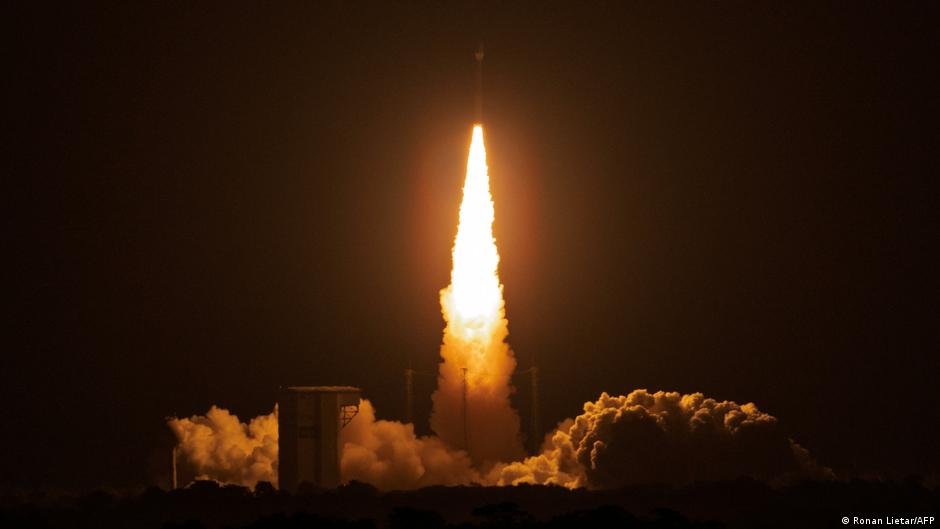
The Vega-C rocket carrying the Sentinel-3C and Flex satellites lifted off from the Kourou space center in French Guiana at 10:21 p.m. Monday (0121 GMT Tuesday), with the two spacecraft entering sun-synchronous orbit within two hours of lift-off.
What will the Flex satellite do?
asserted
satellite → carry → What
The Flex (Fluorescence Explorer) satellite aims to provide data on the impact of heat waves on plant matter by monitoring the very faint fluorescence emitted by plants when they carry out photosynthesis.
asserted
they → aim → photosynthesis
That fluorescence gives an indication of how efficiently vegetation is converting sunlight and carbon dioxide into energy.
asserted
vegetation → give → energy
The measurements provided by the satellite will thus "help scientists assess plant health, ecosystem productivity and the effects of environmental stress and climate change," according to ESA.
uncertain
scientists → provide → ESA
The €350 million ($403.5 million) mission is planned to last three years.
asserted
mission → plan → ?
The satellite will orbit the Earth 14 times a day, revisiting particular locations every 27 days.
asserted
satellite → orbit → locations
The Sentinel-3C satellite is to collect data from the marine environment, including temperature, wave height and ocean currents.
asserted
satellite → collect → temperature
It will also monitor land use and land cover with the aim of optimizing yields to prevent food crises.
asserted
It → monitor → crises
Simonetta Cheli, the director of Earth Observation Programmes at the ESA, described the missions as "essential" in helping with the "climate change we are experiencing."
asserted
we → describe → change
 The Aporia