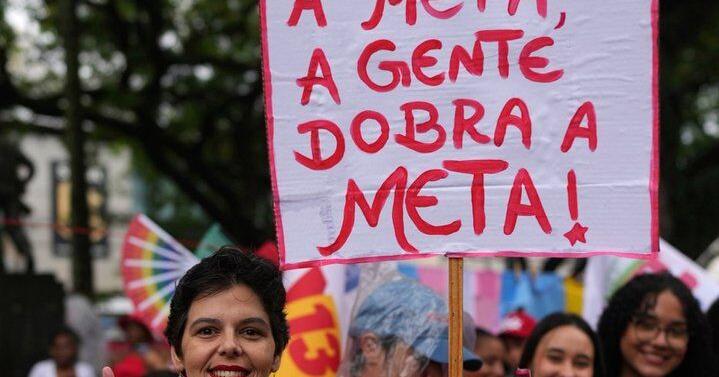
In the race to be Brazil’s next president, the final two candidates are appealing to voters not only at rallies but online as well.
asserted
candidates → appeal → rallies
On Sunday, incumbent President Luiz Inacio Lula da Silva will face right-wing Senator Flavio Bolsonaro in the final round of the election.
asserted
Silva → face → election
Recommended Stories
list of 3 items- list 1 of 3Meta, Facebook to drop fact-checkers: What does this mean for social media?
- list 2 of 3Bolsonaro’s election fraud claims spark ‘unprecedented crisis’
- list 3 of 3Brazil leaders condemn ‘terrorist acts’, vow to defend democracy
The race is expected to be tight.
uncertain
race → drop → democracy
But in its final days, questions have festered over whether the digital arena has been a level playing field for the two candidates.
asserted
arena → fester → candidates
The social media giant Meta, which owns Facebook, WhatsApp and Instagram, has faced accusations before Brazil’s top election authority, the Superior Electoral Court (TSE), that it suppressed Lula’s content and favoured material promoting Bolsonaro.
asserted
it → own → Bolsonaro
Meta’s products rank among the most popular social media platforms in Brazil, and political ad spending on its sites has grown at a breakneck pace.
asserted
spending → rank → pace
An analysis from the Brazilian news outlet G1 found that Meta received at least 288m Brazilian reais ($57m) in direct campaign spending in 2026, double what it received during the 2022 presidential race.
asserted
it → find → race
That increase marks a shift in how Brazil runs elections.
asserted
Brazil → mark → elections
More than 76 percent of Brazilian voters now get their news online, said Andre K Rodarte, a researcher at the Digital Democracy Centre at the University of Southern Denmark.
asserted
Rodarte → get → Denmark
With social media eclipsing traditional advertising, Rodarte explained that a growing class of politicians is using provocative, viral messaging to connect with voters.
asserted
class → eclipse → voters
He pointed to the success of online influencers like right-wing personality Nikolas Ferreira and left-wing activist Erika Hilton, who each were reelected this year to Brazil’s Chamber of Deputies with record numbers of votes.
asserted
who → point → votes
“You are seeing people transitioning from information-producer roles to politics, and they are just getting more and more power, more and more votes,” Rodarte told Al Jazeera.
asserted
Rodarte → see → Jazeera
“If this is the media landscape they are dealing with, it’s unlikely they will adopt a different campaign style, or different style of politics.
asserted
they → deal → politics
But critics warn that this shift to online campaigning has put political hopefuls at the mercy of Big Tech corporations and their biases.
asserted
shift → warn → corporations
Effort to regulate
In Brazil, the reliance on online campaigning first took off in 2018, with the election of President Jair Bolsonaro, according to Leticia Cesarino, an anthropologist at the Federal University of Santa Catarina who studies far-right politics online.
Jair, a far-right leader, is the father of this year’s presidential frontrunner, Flavio Bolsonaro.
When Jair first ran for president eight years ago, his platform promised tough-on-crime tactics and a return to traditional Christian family values, which he spread through bite-sized social media posts.
At his 2019 inauguration, supporters chanted “Facebook!” and “WhatsApp!” in unison to show their support for his online presence.
uncertain
supporters → regulate → presence
“Since then, the left and pro-democracy actors have slowly come to recognise the importance of such media for elections and learned how to deploy it strategically,” Cesarino told Al Jazeera.
asserted
Cesarino → come → Jazeera
“They still lag significantly behind the far right when it comes to digital communication, though, especially since the kind of logic that underlies the attention economy is structurally beneficial to the kind of alarmistic, simplistic, affect-laden far-right discourse.”
asserted
that → lag → discourse
But during his presidential term, Jair used his social media platforms to cast doubt on the accuracy of Brazil’s election system.
asserted
Jair → use → system
After losing the 2022 election, Jair continued to spread false claims that the vote had been rigged.
uncertain
vote → lose → claims
His supporters ultimately stormed three buildings – Congress, the Supreme Court and the presidential palace – in the capital, Brasilia, on January 8, 2023, after Lula was sworn in.
asserted
Lula → storm → January
In the aftermath, the TSE ruled that Jair had abused his position to undermine the election and prohibited him from holding public office for eight years.
asserted
Jair → rule → years
He is currently serving a separate 27-year sentence for plotting a coup.
asserted
He → serve → coup
He is also barred from using social media.
asserted
He → bar → media
The scandal “really shocked a lot of policymakers and political elites to act”, said Vicky Wyatt, a campaign director at Eko, a coalition advocating for more accountability from tech companies.
asserted
Wyatt → shock → companies
Although Brazil had already passed some data privacy and data protection laws, leaders added a slew of new regulations after Jair’s presidency.
asserted
leaders → pass → presidency
Brazilian law now bans depictions of electoral candidates generated by artificial intelligence (AI), and it also requires any political ads using AI to carry a disclaimer.
asserted
it → ban → disclaimer
Content that advocates violence, hate speech or gender-based discrimination is also considered illegal.
asserted
that → advocate → violence
Only those with official campaign backing are supposed to be able to run ads on platforms like Instagram, Facebook and WhatsApp.
asserted
those → suppose → Instagram
The country, said Wyatt, now has “some of the strictest laws in the world when it comes to guardrails around the use of AI on tech platforms”.
asserted
it → say → platforms
In a statement to Al Jazeera, a Meta spokesperson framed the restrictions as a potential threat to free speech.
asserted
spokesperson → frame → speech
“Meta has long warned that Brazil’s strict digital-content rules increase the risk of over-enforcement and threaten free expression,” the company said.
asserted
company → warn → expression
Meta accused of flouting regulations
Tech companies like Meta are supposed to walk regulators through their plans to comply with Brazil’s laws.
asserted
companies → accuse → laws
However, evidence suggests Meta has not met its obligations.
uncertain
Meta → suggest → obligations
Daniela da Silva, executive director of CTRL+Z, a nonprofit digital rights group, said some campaign coordinators have found their posts are not being shared as widely as they expected.
asserted
they → say → CTRL+Z
“They find their organic reach has decreased since the beginning of the elections, and they need to boost their posts,” da Silva told Al Jazeera.
asserted
Silva → find → Jazeera
She added that some coordinators reported spending more than 70 percent of their budgets for such boosts on Meta.
asserted
coordinators → add → Meta
As of October, CTRL+Z says it has collected 1,100 reports this year of accounts being taken down or having their reach restricted.
asserted
reach → say → reports
It determined that “the cases are mainly related to profiles supporting Lula”, who saw his own advertising account briefly suspended last month.
asserted
account → determine → Lula
Lula’s campaign has cited studies by Eko, CTRL+Z and other groups to petition the TSE to intervene and enforce rules that require equal treatment for political campaigns.
asserted
that → cite → campaigns
Watchdog groups have also questioned whether social media platforms are complying with regulations that require them to remove false information and restrict AI-generated content.
asserted
that → question → content
…and 18 more, not listed.
 The Aporia